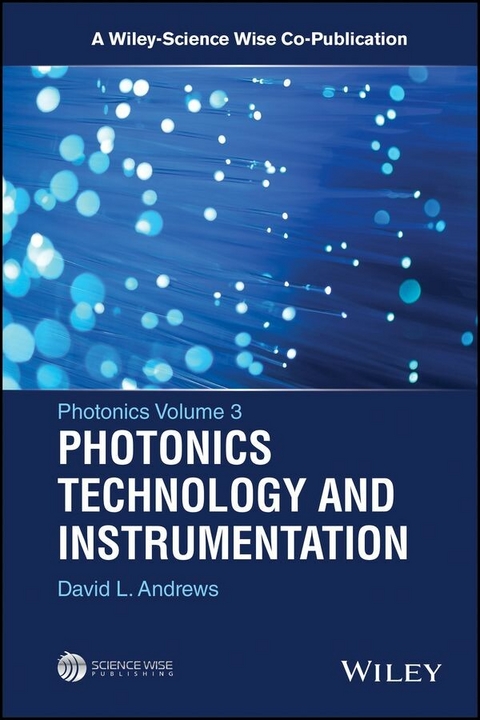
Photonics, Volume 3 (eBook)
John Wiley & Sons (Verlag)
978-1-119-01177-4 (ISBN)
Discusses the basic physical principles underlying the technology instrumentation of photonics
This volume discusses photonics technology and instrumentation. The topics discussed in this volume are: Communication Networks; Data Buffers; Defense and Security Applications; Detectors; Fiber Optics and Amplifiers; Green Photonics; Instrumentation and Metrology; Interferometers; Light-Harvesting Materials; Logic Devices; Optical Communications; Remote Sensing; Solar Energy; Solid-State Lighting; Wavelength Conversion- Comprehensive and accessible coverage of the whole of modern photonics
- Emphasizes processes and applications that specifically exploit photon attributes of light
- Deals with the rapidly advancing area of modern optics
- Chapters are written by top scientists in their field
Written for the graduate level student in physical sciences; Industrial and academic researchers in photonics, graduate students in the area; College lecturers, educators, policymakers, consultants, Scientific and technical libraries, government laboratories, NIH.
David L. Andrews leads research on fundamental molecular photonics and energy transport, optomechanical forces and nonlinear optical phenomena. He has over 160 research papers and also eight books to his name - including the widely adopted textbook Lasers in Chemistry. The current focus of his research group is on novel mechanisms for optical nanomanipulation and switching, and light-harvesting in nanostructured molecular systems. The group enjoys strong international links, particularly with groups in Canada, Lithuania, New Zealand and the United States. Andrews is a Fellow of the Royal Society of Chemistry, and a Fellow of the Institute of Physics, and he is the inaugural Chair of the SPIE Nanotechnology Technical Group.
Discusses the basic physical principles underlying the technology instrumentation of photonics This volume discusses photonics technology and instrumentation. The topics discussed in this volume are: Communication Networks; Data Buffers; Defense and Security Applications; Detectors; Fiber Optics and Amplifiers; Green Photonics; Instrumentation and Metrology; Interferometers; Light-Harvesting Materials; Logic Devices; Optical Communications; Remote Sensing; Solar Energy; Solid-State Lighting; Wavelength Conversion Comprehensive and accessible coverage of the whole of modern photonics Emphasizes processes and applications that specifically exploit photon attributes of light Deals with the rapidly advancing area of modern optics Chapters are written by top scientists in their field Written for the graduate level student in physical sciences; Industrial and academic researchers in photonics, graduate students in the area; College lecturers, educators, policymakers, consultants, Scientific and technical libraries, government laboratories, NIH.
David L. Andrews leads research on fundamental molecular photonics and energy transport, optomechanical forces and nonlinear optical phenomena. He has over 160 research papers and also eight books to his name - including the widely adopted textbook Lasers in Chemistry. The current focus of his research group is on novel mechanisms for optical nanomanipulation and switching, and light-harvesting in nanostructured molecular systems. The group enjoys strong international links, particularly with groups in Canada, Lithuania, New Zealand and the United States. Andrews is a Fellow of the Royal Society of Chemistry, and a Fellow of the Institute of Physics, and he is the inaugural Chair of the SPIE Nanotechnology Technical Group.
1
SOLID-STATE LIGHTING: TOWARD SMART AND ULTRAEFFICIENT MATERIALS, DEVICES, LAMPS, AND SYSTEMS
M. H. Crawford,1 J. J. Wierer,1 A. J. Fischer,1 G. T. Wang,1 D. D. Koleske,1 G. S. Subramania,1 M. E. Coltrin,1 R. F. Karlicek, Jr.2 and J. Y. Tsao,1
1Energy Frontier Center for Solid-State Lighting Science, Sandia National Laboratories, Albuquerque, NM, USA
2Smart Lighting Engineering Research Center, Electrical, Computer, and Systems Engineering Department, Rensselaer Polytechnic Institute, Troy, NY, USA
1.1 A BRIEF HISTORY OF SSL [1]
We start this section with a brief history of solid-state lighting (SSL): key materials and device breakthroughs (illustrated in Fig. 1.1); the current state-of-the-art device and lamp architectures that those breakthroughs have enabled; and the current dominant system applications that those device and lamp architectures have enabled.
Figure 1.1 (a) Historical evolution of the performance (lm W–1) for commercial red, green, blue, and phosphor-converted white LEDs. Data for Part (a) were compiled from Reference 2 and Philips Lumileds datasheets. (b) Historical evolution of the performance (lumen per package) and cost ($ per lumen) for commercially available red and phosphor-converted (PC) white LEDs. Part (b) was adapted from Reference 1.
1.1.1 Stepping Stones: Red and Blue LEDs
Semiconductor electroluminescence was first reported by H. J. Round in 1907, and the first light-emitting diode (LED) was reported by O. V. Losev in 1927 [3]. Not until the birth of semiconductor physics in the 1940s and 1950s, however, was scientific development of technologies for light emission possible.
For SSL, the use of semiconductor electroluminescence to produce visible light for illumination, the seminal advances were first, the demonstration of red light emission by N. Holonyak in 1962 [4] and, second, the demonstration of a bright blue LED by S. Nakamura in 1993 [5], along with earlier material advances by I. Akasaki and H. Amano [6, 7]. In Sections 1.1.1.1 and 1.1.1.2, we briefly discuss these two advances and their subsequent evolution.
1.1.1.1 Red LEDs: Ever Increasing Efficiencies and Powers
As mentioned earlier, the first seminal advance in visible light emission was in the red, and this is the LED color that dominated the early history of LEDs. The first commercial LED lamps were introduced in 1968: indicator lamps by Monsanto and electronic displays by Hewlett-Packard. The initial performance of these products was poor, around 1 mlm at 20 mA, in part because the only color available was deep red, where the human eye is relatively insensitive. Since then, steady, even spectacular, progress has been made in efficiency, lumens per package, and cost per lumen.
As illustrated in Figure 1.1 (top panel), progress in efficiency was largely an outcome of the exploration and development of new semiconductor materials: first GaP and GaAsP, then AlGaAs, then, finally, AlInGaP. Luminous efficacies improved by more than three orders of magnitude: from about 0.02 lm W−1 in the 1970s from GaP and GaAsP LEDs to 10 lm W−1 in 1990 from AlGaAs LEDs (for the first time exceeding that of equivalent red-filtered incandescent lamps) to the current state-of-the-art of >150 lm W−1 from AlInGaP LEDs.1
Also, as illustrated in Figure 1.1 (bottom Haitz' Law panel), progress in efficiency (as well as progress in high-power packaging) then enabled tremendous progress in lumens per package and cost per lumen. In 1968, red LEDs were viewable only if competing with dim indoor lights; by 1985, they were viewable in bright ambient light, even in sunlight. Nevertheless, red LEDs at that time were still limited to small-signal indicators and display applications requiring less than 100 mlm per indicator function or display pixel. Then, around 1985, red LEDs stepped beyond those small-signal applications and entered the medium-flux power signaling market with flux requirements of 1–100 lm, beginning with the newly required center high-mount stop light (CHMSL) in automobiles. At this point in time, red LEDs are well into the >100 lm high-flux domain associated with lighting-class applications.
Of course, it was not just that increasingly higher efficiency enabled these increasingly higher flux applications; the needs of these higher flux applications also drove the quest for higher efficiency. In other words, there was a coevolution of higher efficiency (technology push) and power-signaling applications (market pull) that could make use of higher efficiency. Solutions based on large numbers of small-signal lamps were too expensive, thus demanding the development of higher-efficiency, higher-power LEDs. The development of higher-efficiency, higher-power LEDs, in turn, opened up additional stepping-stone markets. The result is the Haitz' law evolution illustrated in the bottom panel of Figure 1.1. In a Moore's-law-like fashion, flux per lamp has been increasing 20× per decade while cost per lumen (the price charged by LED suppliers to original equipment manufacturers, or OEMs) has been decreasing 10× per decade.
1.1.1.2 Blue LEDs: Enabling White Light
As mentioned earlier, the second seminal advance in visible LEDs was the blue LED, and this is the color that came to dominate the subsequent history of LEDs. The initial breakthroughs came in the late 1980s and early 1990s, with the discoveries by I. Akasaki and H. Amano that a previously recalcitrant wide-bandgap semiconductor, GaN, could be p-type doped [7] and grown with reasonable quality on lattice-mismatched sapphire [6]. Building on these discoveries, in 1993 S. Nakamura at Nichia Chemical Corporation demonstrated a bright blue LED [5]. As illustrated in the top panel of Figure 1.1, efficiency improvements followed quickly, to the point where today's state-of-the-art blue LEDs, at least at low-power densities, have power-conversion efficiencies exceeding 80% [8].
Most importantly, because blue is at the short-wavelength (high-energy) end of the visible spectrum, it proved possible to “downconvert” blue light into green, yellow, and even red light using passive phosphorescent and fluorescent materials [9]. The visible spectrum could thus be filled out, white light could be produced, and general illumination applications became a possibility. Indeed, as illustrated in the bottom panel of Figure 1.1, Haitz' Law, developed originally for red LEDs, is continuing for white LEDs. There is now virtually no question that SSL will eventually displace all conventional technologies in general illumination applications, and indeed in virtually every application in which visible light is needed [10].
1.1.2 State-of-the-Art SSL Device Architecture: InGaN Blue LED + Green/Red Phosphors
At this point in time, the state-of-the-art SSL architecture is based on blue LEDs combined with green, yellow, and/or red phosphors, the so-called PC-LED (phosphor-converted LED) architecture illustrated in Figure 1.2. As indicated, the sub-efficiencies of this PC-LED are blue LED (40%), phosphor + package (70%), and spectral match to the human eye response (80%). Taken together, the overall wall-plug efficiency is 22% (≈ 0.4 × 0.7 × 0.8).
Figure 1.2 State-of-the-art PC-LED (phosphor-converted white LED). The blue LED is a thin-film flip-chip (TFFC) design, on top of which red and green phosphors have been coated. The TFFC schematic is courtesy of Jon Wierer (Sandia National Laboratories); the photo at the top is courtesy of Bobby Mercer.
The reasons this architecture has prevailed, as opposed to a color-mixing architecture in which light from multiple LEDs with different colors is mixed (and which would potentially eliminate the inefficiencies stemming from the phosphor and spectral mismatch), are fourfold.
First, improvements in the efficiency of direct electroluminescence have been uneven across the visible spectrum [11]. As illustrated in Figure 1.3 [12], the wall-plug efficiencies of blue and red LEDs at the wavelengths (460 and 614 nm, respectively) desirable for general illumination are now over 40% and 30%, respectively. However, the efficiency of green and yellow LEDs at the wavelengths (535 and 573 nm, respectively) desirable for general illumination is of the order 20% or less. Thus, at least for green and yellow light, it is more efficient to produce these colors from LED-pumped phosphors than directly from LEDs.
Figure 1.3 (a) Human photopic eye response. (b) Wall-plug efficiency of current state-of-the-art commercial LEDs of different colors operated at room temperature and input power densities of 100–250 W cm−2. Also shown as a horizontal white line is the wall-plug efficiency of current state-of-the-art commercial warm white LEDs, similarly operated at input power densities of 100–250 W cm−2. Data were taken from Reference...
| Erscheint lt. Verlag | 27.2.2015 |
|---|---|
| Reihe/Serie | A Wiley-Science Wise Co-Publication |
| A Wiley-Science Wise Co-Publication | A Wiley-Science Wise Co-Publication |
| Sprache | englisch |
| Themenwelt | Technik ► Elektrotechnik / Energietechnik |
| Schlagworte | Communication Networks • Data Buffers • Defense and Security Applications • detectors • Electrical & Electronics Engineering • Elektrotechnik u. Elektronik • Fiber Optics and Amplifiers • Green photonics • Instrumentation and Metrology • Interferometers • Light-Harvesting Materials • Logic Devices • Optical Communications • Optics & Photonics • Optik u. Photonik • Photonics & Lasers • Photonik u. Laser • Physics • Physik • Remote Sensing • Sensoren, Instrumente u. Messung • Sensors, Instrumentation & Measurement • Solar energy • solid-state lighting • Wavelength conversion |
| ISBN-10 | 1-119-01177-9 / 1119011779 |
| ISBN-13 | 978-1-119-01177-4 / 9781119011774 |
| Informationen gemäß Produktsicherheitsverordnung (GPSR) | |
| Haben Sie eine Frage zum Produkt? |
 EPUB (Adobe DRM)
Kopierschutz: Adobe-DRM
Adobe-DRM ist ein Kopierschutz, der das eBook vor Mißbrauch schützen soll. Dabei wird das eBook bereits beim Download auf Ihre persönliche Adobe-ID autorisiert. Lesen können Sie das eBook dann nur auf den Geräten, welche ebenfalls auf Ihre Adobe-ID registriert sind.
Details zum Adobe-DRM
Dateiformat: EPUB (Electronic Publication)
EPUB ist ein offener Standard für eBooks und eignet sich besonders zur Darstellung von Belletristik und Sachbüchern. Der Fließtext wird dynamisch an die Display- und Schriftgröße angepasst. Auch für mobile Lesegeräte ist EPUB daher gut geeignet.
Systemvoraussetzungen:
PC/Mac: Mit einem PC oder Mac können Sie dieses eBook lesen. Sie benötigen eine
eReader: Dieses eBook kann mit (fast) allen eBook-Readern gelesen werden. Mit dem amazon-Kindle ist es aber nicht kompatibel.
Smartphone/Tablet: Egal ob Apple oder Android, dieses eBook können Sie lesen. Sie benötigen eine
Geräteliste und zusätzliche Hinweise
Buying eBooks from abroad
For tax law reasons we can sell eBooks just within Germany and Switzerland. Regrettably we cannot fulfill eBook-orders from other countries.
aus dem Bereich