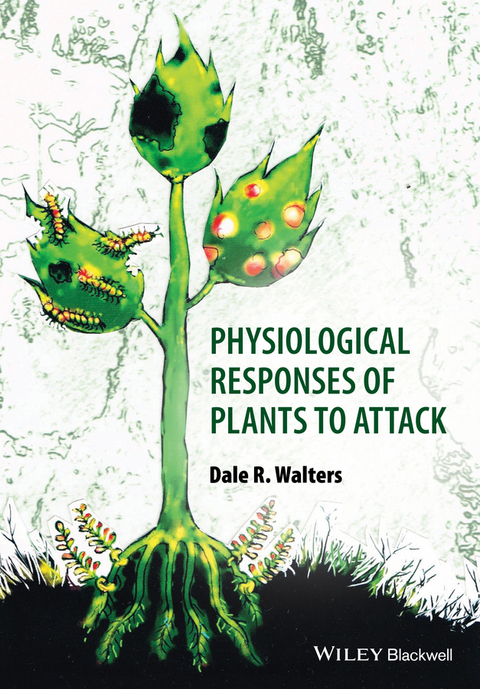
Physiological Responses of Plants to Attack (eBook)
John Wiley & Sons (Verlag)
978-1-118-78308-5 (ISBN)
Despite the research effort put into controlling pathogens, pests and parasitic plants, crop losses are still a regular feature of agriculture worldwide. This makes it important to manage the crop appropriately in order to maximise yield. Understanding the relationship between the occurrence and severity of attack, and the resulting yield loss, is an important step towards improved crop protection. Linked to this, is the need to better understand the mechanisms responsible for reductions in growth and yield in affected crops.
Physiological Responses of Plants to Attack is unique because it deals with the effects of different attackers – pathogens, herbivores, and parasitic plants, on host processes involved in growth, reproduction, and yield. Coverage includes effects on photosynthesis, partitioning of carbohydrates, water and nutrient relations, and changes in plant growth hormones. Far from being simply a consequence of attack, the alterations in primary metabolism reflect a more dynamic and complex interaction between plant and attacker, sometimes involving re-programming of plant metabolism by the attacker.
Physiological Responses of Plants to Attack is written and designed for use by senior undergraduates and postgraduates studying agricultural sciences, applied entomology, crop protection, plant pathology and plant sciences. Biological and agricultural research scientists in the agrochemical and crop protection industries, and in academia, will find much of use in this book. All libraries in universities and research establishments where biological and agricultural sciences are studied and taught should have copies of this exciting book on their shelves
Dale R. Walters is based in the Crop and Soil Systems Research Group at Scotland’s Rural College (SRUC), Edinburgh, UK, where he is Professor of Plant Pathology.
Dale R. Walters is based in the Crop and Soil Systems Research Group at Scotland's Rural College (SRUC), Edinburgh, UK, where he is Professor of Plant Pathology.
Preface xi
1 The Interaction Between a Plant and Its Attacker 1
1.1 Introduction 1
1.2 Different types of attacker 1
1.3 Symptoms exhibited by plants following attack 20
1.4 Conclusions 21
Recommended reading 21
References 22
2 Growth, Development and Yield of Infected and InfestedPlants and Crops 24
2.1 Introduction 24
2.2 Effects of pathogens on growth, development and yield 24
2.3 Effects of nematodes on growth, development and yield 29
2.4 Effects of herbivores on growth, development and yield30
2.5 Effects of parasitic plants on growth, development and yield36
2.6 Conclusions 37
Recommended reading 38
References 38
3 Photosynthesis in Attacked Plants and Crops 41
3.1 Introduction 41
3.2 Photosynthesis in diseased plants 41
3.3 Photosynthesis in plants infected with nematodes 61
3.4 Photosynthesis in plants infested with insects 65
3.5 Photosynthesis in plants infected with parasitic plants73
3.6 The caring robber? hardly! 80
3.7 Conclusions 81
Recommended reading 81
References 81
4 Respiration in Plants Interacting with Pathogens, Pests andParasitic Plants 88
4.1 Introduction 88
4.2 Effects of attack on respiration 90
4.3 Photorespiration in attacked plants 105
4.4 Conclusion 108
Recommended reading 109
References 109
5 Effects on Carbohydrate Partitioning and Metabolism114
5.1 Introduction 114
5.2 Carbohydrate partitioning and metabolism in plants infectedby pathogens 114
5.3 Carbohydrate metabolism and partitioning inplant-insect herbivore interactions 122
5.4 Carbohydrate metabolism and partitioning in interactionsbetween plants and parasitic angiosperms 124
5.5 Conclusions 125
Recommended reading 126
References 127
6 Water Relations of Plants Attacked by Pathogens, InsectHerbivores and Parasitic Plants 130
6.1 Introduction 130
6.2 Effects of pathogens on plant water relations 130
6.3 Effects of nematodes on plant water relations 139
6.4 Water relations in plants infested with insect herbivores140
6.5 Effects of parasitic angiosperms 145
6.6 Conclusions 148
Recommended reading 149
References 149
7 Mineral Nutrition in Attacked Plants 153
7.1 Introduction 153
7.2 Mineral nutrition in plant-pathogen interactions156
7.3 Mineral nutrition in plant-nematode interactions164
7.4 Mineral nutrition in plant-insect interactions 165
7.5 Mineral nutrition in interactions between plants andparasitic angiosperms 170
7.6 Conclusions 175
Recommended reading 176
References 176
8 Hormonal Changes in Plants Under Attack 181
8.1 Introduction 181
8.2 Hormonal changes in plants responding to pathogens 181
8.3 Hormonal changes in plants responding to insect attack198
8.4 Hormonal changes in plants infected with parasitic plants201
8.5 Conclusions 205
Recommended reading 207
References 207
9 Bringing It Together: Physiology and Metabolism of theAttacked Plant 215
9.1 Introduction 215
9.2 Metabolic reprogramming in plant-pathogen interactions215
9.3 Metabolic reprogramming in interactions between plant andparasitic nematodes 220
9.4 Metabolic reprogramming in plant-insect interactions221
9.5 Metabolic reprogramming in interactions between plants andparasitic angiosperms 222
9.6 Metabolic reprogramming - is the plant just abystander in compatible interactions? 222
9.7 Plant responses to attack - a look to the future222
Recommended reading 223
References 223
Index 225
Chapter 1
The Interaction Between a Plant and Its Attacker
1.1 Introduction
Plants are the only higher organisms on the planet capable of converting energy from the Sun into chemical forms of energy that can be stored or used (Agrios, 2005). Not surprisingly therefore, plants are a source of food for a great many organisms. Indeed, directly or indirectly, plants are a source of nourishment for all humans and animals. Although plants have evolved a bewildering array of defences with which to ward off attack (Walters, 2011), many plants succumb to attack and suffer damage and disease as a result. This, in turn, can affect the growth and reproductive output of the plant, which can exert a significant effect on competitive ability and survival. In terms of crop production, damage and disease can affect the yield and quality of produce, with economic consequences to the farmer or grower. In this book, we examine the mechanisms responsible for the changes in plant growth, development and yield following attack by various organisms. Such knowledge is important because it can be useful in our attempts to protect crops from attack, as well as helping them to cope with the consequences of attack.
Plants that are attacked are likely to show visible signs of the encounter and the resulting after effects. Symptoms can be useful, not only in identifying an affected plant, but also in hinting at the cause of the problem and even the nature of the attacker. We look at symptoms in some detail later in this chapter, but let us turn our attention first to the attackers, because the nature of the attacker and the way it obtains food from the plant can exert a profound influence on the way the plant responds and the symptoms we observe.
1.2 Different types of attacker
The range of organisms that use plants as a source of food includes microorganisms, nematodes, insects, vertebrates and other plants. The major microorganisms attacking plants are fungi, bacteria and viruses, some of which can have devastating effects on plants. Herbivory by insects, invertebrates and vertebrates can also lead to considerable damage and plant death, while plants are not safe even from other plants, as some have evolved the parasitic habit, with serious economic consequences.
1.2.1 Microorganisms
Microorganisms can obtain food from plants by a number of routes. Some live on dead material, decomposing plant tissues and releasing nutrients that would otherwise remain unavailable to other organisms. These microbes are known as saprotrophs, and they subsist entirely on organic debris. Other microbes have developed the ability to infect plants, living as parasites, taking nourishment from the living plant but giving nothing back in return. If such parasitic microbes, as a result of their association with the host plant, also lead to disruptions in normal functioning of the plant, they are defined as pathogens, and the plant is said to be diseased. Some pathogens infect a living plant, but then kill all or part of their host rapidly, and survive on the dead plant tissues. These are known as necrotrophs, while those pathogens that infect the plant and then coexist with it for an extended period, causing little damage, are known as biotrophs. Although it might appear that biotrophy and necrotrophy represent absolute categories, they are actually at opposite ends of a continuum (Walters et al., 2008; Newton et al., 2010). At one end of the continuum are pathogens that require living host cells to survive, such as viruses and biotrophic fungi, for example powdery mildews and rusts, while at the other end are the necrotrophic pathogens such as damping-off fungi and soft rot bacteria. As one moves from one end of this continuum to the other, one encounters pathogens with intermediate characteristics. Some of these pathogens possess an initial biotrophic phase in their life cycle, during which they cause little, if any, damage to plant cells and tissues, but then move into a necrotrophic phase, where plant cells and tissues are killed. These pathogens have been termed hemibiotrophs and include the late blight pathogen Phytophthora infestans and the pathogenic bacterium Pseudomonas syringae. The triggers responsible for the transition between the biotrophic and necrotrophic phases in these pathogens are not known (Newton et al., 2010).
1.2.1.1 Fungi
The vegetative phase of fungi may be quite limited, occurring, for example, as single cells (yeasts) or may be more extensive. For most plant pathogenic fungi, vegetative growth is as filamentous hyphae, which grow by extension at the tips. These hyphae can form a network known as a mycelium, while the interconnected network of hyphae derived from one fungal propagule is known as a colony. The lifespan of the colony and its functional relationship with the growing hyphal tips vary depending on the fungus. Thus, in pathogenic fungi belonging to the genus Pythium, as hyphal tips grow and extend, the older parts of the colony die. In these fungi, sporulation occurs at the advancing edge of the colony. Although the hyphal lifespan in fungi such as Pythium is short, in other fungi, hyphae live for considerably longer. Good examples are the runner hyphae produced by the take-all fungus Gaeumannomyces graminis and rhizomorphs produced by the tree pathogen Armillaria mellea. These hyphae grow on plant surfaces or away from the host plant, exposing them to harsh environments. As a result, they possess thick, dark-coloured walls, enabling them to withstand desiccation and the vagaries of the aerial or soil environments. Indeed, the rhizomorphs produced by A. mellea are large, elaborate structures, with thick, pigmented walls. Runner hyphae and rhizomorphs allow the fungus to grow from one host plant to another, with nutrients transported from the older, established parts of the colony, to the expeditionary hyphae seeking new sources of nourishment. In contrast, colonies in biotrophic fungal pathogens such as rusts and powdery mildews remain functional for long periods, with nutrients transported from hyphae at the outer edges of the colony to the colony centre. In this case, the older, central portion of the colony remains functional and is associated with important developmental processes such as sporulation.
1.2.1.2 Bacteria
Although bacteria are important as pathogens of animals, including man, relatively few are known to be plant pathogens. Bacteria are prokaryotic. In other words, they possess no nuclear membrane or mitotic apparatus, and additionally, mitochondria and a visible endoplasmic reticulum are lacking. Most bacteria are unicellular, although some occur in groups or chains of cells. Bacterial cells are small (5–10 µm), and some are rod shaped (bacilli) or spherical (cocci), while others have unusual shapes. All plant pathogenic bacteria are rod shaped, and many possess flagella, making them motile and capable of moving along nutrient gradients.
Within the plant, bacterial cells can spread throughout an organ, as is the case with soft rot bacteria in potato tubers, or can spread widely in the plant, as with vascular wilt bacteria, which can be spread throughout the plant in the xylem.
1.2.1.3 Viruses
Most plant viruses consist of a single strand of RNA surrounded by a protein sheath (the capsid), although a few consist of double-stranded RNA or of DNA. In fact, five classes of plant virus have been described on the basis of whether the nucleic acid is RNA or DNA, whether it is single or double stranded and whether the strand is of the same (+) or opposite (−) polarity to messenger RNA (Table 1.1). Most plant viruses described to date belong to Class IV, consisting of single-stranded RNA. Inside the plant cell, once this single strand of RNA is freed from its protein coat, it can act as messenger RNA in the synthesis of new virus particles. Examples of plant viruses belonging to Class IV include tobacco mosaic virus (TMV) and cucumber mosaic virus (CMV). Viral parasitism is unique, because viruses act as ‘molecular pirates’, hijacking the synthetic machinery of the plant to make more virus particles (Lucas, 1998).
Table 1.1 The Baltimore system for virus classification, based on the type of nucleic acid present (RNA or DNA), whether it is double (ds) or single stranded (ss) and whether the strand is of the same (+) or opposite (−) polarity to messenger RNA.
| Genome | Examples of plant viruses |
| Class I | ds(±)DNA | Cauliflower mosaic virus (CaMV) |
| Class II | ss(+)DNA | Gemini viruses, e.g. African cassava mosaic virus (ACMV) |
| Class III | ds(±)RNA | Wound tumour virus (WTV) |
| Class IV | ss(±)RNA | Tobacco mosaic virus (TMV) |
| Class V | ss(−)RNA | Rhabdoviruses, e.g. lettuce necrotic yellows virus (LNYV) |
| Class VI | ss(+)RNA transcribed to DNA for replication | No plant-infecting examples known |
| Class VII | ssRNA does not contain structural genes and has no protein coat | Viroids, e.g. potato spindle tuber viroid |
Source: Adapted from Lucas (1998). Reproduced with permission of John Wiley & Sons.
Class VII in Table 1.1...
| Erscheint lt. Verlag | 23.2.2015 |
|---|---|
| Sprache | englisch |
| Themenwelt | Naturwissenschaften ► Biologie ► Botanik |
| Technik | |
| Weitere Fachgebiete ► Land- / Forstwirtschaft / Fischerei | |
| Schlagworte | Agriculture • Ãkologie / Pflanzen • Biowissenschaften • Botanik / Physiologie • Landwirtschaft • Life Sciences • Ökologie / Pflanzen • Pests, Diseases & Weeds • plant ecology • Plant Physiology • Plant science, Plant protection, Crop protection, Crops, Pests, Weeds, Diseases, Plant physiology , Plant defense, Predation • Schädlinge, Krankheiten u. Unkräuter • Schädlinge, Krankheiten u. Unkräuter |
| ISBN-10 | 1-118-78308-5 / 1118783085 |
| ISBN-13 | 978-1-118-78308-5 / 9781118783085 |
| Informationen gemäß Produktsicherheitsverordnung (GPSR) | |
| Haben Sie eine Frage zum Produkt? |
 EPUB (Adobe DRM)
Kopierschutz: Adobe-DRM
Adobe-DRM ist ein Kopierschutz, der das eBook vor Mißbrauch schützen soll. Dabei wird das eBook bereits beim Download auf Ihre persönliche Adobe-ID autorisiert. Lesen können Sie das eBook dann nur auf den Geräten, welche ebenfalls auf Ihre Adobe-ID registriert sind.
Details zum Adobe-DRM
Dateiformat: EPUB (Electronic Publication)
EPUB ist ein offener Standard für eBooks und eignet sich besonders zur Darstellung von Belletristik und Sachbüchern. Der Fließtext wird dynamisch an die Display- und Schriftgröße angepasst. Auch für mobile Lesegeräte ist EPUB daher gut geeignet.
Systemvoraussetzungen:
PC/Mac: Mit einem PC oder Mac können Sie dieses eBook lesen. Sie benötigen eine
eReader: Dieses eBook kann mit (fast) allen eBook-Readern gelesen werden. Mit dem amazon-Kindle ist es aber nicht kompatibel.
Smartphone/Tablet: Egal ob Apple oder Android, dieses eBook können Sie lesen. Sie benötigen eine
Geräteliste und zusätzliche Hinweise
Buying eBooks from abroad
For tax law reasons we can sell eBooks just within Germany and Switzerland. Regrettably we cannot fulfill eBook-orders from other countries.
aus dem Bereich