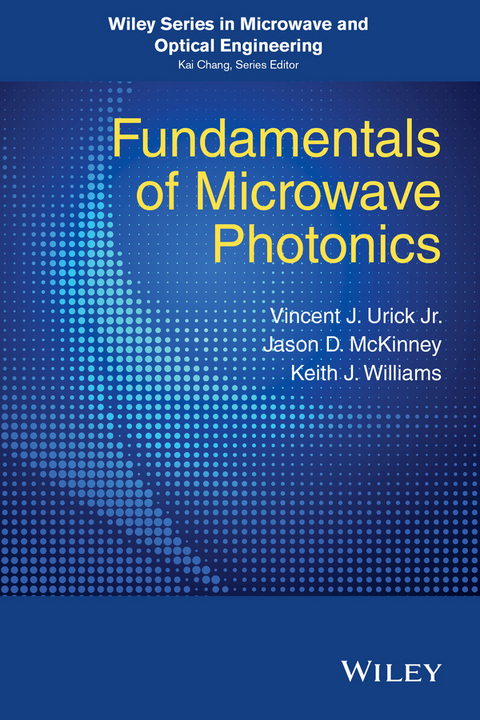
Fundamentals of Microwave Photonics (eBook)
496 Seiten
John Wiley & Sons (Verlag)
978-1-119-02980-9 (ISBN)
constructing analog photonic links capable of high RF
performance
Fundamentals of Microwave Photonics provides a
comprehensive description of analog optical links from basic
principles to applications. The book is organized into four
parts. The first begins with a historical perspective of microwave
photonics, listing the advantages of fiber optic links and
delineating analog vs. digital links. The second section covers
basic principles associated with microwave photonics in both the RF
and optical domains. The third focuses on analog modulation
formats--starting with a concept, deriving the RF performance
metrics from basic physical models, and then analyzing issues
specific to each format. The final part examines applications of
microwave photonics, including analog receive-mode systems,
high-power photodiodes applications, radio astronomy, and arbitrary
waveform generation.
* Covers fundamental concepts including basic treatments of
noise, sources of distortion and propagation effects
* Provides design equations in easy-to-use forms as quick
reference
* Examines analog photonic link architectures along with their
application to RF systems
A thorough treatment of microwave photonics, Fundamentals of
Microwave Photonics will be an essential resource in the
laboratory, field, or during design meetings.
The authors have more than 55 years of combined professional
experience in microwave photonics and have published more than 250
associated works.
The authors have more than 55 years of combined professional experience in microwave photonics and have published more than 250 associated works. Vincent J. Urick Jr., PhD, joined the U.S. Naval Research Laboratory (NRL) in 2001, where he heads the Applied RF Photonics Section. Jason D. McKinney, PhD, has been with NRL as a senior electrical engineer in the Applied Microwave Photonics Section since 2006. Prior to joining NRL, he conducted research in the field on staff at Purdue University starting in 2001. Keith J. Williams, PhD, started at NRL in 1987, where he heads the Photonics Technology Branch.
| Erscheint lt. Verlag | 6.2.2015 |
|---|---|
| Reihe/Serie | Wiley Series in Microwave and Optical Engineering | Wiley Series in Microwave and Optical Engineering |
| Sprache | englisch |
| Themenwelt | Technik ► Elektrotechnik / Energietechnik |
| Technik ► Nachrichtentechnik | |
| Schlagworte | Communication Technology - Networks • Electrical & Electronics Engineering • Elektrotechnik u. Elektronik • Kommunikationsnetze • Mikrowellen- u. Hochfrequenztechnik u. Theorie • Optical Communications • Optische Nachrichtentechnik • RF / Microwave Theory & Techniques |
| ISBN-10 | 1-119-02980-5 / 1119029805 |
| ISBN-13 | 978-1-119-02980-9 / 9781119029809 |
| Informationen gemäß Produktsicherheitsverordnung (GPSR) | |
| Haben Sie eine Frage zum Produkt? |
 EPUB (Adobe DRM)
Kopierschutz: Adobe-DRM
Adobe-DRM ist ein Kopierschutz, der das eBook vor Mißbrauch schützen soll. Dabei wird das eBook bereits beim Download auf Ihre persönliche Adobe-ID autorisiert. Lesen können Sie das eBook dann nur auf den Geräten, welche ebenfalls auf Ihre Adobe-ID registriert sind.
Details zum Adobe-DRM
Dateiformat: EPUB (Electronic Publication)
EPUB ist ein offener Standard für eBooks und eignet sich besonders zur Darstellung von Belletristik und Sachbüchern. Der Fließtext wird dynamisch an die Display- und Schriftgröße angepasst. Auch für mobile Lesegeräte ist EPUB daher gut geeignet.
Systemvoraussetzungen:
PC/Mac: Mit einem PC oder Mac können Sie dieses eBook lesen. Sie benötigen eine
eReader: Dieses eBook kann mit (fast) allen eBook-Readern gelesen werden. Mit dem amazon-Kindle ist es aber nicht kompatibel.
Smartphone/Tablet: Egal ob Apple oder Android, dieses eBook können Sie lesen. Sie benötigen eine
Geräteliste und zusätzliche Hinweise
Buying eBooks from abroad
For tax law reasons we can sell eBooks just within Germany and Switzerland. Regrettably we cannot fulfill eBook-orders from other countries.
aus dem Bereich