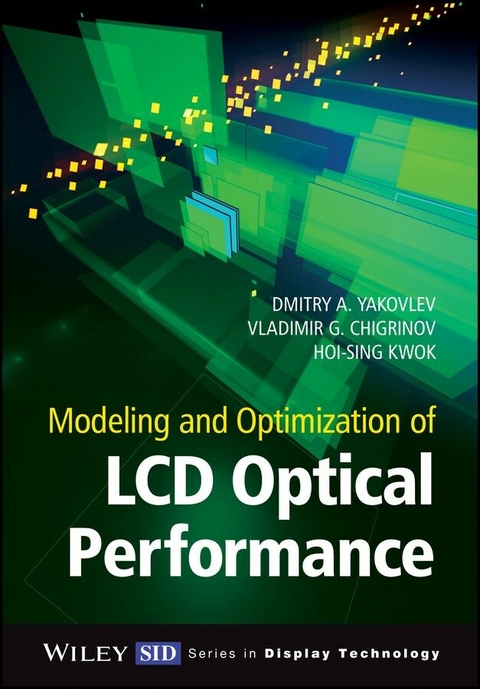
Modeling and Optimization of LCD Optical Performance (eBook)
John Wiley & Sons (Verlag)
978-1-118-70673-2 (ISBN)
Focusing on polarization matrix optics in many forms, this book includes coverage of a wide range of methods which have been applied to LCD modeling, ranging from the simple Jones matrix method to elaborate and high accuracy algorithms suitable for off-axis optics. Researchers and scientists are constantly striving for improved performance, faster response times, wide viewing angles, improved colour in liquid crystal display development, and with this comes the need to model LCD devices effectively. The authors have significant experience in dealing with the problems related to the practical application of liquid crystals, in particular their optical performance.
Key features:
- Explores analytical solutions and approximations to important cases in the matrix treatment of different LC layer configurations, and the application of these results to improve the computational method
- Provides the analysis of accuracies of the different approaches discussed in the book
- Explains the development of the Eigenwave Jones matrix method which offers a path to improved accuracy compared to Jones matrix and extended Jones matrix formalisms, while achieving significant improvement in computational speed and versatility compared to full 4x4 matrix methods
- Includes a companion website hosting the authors' program library LMOPTICS (FORTRAN 90), a collection of routines for calculating the optical characteristics of stratified media, the use of which allows for the easy implementation of the methods described in this book. The website also contains a set of sample programs (source codes) using LMOPTICS, which exemplify the application of these methods in different situations
Dmitry A. Yakovlev, Saratov State University, Russia
Dr Yakovlev is a senior researcher in the Department of Physics at Saratov State University, Russia. He is the head developer of commercial software MOUSE-LCD (MOdeling Universal System of Electrooptics of LCDs), developed in cooperation with HKUST, and the author of a number of efficient methods for computer modeling and optimization of LCDs used within many research projects performed in cooperation with Center Display Research of Hong Kong University of Science and Technology, ROLIC Research Ltd (Switzerland), TechnoDisplay AS (Norway. He has authored 30 refereed journal papers.
Vladimir G. Chigrinov, Hong Kong University of Science and Technology, Hong Kong
Professor Chigrinov is a member of the department of electrical and electronic engineering at Hong Kong University of Science and Technology. He is the author of 3 books, including Photoalignment of Liquid Crystalline Materials (with Professor Kwok), published by Wiley (2008). He has authored more than 150 refereed journal papers and holds 56 patents in the field of liquid crystals. He is a member of the editorial board of Liquid Crystal Today and Associate Editor of the Journal of SID. Prof. Chigrinov is Vice-President of the Russian SID chapter and a SID Fellow.
Hoi Sing Kwok, Hong Kong University of Science and Technology, Hong Kong
Professor Kwok is a member of the department of electrical and electronic engineering at Hong Kong University of Science and Technology. He is a fellow of the IEEE, Optical Society of America and the Hong Kong Institution of Engineers. Prof. Kwok is the co-author of Photoalignment of Crystalline Materials (Wiley, 2008) with Prof. Chigrinov and Vladimir M. Kozenkov, and has authored over 300 refereed journal papers.
Focusing on polarization matrix optics in many forms, this book includes coverage of a wide range of methods which have been applied to LCD modeling, ranging from the simple Jones matrix method to elaborate and high accuracy algorithms suitable for off-axis optics. Researchers and scientists are constantly striving for improved performance, faster response times, wide viewing angles, improved colour in liquid crystal display development, and with this comes the need to model LCD devices effectively. The authors have significant experience in dealing with the problems related to the practical application of liquid crystals, in particular their optical performance. Key features: Explores analytical solutions and approximations to important cases in the matrix treatment of different LC layer configurations, and the application of these results to improve the computational method Provides the analysis of accuracies of the different approaches discussed in the book Explains the development of the Eigenwave Jones matrix method which offers a path to improved accuracy compared to Jones matrix and extended Jones matrix formalisms, while achieving significant improvement in computational speed and versatility compared to full 4x4 matrix methods Includes a companion website hosting the authors' program library LMOPTICS (FORTRAN 90), a collection of routines for calculating the optical characteristics of stratified media, the use of which allows for the easy implementation of the methods described in this book. The website also contains a set of sample programs (source codes) using LMOPTICS, which exemplify the application of these methods in different situations
Dmitry A. Yakovlev, Saratov State University, Russia Dr Yakovlev is a senior researcher in the Department of Physics at Saratov State University, Russia. He is the head developer of commercial software MOUSE-LCD (MOdeling Universal System of Electrooptics of LCDs), developed in cooperation with HKUST, and the author of a number of efficient methods for computer modeling and optimization of LCDs used within many research projects performed in cooperation with Center Display Research of Hong Kong University of Science and Technology, ROLIC Research Ltd (Switzerland), TechnoDisplay AS (Norway. He has authored 30 refereed journal papers. Vladimir G. Chigrinov, Hong Kong University of Science and Technology, Hong Kong Professor Chigrinov is a member of the department of electrical and electronic engineering at Hong Kong University of Science and Technology. He is the author of 3 books, including Photoalignment of Liquid Crystalline Materials (with Professor Kwok), published by Wiley (2008). He has authored more than 150 refereed journal papers and holds 56 patents in the field of liquid crystals. He is a member of the editorial board of Liquid Crystal Today and Associate Editor of the Journal of SID. Prof. Chigrinov is Vice-President of the Russian SID chapter and a SID Fellow. Hoi Sing Kwok, Hong Kong University of Science and Technology, Hong Kong Professor Kwok is a member of the department of electrical and electronic engineering at Hong Kong University of Science and Technology. He is a fellow of the IEEE, Optical Society of America and the Hong Kong Institution of Engineers. Prof. Kwok is the co-author of Photoalignment of Crystalline Materials (Wiley, 2008) with Prof. Chigrinov and Vladimir M. Kozenkov, and has authored over 300 refereed journal papers.
| Erscheint lt. Verlag | 4.2.2015 |
|---|---|
| Reihe/Serie | Wiley Series in Display Technology | Wiley Series in Display Technology |
| Sprache | englisch |
| Themenwelt | Technik ► Elektrotechnik / Energietechnik |
| Schlagworte | Dmitry A. Yakovlev • Electrical & Electronics Engineering • Electrical Engineering - Displays • Elektronische Displays • Elektrotechnik u. Elektronik • Flüssigkristallanzeige • Flüssigkristallanzeige • Hoi-Sing Kwok • LCD • Materials Science • Materialwissenschaften • Modeling and Optimization of Liquid Crystal Displays • Optical and Non-Linear Optical Materials • Optical Communications • Optics & Photonics • optics of anisotropic media • optics of stratified media • Optik u. Photonik • Optische Nachrichtentechnik • Optische u. Nichtlineare Optische Materialien • Physics • Physik • Polarization Optics • Vladimir G. Chigrinov |
| ISBN-10 | 1-118-70673-0 / 1118706730 |
| ISBN-13 | 978-1-118-70673-2 / 9781118706732 |
| Informationen gemäß Produktsicherheitsverordnung (GPSR) | |
| Haben Sie eine Frage zum Produkt? |
 PDF (Adobe DRM)
Kopierschutz: Adobe-DRM
Adobe-DRM ist ein Kopierschutz, der das eBook vor Mißbrauch schützen soll. Dabei wird das eBook bereits beim Download auf Ihre persönliche Adobe-ID autorisiert. Lesen können Sie das eBook dann nur auf den Geräten, welche ebenfalls auf Ihre Adobe-ID registriert sind.
Details zum Adobe-DRM
Dateiformat: PDF (Portable Document Format)
Mit einem festen Seitenlayout eignet sich die PDF besonders für Fachbücher mit Spalten, Tabellen und Abbildungen. Eine PDF kann auf fast allen Geräten angezeigt werden, ist aber für kleine Displays (Smartphone, eReader) nur eingeschränkt geeignet.
Systemvoraussetzungen:
PC/Mac: Mit einem PC oder Mac können Sie dieses eBook lesen. Sie benötigen eine
eReader: Dieses eBook kann mit (fast) allen eBook-Readern gelesen werden. Mit dem amazon-Kindle ist es aber nicht kompatibel.
Smartphone/Tablet: Egal ob Apple oder Android, dieses eBook können Sie lesen. Sie benötigen eine
Geräteliste und zusätzliche Hinweise
Buying eBooks from abroad
For tax law reasons we can sell eBooks just within Germany and Switzerland. Regrettably we cannot fulfill eBook-orders from other countries.
aus dem Bereich