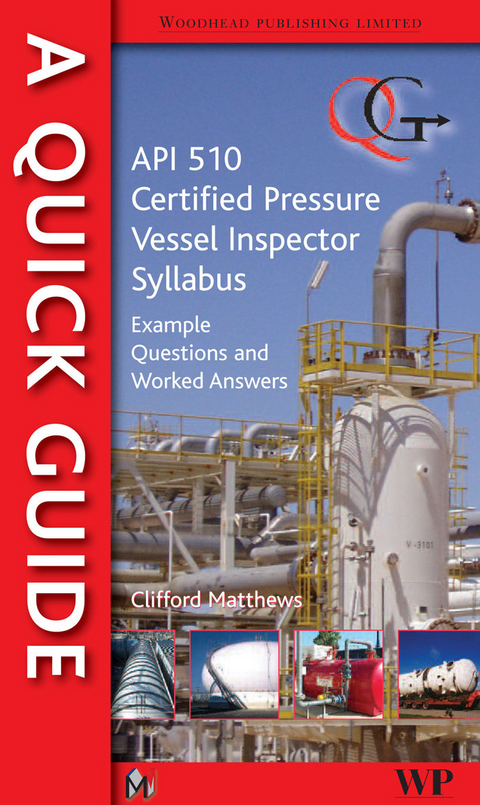
Quick Guide to API 510 Certified Pressure Vessel Inspector Syllabus (eBook)
336 Seiten
Elsevier Science (Verlag)
978-0-85709-102-4 (ISBN)
Clifford Matthews CEng, FIMechE is Director of Matthews Engineering Training Limited, UK, which runs training courses in API 510/570/653, plant inspection, code design, pressure relief equipment and related subjects: over 4000 delegates have been trained in the past 10 years. He has worldwide experience in various industries and is the author of several books on topics relating to inspection. Matthews Training's approach to teaching API subjects has achieved a first-time examination pass rate in the region of 90%.The company is an authorised global training provider to the American Society of Mechanical Engineers (ASME).
The API Individual Certification Programs (ICPs) are well established worldwide in the oil, gas, and petroleum industries. This Quick Guide is unique in providing simple, accessible and well-structured guidance for anyone studying the API 510 Certified Pressure Vessel Inspector syllabus by summarizing and helping them through the syllabus and providing multiple example questions and worked answers.Technical standards are referenced from the API 'body of knowledge' for the examination, i.e. API 510 Pressure vessel inspection, alteration, rerating; API 572 Pressure vessel inspection; API RP 571 Damage mechanisms; API RP 577 Welding; ASMEVIII Vessel design; ASMEV NDE; and ASME IX Welding qualifications. - Provides simple, accessible and well-structured guidance for anyone studying the API 510 Certified Pressure Vessel Inspector syllabus- Summarizes the syllabus and provides the user with multiple example questions and worked answers- Technical standards are referenced from the API 'body of knowledge' for the examination
An Introduction to API 510 (Sections 1–4)
2.1 Introduction
This chapter is about learning to become familiar with the layout and contents of API 510. It forms a vital preliminary stage that will ultimately help you understand not only the content of API 510 but also its cross-references to the other relevant API and ASME codes.
API 510 is divided into nine sections (sections 1 to 9), five appendices (appendices A to E), one figure and two tables. Even when taken together, these are not sufficient to specify fully a methodology for the inspection, repair and re-rating of pressure vessels. To accomplish this, further information and guidance has to be drawn from other codes.
So that we can start to build up your familiarity with API 510, we are going to look at some of the definitions that form its basis. We can start to identify these by looking at the API 510 contents/index page. This is laid out broadly as shown in Fig. 2.1.
Figure 2.1 API 510 contents/index
2.2 Section 1: scope
This is a very short (one-page) part of the code. The main point is in section 1.1.1, which states that all refining and chemical process vessels are included in the scope of API 510 except those vessels that are specifically excluded from the coverage of API 510. Note that this list (look at section 1.2.2) links together with a longer list in appendix A (look near the back of the document). Essentially, vessels that are excluded from the coverage of API 510 are:
• Mobile plant
• Anything designed to other parts of ASME
• Fired heaters
• Machinery, i.e. pumps, compressors, etc.
• Pipes and fittings
There are also some specific exemptions on size. Read the list in appendix A and relate them to Figs 2.2 and 2.3 below.
Figure 2.2 API 510 exemption: water under pressure
Figure 2.3 API 510 pressure–volume exemptions (appendix A (d))
Appendix A (b6) gives an overall pressure temperature exemption for vessels that contain water (or water with air provided as a ‘cushion’ only, i.e. accumulators).
Appendix A (b7) covers hot water storage tanks.
Appendix A (b8) gives a more general exemption based on minimum pressures and diameters.
Finally: Appendix A (d) covers a further general exemption based on pressure and volume.
Remember, section 1.2.2 at the front of API 510 only gives you half the story about exemptions. You have to look at the detail given in API 510 appendix A to get a fuller picture.
2.3 Section 3: definitions
Section 3.2 alteration
An alteration is defined as a change that takes a pressure vessel or component outside of its documented design criteria envelope. What this really means is moving it outside the design parameters of its design code (ASME VIII).
Note also how adding some types of nozzle connections may not be classed as an alteration. It depends on the size and whether it has nozzle reinforcement (in practice, you would need to check this in ASME VIII).
Section 3.6: authorized inspection agency
This can be a bit confusing. The four definitions (a to d) shown in API 510 relate to the situation in the USA, where the authorized inspection agency has some kind of legal jurisdiction, although the situation varies between states. Note this term jurisdiction used throughout API codes and remember that it was written with the various states of the USA in mind.
The UK situation is completely different, as the Pressure Systems Safety Regulations (PSSRs) are the statutory requirement. The nearest match to the ‘authorized inspection agency’ in the UK is probably ‘The Competent Person’ (organization) as defined in the PSSRs. This can be an independent inspection body or the plant owner/user themselves.
For API 510 exam purposes, assume that ‘The Competent person’ (organization) is taking the role of the authorized inspection agency mentioned in API 510 Section 3.6.
Section 3.7: authorized pressure vessel inspector
This refers to the USA situation where, in many states, vessel inspectors have to be certified to API 510. There is no such legal requirement in the UK. Assume, however, that the authorized vessel inspector is someone who has passed the API 510 certification exam and can therefore perform competently the vessel inspection duties covered by API 510.
Section 3.9: condition monitoring locations (CMLs)
These are simply locations on a vessel where parameters such as wall thickness are measured. They used to be called thickness measurement locations (TMLs) but have now been renamed CMLs. CMLs pop up like spring flowers in a few places in API 510 and 572, with emphasis being placed on how many you need and where they should be.
Section 3.19: engineer
In previous editions of API 510, reference was made to the ‘pressure vessel engineer’ as someone to be consulted by the API inspector for detailed advice on vessel design. This person has now been renamed ‘The Engineer’. There’s progress for you.
Section 3.20: examiner
Don’t confuse this as anything to do with the examiner that oversees the API certification exams. This is the API terminology for the NDT technician who provides the NDT results for evaluation by the API-qualified pressure vessel inspector. API recognizes the NDT technician as a separate entity from the API authorized pressure vessel inspector.
API codes (in fact most American-based codes) refer to NDT (the European term) as NDE (non-destructive examination), so expect to see this used throughout the API 510 training programme and examination.
Section 3.37 MAWP
US pressure equipment codes mainly refer to MAWP (maximum allowable working pressure). It is, effectively, the maximum pressure that a component is designed for. European codes are more likely to call it design pressure. For the purpose of the API exam, they mean almost the same, so you can consider the terms interchangeable.
Note how API 510 Section 3.37 defines two key things about MAWP:
• It is the maximum gauge pressure permitted at the top of a vessel as it is installed (for a designated temperature). This means that at the bottom of a vessel the pressure will be slightly higher owing to the self-weight of the fluid (hydrostatic head). The difference is normally pretty small, but it makes for a good exam question.
• MAWP is based on calculations using the minimum thickness, excluding the amount of the actual thickness designated as corrosion allowance.
A significant amount of the exam content (closed-book and open-book questions) involves either the calculation of MAWP for vessels with a given amount of corrosion or the calculation of the minimum allowable corroded thickness for a given MAWP.
Section 3.53: repair
This is a revised definition added in the latest edition of API 510. It is mainly concerned with making a corroded vessel suitable for a specified design condition. If an activity does not qualify as an alteration then, by default, it is classed as a repair.
Section 3.54: repair organizations
API 510 has specific ideas on who is allowed to carry out repairs to pressure vessels. Look how definition 3.54 specifies four possible types of organization, starting with an organization that holds an ASME ‘code stamp’ (certificate of authorization). This links in with the general philosophy of ASME VIII, requiring formal certification of companies who want to manufacture/repair ASME-stamped vessels.
Section 3.56: re-rating
The word re-rating appears frequently throughout API codes. Re-rating of the MAWP or MDMT (minimum design metal temperature) of pressure vessels is perfectly allowable under the requirements of API 510, as long as code compliance is maintained. In the USA, the API authorized inspector is responsible for re-rating a pressure vessel, once happy with the results of thickness checks, change of process conditions, etc. In the European way of working, this is unlikely to be carried out by a single person (although, in theory, the API 510 qualification should qualify a vessel inspector to do it). Re-rating may be needed owing to any combination of four main reasons – we will look at this in detail in Chapter 5.
Section 3.62: transition...
| Erscheint lt. Verlag | 22.10.2010 |
|---|---|
| Sprache | englisch |
| Themenwelt | Kunst / Musik / Theater ► Design / Innenarchitektur / Mode |
| Technik ► Elektrotechnik / Energietechnik | |
| Technik ► Maschinenbau | |
| Wirtschaft | |
| ISBN-10 | 0-85709-102-6 / 0857091026 |
| ISBN-13 | 978-0-85709-102-4 / 9780857091024 |
| Informationen gemäß Produktsicherheitsverordnung (GPSR) | |
| Haben Sie eine Frage zum Produkt? |
 EPUB (Adobe DRM)
Kopierschutz: Adobe-DRM
Adobe-DRM ist ein Kopierschutz, der das eBook vor Mißbrauch schützen soll. Dabei wird das eBook bereits beim Download auf Ihre persönliche Adobe-ID autorisiert. Lesen können Sie das eBook dann nur auf den Geräten, welche ebenfalls auf Ihre Adobe-ID registriert sind.
Details zum Adobe-DRM
Dateiformat: EPUB (Electronic Publication)
EPUB ist ein offener Standard für eBooks und eignet sich besonders zur Darstellung von Belletristik und Sachbüchern. Der Fließtext wird dynamisch an die Display- und Schriftgröße angepasst. Auch für mobile Lesegeräte ist EPUB daher gut geeignet.
Systemvoraussetzungen:
PC/Mac: Mit einem PC oder Mac können Sie dieses eBook lesen. Sie benötigen eine
eReader: Dieses eBook kann mit (fast) allen eBook-Readern gelesen werden. Mit dem amazon-Kindle ist es aber nicht kompatibel.
Smartphone/Tablet: Egal ob Apple oder Android, dieses eBook können Sie lesen. Sie benötigen eine
Geräteliste und zusätzliche Hinweise
Buying eBooks from abroad
For tax law reasons we can sell eBooks just within Germany and Switzerland. Regrettably we cannot fulfill eBook-orders from other countries.
aus dem Bereich