


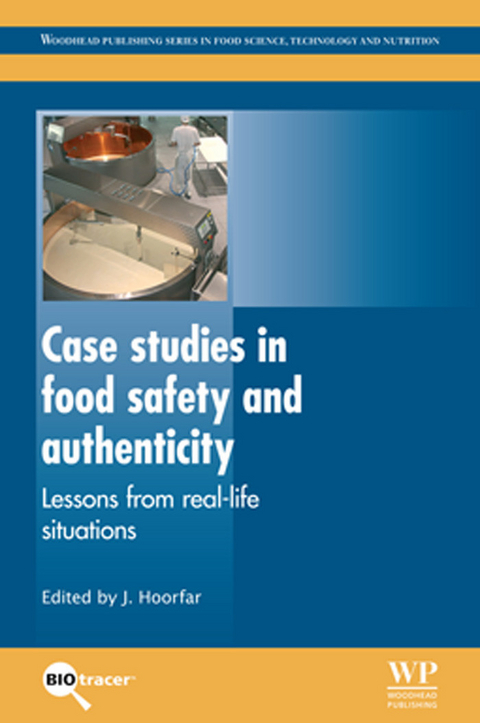
Case Studies in Food Safety and Authenticity (eBook)
408 Seiten
Elsevier Science (Verlag)
978-0-85709-693-7 (ISBN)
The identification and control of food contaminants rely on careful investigation and implementation of appropriate management strategies. Using a wide range of real-life examples, Case studies in food safety and authenticity provides a vital insight into the practical application of strategies for control and prevention.Part one provides examples of recent outbreak investigations from a wide range of experts around the world, including lessons learnt, before part two goes on to explore examples of how the source was traced and the implications for the food chain. Methods of crisis management are the focus of part three, whilst part four provides studies of farm-level interventions and the tracking of contaminants before they enter the food chain. Part five is focussed on safe food production, and considers the challenges of regulatory testing and certification, hygiene control and predictive microbiology. The book concludes in part six with an examination of issues related to food adulteration and authenticity.With its distinguished editor and international team of expert contributors, Case studies in food safety and authenticity is a key reference work for those involved in food production, including quality control, laboratory and risk managers, food engineers, and anyone involved in researching and teaching food safety. - Delivers a vital insight into the practical application of strategies for control and prevention of food contaminants- Provides detailed examples of recent outbreak investigations from a wide range of international experts, discussing how the source was traced and the implications for the food chain- Chapters discuss methods of crisis management, farm-level interventions, safe food production and the challenges of regulatory testing and certification
Contributor contact details
Editor and Chapters 4, 20, 24, 29 and 38
J. Hoorfar, National Food Institute, Technical University of Denmark, National Food Institute, Mørkhøj Bygade 28, 2860 Søborg, Denmark. E-mail address: jhoo@food.dtu.dk
D. Schoder, Institute of Milk Hygiene and Food Science, Vienna, Austria
M. Wagner*, Bi-National Advisory Laboratory for Listeriosis, Austrian Agency for Health and Food Safety, Spargelfeldstrasse 171, 1220, Vienna, Austria. E-mail address: Martin.Wagner@vetmeduni.ac.at
F. Allerberger, Christian-Doppler Laboratory for Molecular Food Analytics, Vienna, Austria
A.G. Stewart*
R. Vivancos, Consultants in Communicable Disease Control, Cheshire & Merseyside Health Protection Unit, 5th Floor, Rail House, Lord Nelson Street, Liverpool L1 1JF, UK. E-mail address: alex.stewart@hpa.org.uk
A. Keenan, Epidemiology & Surveillance Analyst, Cheshire & Merseyside Health Protection Unit, Liverpool, UK
C. Theodore, Environmental Health Officer, Liverpool City Council, Liverpool, UK
A.G. Stewart* alex.stewart@hpa.org.uk
S. Ghebrehewet, Consultants in Communicable Disease Control, Cheshire & Merseyside Health Protection Unit, 5th Floor, Rail House, Lord Nelson Street, Liverpool L1 1JF, UK
M.A. Smith, Food and Drug Administration, Center for Food Safety and Allied Nutrition, Office of Food Safety (HFS-317), 5100 Paint Branch Parkway, College Park, MD 20740, USA. E-mail address: michelle.smith@fda.hhs.gov
L.D. Goodridge*, Center for Red Meat Safety and Quality, Department of Animal Sciences, Colorado State University, Fort Collins, CO 80523, USA. E-mail address: Lawrence.Goodridge@Colostate.edu
J.T. LeJeune, Ohio Agricultural Research and Development Center, The Ohio State University, 1680 Madison Ave, Wooster, OH 44691, USA. E-mail address: Lejeune.3@osu.edu
L. Beutin, Nationales Referenzlabor fur Escherichia coli (NRL-E.coli), Bundesinstitut fur Risikobewertung (BfR), Diedersdorfer Weg 1, D-12277 Berlin, Germany. E-mail address: Lothar.Beutin@bfr.bund.de
Marja-Liisa Hänninen*, Department of Food Hygiene and Environmental Health, Helsinki University, P.O. Box 66, 00014 Helsinki University, Finland. E-mail address: marja-liisa.hanninen@helsinki.fi
Ari Hörman, The Finnish Defense Forces, P.O. Box 919, 00131 Helsinki, Finland
Prof. Dr Monika Ehling-Schulz*, Institute of Functional Microbiology, Department of Pathobiology, University of Veterinary Medicine, Veterinaerplatz 1, 1210 Vienna, Austria. E-mail address: monika.ehling-schulz@vetmeduni.ac.at
U. Messelhäusser, Bavarian Health and Food Safety Authority, Veterinaerstr.2 85764 Oberschleissheim, Germany. E-mail address: ute.messelhaeusser@lgl.bayern.de
M.F. Dutton, Mycotoxin Research Group, University of KwaZulu Natal, Durban, South Africa. E-mail address: mdutton@uj.ac.za
Dr Brent Dixon*, Bureau of Microbial Hazards, Food Directorate, Health Canada, 251 Sir Frederick Banting Driveway, P.L. 2204E, Ottawa, Ontario, Canada K1A0K9. E-mail address: Brent.Dixon@hc-sc.gc.ca
L. Landry, Centre for Food-borne Environmental and Zoonotic Infectious Diseases, Public Health Agency of Canada, Guelph, Ontario, Canada
F. Milord, Direction de la Santé Publique de la Montérégie, Longueuil, Quebec, Canada
Kieran N. Jordan*, Karen Hunt and Edward M. Fox, Teagasc Food Research Centre, Moorepark, Fermoy, Co.Cork, Ireland. E-mail address: Kieran.Jordan@teagasc.ie
V. Biguzzi, Responsible for Quality Control Unit in Food Industry (retired). E-mail address: valeriano.biguzzi@libero.it
G. Pezzotti, Istituto Zooprofilattico Sperimentale dell’Umbria e le Marche, Via Gaetano Salvemini, 1, Perugia Italy. E-mail address: g.pezzotti@izsum.it
M.V. Gianfranceschi monica.gianfranceschi@iss.it
D. De Medici*, Department of Veterinary Public Health and Food Safety – Microbiological Foodborne Hazard Unit, Istituto Superiore di Sanità, Viale Regina Elena 299, 00161 Rome, Italy. E-mail address: dario.demedici@iss.it
Erik Nordkvist, National Veterinary Institute, Uppsala, Sweden. E-mail address: erik.nordkvist@sva.se
N.C. Elviss* Nicola.Elviss@hpa.org.uk
F. Jørgensen, Health Protection Agency (HPA), Food, Water and Environmental Microbiology Laboratories, Sutton Coldfield, Birmingham B75 7RR, UK
Suresh D. Pillai, National Center for Electron Beam Research, Food Safety & Environmental Microbiology Program, Texas A&M University, College Station, Texas, USA. E-mail address: s-pillai@tamu.edu
Knut Rudi* knut.rudi@umb.no
Hedmark University College, Hamar, Norway
The Norwegian University for Life Sciences, As, Norway
Petr Ricanek
Department of Gastroenterology, Akershus University Hospital, Lerenskog, Norway
EpiGen Institute, Research Centre, Akershus University Hospital, Lørenskog, Norway
Tone Tannæs and Stephan Brackmann, University of Oslo, EpiGen-Institute, Akershus University Hospital, University of Oslo, Oslo, Norway
Gøri Perminow, Pediatric Department, Oslo University Hospital, Ullevål, Oslo, Norway
Morten H. Vatn
University of Oslo, EpiGen-Institute, Akershus University Hospital, University of Oslo, Oslo, Norway
Medical Clinic, Oslo University Hospital, Rikshospitalet, Norway
A. Wingstrand*, National Food Institute, Technical University of Denmark, 19 Mørkhøj Bygade, DK-2860 Søborg, Denmark. E-mail address: awin@food.dtu.dk
T. Jensen, Danish Veterinary and Food, Administration 19, Mørkhøj Bygade, DK-2860 Søborg, Denmark. E-mail address: teje@fvst.dk
G. Sørensen, National Food Institute Technical...
| Erscheint lt. Verlag | 25.6.2012 |
|---|---|
| Sprache | englisch |
| Themenwelt | Technik ► Lebensmitteltechnologie |
| ISBN-10 | 0-85709-693-1 / 0857096931 |
| ISBN-13 | 978-0-85709-693-7 / 9780857096937 |
| Informationen gemäß Produktsicherheitsverordnung (GPSR) | |
| Haben Sie eine Frage zum Produkt? |
 EPUB (Adobe DRM)
Kopierschutz: Adobe-DRM
Adobe-DRM ist ein Kopierschutz, der das eBook vor Mißbrauch schützen soll. Dabei wird das eBook bereits beim Download auf Ihre persönliche Adobe-ID autorisiert. Lesen können Sie das eBook dann nur auf den Geräten, welche ebenfalls auf Ihre Adobe-ID registriert sind.
Details zum Adobe-DRM
Dateiformat: EPUB (Electronic Publication)
EPUB ist ein offener Standard für eBooks und eignet sich besonders zur Darstellung von Belletristik und Sachbüchern. Der Fließtext wird dynamisch an die Display- und Schriftgröße angepasst. Auch für mobile Lesegeräte ist EPUB daher gut geeignet.
Systemvoraussetzungen:
PC/Mac: Mit einem PC oder Mac können Sie dieses eBook lesen. Sie benötigen eine
eReader: Dieses eBook kann mit (fast) allen eBook-Readern gelesen werden. Mit dem amazon-Kindle ist es aber nicht kompatibel.
Smartphone/Tablet: Egal ob Apple oder Android, dieses eBook können Sie lesen. Sie benötigen eine
Geräteliste und zusätzliche Hinweise
Buying eBooks from abroad
For tax law reasons we can sell eBooks just within Germany and Switzerland. Regrettably we cannot fulfill eBook-orders from other countries.
aus dem Bereich


