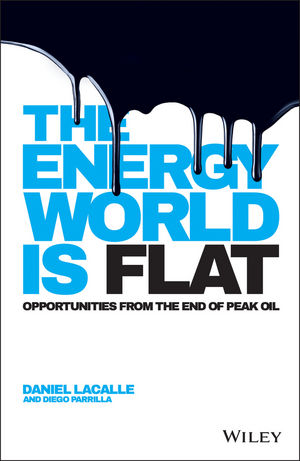
The Energy World is Flat (eBook)
John Wiley & Sons (Verlag)
978-1-118-86799-0 (ISBN)
The Energy World Is Flat provides a forward-lookinganalysis of the energy markets and addresses the implications oftheir rapid transformation. Written by acknowledged expert DanielLacalle, who is actively engaged with energy portfolios in thefinancial space, this book is grounded in experience with the worldof high-stakes finance, and relays a realist's perspective of thecurrent and future state of the energy markets. Readers will bebrought up to date on the latest developments in the area, andlearn the strategies that allow investors to profit from thesedevelopments. An examination of the markets' history drawsparallels between past and current shifts, and a discussion oftechnological advancements helps readers understand the issuesdriving these changes.
Energy has always been at the forefront of the economic agenda,being both the key to and a driver for development and growth. Itscentrality to the world of finance makes it imperative forinvestors and analysts to understand the energy markets,irrespective of where on the wide range of energy spectrumobservers they fall. The Energy World Is Flat is a guide tothe past, present, and future of these crucial markets, and thestrategies that make them profitable. These include:
- Understanding the state of the energy markets, including keydevelopments and changes
- Discovering the ten pillars of a successful energy investmentstrategy
- Reviewing the history of the energy markets to put recentchanges into perspective
- Learning which technologies are driving the changes, and how itwill affect investors
The recent energy market changes were both unexpected and sofundamental in nature that they represent a true shift in theenergy macro- and microeconomic landscape. Investors and analystsseeking a stronger approach to these markets need the expertguidance provided by The Energy World Is Flat.
A stronger, more informed approach to the energy markets The Energy World Is Flat provides a forward-looking analysis of the energy markets and addresses the implications of their rapid transformation. Written by acknowledged expert Daniel Lacalle, who is actively engaged with energy portfolios in the financial space, this book is grounded in experience with the world of high-stakes finance, and relays a realist's perspective of the current and future state of the energy markets. Readers will be brought up to date on the latest developments in the area, and learn the strategies that allow investors to profit from these developments. An examination of the markets' history draws parallels between past and current shifts, and a discussion of technological advancements helps readers understand the issues driving these changes. Energy has always been at the forefront of the economic agenda, being both the key to and a driver for development and growth. Its centrality to the world of finance makes it imperative for investors and analysts to understand the energy markets, irrespective of where on the wide range of energy spectrum observers they fall. The Energy World Is Flat is a guide to the past, present, and future of these crucial markets, and the strategies that make them profitable. These include: Understanding the state of the energy markets, including key developments and changes Discovering the ten pillars of a successful energy investment strategy Reviewing the history of the energy markets to put recent changes into perspective Learning which technologies are driving the changes, and how it will affect investors The recent energy market changes were both unexpected and so fundamental in nature that they represent a true shift in the energy macro- and microeconomic landscape. Investors and analysts seeking a stronger approach to these markets need the expert guidance provided by The Energy World Is Flat.
DANIEL LACALLE is an economist, fund manager and certified financial analyst specialised in Global Energy with experience in equities, bonds and commodities. He holds a postgraduate degree in IESE and a master's degree in economy investigation. After work-ing for ten years in the Oil and Gas sector, in charge of exports to the Middle East and Africa as well as Investor Relations, and in the utilities sector, Mr Lacalle joined the financial sector developing his career as a fund manager in some of the largest investment funds in the world, and was voted Top 3 Generalist and Number 1 Pan-European Buyside Individual in Oil & Gas in Thomson Reuters' Extel Survey in 2011, the leading survey among companies and financial institutions. Author of two best-selling books Nosotros los Mercados and Viaje a la Libertad Económica, now in their fifth and fourth editions respectively, as well as The Life In The Financial Markets (Wiley, 2014). Website www.dlacalle.com and Twitter @dlacalle DIEGO PARRILLA is a Hedge Fund Manager at BlueCrest Capital Management where he runs a portfolio of liquid macro commodity strategies. Prior to starting his career in fund management in 2011, Diego worked in commodities sales and trading holding, amongst others, the positions of Managing Director, Global Head of Commodity Solutions and Head of Commodities Asia Pacific. Diego holds a Bachelors and Master of Science in Mining and Petroleum Engineering from the Polytechnic University of Madrid in Spain, a Master of Science in Mineral Economics from the Colorado School of Mines in the USA, and a Master of Science in Petroleum Economics and Management by the French Institute of Petroleum in Paris, France. Diego currently resides in Singapore with his wife and three children.
Chapter 1 The Mother of All Battles. The Flattening and Globalization of the Energy World 1
Chapter 2 Lessons from the Internet Revolution and the Dotcom Bubble 11
Chapter 3 The 10 Forces that are Flattening the Energy World 31
Chapter 4 Flattener #1 - Geopolitics: The Two Sides of the Energy Security Coin 35
Chapter 5 Flattener #2 - The Energy Reserves and Resources Glut 53
Sorry, No Peak Oil 64
No Peak Gas Either 76
Chapter 6 Flattener #3 - Horizontal Drilling and Fracking 85
Chapter 7 Flattener #4 - The Energy Broadband 103
Chapter 8 Flattener #5 - Overcapacity 117
Chapter 9 Flattener #6 - Globalization, Industrialization, and Urbanization 123
Chapter 10 Flattener #7 - Demand Destruction 131
Chapter 11 Flattener #8 - Demand Displacement 135
The Battle for Transportation Demand 135
The Battle for Electricity and Industrial Demand 148
The Energy Domino 151
Chapter 12 Flattener #9 - Regulation and Government Intervention 159
Regulation vs. Free Markets 160
The War on Pollution and Coal 165
Renewable Energy and the Disinflation of Power Prices 172
Biofuels and Food Inflation 193
Chapter 13 Flattener #10 - Fiscal, Monetary, and Macroeconomic Flatteners 207
The Btu that Broke OPEC's Back 209
The Oil Tax Weapon 214
Monetary Experiments and the Credit Risk Time Bomb 220
Financial Flows. Let's Blame the Speculators 232
Chapter 14 Implications and Opportunities in the Financial Markets 245
Concluding Remarks 275
Appendix For a Competitive European Energy Policy 279
Index 289
"For industry analysts, this blogger included, it's a brilliant and realistic assessment of the state of affairs and what potential investors should or shouldn't look to" (Oilholics Synonymous Report, April 2015)
Chapter One
The Mother of All Battles. The Flattening and Globalization of the Energy World
There is nothing permanent, except change.
Heraclitus
At 2.46 pm on the 11 March 2011, the largest earthquake in the history of Japan triggered a giant tsunami wave that would change the energy world forever.
I was on a conference call in my office when the prices of the Japanese yen started to swing wildly. Something had happened. Shortly after, the news was hitting the wires: “Massive 9.0 Earthquake Hits East Coast of Japan. Tsunami Warning Issued”. While Japan had a long history of earthquakes, such as the Unzen earthquake and tsunami in 1792 that left a death toll of over 15,000,1 a tremor of 9.0 on the Richter scale was at a whole new level, and would make this earthquake the largest in the history of Japan and the fifth largest globally since records began in 1900.
Within minutes, a series of giant tsunami waves reached Fukushima Daiichi power plant. More than twice as high as the protective seawalls, the waves flooded the power station and damaged the back-up generation and cooling systems. The situation was out of control, and radiation was eventually released, making Fukushima the worst nuclear accident since Chernobyl in 1986, both rated level 7 on the International Nuclear Event Scale.
Nuclear politics
I immediately recognized Fukushima as yet another “black swan”, an event that has a very large impact that no one had anticipated before the fact, but that everyone viewed as obvious after the fact. The scale of the earthquake and the unfortunate series of events were unique to Fukushima, but lessons would be learnt and new processes and security measures would be put in place, as has always been the case when accidents and natural disasters have occurred.
But within days, and despite decades of safe nuclear power, countries around the world were closing down nuclear plants and rethinking their plans of extending the life of existing plants and building new ones. Politicians had taken over and were reshaping the future of nuclear power.
But not all countries reacted the same way. Fukushima did not change the position of France, which produces over 75% of its own energy needs from nuclear power. And it did not change the position of China either, which maintained its plans to build up to 70 new nuclear plants by 2020.
The nuclear world was polarized, but I was optimistic that common sense would prevail and that short-term knee-jerk reactions would give way to long-term constructive solutions and even safer power generation across the world.
There is, however, no doubt in my mind that Fukushima was a critical milestone towards the end of OPEC's dominance. Let me tell you why.
The sustained spike in natural gas prices
The close down of all nuclear capacity in Japan left a large gap in power generation that had to be filled by coal, natural gas, and crude oil.
The seaborne coal market was able to absorb the increase in Japanese demand with relative ease, but the much smaller market of seaborne liquefied natural gas (LNG) suffered a severe shock that sent prices skyrocketing.
Prices of natural gas in Asia more than doubled reaching over $20/MMBtu, equivalent to over US$110 per barrel of oil equivalent (USD/boe).2
Fukushima impacted other large Asian consumers, such as Korea, Taiwan, and China, who also rely on natural gas for their current and future power generation mix, reinforcing the perception that Asia would buy “unlimited amounts of gas, at unlimited prices”.
The imbalances could not be resolved easily, and the price of LNG for delivery to Japan stayed at an extremely high level for several years in order to direct any available LNG towards North East Asia.
In March 2014, three years after the Fukushima accident, and after extensive political debate in Japan, Japanese Prime Minister Abe announced his pledge to gradually restart nuclear reactors towards the end of the year, which will most likely ease the demand and domestic tightness of natural gas in the region.
However, the sustained high prices and optimistic demand expectations have been a major incentive to the development of new production and liquefaction capacity around the world. The list of producing countries and investments is long.
Look at Australia, for example, investing over half a trillion dollars in new LNG infrastructure to unlock large stranded reserves.
Or Mozambique, where local engineers in the mid-1990s were telling me how desperate they were to prove the large potential of the country, but where the perception among politicians was that it was not worth exploring. Ten years later, with the incentives of high prices and cooperation with international investors and companies, the country made some of the most important gas discoveries and infrastructure development in the region.
Or, even Cyprus and Israel, where large discoveries are putting them on the energy map …as producers!
Fracking and the collapse in US natural gas prices
While Fukushima created a demand shock and sharply higher global LNG prices, a quiet revolution had been taking place in North America for over a decade that had transformed the supply and drastically reduced prices of domestic US natural gas.
For decades, engineers knew about the vast amounts of natural gas resources that were trapped inside shale formations, but had not found a way to extract them commercially on a large scale. But the supply revolution which had started quietly in the Barnett Shale, Texas, in the early 2000s changed that.
“Not sure I told you before”, a senior member of one the largest sovereign wealth funds in the world told me, “I have a degree in nuclear engineering. My first job during the 1970s was to research the application of nuclear technology to extract natural gas from shale formations. It has taken a few decades, and a different technology, but I guess my fellow engineers have finally won”.
Indeed, production engineers had found a solution to unlock the gas trapped inside shale rock formations thanks to the combination of horizontal drilling and hydraulic fracturing. And the potential was massive.
The United States, once thought to be in critical shortage of natural gas, was now enjoying an abundance with enough supply to cover over 100 years of demand.
I remember the first time I heard “US energy independence is real”. It was in 2006, and I was meeting large oil and gas producers in Houston. I had endless debates about decline rates, lack of commerciality, environmental risks, the impossibility to replicate the success of the Marcellus Shale elsewhere in the United States, and other considerations. At that time the view was that shale gas would not be economical below$8/MMBtu and that decline rates would make the “fad” disappear soon.
But the reality turned out to be quite different.
By April 2012, following the unusually warm winter in North America, the price of US natural gas had fallen to $2/MMBtu,3 levels not seen for over a decade. The words of a good friend resonate in my head: “never bet against human ingenuity”.
The divergence in prices between North America and Asia had indeed been extraordinary. Exactly the same molecules of natural gas were trading at a 1000% premium across the world. The implications are deep, and go beyond energy markets.
Access to abundant, cheap, and cleaner energy has been an important contributor to the recovery and enhanced competitiveness of the United States relative to the rest of the world. On the other hand, expensive energy has had a negative impact on the Japanese economy and competitiveness.
Looking forward, the combination of political and logistical constraints may keep these extraordinary differentials for several more years, but this will not last forever. The markets are sending strong signals, and the response is simply a matter of time.
US tight oil
The shale gas revolution is not just about natural gas. It is also about crude oil.
The engineering feats of horizontal drilling and fracking have been applied with great success in the extraction of crude oil from shale-like formations.
The impact of this “tight oil” is very significant, and has contributed to the growth towards record domestic production in North America.
I was in Moscow in 2006 when a senior executive of a large national oil multinational told me “shale oil is a bluff”. I started talking about the rapid development in technology and reduction in the cost curve, and how the trend would make tight oil economical within three years at above $70/bbl. I could see he was getting agitated. “I will not see shale oil reach a meaningful level of production, and neither will my children nor my grandchildren”. And four years later, during a debate in Spain with some peak oil defenders who had never seen an oil field in their lives, I was told again “shale oil is a bluff”. Yet, during that time, the production in North Dakota had increased threefold,4 twice as much as what doomsayers said would be “the peak”, contributing to the record US production, now as high as Saudi Arabia. Yet, still today I hear the occasional “shale oil is a bluff”.
Geopolitics and high crude oil prices
The oil embargo in 1973...
| Erscheint lt. Verlag | 30.1.2015 |
|---|---|
| Sprache | englisch |
| Themenwelt | Recht / Steuern ► Wirtschaftsrecht |
| Technik ► Elektrotechnik / Energietechnik | |
| Wirtschaft ► Betriebswirtschaft / Management ► Finanzierung | |
| Schlagworte | approach to energy investing • Daniel Lacalle • Ecofin • Energiemarkt • Energy Investment • energy investment technologies • energy market changes • energy market guide • energy market issues • energy market opportunities • energy market performance • energy market problems • Energy Markets • energy market strategies • Finance & Investments • Finanz- u. Anlagewesen • Finanzwesen • Investment Strategy • Kapitalanlage • keys to successful energy investment • renewable energy investing • The Energy World Is Flat: Opportunities From the End of Peak Oil |
| ISBN-10 | 1-118-86799-8 / 1118867998 |
| ISBN-13 | 978-1-118-86799-0 / 9781118867990 |
| Informationen gemäß Produktsicherheitsverordnung (GPSR) | |
| Haben Sie eine Frage zum Produkt? |
 EPUB (Adobe DRM)
Kopierschutz: Adobe-DRM
Adobe-DRM ist ein Kopierschutz, der das eBook vor Mißbrauch schützen soll. Dabei wird das eBook bereits beim Download auf Ihre persönliche Adobe-ID autorisiert. Lesen können Sie das eBook dann nur auf den Geräten, welche ebenfalls auf Ihre Adobe-ID registriert sind.
Details zum Adobe-DRM
Dateiformat: EPUB (Electronic Publication)
EPUB ist ein offener Standard für eBooks und eignet sich besonders zur Darstellung von Belletristik und Sachbüchern. Der Fließtext wird dynamisch an die Display- und Schriftgröße angepasst. Auch für mobile Lesegeräte ist EPUB daher gut geeignet.
Systemvoraussetzungen:
PC/Mac: Mit einem PC oder Mac können Sie dieses eBook lesen. Sie benötigen eine
eReader: Dieses eBook kann mit (fast) allen eBook-Readern gelesen werden. Mit dem amazon-Kindle ist es aber nicht kompatibel.
Smartphone/Tablet: Egal ob Apple oder Android, dieses eBook können Sie lesen. Sie benötigen eine
Geräteliste und zusätzliche Hinweise
Buying eBooks from abroad
For tax law reasons we can sell eBooks just within Germany and Switzerland. Regrettably we cannot fulfill eBook-orders from other countries.
aus dem Bereich