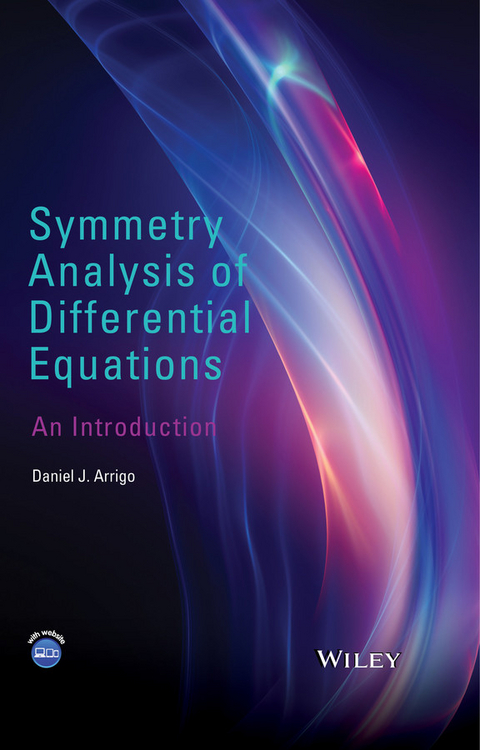
DANIEL J. ARRIGO, PhD, is Professor in the Department of Mathematics at the University of Central Arkansas. The author of over 30 journal articles, his research interests include the construction of exact solutions of PDEs; symmetry analysis of nonlinear PDEs; and solutions to physically important equations, such as nonlinear heat equations and governing equations modeling of granular materials and nonlinear elasticity. In 2008, Dr. Arrigo received the Oklahoma-Arkansas Section of the Mathematical Association of America's Award for Distinguished Teaching of College or University Mathematics.
Preface xi
Acknowledgments xiii
1 An Introduction 1
1.1 What is a Symmetry? 1
1.2 Lie Groups 4
1.3 Invariance of Differential Equations 6
1.4 Some Ordinary Differential Equations 8
Exercises 12
2 Ordinary Differential Equations 15
2.1 Infinitesimal Transformations 19
2.2 Lie's Invariance Condition 23
Exercises 27
2.3 Standard Integration Techniques 28
2.3.1 Linear Equations 28
2.3.2 Bernoulli Equation 30
2.3.3 Homogeneous Equations 31
2.3.4 Exact Equations 32
2.3.5 Riccati Equations 35
Exercises 37
2.4 Infinitesimal Operator and Higher Order Equations 38
2.4.1 The Infinitesimal Operator 38
2.4.2 The Extended Operator 39
2.4.3 Extension to Higher Orders 40
2.4.4 First-Order Infinitesimals (revisited) 40
2.4.5 Second-Order Infinitesimals 41
2.4.6 The Invariance of Second-Order Equations 42
2.4.7 Equations of arbitrary order 43
2.5 Second-Order Equations 43
Exercises 55
2.6 Higher Order Equations 56
Exercises 61
2.7 ODE Systems 61
2.7.1 First Order Systems 61
2.7.2 Higher Order Systems 67
Exercises 71
3 Partial Differential Equations 73
3.1 First-Order Equations 73
3.1.1 What Do We Do with the Symmetries of PDEs? 77
3.1.2 Direct Reductions 80
3.1.3 The Invariant Surface Condition 83
Exercises 84
3.2 Second-Order PDEs 84
3.2.1 Heat Equation 84
3.2.2 Laplace's Equation 91
3.2.3 Burgers' Equation and a Relative 94
3.2.4 Heat Equation with a Source 100
Exercises 107
3.3 Higher Order PDEs 109
Exercises 115
3.4 Systems of PDEs 115
3.4.1 First-Order Systems 115
3.4.2 Second-Order Systems 120
Exercises 124
3.5 Higher Dimensional PDEs 126
Exercises 132
4 Nonclassical Symmetries and Compatibility 133
4.1 Nonclassical Symmetries 133
4.1.1 Invariance of the Invariant Surface Condition 135
4.1.2 The Nonclassical Method 137
4.2 Nonclassical Symmetry Analysis and Compatibility 146
4.3 Beyond Symmetries Analysis-General Compatibility 147
4.3.1 Compatibility with First-Order PDEs-Charpit's Method 149
4.3.2 Compatibility of Systems 157
4.3.3 Compatibility of the Nonlinear Heat Equation 159
Exercises 160
4.4 Concluding Remarks 161
Solutions 163
References 171
Index 175
| Erscheint lt. Verlag | 30.1.2015 |
|---|---|
| Sprache | englisch |
| Themenwelt | Mathematik / Informatik ► Mathematik ► Analysis |
| Technik | |
| Schlagworte | algorithmic methods • Applied mathematics • Differential Equations • Differentialgleichung • Differentialgleichungen • <p>Symmetry analysis • Mathematical Analysis • Mathematics • Mathematik • Mathematische Analyse • Ordinary differential equations • Partial differential equations • statistical software</p> • Statistical Software / Maple • Statistics • Statistik • Statistiksoftware / Maple • symmetry methods |
| ISBN-10 | 1-118-72165-9 / 1118721659 |
| ISBN-13 | 978-1-118-72165-0 / 9781118721650 |
| Informationen gemäß Produktsicherheitsverordnung (GPSR) | |
| Haben Sie eine Frage zum Produkt? |
 EPUB (Adobe DRM)
Kopierschutz: Adobe-DRM
Adobe-DRM ist ein Kopierschutz, der das eBook vor Mißbrauch schützen soll. Dabei wird das eBook bereits beim Download auf Ihre persönliche Adobe-ID autorisiert. Lesen können Sie das eBook dann nur auf den Geräten, welche ebenfalls auf Ihre Adobe-ID registriert sind.
Details zum Adobe-DRM
Dateiformat: EPUB (Electronic Publication)
EPUB ist ein offener Standard für eBooks und eignet sich besonders zur Darstellung von Belletristik und Sachbüchern. Der Fließtext wird dynamisch an die Display- und Schriftgröße angepasst. Auch für mobile Lesegeräte ist EPUB daher gut geeignet.
Systemvoraussetzungen:
PC/Mac: Mit einem PC oder Mac können Sie dieses eBook lesen. Sie benötigen eine
eReader: Dieses eBook kann mit (fast) allen eBook-Readern gelesen werden. Mit dem amazon-Kindle ist es aber nicht kompatibel.
Smartphone/Tablet: Egal ob Apple oder Android, dieses eBook können Sie lesen. Sie benötigen eine
Geräteliste und zusätzliche Hinweise
Buying eBooks from abroad
For tax law reasons we can sell eBooks just within Germany and Switzerland. Regrettably we cannot fulfill eBook-orders from other countries.
aus dem Bereich