Project Management in Construction (eBook)
John Wiley & Sons (Verlag)
9781118500392 (ISBN)
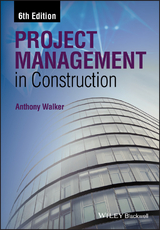
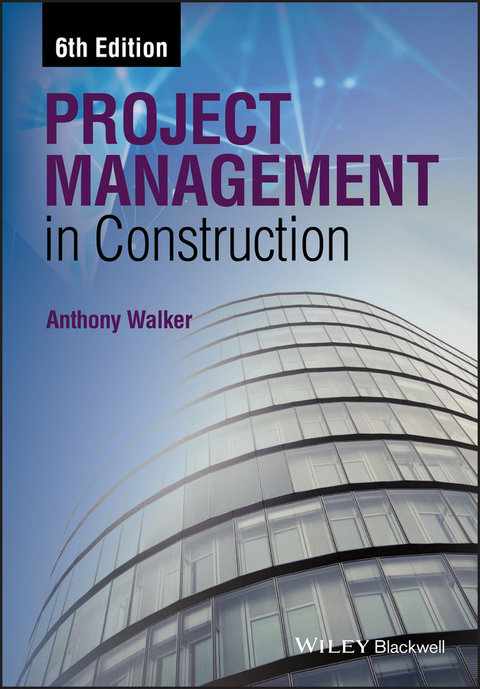
As with all previous editions of Project Management in Construction, this sixth edition focuses on systems theory as the approach suitable for organizing and managing people skilled in the design and completion of construction projects. It discusses the many competing paradigms and alternative perspectives available, for example in relation to differentiation and integration, as well as the emerging study of temporary organizations and its relevance to construction project management.
Whilst encompassing the need to develop further theoretical aspects of construction project organization theory, this edition has also enhanced the application of organization studies to practical issues of construction project management. More emphasis has been placed on the added complexity of construction project management by issues surrounding clients and stakeholders, and the control and empowerment of project participants. Additional focus has been placed on sustainability issues as they impinge on construction project management, on reworked views on supply chain management and on developments in partnering, together with clarification of the shifting terms and definitions relating to construction organization structures and their uses.
ANTHONY WALKER BBS, MSc, PhD, FRICS, holds the title of Professor Emeritus in Real Estate and Construction at the University of Hong Kong, where he has been engaged in teaching and research since 1985, prior to which he held academic appointments in the United Kingdom. He is a chartered surveyor and has worked in Britain, the Middle East and the Far East.
ANTHONY WALKER BBS, MSc, PhD, FRICS, holds the title of Professor Emeritus in Real Estate and Construction at the University of Hong Kong, where he has been engaged in teaching and research since 1985, prior to which he held academic appointments in the United Kingdom. He is a chartered surveyor and has worked in Britain, the Middle East and the Far East.
1
Introduction
1.1 Introduction
The management of construction projects has been carried out since people first cooperated to erect buildings, yet there is little documented knowledge of how people interacted in this process. It is revealing that historical and contemporary accounts of construction work pay little attention to how people worked together and managed their activities. Writers over the ages have concentrated upon the buildings themselves, particularly on aesthetics, the use of new materials, technological developments and the impact of buildings on their environment. How people were organised and managed received scant attention until recent times. What was written tended to be about such charismatic characters of enormous ability as Brunel and Wren, and not about how they structured their organisations.
The way in which available skills are provided and used is of paramount importance in providing what clients expect from their projects. There is little point in the construction industry developing the special skills of its members if no one is going to amalgamate them in the best manner to meet a particular client’s objective.
The conventional method of organisation for construction projects, by which is meant one in which the architect or engineer is the designer and manager of the process using specialist consultants with the construction contract awarded by competitive tender after the design is substantially complete, evolved in contexts (environments) that were considerably more stable than those faced today by both the construction industry and its clients. The complexity of the conditions within which the construction industry’s clients now exist makes them place increasing demands upon the industry in terms of the performance of projects (both functionally and aesthetically), the capital and running costs, environmental and sustainability demands and the time required from conception of the project to occupation. This has come about as a result of technological developments, globalisation, uncertain economic conditions, social pressures, political instability, and so on. Such forces have led to the emergence of stakeholders in projects: that is, organisations, institutions and individuals that are not formally clients but can claim a socially/commercially acceptable interest in projects which clients are required to acknowledge and respond to. Thus, generally, the term ‘client(s)’ used in this book also incorporates ‘stakeholder(s)’ as appropriate. The distinction between clients and stakeholders is covered in Chapter 4.
Within such conditions, clients from both private and public sectors have to increase their effectiveness to remain competitive and to satisfy their own clients who transmit the demands of a complex world to them. The construction industry has in turn to respond to demands from clients that arise from such conditions and is itself also subject to external pressures in a manner similar to that of its clients. It therefore needs to respond by mobilising the talents it possesses in a way which recognises the particular needs of individual clients. It has become clearly recognised that it is unreasonable to suppose that the conventional way of organising construction projects remains a universal solution to producing a project in today’s conditions.
The complexity of clients’ demands, together with the increasing complexity of building, civil and industrial engineering and other construction work, particularly as a result of technological developments, has over the years resulted in increasing specialisation within the construction industry. The professions associated with construction emerged as separate skills (e.g. architecture; quantity surveying; structural, mechanical and electrical engineering; acoustics and safety), as have the many specialist subcontractors. On any project, even a small one, large numbers of contributors and skills are involved. On the largest, there is a vast range of skills and materials required and an enormous variety of people and equipment to mobilise. Where these projects are carried out overseas, there are many additional issues of culture, logistics and language. Fundamental to the management of construction projects is therefore the way in which the contributors are organised so that their skills are used in the right manner and at the right time for the maximum benefit to the client. There is little point in the construction industry developing its skills if they are not then implemented effectively.
The way in which the industry and its skills and professions evolved has compounded the problem of organising effectively as it was reinforced by professional allegiances which, in the United Kingdom and elsewhere, were compounded by the establishment of professional institutions, which in turn contributed to the division of the design professions and their separation from construction firms. Specialisation has been accompanied by the creation of independent companies offering the specialisations, and the complexity of construction has led to greater interdependency between the specialisations and hence between companies. Whilst this has also led to the amalgamation of many specialist firms into multidiscipline firms, nevertheless, a high level of differentiation continues to exist within the construction process together with a consequent need for strong integration between independent specialist companies and between specialists within the multidisciplinary organisations.
It was against this background that the conventional solution to project organisation attempted to cope with increasing complexity and uncertainty leading to the development and increasing use of alternative approaches such as design-and-build, management contracting and construction management and initiatives such as partnering and prime contracting. There are now many alternative forms of organisation for construction projects, but there remains the need to select the most appropriate for each specific project. So what is needed is a framework for designing an organisation structure to suit the particular project in the conditions in which it has to be executed. Pressure from clients has made the professions and industry take more seriously the need for organisation design, which is a key to the ability of the project management process to be effective.
It should be clear by now that this book views a most important element of project management as an organisational issue which incorporates the way in which people are organised and managed in the project management process. This is a long step from the view of project management still taken by many who see it as a collection of planning and control techniques and other management and decision-making tools which, historically, appear to be the root of project management generally, particularly in the United States (Johnson 2013). The distinction is important as the use of techniques and tools, however sophisticated, will be of no avail if they are applied within inappropriate organisation structures seeking to achieve misguided objectives. Objectives and organisation must come first if the use of planning and control techniques is to be effective in providing the information on which management decisions can be based.
While the terminology in this book is drawn from building rather than civil engineering, the application of organisation theory is as relevant to civil engineering as it is to building. The design of both civil engineering and building project organisations will benefit from the application of the ideas arising from the issues discussed here. Project management is now fully accepted as fundamental to the success of projects by both sectors, demonstrating the parallel need identified by sponsors and managers of projects. Further progress will be made through a fuller understanding of the basis of project management, which will arise from a wider knowledge of the theoretical work identified in this book.
1.2 Evolution of Project Organisation
The way in which construction projects are organised in different countries has evolved from traditions and conventions laid down in each country over many years. The traditions and conventions of the United Kingdom have had a particularly wide significance as they have been exported to many parts of the world over the last two centuries. A very brief account of project organisation evolution in the United Kingdom may help to explain the position reached in trying to develop more effective ways of managing construction projects. It will have been paralleled in many other countries. Whilst many magnificent buildings were built in the United Kingdom in the centuries before the Industrial Revolution using traditional methods of construction and organisation typical of their time, the advent of the Industrial Revolution saw the beginning of revolution in the way in which the buildings needed by the new industrialisation were constructed and managed. The accompanying prosperity created demands for buildings for the new industries, housing to accommodate both workers and owners and demand for improved transportation all of which led to the development of new engineering and building techniques. These activities created a concentration upon the specialist skills of the members of the building industry. The increasing importance of the engineer emerged; there was the further separation of the architect and builder as specialists; quantity-surveying skills were more firmly identified; and engineering was subdivided into civil, mechanical and electrical skills. However, this was an incremental process and specialists...
| Erscheint lt. Verlag | 30.1.2015 |
|---|---|
| Sprache | englisch |
| Themenwelt | Technik ► Bauwesen |
| Wirtschaft ► Betriebswirtschaft / Management ► Projektmanagement | |
| Schlagworte | Baubetrieb • Bauen • Bauingenieur- u. Bauwesen • Business & Management • Civil Engineering & Construction • complexity <br />construction organization structures <br />Construction Project Management <br />control<br />empowerment <br />organization studies <br />partnering<br />Project Management in Construction<br />project organization theory, <br />project participants<br />supply chain management <br />sustainability issues <br />systems theory <br />temporary organizations • Construction Management • Project Management • Projektmanagement • Wirtschaft u. Management |
| ISBN-13 | 9781118500392 / 9781118500392 |
| Informationen gemäß Produktsicherheitsverordnung (GPSR) | |
| Haben Sie eine Frage zum Produkt? |
 EPUB (Adobe DRM)
Kopierschutz: Adobe-DRM
Adobe-DRM ist ein Kopierschutz, der das eBook vor Mißbrauch schützen soll. Dabei wird das eBook bereits beim Download auf Ihre persönliche Adobe-ID autorisiert. Lesen können Sie das eBook dann nur auf den Geräten, welche ebenfalls auf Ihre Adobe-ID registriert sind.
Details zum Adobe-DRM
Dateiformat: EPUB (Electronic Publication)
EPUB ist ein offener Standard für eBooks und eignet sich besonders zur Darstellung von Belletristik und Sachbüchern. Der Fließtext wird dynamisch an die Display- und Schriftgröße angepasst. Auch für mobile Lesegeräte ist EPUB daher gut geeignet.
Systemvoraussetzungen:
PC/Mac: Mit einem PC oder Mac können Sie dieses eBook lesen. Sie benötigen eine
eReader: Dieses eBook kann mit (fast) allen eBook-Readern gelesen werden. Mit dem amazon-Kindle ist es aber nicht kompatibel.
Smartphone/Tablet: Egal ob Apple oder Android, dieses eBook können Sie lesen. Sie benötigen eine
Geräteliste und zusätzliche Hinweise
Buying eBooks from abroad
For tax law reasons we can sell eBooks just within Germany and Switzerland. Regrettably we cannot fulfill eBook-orders from other countries.
aus dem Bereich