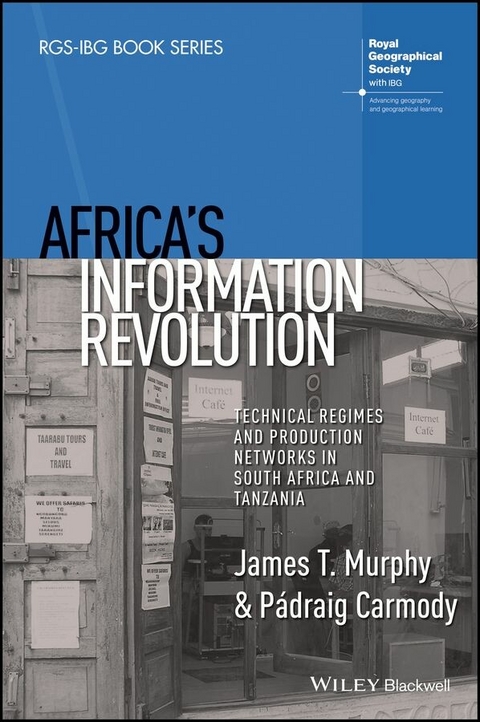
Africa's Information Revolution (eBook)
John Wiley & Sons (Verlag)
978-1-118-75130-5 (ISBN)

Africa’s Information Revolution presents anin-depth examination of the development and economic geographiesaccompanying the rapid diffusion of new ICTs in Sub-SaharanAfrica.
- Represents the first book-length comparative case study ICTdiffusion in Africa of its kind
- Confronts current information and communication technologiesfor development (ICT4D) discourse by providing a counter to largelyoptimistic mainstream perspectives on Africa’s prospects form- and e-development
- Features comparative research based on more than 200 interviewswith firms from a manufacturing and service industry in Tanzaniaand South Africa
- Raises key insights regarding the structural challenges facingAfrica even in the context of the continent’s recent economicgrowth spurt
- Combines perspectives from economic and development geographyand science and technology studies to demonstrate the power ofintegrated conceptual-theoretical frameworks
- Include maps, photos, diagrams and tables to highlight theconcepts, field research settings, and key findings
James T. Murphy is Associate Professor at ClarkUniversity’s Graduate School of Geography. He isco-author of Key Concepts in Economic Geography(2011).
Pádraig Carmody is Associate Professor in Geographyat Trinity College Dublin, where he co-directs the TCD-UCD Mastersin Development Practice and Research Fellow in the Department ofGeography, Environmental Management and Energy Studies at theUniversity of Johannesburg. His books include The New Scramblefor Africa (2011) and The Rise of the BRICS in Africa(2013).
Africa s Information Revolution was recently announced as the 2016 prizewinner of the Royal Academy for Overseas Sciences - congratulations to the authors James T. Murphy and Padraig Carmody! Africa s Information Revolution presents an in-depth examination of the development and economic geographies accompanying the rapid diffusion of new ICTs in Sub-Saharan Africa. Represents the first book-length comparative case study ICT diffusion in Africa of its kind Confronts current information and communication technologies for development (ICT4D) discourse by providing a counter to largely optimistic mainstream perspectives on Africa s prospects for m- and e-development Features comparative research based on more than 200 interviews with firms from a manufacturing and service industry in Tanzania and South Africa Raises key insights regarding the structural challenges facing Africa even in the context of the continent s recent economic growth spurt Combines perspectives from economic and development geography and science and technology studies to demonstrate the power of integrated conceptual-theoretical frameworks Include maps, photos, diagrams and tables to highlight the concepts, field research settings, and key findings
James T. Murphy is Associate Professor at Clark University's Graduate School of Geography. He is co-author of Key Concepts in Economic Geography (2011). Pádraig Carmody is Associate Professor in Geography at Trinity College Dublin, where he co-directs the TCD-UCD Masters in Development Practice and Research Fellow in the Department of Geography, Environmental Management and Energy Studies at the University of Johannesburg. His books include The New Scramble for Africa (2011) and The Rise of the BRICS in Africa (2013).
Series Editors' Preface viii
Acknowledgements ix
Abbreviations xi
Introduction xiii
1 ICT4D: The Making of a Neoliberalized Meta-discourse (with Bjoern Surborg) 1
2 ICTs and Economic Development in Africa: Theorizing Channels, Assessing Impacts 25
3 ICTs, Industrial Change, and Globalization in Africa: A Conceptual Framework 47
4 ICTs in Action: SMMEs and Industrial Change in South Africa and Tanzania 73
5 ICT Integration, Sociotechnical Regimes, and Global Production Networks 113
6 Downgrading and Differentiation in African SMMEs 147
7 Emerging Regime and GPN Configurations: Neo-intermediation and ICT-enabled Extraversion (with Bjoern Surborg) 176
8 Conclusion 200
References 215
Index 243
'Murphy and Carmody have made an important contribution to the
literature on the role of ICT in developing countries. Central to
their analysis is a critique of technologically deterministic
approaches to the debate. They go well beyond traditional 'impact
studies' to consider the structuralist context in which ICT is
applied. This leads to a fresh set of conclusions that will in my
opinion be widely cited.'
-- Jeffrey James, Professor of Development Economics,
Tilburg University, The Netherlands
'Drawing on detailed and original empirical research, this book
makes a valuable contribution to our understanding of the dynamics
of upgrading and downgrading in Global Value Chains and Global
Production Networks. The book will be of considerable interest to
researchers, students and policymakers.'
-- Raphael Kaplinsky, Professor of International
Development, The Open University, UK
Introduction
The rapid diffusion of mobile phones in Africa is widely held to be one of the main developmental successes on the continent in the last decade. There are now more than 700 million mobile phone subscriptions on the continent, with a penetration rate of 78% (Global Systems Mobile Association [GSMA], 2011). Most people across Africa have access to mobile telephony and the rate of computer and internet penetration has increased exponentially in the past decade. Although there remain significant gaps and challenges with regard to the diffusion of mobile phones, computers, and the internet (ICTs), the pace of adoption and the innovations (e.g., mobile applications or apps) associated with them have led many to believe that these technologies will dramatically transform livelihoods, government, financial systems, and markets throughout Africa. Moreover, many see ICT-enabled improvements in the pace, scale, and intensity of the region’s connectivity to the rest of the world as creating information and communication conditions that will enable Africa to engage more evenly and progressively with the world economy; one that is increasingly driven and organized by information-intensive forms of capitalism.
There have been a variety of negative Orientalist tropes around Africa propounded in the West, such as it being the “Dark” or “Hopeless” continent, but the recent ICT-diffusion success story has accompanied a discourse around “Africa Rising” (Mahajan, 2009). In this emergent discourse, Africa is the “last” or final investment frontier for international capital, which is resulting in the continent’s economic transformation or “rise” (Sizemore, 2012). Mobile phones, computers, and the internet (ICTs) are held to play a central role in this dynamic transformation, as the authors of the eTransform Africa report (2012, p. 6) observed:
While the world’s economy is struggling to recover from the global financial crisis, the African economy is in the midst of a long boom. Over the past decade GDP has been increasing on average at 5% a year, and over the next five years, Africa’s economy will grow faster than any other continent. One contributory factor has been the take-up of information and communications technologies (ICTs) and, in particular, the spectacular growth in mobile communications. The number of mobile subscriptions in use in Africa increased from fewer than 25 million in 2001 to almost 650 million by 2012. Two-thirds of African adults now have access to ICTs. The power of ICTs is more than just putting mobile phones in the hands of poor people. By allowing people to access health information, agricultural price data or educational games, ICTs can strengthen other sectors, and possibly the whole economy.
Although the idea that Africa is in a process of rapid and structurally transformative “emergence” has been critiqued effectively (Taylor, 2014), the potential for ICTs to transform livelihoods and economies in Africa remains deeply entrenched within contemporary thinking about how to resolve pressing development challenges in the region.1 Particularly powerful are notions about the flexibility, mobility, and reach of the information access and communications made possible through ICTs, and the subsequent contributions these can make to improvements in the material conditions of those living in poverty.
As such, new ICTs hold not only a very important place in the “Africa Rising” discourse but a particular fascination for development agencies. This fascination is most clearly apparent in the emergence of a global community of scholars, practitioners, policymakers, entrepreneurs, corporate actors, and engineers concerned with the ways in which information and communication technologies can be used for development (ICT4D). The ICT4D community is well organized (e.g., they hold a semi-annual international conference – see http://www.ictd2013.info/), has significant levels of participation from stakeholders in the Global South, and is very well funded thanks in large part to investments made by transnational corporations such as Microsoft, Nokia, Google, and IBM. Although this is a diverse group of thinkers and doers, with some taking critical positions about the limitations on ICT4D strategies, much of the community maintains an optimistic and somewhat technologically deterministic perspective on the prospects for ICTs to transform development processes in regions like Africa. ICT4D notions have also been taken up by proponents of the “New Economic Geography” (NEG) (e.g., The World Bank’s World Development Report 2009) who suggest that African poverty is an outcome of a lack of connection to the developed world, and that new ICTs will thus help transcend this problem through their ability to facilitate socio-economic connectivity. In both cases, ICT artefacts are viewed as central to enabling development (the D) to emerge, and there is relatively limited consideration of how non-ICT-related factors and forces influence socioeconomic change, particularly in cases where they undermine the purported benefits of enhanced communications and information access.
We write this book to engage critically with both the Africa rising and ICT4D discourses through an examination of the development and economic geographies accompanying the rapid diffusion of new ICTs in sub-Saharan Africa. Our overarching argument is that studies of ICT use and impact in regions like Africa have generally lacked a sufficient geographical contextualization, theoretical grounding, and/or inter-study comparability or transferability. Instead, much of the emphasis has been placed on individual-scale or firm-scale uptake and use of new ICTs, and/or the contribution of the telecommunications industry to government revenues and employment. Where other claims are made, such as those associated with livelihoods, governance, finance, institutions, and entrepreneurship, they are often speculative, anecdotal, vague, and/or lacking a clear grounding in empirical evidence beyond a single case study community, application, and/or program initiative. As such, crucial questions often remain unanswered regarding whether, and the explicit ways in which, ICTs are transforming multi-scalar and embedded power relations, institutions, inequalities, and other structural features that have held back African economies for decades.
For example, the eTransform Africa report (2012) has a case study section dedicated to the role that ICTs can play in regional trade and integration in Africa. The section is largely devoted to a lengthy, somewhat abstract discussion regarding the ways in which ICTs can make cross-border transactions and logistics more efficient and transparent. Particular emphasis is placed on the discrete applications of new ICTs for customs and border management (e.g., tracking and tracing goods) and the kinds of capabilities, infrastructure, institutions, and incentives that can facilitate ICT uptake within exporters, importers, and relevant government agencies. Unfortunately, however, the empirical case studies – on Kenya and Senegal’s customs administration – provide, at best, somewhat equivocal evidence to support the claim that ICTs can significantly facilitate cross-border trade through the implementation of a “single-window” platform for managing the flow of goods between regional trading partners. No evidence is provided to show how the (admittedly problematic) implementation of this platform is changing the volume or quality of trade relations in either country, but the logic, evident in the post-hoc analysis, holds that if it can be implemented it must lead to enhanced trade performance that is “good” for development within countries like Kenya and Senegal. Although the report highlights some of the ICT and non-ICT specific institutional and infrastructural challenges that limited the success of these initiatives, the “gaze” remains firmly intact: if ICTs can be deployed effectively within the trade-management bureaucracy, performance will necessarily improve.
This sort of gaze, when coupled with a political-economic ideology manifest in the prioritization of markets, free trade, property rights, liberal democracy, and growth as the key drivers of development, helps to constitute a celebratory discourse regarding the power of ICTs to progressively modernize and globally integrate African economies into the world system. Individuals and individual firms are often key figures and actors in this neoliberal narrative, manifest principally as entrepreneurs, farmers, fisher folk, women, youth, and government workers who exploit the power of enhanced communications and information access in order to improve their livelihoods, innovate, profit, and/or maintain a more vibrant and healthy civil society. This individuation of ICT use and potential helps to empower the discourse among both the usual suspects (e.g., institutions such as the World Bank) and those who view ICTs as a potentially emancipatory and alternative means through which Africans might manoeuvre around the structures (e.g., weak states, exploitative value chains) that have institutionalized underdevelopment and injustice in the region. All told, new ICTs are encouraging strange bedfellows through what we describe as a meta-discourse that can be adapted to a diverse range of ideological perspectives on development.
But what has the attention to ICTs and...
| Erscheint lt. Verlag | 20.1.2015 |
|---|---|
| Reihe/Serie | RGS-IBG Book Series | RGS-IBG Book Series |
| Sprache | englisch |
| Themenwelt | Naturwissenschaften ► Geowissenschaften ► Geografie / Kartografie |
| Sozialwissenschaften ► Kommunikation / Medien ► Medienwissenschaft | |
| Technik | |
| Wirtschaft ► Volkswirtschaftslehre | |
| Schlagworte | Africa development • Africa Economy • Africa information revolution • African Studies • Africa rising • Anthropogeographie • Development geography • Economic Development • Economic Geography • Economics • entwicklungsgeographie • Geographie • Geography • Geography of Development • Human geography • ICT • ICT4D • ICT integration • Information Geographies • Südafrika /Wirtschaft, Volkswirtschaft • STS • Südafrika /Wirtschaft, Volkswirtschaft • Tansania /Wirtschaft, Volkswirtschaft • Technological Change • Volkswirtschaftslehre • wirtschaftliche Entwicklung |
| ISBN-10 | 1-118-75130-2 / 1118751302 |
| ISBN-13 | 978-1-118-75130-5 / 9781118751305 |
| Informationen gemäß Produktsicherheitsverordnung (GPSR) | |
| Haben Sie eine Frage zum Produkt? |
 EPUB (Adobe DRM)
Kopierschutz: Adobe-DRM
Adobe-DRM ist ein Kopierschutz, der das eBook vor Mißbrauch schützen soll. Dabei wird das eBook bereits beim Download auf Ihre persönliche Adobe-ID autorisiert. Lesen können Sie das eBook dann nur auf den Geräten, welche ebenfalls auf Ihre Adobe-ID registriert sind.
Details zum Adobe-DRM
Dateiformat: EPUB (Electronic Publication)
EPUB ist ein offener Standard für eBooks und eignet sich besonders zur Darstellung von Belletristik und Sachbüchern. Der Fließtext wird dynamisch an die Display- und Schriftgröße angepasst. Auch für mobile Lesegeräte ist EPUB daher gut geeignet.
Systemvoraussetzungen:
PC/Mac: Mit einem PC oder Mac können Sie dieses eBook lesen. Sie benötigen eine
eReader: Dieses eBook kann mit (fast) allen eBook-Readern gelesen werden. Mit dem amazon-Kindle ist es aber nicht kompatibel.
Smartphone/Tablet: Egal ob Apple oder Android, dieses eBook können Sie lesen. Sie benötigen eine
Geräteliste und zusätzliche Hinweise
Buying eBooks from abroad
For tax law reasons we can sell eBooks just within Germany and Switzerland. Regrettably we cannot fulfill eBook-orders from other countries.
aus dem Bereich