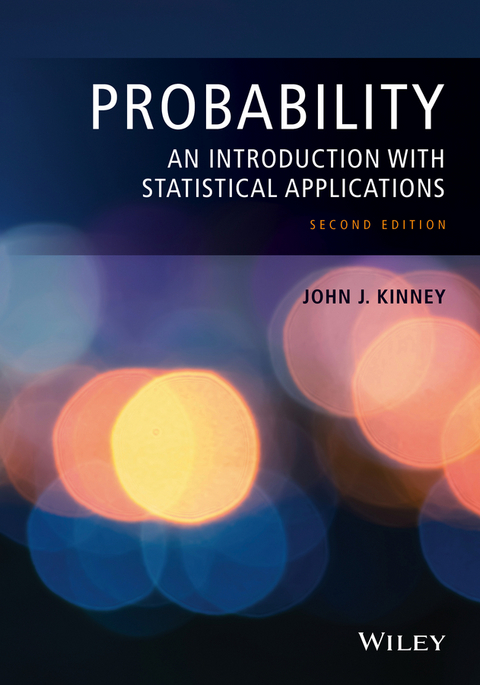
Probability (eBook)
John Wiley & Sons (Verlag)
978-1-118-94710-4 (ISBN)

Praise for the First Edition
'This is a well-written and impressively presented introduction to probability and statistics. The text throughout is highly readable, and the author makes liberal use of graphs and diagrams to clarify the theory.' - The Statistician
Thoroughly updated, Probability: An Introduction with Statistical Applications, Second Edition features a comprehensive exploration of statistical data analysis as an application of probability. The new edition provides an introduction to statistics with accessible coverage of reliability, acceptance sampling, confidence intervals, hypothesis testing, and simple linear regression. Encouraging readers to develop a deeper intuitive understanding of probability, the author presents illustrative geometrical presentations and arguments without the need for rigorous mathematical proofs.
The Second Edition features interesting and practical examples from a variety of engineering and scientific fields, as well as:
- Over 880 problems at varying degrees of difficulty allowing readers to take on more challenging problems as their skill levels increase
- Chapter-by-chapter projects that aid in the visualization of probability distributions
- New coverage of statistical quality control and quality production
- An appendix dedicated to the use of Mathematica® and a companion website containing the referenced data sets
Featuring a practical and real-world approach, this textbook is ideal for a first course in probability for students majoring in statistics, engineering, business, psychology, operations research, and mathematics. Probability: An Introduction with Statistical Applications, Second Edition is also an excellent reference for researchers and professionals in any discipline who need to make decisions based on data as well as readers interested in learning how to accomplish effective decision making from data.
John J. Kinney, PhD, is Professor Emeritus of Mathematics at Rose-Hulman Institute of Technology in Terre Haute, Indiana. A Member of the American Statistical Association and the Colorado Council of Teachers of Mathematics, Dr. Kinney is the author of numerous journal articles and three books, including A Probability and Statistics Companion, also published by Wiley.
John J. Kinney, PhD, is Professor Emeritus of Mathematics at Rose-Hulman Institute of Technology in Terre Haute, Indiana. A Member of the American Statistical Association and the Colorado Council of Teachers of Mathematics, Dr. Kinney is the author of numerous journal articles and three books, including A Probability and Statistics Companion, also published by Wiley.
Preface for the First Edition
Historical Note
The theory of probability is concerned with events that occur when randomness or chance influences the result. When the data from a sample survey or the occurrence of extreme weather patterns are common enough examples of situations where randomness is involved, we have come to presume that many models of the physical world contain elements of randomness as well. Scientists now commonly suppose that their models contain random components as well as deterministic components. Randomness, of course, does not involve any new physical forces; rather than measuring all the forces involved and thus predicting the exact outcome of an experiment, we choose to combine all these forces and call the result random. The study of random events is the subject of this book.
It is impossible to chronicle the first interest in events involving randomness or chance, but we do know of a correspondence between Blaise Pascal and Pierre de Fermat in the middle of the seventeenth century regarding questions arising in gambling games. Appropriate mathematical tools for the analysis of such situations were not available at that time, but interest continued among some mathematicians. For a long time, the subject was connected only to gambling games and its development was considerably restricted by the situations arising from such considerations. Mathematical techniques suitable for problems involving randomness have produced a theory applicable to not only gambling situations but also more practical situations. It has not been until recent years, however, that scientists and engineers have become increasingly aware of the presence of random factors in their experiments and manufacturing processes and have become interested in measuring or controlling these factors.
It is the realization that the statistical analysis of experimental data, based on the theory of probability, is of great importance to experimenters that has brought the theory to the forefront of applicable mathematics. The history of probability and the statistical analysis it makes possible illustrate a prime example of seemingly useless mathematical research that now has an incredibly wide range of practical application. Mathematical models for experimental situations now commonly involve both deterministic and random terms. It is perhaps a simplification to say that science, while interested in deterministic models to explain the physical world, now is interested as well in separating deterministic factors from random factors and measuring their relative importance.
There are two facts that strike me as most remarkable about the theory of probability. One is the apparent contradiction that random events are in reality well behaved and that there are laws of probability. The outcome on one toss of a coin cannot be predicted, but given 10,000 tosses of the same coin, many events can be predicted with a high degree of accuracy. The second fact, which the reader will soon perceive, is the pervasiveness of a probability distribution known as the normal distribution. This distribution, which will be defined and discussed at some length, arises in situations which at first glance have little in common: the normal distribution is an essential tool in statistical modeling and is perhaps the single most important concept in statistical inference.
There are reasons for this, and it is my purpose to explain these in this book.
About the Text
From the author's perspective, the characteristics of this text which most clearly differentiate it from others currently available include the following:
- Applications to a variety of scientific fields, including engineering, appear in every chapter.
- Integration of computer algebra systems such as Mathematica provides insight into both the structure and results of problems in probability.
- A great variety of problems at varying levels of difficulty provides a desirable flexibility in assignments.
- Topics in statistics appear throughout the text so that professors can include or omit these as the nature of their course warrants.
- Some problems are structured and solved using recursions since computers and computer algebra systems facilitate this.
- Significant and practical topics in quality control and quality production are introduced.
It has been my purpose to write a book that is readable by students who have some background in multivariable calculus. Mathematical ideas are often easily understood until one sees formal definitions that frequently obscure such understanding. Examples allow us to explore ideas without the burden of language. Therefore, I often begin with examples and follow with the ideas motivated first by them; this is quite purposeful on my part, since language often obstructs understanding of otherwise simply perceived notions.
I have attempted to give examples that are interesting and often practical in order to show the widespread applicability of the subject. I have sometimes sacrificed exact mathematical precision for the sake of readability; readers who seek a more advanced explication of the subject will have no trouble in finding suitable sources. I have proceeded in the belief that beginning students want most to know what the subject encompasses and for what it may be useful. More theoretical courses may then be chosen as time and opportunity allow. For those interested, the bibliography contains a number of current references.
An author has considerable control over the reader by selecting the material, its order of presentation, and the explication. I am hopeful that I have executed these duties with due regard for the reader. While the author may not be described with any sort of precision as the holder of a tightrope, I have been guided by the admonition: “It's not healthy for the tightrope walker to be misunderstood by the person who's holding the rope.”1
The book makes free use of the now widely available computer algebra systems. I have used Mathematica, Maple, and Derive for various problems and examples in the book, and I hope the reader has access to one of these marvelous mathematical aids. These systems allow us the incredible opportunity to see graphs and surfaces easily, which otherwise would be very difficult and time-consuming to produce. Computer algebra systems make some parts of mathematics visual and thereby add immensely to our understanding. Derivatives, integrals, series expansions, numerical computation, and the solution of recursions are used throughout the book, but the reader will find that only the results are included: in my opinion there is no longer any reason to dwell on calculation of either a numeric or algebraic sort. We can now concentrate on the meaning of the results without being restrained by the often mechanical effort in achieving them; hence our concentration is on the structure of the problem and the insight the solution gives. Graphs are freely drawn and, when appropriate, a geometric view of the problem is given so that the solution and the problem can be visualized. Numerical approximations are given when exact solutions are not feasible. The reader without a computer algebra system can still do the problems; the reader with such a system can reproduce every graph in the book exactly as it appears. I have included a fairly expensive appendix in which computer commands in Mathematica are given for many of the examples in which Mathematica was used; this should also ease the translation to other computer algebra systems. The reader with access to a computer algebra system should refer to Appendix 1 fairly frequently.
Although I hope the book is readable and as completely explanatory as a probability text may be, I know that students often do not read the text, but proceed directly to the problems. There is nothing wrong with this; after all, if the ability to solve practical problems is the goal, then the student who can do this without reading the text is to be admired. Readers are warned, however, that probability problems are rarely repetitive; the solution of one problem does not necessarily give even any sort of hint as to the solution of the next problem. I have included over 840 problems so that a reader who solves the problems can be reasonably assured that the concepts involving them are understood.
The problem sections begin with the easiest problems and gradually work their way up to some reasonably difficult problems while remaining within the scope and level of the book. In discussing a forthcoming examination with my students, I summarize the material and give some suggestions for practice problems, so I have followed each chapter by a Chapter Summary, some suggestions for Review Problems, and finally some Supplementary Problems.
For the Instructor
Texts on probability often use generating functions and recursions in the solution of many complex problems; with our use of computer algebra systems, we can determine generating functions, and often their power series expansions, with ease. The structure of generating functions is also used to explain limiting behavior in many situations. Many interesting problems can be best described in terms of recursions; since computer algebra systems allow us to solve such recursions, some discussion of recursive functions is given. Proofs are often given using recursions, a novel feature of the book. Occasionally, the more traditional proofs are given in the exercises.
Although numerous applications of the theory are given in the text and in the problems, the text by no means exhausts the applications of the theory of probability. In addition to solving many...
| Erscheint lt. Verlag | 13.1.2015 |
|---|---|
| Sprache | englisch |
| Themenwelt | Mathematik / Informatik ► Mathematik ► Statistik |
| Mathematik / Informatik ► Mathematik ► Wahrscheinlichkeit / Kombinatorik | |
| Technik | |
| Schlagworte | Angewandte Wahrscheinlichkeitsrechnung u. Statistik • Applied mathematics • Applied Probability & Statistics • computer science</p> • curve modeling • <p>Computer graphics • Probability & Mathematical Statistics • programming • Statistical Software / Mathematica • Statistics • Statistik • Statistiksoftware / Mathematica • two- and three-dimensional computer graphics • Vector Geometry • Wahrscheinlichkeitsrechnung u. mathematische Statistik |
| ISBN-10 | 1-118-94710-X / 111894710X |
| ISBN-13 | 978-1-118-94710-4 / 9781118947104 |
| Informationen gemäß Produktsicherheitsverordnung (GPSR) | |
| Haben Sie eine Frage zum Produkt? |
 EPUB (Adobe DRM)
Kopierschutz: Adobe-DRM
Adobe-DRM ist ein Kopierschutz, der das eBook vor Mißbrauch schützen soll. Dabei wird das eBook bereits beim Download auf Ihre persönliche Adobe-ID autorisiert. Lesen können Sie das eBook dann nur auf den Geräten, welche ebenfalls auf Ihre Adobe-ID registriert sind.
Details zum Adobe-DRM
Dateiformat: EPUB (Electronic Publication)
EPUB ist ein offener Standard für eBooks und eignet sich besonders zur Darstellung von Belletristik und Sachbüchern. Der Fließtext wird dynamisch an die Display- und Schriftgröße angepasst. Auch für mobile Lesegeräte ist EPUB daher gut geeignet.
Systemvoraussetzungen:
PC/Mac: Mit einem PC oder Mac können Sie dieses eBook lesen. Sie benötigen eine
eReader: Dieses eBook kann mit (fast) allen eBook-Readern gelesen werden. Mit dem amazon-Kindle ist es aber nicht kompatibel.
Smartphone/Tablet: Egal ob Apple oder Android, dieses eBook können Sie lesen. Sie benötigen eine
Geräteliste und zusätzliche Hinweise
Buying eBooks from abroad
For tax law reasons we can sell eBooks just within Germany and Switzerland. Regrettably we cannot fulfill eBook-orders from other countries.
aus dem Bereich