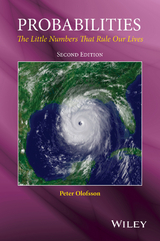
Probabilities (eBook)
Wiley (Verlag)
978-1-118-89893-2 (ISBN)
Praise for the First Edition
“If there is anything you want to know, or remind yourself, about probabilities, then look no further than this comprehensive, yet wittily written and enjoyable, compendium of how to apply probability calculations in real-world situations.”
- Keith Devlin, Stanford University, National Public Radio’s “Math Guy” and author of The Math Gene and The Unfinished Game
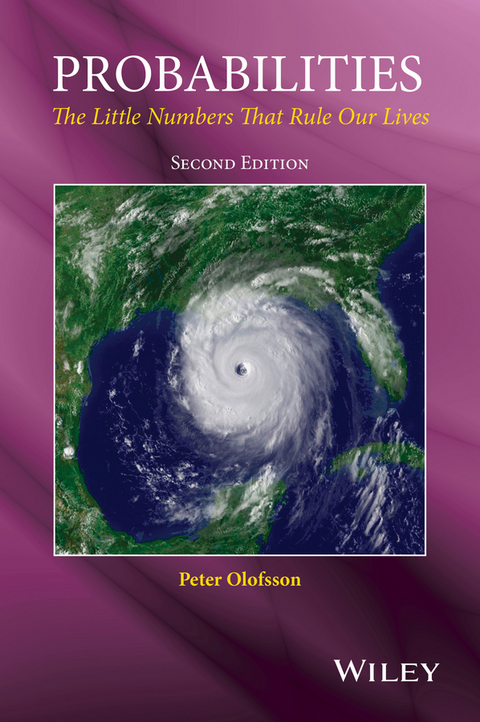
From probable improbabilities to regular irregularities, Probabilities: The Little Numbers That Rule Our Lives, Second Edition investigates the often surprising effects of risk and chance in our lives. Featuring a timely update, the Second Edition continues to be the go-to guidebook for an entertaining presentation on the mathematics of chance and uncertainty.
The new edition develops the fundamental mathematics of probability in a unique, clear, and informal way so readers with various levels of experience with probability can understand the little numbers found in everyday life. Illustrating the concepts of probability through relevant and engaging real-world applications, the Second Edition features numerous examples on weather forecasts, DNA evidence, games and gambling, and medical testing. The revised edition also includes:
- The application of probability in finance, such as option pricing
- The introduction of branching processes and the extinction of family names
- An extended discussion on opinion polls and Nate Silver’s election predictions
Probabilities: The Little Numbers That Rule Our Lives, Second Edition is an ideal reference for anyone who would like to obtain a better understanding of the mathematics of chance, as well as a useful supplementary textbook for students in any course dealing with probability.
Peter Olofsson, PhD, is Professor in the Department of Mathematics at Trinity University, USA. An active researcher in the field of applied probability and an experienced teacher, Dr. Olofsson is the author of Probability, Statistics, and Stochastic Processes, Second Edition, also published by Wiley.
Praise for the First Edition If there is anything you want to know, or remind yourself, about probabilities, then look no further than this comprehensive, yet wittily written and enjoyable, compendium of how to apply probability calculations in real-world situations. - Keith Devlin, Stanford University, National Public Radio s Math Guy and author of The Math Gene and The Unfinished Game From probable improbabilities to regular irregularities, Probabilities: The Little Numbers That Rule Our Lives, Second Edition investigates the often surprising effects of risk and chance in our lives. Featuring a timely update, the Second Edition continues to be the go-to guidebook for an entertaining presentation on the mathematics of chance and uncertainty. The new edition develops the fundamental mathematics of probability in a unique, clear, and informal way so readers with various levels of experience with probability can understand the little numbers found in everyday life. Illustrating the concepts of probability through relevant and engaging real-world applications, the Second Edition features numerous examples on weather forecasts, DNA evidence, games and gambling, and medical testing. The revised edition also includes: The application of probability in finance, such as option pricing The introduction of branching processes and the extinction of family names An extended discussion on opinion polls and Nate Silver s election predictions Probabilities: The Little Numbers That Rule Our Lives, Second Edition is an ideal reference for anyone who would like to obtain a better understanding of the mathematics of chance, as well as a useful supplementary textbook for students in any course dealing with probability.
Peter Olofsson, PhD, is Professor in the Department of Mathematics at Trinity University, USA. An active researcher in the field of applied probability and an experienced teacher, Dr. Olofsson is the author of Probability, Statistics, and Stochastic Processes, Second Edition, also published by Wiley.
Preface ix
Preface to the First Edition xi
1 Computing Probabilities: Right Ways and Wrong Ways 1
The Probabilist 1
The Probabilist's Toys and Language 4
The Probabilist's Rule Book 10
Independence, Airplanes, and Russian Peasants 15
Conditional Probability, Swedish TV, and British Courts 20
Liar, Liar 25
Car Dealers and Color Blindness 29
Shuttlecocks and Spaghetti Westerns 34
Combinatorics, Pastrami, and Poetry 40
The Von Trapps and The Binomial Distribution 45
Final Word 51
2 Surprising Probabilities: When Intuition Struggles 53
Boys, Girls, Aces, and Colored Cards 53
Goats and Gloats 58
Happy Birthday 61
Typical Atypicalities 66
The British Snob and I 72
Strategery 75
Final Word 78
3 Tiny Probabilities: Why Are They So Hard to Escape? 79
Probable Improbabilities 79
Saddam and I 83
Taking Tiny Risks 89
A Million-to-One Shot, Doc, Million to One! 91
Monsieur Poisson and the Mysterious Number 37 93
Clumps in Space 98
Final Word 100
4 Backward Probabilities: The Reverend Bayes to Our Rescue 101
Driving Miss Daisy 101
Bayes, Balls, and Boys (and Girls) 104
Bayes and My Green Card 107
Objection Your Honor 112
Ornithology 122
Final Word 125
5 Beyond Probabilities: What to Expect 127
Great Expectations 127
The Price is Right (Maybe) 134
Blood, Sweat, and Theory 137
Good Things Come to Those Who Wait 140
Expect the Unexpected 145
Exponential Growth toward Extinction 149
Size Matters (and Length, and Age) 159
Mean, Median, Mode 165
Deviant Behavior 171
Final Word 176
6 Inevitable Probabilities: Two Fascinating Mathematical Results 177
Alea Iacta Est, Over and Over 177
Even-Steven? The Law Misunderstood 181
Coin Tosses and Freeway Congestion 188
Let's Get Serious 195
Bells and Bread 200
How a Toronto Quincunx Changed My Life 204
Final Word 206
7 Gambling Probabilities: Why Donald Trump Is Richer than You 209
French Letters 209
Roulette: A Classy Way to Waste Your Money 214
Craps: Not so Dicey after All 219
Blackjack: Money for Mnemonics 222
Math for Losers 227
Win Money and Lose Friends 234
Final Word 245
8 Guessing Probabilities: Enter the Statisticians 247
Lies, Damned Lies, and Beautiful Lies? 247
4 Out of 10 Like the President 19 Times Out of 20 251
Polls Gone Wild 257
The Silver Lining 262
The Lawsuit and the Lurker 265
Football Players and Geyser Eruptions 271
Snooping in the Abbot's Garden 278
Final Word 284
9 Faking Probabilities: Computer Simulation 285
Mahogany Dice and Modular Arithmetic 285
Random and Not-So-Random Digits 293
Number One is Number One 294
Is Random Really Random? 297
Final Word 302
Index 305
"The book is an ideal reference for anyone who would like to obtain a better understanding of the mathematics of chance, as well as a useful supplementary textbook for students in any course dealing with probability." (Zentralblatt MATH, 1 June 2015)
Chapter 1
Computing Probabilities: Right Ways and Wrong Ways
The Probabilist
Whether you like it or not, probabilities rule your life. If you have ever tried to make a living as a gambler, you are painfully aware of this, but even those of us with more mundane life stories are constantly affected by these little numbers. Some examples from daily life where probability calculations are involved are the determination of insurance premiums, the introduction of new medications on the market, opinion polls, weather forecasts, and DNA evidence in courts. Probabilities also rule who you are. Did daddy pass you the X or the Y chromosome? Did you inherit grandma's big nose? And on a more profound level, quantum physicists teach us that everything is governed by the laws of probability. They toss around terms like the Schrödinger wave equation and Heisenberg's uncertainty principle, which are much too difficult for most of us to understand, but one thing they do mean is that the fundamental laws of physics can only be stated in terms of probabilities. And the fact that Newton's deterministic laws of physics are still useful can also be attributed to results from the theory of probabilities. Meanwhile, in everyday life, many of us use probabilities in our language and say things like “I'm 99% certain” or “There is a one-in-a-million chance” or, when something unusual happens, ask the rhetorical question “What are the odds?”
Some of us make a living from probabilities, by developing new theory and finding new applications, by teaching others how to use them, and occasionally by writing books about them. We call ourselves probabilists. In universities, you find us in mathematics and statistics departments; there are no departments of probability. The terms “mathematician” and “statistician” are much more well known than “probabilist,” and we are a little bit of both but we don't always like to admit it. If I introduce myself as a mathematician at a cocktail party, people wish they could walk away. If I introduce myself as a statistician, they do. If I introduce myself as a probabilistwell, most actually still walk away. They get upset that somebody who sounds like the Swedish Chef from the Muppet Show tries to impress them with difficult words. But some stay and give me the opportunity to tell them some of the things I will now tell you about.
Let us be etymologists for a while and start with the word itself, probability. The Latin roots are probare, which means to test, prove, or approve, and habilis, which means apt, skillful, able. The word “probable” was originally used in the sense “worthy of approval,” and its connection to randomness came later when it came to mean “likely” or “reasonable.” In my native Swedish, the word for probable is “sannolik,” which literally means “truthlike” as does the German word “wahrscheinlich.” The word “probability” still has room for nuances in the English language, and Merriam-Webster's online dictionary lists four slightly different meanings. To us a probability is a number used to describe how likely something is to occur, and probability (without the indefinite article) is the study of probabilities.
Probabilities are used in situations that involve randomness. Many clever people have thought about and debated what randomness really is, and we could get into a long philosophical discussion that could fill the rest of the book. Let's not. The French mathematician Pierre-Simon Laplace (1749–1827) put it nicely: “Probability is composed partly of our ignorance, partly of our knowledge.” Inspired by Monsieur Laplace, let us agree that you can use probabilities whenever you are faced with uncertainty. You could:
- Toss a coin, roll a die, or spin a roulette wheel
- Watch the stock market, the weather, or the Super Bowl
- Wonder if there is an oil well in your backyard, if there is life on Mars, if Elvis is alive
These examples differ from each other. The first three are cases where the outcomes are equally likely. Each individual outcome has a probability that is simply one divided by the number of outcomes. The probability is 1/2 to toss heads, 1/6 to roll a 6, and 1/38 to get the number 29 in roulette (an American roulette wheel has the numbers 1–36, 0, and 00). Pure and simple. We can also compute probabilities of groups of outcomes. For example, what is the probability to get an odd number when rolling a die? As there are three odd outcomes out of six total, the answer is 3/6 = 1/2. These are examples of classical probability, which is the first type of probability problems studied by mathematicians, most notably, Frenchmen Pierre de Fermat and Blaise Pascal whose seventeenth century correspondence with each other is usually considered to have started the systematic study of probabilities. You will learn more about Fermat and Pascal later in the book.
The next three examples are cases where we must use data to be able to assign probabilities. If it has been observed that under current weather conditions it has rained about 20% of the days, we can say that the probability of rain today is 20%. This probability may change as more weather data are gathered and we can call it a statistical probability. As for the Super Bowl, at the time of writing, the 2014–2015 season has yet to start and the highest odds are on the Jacksonville Jaguars at 100 to 1. This means that the bookmaker estimates a probability of less than 1% that the Jaguars will win, an estimate based on plenty of team data and football statistics.
The third trio of examples is different from the previous two in the sense that the outcome is already fixed; you just don't know what it is. Either there is an oil well or there isn't. Before you start drilling, you still want to have some idea of how likely you are to find oil and a geologist might tell you that the probability is about 75%. This percentage does not mean that the oil well is there 9 months of the year and slides over to your neighbor the other 3, but it does mean that the geologist thinks that your chances are pretty good. Another geologist may tell you the probability is 85%, which is a different number but means the same thing: Chances are pretty good. We call these subjective probabilities. In the case of a living Elvis, I suppose that depending on whom you ask you would get either 0% or 100%. I mean, who would say 25%? Little Richard?
Some knowledge about proportions may be helpful when assigning subjective probabilities. For example, suppose that your Aunt Jane in Pittsburgh calls and tells you that her new neighbor seems nice and has a job that “has something to do with the stars, astrologer, or astronomer.” Without having more information, what is the probability that the neighbor is an astronomer? As you have virtually no information, would you say 50%? Some people might. But you should really take into account that there are about four times as many astrologers as astronomers in the United States, so a probability of 20% is more realistic. Just because something is “either/or” does not mean it is “50–50.” Andy Rooney may have been more insightful than he intended when he stated his 50–50–90 rule: “Anytime you have a 50–50 chance of getting something right, there's a 90% probability you'll get it wrong.”
The Probabilist'S Toys and Language
Probabilists love to play with coins and dice. In a platonic sense. We like the idea of tossing coins and rolling dice as experiments that have equally likely outcomes. Suppose that a family with four children is chosen at random. What is the probability that all four are girls? A coin-tossing analogy would be to ask for the probability to get four heads when a coin is tossed four times. Many probability problems can be illustrated by coin tossing, but this would quickly become boring, so we introduce variation by also rolling dice, spinning roulette wheels, picking balls from urns, or drawing from decks of cards. Dice, roulette, and card games are alsointeresting in their own right, and you will find a chapter on gambling later in the book. Of course. Probability without gambling is like beer without bubbles.
Probability is the art of being certain of how uncertain you are. The statement “the probability to get heads is 1/2” is a precise statement. It tells you that you are as likely to get heads as you are to get tails. Another way to think about probabilities is in terms of average long-term behavior. In this case, if you toss the coin repeatedly, in the long run you will get roughly 50% heads and 50% tails. Of this you can be certain. What you cannot be certain of is how the next toss will come up.
Probabilists use special terminology. For example, we often refer to a situation where there is uncertainty as an “experiment.” This situation could be an actual experiment such as tossing a coin or rolling a die, but also something completely different such as following the stock market or watching the Wimbledon final. An experiment results in an outcome such as “heads,” “6,” “Volvo went up,” or “Björn Borg won” (those were the...
| Erscheint lt. Verlag | 29.12.2014 |
|---|---|
| Sprache | englisch |
| Themenwelt | Mathematik / Informatik ► Mathematik ► Statistik |
| Mathematik / Informatik ► Mathematik ► Wahrscheinlichkeit / Kombinatorik | |
| Technik | |
| Schlagworte | Angewandte Wahrscheinlichkeitsrechnung u. Statistik • applied probability • Applied Probability & Statistics • Chance • likelihood • Mathematical Statistics • opinion polls • Option pricing • Probability • Probability & Mathematical Statistics • Risk • Statistics • Statistics - Text & Reference • Statistik • Statistik / Lehr- u. Nachschlagewerke • theoretical mathematics • Uncertainty • Wahrscheinlichkeitsrechnung u. mathematische Statistik |
| ISBN-10 | 1-118-89893-1 / 1118898931 |
| ISBN-13 | 978-1-118-89893-2 / 9781118898932 |
| Informationen gemäß Produktsicherheitsverordnung (GPSR) | |
| Haben Sie eine Frage zum Produkt? |
 EPUB (Adobe DRM)
Kopierschutz: Adobe-DRM
Adobe-DRM ist ein Kopierschutz, der das eBook vor Mißbrauch schützen soll. Dabei wird das eBook bereits beim Download auf Ihre persönliche Adobe-ID autorisiert. Lesen können Sie das eBook dann nur auf den Geräten, welche ebenfalls auf Ihre Adobe-ID registriert sind.
Details zum Adobe-DRM
Dateiformat: EPUB (Electronic Publication)
EPUB ist ein offener Standard für eBooks und eignet sich besonders zur Darstellung von Belletristik und Sachbüchern. Der Fließtext wird dynamisch an die Display- und Schriftgröße angepasst. Auch für mobile Lesegeräte ist EPUB daher gut geeignet.
Systemvoraussetzungen:
PC/Mac: Mit einem PC oder Mac können Sie dieses eBook lesen. Sie benötigen eine
eReader: Dieses eBook kann mit (fast) allen eBook-Readern gelesen werden. Mit dem amazon-Kindle ist es aber nicht kompatibel.
Smartphone/Tablet: Egal ob Apple oder Android, dieses eBook können Sie lesen. Sie benötigen eine
Geräteliste und zusätzliche Hinweise
Buying eBooks from abroad
For tax law reasons we can sell eBooks just within Germany and Switzerland. Regrettably we cannot fulfill eBook-orders from other countries.
aus dem Bereich