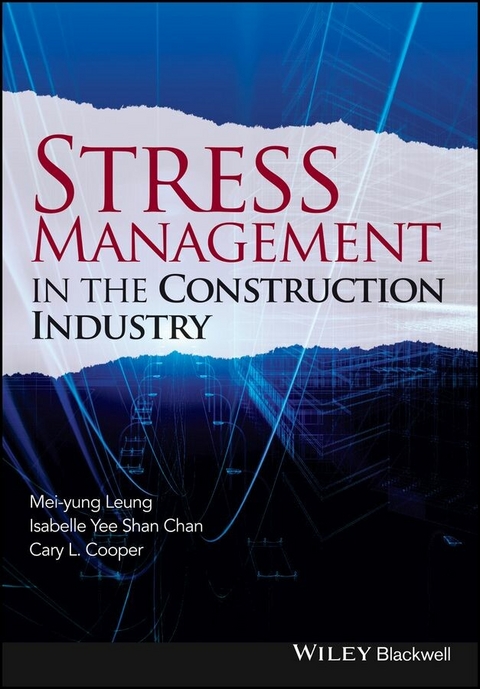
Stress Management in the Construction Industry (eBook)
John Wiley & Sons (Verlag)
978-1-118-45639-2 (ISBN)
‘A book that presents an integrated and comprehensive stress management model that reflects the demands and dynamism of the construction industry is not just important but a must for all those working in the industry.’
Philip Dewe, Professor of Organizational Behaviour, Birkbeck College, University of London
‘Stress kills and successful stress coping enables us to live abundantly… to thrive. This well-conceived, focused volume reveals the stress process in the challenging construction industry, and the best ways to cope.’
James Campbell Quick, Professor of Leadership & Organizational Behavior, John and Judy Goolsby – Jacqualyn A Fouse Endowed Chair, at University of Texas at Arlington
With its task complexity, tight timeframes, complicated work relationships and poor working environments, the construction industry is recognised as stressful.
This book aims to enhance the performance of construction personnel by presenting an integrated and comprehensive stress management model. Though illustrating both how construction personnel are affected by various stressors and how this influences their performance the model also explains how stress levels can be managed by dealing with the stressors and using appropriate adaptive coping behaviours.
Stress Management in the Construction Industry is based on an extensive literature review, on survey studies and on scenario analyses to thoroughly investigate the components of stress management for construction personnel, including the multiple dimensions of the stress they experience, the nature of their stressors, the coping behaviors they adopt, and the consequences of stress for their performance. The book aims to help researchers in construction management and in occupational health and safety understand the issues and theory, as well as offering practical recommendations for professional bodies and policy advisors.
The authors explore various stress management components and analyses for construction personnel, including their different work natures; the various stressors causing their stress; the manifestation of stress; the impact of coping behaviours to the stress; the consequences of stress on their performances; and the stress management strategies.
In order to provide specific and effective recommendations for construction personnel to manage their stress, these topics are supported by scientific research results including both survey statistics and scenario analyses. In chapters where scientific research results are applied, statistical results are first presented, followed by various scenarios to unveil the underlining reasons of the statistical relationships found. Detailed analyses and discussions are then be made using genuine construction context.
The authors’ goal here is to facilitate the development of stress management research and education in construction, while also enhancing the awareness of construction personnel on the significance of stress and the importance of its management.
Dr Mei-yung Leung is Associate Professor of the City University of Hong Kong, PRC. She has more than twenty years of practical/teaching experience in the construction industry/education and has participated in a number of prestigious construction projects in Hong Kong. She has over 150 international publications in various research areas covering stress management, construction project management, value management, facility management, and construction education. Up to the present, she has attracted over HK$ 15 million in the capacity of investigator in both professional and research projects. Dr. Leung has successfully completed all levels (including the teaching level) of the Mindfulness-based Stress Reduction training at the University of Massachusetts in the USA, and conducted various stress management seminars and full course to construction companies, professional institutes, higher educations and religious organizations. She has received a number of international awards, including the Tony Toy Memorial Award issued by the Hong Kong Institute of Value Management in Hong Kong, the Thomas D. Snodgrass Value Teaching Award issued by the SAVE International ‘The Value Society’ in the USA, and the Teaching Excellence Award issued by the City University of Hong Kong. Dr. Leung is also a senior Fulbright Scholar at the Pennsylvania State University and University of Southern California.
Dr Isabelle Yee Shan Chan is lecturer at the University of Hong Kong, PRC. She is the author of over 40 international publications in books, journals and conferences, covering areas of stress management, health and safety, culture, and innovation in construction. In line with these research areas, she has participated in more than 10 research projects in the capacities of principle investigator, co-investigator and project coordinator. Stress management in construction is the research area of her PhD study; she has also successfully completed the mindfulness-based stress reduction program in the Hospital Authority in Hong Kong. Dr. Chan is the vice-chairman of the Institute of Safety and Health Practitioners in Hong Kong, and is also a visiting fellow of Hughes Hall of University of Cambridge in the United Kingdom.
Professor Sir Cary Cooper is Professor of Organizational Psychology and Health, Lancaster University Management School, UK. He is the author of over 120 books (on occupational stress, women at work and industrial and organizational psychology), has written over 400 scholarly articles, and is a frequent contributor to national newspapers, TV and radio. Professor Cooper is a Fellow of the British Academy of Management and also of the Academy of Management (having also won the 1998 Distinguished Service Award). In 2001 he was awarded a CBE in the Queen’s Birthday Honours List for his contribution to organizational health, and in 2014 he was awarded a Knighthood. Professor Cooper was the lead scientist to the UK Government Office for Science on their Foresight programme on Mental Capital and Well Being (2007-2008). He was appointed a member of the expert group on establishing guidance for the National Institute for Health and Clinical Excellence on ‘promoting mental wellbeing through productive and healthy working conditions’, 2009. Professor Cooper is Chair of the UK’s Academy of Social Sciences (an umbrella body of 47 learned societies in the social sciences; and was Chair of the Chronic Disease and Wellbeing Global Agenda Council of the World Economic Forum in Geneva in 2009.
This systematic review of stress management in construction will help an understanding of the issues and theory as well as offering practical recommendations. addresses the growing concern to make work in construction healthier, safer, and more productive integrates research results, survey statistics and scenario analyses to reveal underlying causes of stress offers recommendations for reducing Stress
Dr Mei-yung Leung is Associate Professor of the City University of Hong Kong, PRC. She has more than twenty years of practical/teaching experience in the construction industry/education and has participated in a number of prestigious construction projects in Hong Kong. She has over 150 international publications in various research areas covering stress management, construction project management, value management, facility management, and construction education. Up to the present, she has attracted over HK$ 15 million in the capacity of investigator in both professional and research projects. Dr. Leung has successfully completed all levels (including the teaching level) of the Mindfulness-based Stress Reduction training at the University of Massachusetts in the USA, and conducted various stress management seminars and full course to construction companies, professional institutes, higher educations and religious organizations. She has received a number of international awards, including the Tony Toy Memorial Award issued by the Hong Kong Institute of Value Management in Hong Kong, the Thomas D. Snodgrass Value Teaching Award issued by the SAVE International "The Value Society" in the USA, and the Teaching Excellence Award issued by the City University of Hong Kong. Dr. Leung is also a senior Fulbright Scholar at the Pennsylvania State University and University of Southern California. Dr Isabelle Yee Shan Chan is lecturer at the University of Hong Kong, PRC. She is the author of over 40 international publications in books, journals and conferences, covering areas of stress management, health and safety, culture, and innovation in construction. In line with these research areas, she has participated in more than 10 research projects in the capacities of principle investigator, co-investigator and project coordinator. Stress management in construction is the research area of her PhD study; she has also successfully completed the mindfulness-based stress reduction program in the Hospital Authority in Hong Kong. Dr. Chan is the vice-chairman of the Institute of Safety and Health Practitioners in Hong Kong, and is also a visiting fellow of Hughes Hall of University of Cambridge in the United Kingdom. Professor Sir Cary Cooper is Professor of Organizational Psychology and Health, Lancaster University Management School, UK. He is the author of over 120 books (on occupational stress, women at work and industrial and organizational psychology), has written over 400 scholarly articles, and is a frequent contributor to national newspapers, TV and radio. Professor Cooper is a Fellow of the British Academy of Management and also of the Academy of Management (having also won the 1998 Distinguished Service Award). In 2001 he was awarded a CBE in the Queen's Birthday Honours List for his contribution to organizational health, and in 2014 he was awarded a Knighthood. Professor Cooper was the lead scientist to the UK Government Office for Science on their Foresight programme on Mental Capital and Well Being (2007-2008). He was appointed a member of the expert group on establishing guidance for the National Institute for Health and Clinical Excellence on "promoting mental wellbeing through productive and healthy working conditions", 2009. Professor Cooper is Chair of the UK's Academy of Social Sciences (an umbrella body of 47 learned societies in the social sciences; and was Chair of the Chronic Disease and Wellbeing Global Agenda Council of the World Economic Forum in Geneva in 2009.
About the Authors vii
Preface ix
Acknowledgements xi
Chapter 1 Construction Personnel in Practice 1
1.1 Background to Stress Management in Construction 1
1.2 Construction Organisations 3
1.3 Construction Personnel 8
1.4 Construction Projects 12
1.5 Stress in the Construction Industry 14
References 28
Chapter 2 Theories of Stress 37
2.1 The History of Stress Theory 37
2.2 Arousal Theories 41
2.3 Appraisal and Regulatory Theories 44
2.4 Summary 48
References 48
Chapter 3 Stress 53
3.1 Stress Levels of Construction Personnel 53
3.2 Development of a Conceptual Model of Stress 65
3.3 Research Results on Stress among Construction Personnel 66
3.4 Case Studies 77
3.5 Practical Implications 84
3.6 Summary 85
References 86
Chapter 4 Sources of Stress Affecting Construction Personnel 91
4.1 Stressors Affecting Construction Personnel 91
4.2 Development of a Conceptual Model of Stressors and Stress 104
4.3 Research Results on Stressors and Different Construction Personnel 105
4.4 Case Studies 128
4.5 Practical Implications 137
References 140
Chapter 5 Consequences of Stress 149
5.1 Consequences of Stress Affecting Construction Personnel 149
5.2 (Inter)Personal Performance of Construction Personnel 149
5.3 Task Performance of Construction Personnel 151
5.4 Organisational Performance of Construction Personnel 152
5.5 Development of a Conceptual Model of Stress and Performance 153
5.6 Research Results on Stress and Performance of Construction Personnel 158
5.7 Discussion 165
5.8 Case Studies 169
5.9 Practical Implications 177
References 178
Chapter 6 Stress Management 185
6.1 Coping Behaviours 185
6.2 Effectiveness of Coping Behaviours 195
6.3 Determinants of Various Coping Behaviours 196
6.4 Developing a Conceptual Model of the Individual Coping Behaviours of Construction Personnel 197
6.5 Studies on the Coping Behaviours of Construction Personnel 198
6.6 Case Studies 211
6.7 Discussion 217
6.8 Practical Implications 223
6.9 Summary 224
References 225
Chapter 7 Conclusions 233
7.1 Stress Management for Construction Personnel 233
7.2 Practical Recommendations 242
7.3 Recommendations for Further Research 246
7.4 Conclusion 249
References 251
Index 257
1
Construction Personnel in Practice
This first chapter introduces the background and objectives of the book. It also discusses the characteristics of the construction industry; the nature, functions and interrelationships of various construction organisations, projects and personnel from an international perspective; the contribution of various member throughout the construction life cycle; and the potential for these industrial, organisational, project and individual characteristics, as well as construction-related work tasks, to cause stress for construction personnel. Along with the discussion of stress management in construction in the chapters which follow, several studies of construction personnel from various nations will be discussed here in order to present an overview of the current environment, results and trends in stress management research in the construction industry context. This chapter provides background information to contextualise the discussion in the remainder of the book.
1.1 Background to Stress Management in Construction
The construction industry can be characterised as competitive, dynamic and challenging. A construction project is a unique human endeavour which combines the different goals and objectives of multiple stakeholders. They need to deploy various resources to tackle change and uncertainties and complete the work within a limited time and specific scope (Turner 1993). Normally, construction personnel working in different organisations (such as clients, government departments, consultancy companies, contractors, subcontractors and suppliers) need to work together to ensure the success of a project. Communication and cooperation between stakeholders is critical for construction personnel, since this is directly related to their efficiency and the success of the project. However, due to the fragmented and dynamic nature of the construction sector (The Chartered Institute of Building [CIOB] 2002), communication between stakeholders is often limited, causing difficulties in cooperation and resulting in a negative impact on outcomes (Hewage, Gannoruwa and Ruwanpura 2011). Moreover, construction personnel often work in crisis-ridden site environments at high risk of injury. Hence, it is not surprising that the majority of personnel, including architects, project managers, engineers, surveyors and construction workers, report feelings of stress in their daily working lives (Leung, Chan and Yuen 2010). According to a recent study of occupational stress in the construction industry (CIOB 2006), almost 70% of personnel suffer from stress, anxiety or depression.
The level of stress experienced by construction personnel largely depends on the source of stress, or more specifically the stressors. Stress occurs when an individual encounters a misfit between his/her actual ability and the environment (such as work and home) (French, Rogers and Cobb 1974), which may induce both emotional and physical symptoms (Moorhead and Griffin 1995). Common stressors found in the construction industry include long working hours, tight project schedules, limited organisational support and safety issues (Goldenhar, Williams and Swanson 2003; Leung et al. 2005a). These stressors and the stress reactions they create, are likely to induce physical and mental fatigue, undermine team performance, reduce working abilities and ultimately lead to the potential breakdown of the whole project (Ng, Skitmore and Leung 1995; Sutherland and Davidson 1989).
Stress can have serious implications not only for health and task performance, but also profitability and organisational development (Cooper and Dewe 2008). In terms of health, stress is known to be related to heart disease, negative emotions and extreme physiological symptoms (Cooper 2001). The British Heart Foundation suggests that coronary heart disease, which is often attributable to stress, costs £200 per employee per year in the UK (Hibbert 2003). According to the Health and Safety Executive (2007), 10.5 million working days are lost due to stress-related illnesses in the UK every year. The cost implication of occupational stress for employers is $381 million per annum (Cousins et al. 2004). Moreover, individuals in stressful situations tend to make rigid, simplistic and superficial decisions (Cherrington 1994), leading to the failure of construction projects to meet time, quality and budget requirements. In fact, highly stressed workers change jobs more frequently than those who are under less pressure, so excessive stress may also have a serious effect on the turnover intention of construction personnel (Djebarni 1996).
However, it seems that most construction employers focus mainly on profit while ignoring the importance of the health of their employees. This has a direct influence on project and organisational outcomes. Employees are the most valuable asset of all construction companies (Rowley and Jackson 2011). Ignorance of the effects of stress on their health not only costs companies a lot of money, but can also lead to lawsuits. For example, French, a UK police officer and his colleagues sued their employer, the Chief Constable, for negligently failing to provide proper training resulting in psychiatric injury (e.g. All England Reporter 2006). Employers have a legal responsibility to provide a healthy and safe working environment for their employees.
However, stress is not necessarily always harmful. When talking about stress, people generally mean “overstress” (too much) and its effects. Though overstress can result in burnout, too little stress (understress) can also affect the performance of construction personnel through the phenomenon termed “rustout” (Lingard 2003). Studies suggest that there is an inverted U-shaped relationship between the degree of stress and level of performance (Leung et al. 2005b; Yerkes and Dodson 1908). To optimise performance, an individual needs to be able to react and cope with his/her stress. There are various coping approaches, from which three main sets of behaviours have been identified: (i) problem-based coping, which focuses on task situations or problem solving (Carver, Scheier and Wein 1989; Weatherley and Irit 1996); (ii) emotion-based coping, which deals with emotional or anxiety reactions (Haynes and Love 2004; Lazarus and Folkman 1984); and (iii) meaning-based coping, which focuses on the attitudes resulting in positive emotions and reenacting the adoption of problem- or emotion-focused coping (Kabat-Zinn et al. 1992). However, not all types of coping strategy are adaptive. Studies in this area tend to categorise problem- and meaning-based coping as adaptive (see e.g. Folkman 2010; Leung, Liu and Wong 2006) and emotion-based coping as maladaptive (Dyson and Renk 2006). Maladaptive coping is not uncommon among construction personnel (Haynes and Love 2004; Leung, Liu and Wong 2006).
In fact, numerous researchers have investigated the stress experienced by different types of professionals such as nurses (Dailey, Ickinger and Coo 1986), teachers (Baruch-Feldman et al. 2002) and general managers (Davidson and Cooper 1983). Stress is also increasingly considered as a major problem for the construction industry in many countries such as Australia, South Africa, the UK and the US (Bowen, Edwards and Lingard 2013; Djebarni 1996; Lingard 2004; Loosemore and Waters 2004). However, little comprehensive investigation into stress management methods for construction personnel has so far been conducted, leading to an information gap. There is clearly a need for a comprehensive research study of effective stress management techniques for construction personnel working in industry.
1.2 Construction Organisations
In the modern industrialised and commercialised world, various organisations are involved in the construction industry, including governments, developers, consultants, contractors, subcontractors, and suppliers.
1.2.1 Governments
In order to keep the construction sector in good order, governments in all countries exert a great deal of influence over various activities. There are generally two types of government structure, namely centralised and decentralised. Each affects the construction industry in their country in different ways.
Centralised government refers to a situation where the government makes all the important decisions affecting the nation or state and handles the associated responsibilities. This type of government can directly or indirectly influence the construction industry by applying a large amount of regulations and policies in the areas of planning, financing, construction and maintenance, with a powerful and immediate effect (Wells 1986). The government can directly enact the industrial regulations and codes which construction personnel must observe. Any violation of the code will attract severe punishment in terms of fines and removal of qualifications for example. In addition, centralised governments can also indirectly affect the construction industry via various policies. For instance, China has a centralised government with a comparatively strong top-down mandate. The policy of opening up the construction market internationally, embarked on in 1992, has attracted various overseas competitors who have introduced new technologies to the Chinese construction market. Such a situation may be stressful for local personnel, who were educated in and have worked under the closed system for years, if they are expected to catch up with new technology and create competitive advantage in...
| Erscheint lt. Verlag | 29.12.2014 |
|---|---|
| Sprache | englisch |
| Themenwelt | Geisteswissenschaften ► Psychologie ► Arbeits- und Organisationspsychologie |
| Technik ► Bauwesen | |
| Wirtschaft ► Betriebswirtschaft / Management ► Personalwesen | |
| Schlagworte | affective job satisfaction • arousal theories • Baubetrieb • Bauingenieur- u. Bauwesen • Business & Management • Civil Engineering & Construction • cognitive job satisfaction • conceptual model of stress • Construction Industry • Construction Management • construction personnel • Construction procurement • Consultants • emotional stress • emotion-based coping behaviours • Human Resource Management • integrated stressor-stress-coping behaviours-performance model • interpersonal relationships • meaning-based coping behaviours • Organisational performance • Personalmanagement • personal performance • physical stress • problem-based coping behaviours • Psychiatry • psychobiology • Sociology • Stress • stress management • Stressmanagement • stressors • stress theory • task performance • task stressors • Wirtschaft u. Management • Work Stress |
| ISBN-10 | 1-118-45639-4 / 1118456394 |
| ISBN-13 | 978-1-118-45639-2 / 9781118456392 |
| Informationen gemäß Produktsicherheitsverordnung (GPSR) | |
| Haben Sie eine Frage zum Produkt? |
 EPUB (Adobe DRM)
Kopierschutz: Adobe-DRM
Adobe-DRM ist ein Kopierschutz, der das eBook vor Mißbrauch schützen soll. Dabei wird das eBook bereits beim Download auf Ihre persönliche Adobe-ID autorisiert. Lesen können Sie das eBook dann nur auf den Geräten, welche ebenfalls auf Ihre Adobe-ID registriert sind.
Details zum Adobe-DRM
Dateiformat: EPUB (Electronic Publication)
EPUB ist ein offener Standard für eBooks und eignet sich besonders zur Darstellung von Belletristik und Sachbüchern. Der Fließtext wird dynamisch an die Display- und Schriftgröße angepasst. Auch für mobile Lesegeräte ist EPUB daher gut geeignet.
Systemvoraussetzungen:
PC/Mac: Mit einem PC oder Mac können Sie dieses eBook lesen. Sie benötigen eine
eReader: Dieses eBook kann mit (fast) allen eBook-Readern gelesen werden. Mit dem amazon-Kindle ist es aber nicht kompatibel.
Smartphone/Tablet: Egal ob Apple oder Android, dieses eBook können Sie lesen. Sie benötigen eine
Geräteliste und zusätzliche Hinweise
Buying eBooks from abroad
For tax law reasons we can sell eBooks just within Germany and Switzerland. Regrettably we cannot fulfill eBook-orders from other countries.
aus dem Bereich