Hyaluronic Acid (eBook)
John Wiley & Sons (Verlag)
978-1-118-69595-1 (ISBN)
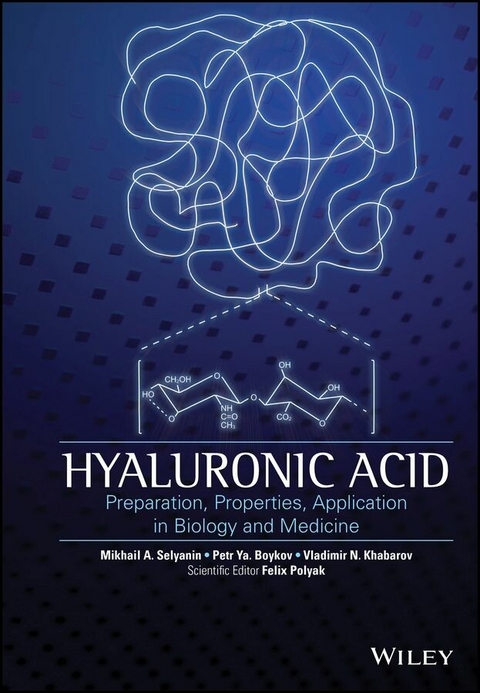
Hyaluronic acid is an essential part of connective, epithelial and neural tissues, and contributes to cell proliferation and migration. It is used as a stimulating agent for collagen synthesis and is a common ingredient in skin-care products, a multi-billion dollar industry, as it is believed to be a key factor in fighting the aging process.
Hyaluronic Acid: Production, Properties, Application in Biology and Medicine consists of six chapters discussing the various issues of hyaluronic acid research. In Chapter 1, a historical analysis recounts the discovery and milestones of the research leading to the practical applications of hyaluronan. Chapter 2 is dedicated to biological role of the hyaluronic acid in nature, in particular in the human body. The chapter starts from the phylogenesis of hyaluronic acid, then describes hyaluronan functions in human ontogenesis and especially the role which hyaluronan plays in extracellular matrix of the different tissues. Chapter 3 describes the methods to manufacture and purify hyaluronic acid, including the analytical means for assessing quality of the finished product. Chapter 4 discusses the structure and rheological properties of hyaluronic acid considering effects on conformation and biological properties related to molecular weight. In Chapter 5, the physical and chemical methods for modifying the structure of hyaluronan are discussed including cross-linking using bi-functional reagents, solid-phase modification and effects of the combined action of high pressures and shift deformation. The final chapter focuses on the products derived from hyaluronic acid, including therapeutics composed of modified hyaluronan conjugated to vitamins, amino acids and oligo-peptides. The biological roles and medical applications of this polysaccharide have been extensively studied and this book provides a wealth of scientific data demonstrating the critical role of hyaluronic acid and its promise as a multifaceted bio-macromolecule.
Approaching hyaluronic acid from multiple angles, this book links relationships between its biological functions, structure and physical–chemical properties. It will be an invaluable resource to researchers, both industrial and academic, involved in all aspects of hyaluronan-based technologies.
Hyaluronic acid is an essential part of connective, epithelial and neural tissues, and contributes to cell proliferation and migration. It is used as a stimulating agent for collagen synthesis and is a common ingredient in skin-care products, a multi-billion dollar industry, as it is believed to be a key factor in fighting the aging process. Hyaluronic Acid: Production, Properties, Application in Biology and Medicine consists of six chapters discussing the various issues of hyaluronic acid research. In Chapter 1, a historical analysis recounts the discovery and milestones of the research leading to the practical applications of hyaluronan. Chapter 2 is dedicated to biological role of the hyaluronic acid in nature, in particular in the human body. The chapter starts from the phylogenesis of hyaluronic acid, then describes hyaluronan functions in human ontogenesis and especially the role which hyaluronan plays in extracellular matrix of the different tissues. Chapter 3 describes the methods to manufacture and purify hyaluronic acid, including the analytical means for assessing quality of the finished product. Chapter 4 discusses the structure and rheological properties of hyaluronic acid considering effects on conformation and biological properties related to molecular weight. In Chapter 5, the physical and chemical methods for modifying the structure of hyaluronan are discussed including cross-linking using bi-functional reagents, solid-phase modification and effects of the combined action of high pressures and shift deformation. The final chapter focuses on the products derived from hyaluronic acid, including therapeutics composed of modified hyaluronan conjugated to vitamins, amino acids and oligo-peptides. The biological roles and medical applications of this polysaccharide have been extensively studied and this book provides a wealth of scientific data demonstrating the critical role of hyaluronic acid and its promise as a multifaceted bio-macromolecule. Approaching hyaluronic acid from multiple angles, this book links relationships between its biological functions, structure and physical chemical properties. It will be an invaluable resource to researchers, both industrial and academic, involved in all aspects of hyaluronan-based technologies.
Dr Vladimir N. Khabarov is Scientific Director at Group Martinex He has comprehensive academic knowlege and expeience in radiochemistry, chemistry of polymers, bioorganic chemistry. Experience in research and development of medicinal products. He has extensive publication experience with 90 scientific papers and 10 patents. Dr Petr Ya. Boikov worked at the I.M.Sechenov Moscow Medicinal Academy as Professor of cell biology, before moving to Group Martinex. He has a PhD in biologcy and works in organic, medicinal and biochemistry, molecular and cell biology, focusing on research of the mechanisms of the biologic and medicinal action of the new chemical products. Dr Mikhail A. Selyanin is a specialist in dermatology and aesthetic medicine and works as part of LLC GC Martinex a major supplier of aesthetic medicine products and equipment in Russia and Eastern Europe. Toskani Laboratory, a subsidiary of Martinex Group produces injection drugs fillers and chemical peels, with their research centre working on new applications of our patented solid-state modification technique of hyaluronic acid. He was vice-president of Institute of microcells at UNESCO, León, 2012 and President of National Society of Mesotherapy in 2008. Dr Felix Polyak is Chief Operating Office at Aluron Biopharma Inc in Montreal Canada. He received his PhD in Organic Chemistry at the Institute of Organic Synthesis, Riga, Latvia, in the early 1970s. He has academic and inductrial experience in organic, medicinal and peptide chemistry. Experience in all chemical aspects of drug development, such as R&D, scale-up and process development, GMP manufacturing and drug product formulation. He is a member of the Chemical Institute of Canada, the European Peptide Society and the American Peptide Society. He has published more than 40 scientific papers and 7 patents.
1
The History of Hyaluronic Acid Discovery, Foundational Research and Initial Use
1.1 Discovery
In 1934, Karl Meyer and John Palmer wrote in the Journal of Biological Chemistry about an unusual polysaccharide with an extremely high molecular weight isolated from the vitreous of bovine eyes [1]. Being the first to mention it, they gave the new substance the name hyaluronic acid (HA, the modern name ‘hyaluronan’) derived from ‘hyaloid’ (glassy glass-like in appearance) and ‘uronic acid’. While Meyer and Palmer are generally considered to have discovered hyaluronic acid, it is fair to mention that as far back as 1918 Levene and Lopez-Suarez had isolated a new polysaccharide from the vitreous body and cord blood that they called ‘mucoitin-sulfuric acid’ [2]. It consisted of glucosamine, glucuronic acid and a small amount of sulfate ions. It is now clear this substance was actually hyaluronic acid extracted together with a mixture of sulfated glycosaminoglycans.
At the time of the discovery of hyaluronan, the polysaccharides, which represent the major part of the organic material on our planet, were already quite well known. A number of so-called mucopolysaccharides, currently known as glycosaminoglycans, had already been discovered. Hyaluronic acid is known to belong to this class as well. Mucopolysaccharides were isolated from mucus, to which they give viscous lubricating properties. These properties, in turn, are related to glycosaminoglycan’s ability to bind to a significant amount of water.
1.2 Foundational Research
Soon after the original work was published, unique properties of the new biopolymer were discovered, which proved it different from other similar glycosaminoglycans, According to Meyer and Palmer, the isolated polysaccharide contained uronic acids and amino sugars, as well as pentose, and was not sulfated [1]. They also decided that the molecular mass of the repeatable unit is approximately 450 Da. It was later proved that HA in fact does not contain sulfate groups or pentose. It was also established that the molecular mass of the repeatable disaccharide residue is 397 Da.
Over the next 10 years, Meyer and other authors isolated hyaluronan from various animal organs. For example, the polysaccharide was found in joint fluid, the umbilical cord and recently it has become possible to extract HA from almost all vertebrate tissues. In 1937, F. Kendall isolated hyaluronan from the capsules of streptococci groups A and C. This work had great scientific and practical importance, as today streptococci groups are the most economical and reliable source for the industrial production of hyaluronic acid [3].
In 1928, F. Duran-Reynals found a certain biologically active compound in rabbit testicles that lead to an extremely important discovery in the chemistry and biology of hyaluronic acid. When the compound was injected with black indian ink subcutaneously, the authors observed extremely fast distribution of the black colour through connective tissue [4]. Similar properties were found for the extracts from semen, leeches, bee sting and snake venom. Further studies confirmed that the observed increasing permeability of connective tissue was mainly caused by the depolymerization of its basic substance, hyaluronic acid. It was thus determined the extract contains a specific enzyme that was given the name ‘hyaluronidase’. The biological material that contains hyaluronidase was recently called the Duran-Reynals spreading factor.
The discovery of enzymes that could selectively break down hyaluronan opened the door for the establishment of the polysaccharide molecule’s chemical structure. In those days, a powerful tool for analysing the structure of polysaccharides such as nuclear magnetic resonance spectroscopy NMR was not known. At the present time, NMR makes it possible to determine the monosaccharide biopolymer residue’s composition, centres for substitution reactions, sequence and three-dimensional structure.
In 1943 E.A. Balazs and L. Piller published a paper in which they described a study of role of hyaluronan in dog knee joints. They found that the intercellular substance of connective tissue of the synovium contains sufficient viscous mucin that can replace the mucin removed from the knee [5]. These observations literally opened the door to further studies on the role of hyaluronan in normal and traumatic joints. In 1949, C. Ragan and K. Mayer published a very important paper in which they described the observation of hyaluronan in rheumatoid synovial fluid. This was the first study in which normal and pathological synovial fluids were compared by determination of the concentration and viscosity of hyaluronan [6].
In the short period between 1948 and 1951, several chemists initiated research to elucidate the structure of hyaluronic acid. In 1948 A. Dorfman published the first results of a kinetics of fermentative hydrolysis of hyaluronan [7]. Three years later in 1951, A.G. Ogston and J.E. Stanier published the first significant data about the structure of the HA macromolecule in aqueous solution. They found that the relationship between viscosity and velocity gradients increased with higher concentrations of the polysaccharide. [8]. It was found that this phenomenon is due to the interlacement of the neighbouring molecules, not individual macromolecule asymmetry. In 1955 an irregular helical configuration of hyaluronan was confirmed by measuring light scattering [9].
Several major research directions on hyaluronic acid were identified in the first half of the twentieth century. Lately, they have developed into independent branches within different fields of science including polymer chemistry, radiochemistry, biochemistry, molecular biology, medicine and glycobiology. The latter term was accepted in 1988 to describe a branch of science that combines a traditional biochemistry of hydrocarbons with a modern understanding of the role of complex sugars in cell and molecular biology.
Causing particular curiosity and scientific wonderment for researchers was the different observed viscosities of the hyaluronan solutions in presence of the different inorganic salts. The largest viscosity was observed for the solution in distilled water. It was proposed that the viscosity could be related to pH values and solution ionic strength. This phenomenon has become common knowledge but was initially described by R. Fuoss only for solutions of the synthetic polyelectrolytes [10].
Fundamental research on the physico-chemical properties of HA is considered to have begun in 1951 with the publication of E.A. Balazs’s article [11]. One of the first attempts to sterilize HA by UV light led to a complete loss of the solution viscosity. A similar result was obtained by A. Caputo in 1957 by X-ray exposure of the hyaluronan solution [12]. Later, it was found that when exposed to gamma radiation or electron beams, even at low initial levels of absorbed dose of ionizing radiation, HA degrades completely. The processes of polysaccharide radiolysis, which are associated with polymer degradation and involve free radicals, are now intensively studied in the radiochemistry of biomolecules.
Unlike sulfated polysaccharides, some of the initial proof of HA’s ability to interact with living cells came with the observation that hyaluronan accelerates cell growth. It has also been observed that hyaluronan initiates some cell aggregation. This was the first indication of a unique binding of the polysaccharide to the cell surface. Currently, several receptor proteins that bind to the surface of the HA cytoplasmic membrane have been isolated, including high-affinity receptor CD44 and receptor RHAMM (receptor for hyaluronan-mediated motility).
The receptor for HA endocytosis had been found on the membrane of endothelial cells of the liver sinuses and fundamentally differs from other hyaluronan-binding proteins (see [13] and references therein).
These early studies accomplished much in a short period of time, notably the establishment of the structure and monomeric composition of the macromolecule. In 1954, Meyer published an article in Nature that presented the result of a study on the decomposition products of HA [14]. The article included the structural formula of the disaccharide, which is the product of HA cleavage by streptococcus hyaluronidase (Figure 1.1).
Figure 1.1 Structure of 4,5-unsaturated disaccharide, obtained by HA cleavage by bacterial hyaluronidase
1.3 Initial Medical Applications
During the second half of the twentieth century, HA was discovered in different tissues and liquids of vertebrae animals as well as humans. It was also found to have clinical applications, mostly for eye surgery, treatment of joint diseases and aesthetic medicine. The first actual use of HA in medicinal practise didn’t actually occur until 1943 during the Second World War. N.F. Gamaleya (Н.Ф. Гамалея) created complex bandages in order to treat the frostbitten soldiers in the military field hospital no. 1321. The main component of the bandage was an extract from the umbilical cord, which he called a ‘factor of regeneration’. The method was later approved by the USSR Ministry of Health and the drug received the name ‘Regenerator’. It is apparent that HA was a major...
| Erscheint lt. Verlag | 22.12.2014 |
|---|---|
| Übersetzer | Felix Polyak |
| Sprache | englisch |
| Themenwelt | Studium ► 1. Studienabschnitt (Vorklinik) ► Biochemie / Molekularbiologie |
| Naturwissenschaften ► Biologie ► Biochemie | |
| Naturwissenschaften ► Chemie ► Organische Chemie | |
| Technik | |
| Schlagworte | Anti-Oxidant • Aromastoffe, Riechstoffe, Kosmetika • Bioengineering • biomaterials • biomedical engineering • Biopharmaceuticals & Pharmaceutical Biotechnology • Biopharmazeutika u. Pharmazeutische Biotechnologie • Biopharmazie • Biotechnology • cellular proliferation • Chemie • Chemistry • Dermatologie • Dermatology • Embryogenesis • Fertilization • Flavor, Perfume & Cosmetic Science • gene switching • hyaluronic acid • Hyaluronsäure • Hyaluronsäure • immune responds • Medical Science • Medizin • mesotherapy • natural polysaccharide • Oncology • Tissue engineering |
| ISBN-10 | 1-118-69595-X / 111869595X |
| ISBN-13 | 978-1-118-69595-1 / 9781118695951 |
| Informationen gemäß Produktsicherheitsverordnung (GPSR) | |
| Haben Sie eine Frage zum Produkt? |
 EPUB (Adobe DRM)
Kopierschutz: Adobe-DRM
Adobe-DRM ist ein Kopierschutz, der das eBook vor Mißbrauch schützen soll. Dabei wird das eBook bereits beim Download auf Ihre persönliche Adobe-ID autorisiert. Lesen können Sie das eBook dann nur auf den Geräten, welche ebenfalls auf Ihre Adobe-ID registriert sind.
Details zum Adobe-DRM
Dateiformat: EPUB (Electronic Publication)
EPUB ist ein offener Standard für eBooks und eignet sich besonders zur Darstellung von Belletristik und Sachbüchern. Der Fließtext wird dynamisch an die Display- und Schriftgröße angepasst. Auch für mobile Lesegeräte ist EPUB daher gut geeignet.
Systemvoraussetzungen:
PC/Mac: Mit einem PC oder Mac können Sie dieses eBook lesen. Sie benötigen eine
eReader: Dieses eBook kann mit (fast) allen eBook-Readern gelesen werden. Mit dem amazon-Kindle ist es aber nicht kompatibel.
Smartphone/Tablet: Egal ob Apple oder Android, dieses eBook können Sie lesen. Sie benötigen eine
Geräteliste und zusätzliche Hinweise
Buying eBooks from abroad
For tax law reasons we can sell eBooks just within Germany and Switzerland. Regrettably we cannot fulfill eBook-orders from other countries.
aus dem Bereich