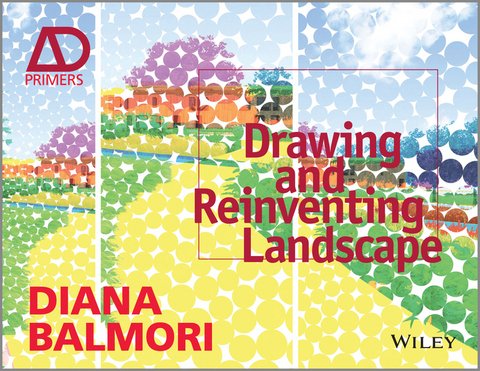
Drawing and Reinventing Landscape (eBook)
John Wiley & Sons (Verlag)
978-1-118-54119-7 (ISBN)
Representation is a hot topic in landscape architecture. While computerization has been a catalyst for change across many fields in design, no other design field has experienced such drastic reinvention as has landscape architecture. As the world urbanizes rapidly and our relationship with nature changes, it is vitally important that landscape designers adopt innovative forms of representation—whether digital, analog, or hybrid.
In this book, author Diana Balmori explores notions of representation in the discipline at large and across time. She takes readers from landscape design's roots in seventeenth-century France and eighteenth-century England through to modern attempts at representation made by contemporary landscape artists.
- Addresses a central topic in the discipline of landscape architecture
- Features historic works and those by leading contemporary practitioners, such as Bernard Lassus, Richard Haag, Stig L Andersson, Lawrence Halprin, and Patricia Johanson
- Written by a renowned practitioner and educator
- Features 150 full-color images
Drawing and Reinventing Landscape, AD Primer is an informative investigation of beauty in landscape design, offering inspiring creative perspectives for students and professionals.
Diana Balmori, FASLA is the founding principal of Balmori Associates Landscape and Urban Design, a New York based experimental design office that explores the line between landscape and architecture and between nature and culture. Her practice seeks also to re-enter landscape into the family of the arts with new formal aims. She teaches at Yale School of Architecture.
How to tackle representation in landscape design Representation is a hot topic in landscape architecture. While computerization has been a catalyst for change across many fields in design, no other design field has experienced such drastic reinvention as has landscape architecture. As the world urbanizes rapidly and our relationship with nature changes, it is vitally important that landscape designers adopt innovative forms of representation whether digital, analog, or hybrid. In this book, author Diana Balmori explores notions of representation in the discipline at large and across time. She takes readers from landscape design's roots in seventeenth-century France and eighteenth-century England through to modern attempts at representation made by contemporary landscape artists. Addresses a central topic in the discipline of landscape architecture Features historic works and those by leading contemporary practitioners, such as Bernard Lassus, Richard Haag, Stig L Andersson, Lawrence Halprin, and Patricia Johanson Written by a renowned practitioner and educator Features 150 full-color images Drawing and Reinventing Landscape, AD Primer is an informative investigation of beauty in landscape design, offering inspiring creative perspectives for students and professionals.
Diana Balmori, FASLA is the founding principal of Balmori Associates Landscape and Urban Design, a New York based experimental design office that explores the line between landscape and architecture and between nature and culture. Her practice seeks also to re-enter landscape into the family of the arts with new formal aims. She teaches at Yale School of Architecture.
Epigraph 005
Acknowledgements 007
Foreword by Michel Conan 010
Introduction 014
Chapter 1: The Contemporary Reinvention of Landscape Architecture and its Representation 019
Chapter 2: The Pleasure of Drawing 032
Chapter 3: Notebooks, Early Sketches and Late Drawings 041
Chapter 4: Contemporary Landscape Architects and Landscape Artists 076
Landscape Urbanism 078
Bernard Lassus 087
Patricia Johanson 094
Richard Haag (Rich Haag Associates) 100
Stig L Andersson (SLA) 103
Diana Balmori 009 Contents Diana Balmori (Balmori Associates) 114
Lawrence Halprin (Lawrence Halprin and Associates) 107Summary 140
Chapter 5: Historical Issues in Landscape Architecture Representation 146
Drawing and Painting 147
Representation of Representation 152
Representation of Space 159
Integrated Drawings 168
Representation of Time 173
Chapter 6: Contemporary Issues Deriving from Change 181
Computing and Hybridising 181
From a Fixed to a Changing Arcadia 183
Project Team Credits 189
Bibliography 192
Index 194
Picture Credits 199
Introduction
There could be a no more apt introduction to the subject of this book – the representation of landscape – than the thoughts and reflections of contemporary landscape practitioners and artists. Designers in my office selected the quotations. Each chose their quote based on their sense that it accurately described the present state of the discipline. The core theme of these quotations – the upheaval and complete break with the past in terms of representation – is the essence of this book. An immediate sense of the maelstrom in the discipline can be gained by this series of snapshots.
The French gardener, garden designer, botanist and entomologist Gilles Clément, has emphasised the flux in the landscape as its essential quality. He argues this is not possible to capture in a design drawing. Creator of the Moving Garden, a garden transformed by seasonal variations, self-sowing plants and unexpected events, he describes how ‘The design of the garden, constantly changing, depends on who maintains it and is not the result of a plan drawn on a computer or a drawing board.’1 (Javier González-Campaña)
Martin Rein-Cano, the landscape architect founder and principal of the Berlin-based firm TOPOTEK 1, stresses the discipline’s artistic character: ‘The tradition of landscape architecture is actually an art tradition, the garden is an interactive piece of art. Landscape architecture is a very traditional and conservative profession, and without art it would become plants and horticulture.’2 (Noémie Lafaurie-Debany)
A revival of the making of a landscape is now taking place. English sculptor Andy Goldsworthy’s work is based on landscape sites and materials, building everything directly on-site without plans. Yet drawing plays a very specific role in his work. In an interview Goldsworthy explains: ‘There is a process of familiarization with [the] site through drawings that explore the location and the space. This is the only time I use drawing to work through ideas.’3 (Mariko Tanaka)
Diana Balmori, sketch for the High Line Park Competition, New York City, New York, USA, 2004. Oil crayon on paper.
Studies for paths for the linear park using color to differentiate various ways of moving through space.
Drawing as a way of capturing and developing ideas is explained by the late American landscape architect Lawrence Halprin: ‘People “think” in different ways, and I find that I am most effective graphically and also that my thinking is influenced a great deal by my ability to get it down where I can look at it and think about it further.’4 (Isabelle Desfoux)
Shunmyo Masuno, Zen priest and head priest of Kenko-ji Temple, president of Japan Landscape Consultants Ltd and garden designer, sees the act of creating a garden as the most critical moment of his ascetic practice. For him, the idea and the actual building comes through the mind and hands of its creator, not through drawings: ‘A famous Zen saying is “when venomous snake drinks water, it becomes poison. When cow drinks water it becomes milk”. This suggests that whether the garden becomes poison or milk is dependent on the creator.’5 (Jingjin Zhong)
Noël van Dooren is a Dutch landscape architect based in Utrecht, the Netherlands, and also past chairman of the Landscape Architecture department at the Academy of Architecture in Amsterdam (2004–2009). He is interested above all in the representation of time: ‘For me the starting point for research into innovative forms of representation for landscape is to take the issue of time into consideration. Film, dance, music, theatre, therefore have in common with landscape that they unfold in time. Think of the storyboard and the choreography of a dance. These disciplines work with notation forms in which the story unfolds over time and is recorded in a recognisable form for others. I am fascinated by the work of American landscape architect Lawrence Halprin, inspired by his wife, Anna, [a] choreographer. He investigated the possibility of the choreographer’s score as a representation technique in landscape architecture. I see an interesting new way being created here.’6 (Linda Joosten)
Anuradha Mathur and Dilip da Cunha, who both teach at the University of Pennsylvania, have focused their work on urban areas around rivers and coasts. As they write in their book SOAK: ‘Our drawings often straddle the worlds of art and information communication; and they are indeed both. For us they are works of art and they are narratives, visual essays about the places we’ve researched. And though they are not always done with the intention of implementing the project, they do often construct the ground for projects.’7 (Reva Meeks)
Bernard Lassus is a French kinetic artist who turned to landscape in the 1960s and in 2009 he was awarded the International Federation of Landscape Architects Sir Geoffrey Jellicoe Gold Medal. He rejects representation altogether: ‘I had an exhibition in a space at the Coracle Gallery in London a few years ago. I hung strips of yellow paper from the ceiling of the gallery, suspended a plumb line next to a wall and put a level on the floor. I did this in order to destroy the notion that rooms are exact geometric forms. You see, people believe in geometric forms. And this is the big mistake in many present garden designs. They see a whole series of geometric drawings with angles, straight lines and so on, but in fact these don’t actually mean anything. They’re just drawings. I wanted my work … to show that no room is completely vertical or horizontal. I enjoy such projects as they ask important questions. It’s a matter of destroying misconceptions and examining what seems to be reality.’8 (Theodore Hoerr)
Petra Blaisse founded the landscape, textiles and interiors office Inside Outside in Amsterdam in 1991. Her comments on Yves Brunier, the late French landscape architect who died the same year Inside Outside was founded, emphasise Brunier’s ability to bring out sensations in his representations and how he tried to be predictive in what he showed: ‘His plans described the future, they were predictions. They were not necessarily correct in substance, but in sensation, colour, light, feeling, atmosphere … More than architecture, landscape architecture is a prediction. Whereas architecture describes a stable state, landscape architecture triggers literally endless scenarios of life and earth, rebirth, transformation, mutation. That’s why buildings cannot live without it.’9 (Noémie Lafaurie-Debany)
Frederick Law Olmsted, the American 19th-century landscape architect, creator of Central Park in New York City, wrote in 1882: ‘What artist so noble as he, who, with far-reaching conception of beauty and designing-power, sketches the outlines, writes the colors, and directs the shadows, of a picture so great that Nature shall be employed upon it for generations, before the work he has arranged for her shall realize his intentions!’10 (Mark Thomann)
This last statement, brought in as contrast, shows the changes from his time to ours. Olmsted expected nature to achieve over generations the landscape represented in the design. No contemporary practitioner would believe that today.
My own view is presented in different guises throughout the book. But as a point of departure for the text and a coda for my co-workers’ collected statements, I will state that the changes in our knowledge of nature and in the ramifications of that knowledge in our culture have modified the discipline completely. The what and the how to be represented in landscape have changed so dramatically that I can say with conviction that a different discipline altogether is under discussion.
References
1 See Gilles Clément’s website, <http://www.gillesclement.com/cat-mouvement-tit-Le-Jardin-en-Mouvement>.
2 In an interview with Martin Rein-Cano and Lorenz Dexler by Vernissage TV, 8 October 2010: <http://vernissage.tv/blog/2010/11/11/topotek-1-studio-visit-the-art-of-landscape-architecture/>.
3 In an interview with John Fowles, reprinted from ‘Winter Harvest’ in Hand to Earth, Andy Goldsworthy Sculpture, 1976–1990, Abrams (New York), 1993, p 162.
4 Lawrence Halprin, Notebooks 1959–1971, MIT Press (Cambridge, MA), 1972.
5 Shunmyo Masuno’s website, <http://www.kenkohji.jp/s/english/philosophy_e.html>.
6 Translation of an interview with Noël van Dooren on the Academy of Architecture Amsterdam website, published on 16 December 2011: <http://www.ahk.nl/bouwkunst/actueel/nieuws/nieuwsarchief/bericht/voormalig-hoofd-landschapsarchitectuur-noel-van-dooren-promoveert-aan-de-universiteit-van-amsterdam/>.
7 In Preparing Ground: An Interview with Anuradha Mathur and Dilip da Cunha, conducted by Nicholas Pevzner...
| Erscheint lt. Verlag | 5.12.2014 |
|---|---|
| Reihe/Serie | Architectural Design Primer |
| Architectural Design Primer | Architectural Design Primer |
| Sprache | englisch |
| Themenwelt | Technik ► Architektur |
| Schlagworte | Architecture • Architektur • Design, Drawing & Presentation • Diana Balmori • Diana Balmori book • drawing and reinventing landscape • Entwurf, Zeichnung u. Präsentation • Entwurf, Zeichnung u. Präsentation • history of landscape architecture • history of landscape design • illustrated guide to landscape architecture • illustrated guide to landscape design • landscape architecture book • landscape architecture history • landscape architecture representation • Landscape Design • landscape design book • landscape design history • landscape design representation • landscape representation • Landschaftsarchitektur • representation in landscape architecture • representation in landscape design |
| ISBN-10 | 1-118-54119-7 / 1118541197 |
| ISBN-13 | 978-1-118-54119-7 / 9781118541197 |
| Informationen gemäß Produktsicherheitsverordnung (GPSR) | |
| Haben Sie eine Frage zum Produkt? |
 EPUB (Adobe DRM)
Kopierschutz: Adobe-DRM
Adobe-DRM ist ein Kopierschutz, der das eBook vor Mißbrauch schützen soll. Dabei wird das eBook bereits beim Download auf Ihre persönliche Adobe-ID autorisiert. Lesen können Sie das eBook dann nur auf den Geräten, welche ebenfalls auf Ihre Adobe-ID registriert sind.
Details zum Adobe-DRM
Dateiformat: EPUB (Electronic Publication)
EPUB ist ein offener Standard für eBooks und eignet sich besonders zur Darstellung von Belletristik und Sachbüchern. Der Fließtext wird dynamisch an die Display- und Schriftgröße angepasst. Auch für mobile Lesegeräte ist EPUB daher gut geeignet.
Systemvoraussetzungen:
PC/Mac: Mit einem PC oder Mac können Sie dieses eBook lesen. Sie benötigen eine
eReader: Dieses eBook kann mit (fast) allen eBook-Readern gelesen werden. Mit dem amazon-Kindle ist es aber nicht kompatibel.
Smartphone/Tablet: Egal ob Apple oder Android, dieses eBook können Sie lesen. Sie benötigen eine
Geräteliste und zusätzliche Hinweise
Buying eBooks from abroad
For tax law reasons we can sell eBooks just within Germany and Switzerland. Regrettably we cannot fulfill eBook-orders from other countries.
aus dem Bereich