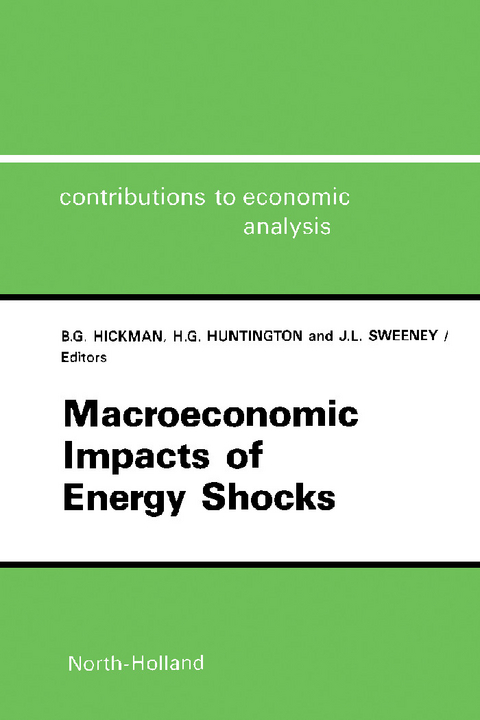
Macroeconomic Impacts of Energy Shocks (eBook)
347 Seiten
Elsevier Science (Verlag)
978-1-4832-9545-9 (ISBN)
Large-scale macroeconomic models have been used extensively to analyze a wide range of important economic issues. They were originally developed to study the economy's response to monetary and fiscal policies. During the 1970s these models were expanded and revised to track the inflationary processes and to incorporate key energy variables so that they could be used to examine the impacts of energy price shocks.This study compares the responses of 14 prominent macroeconomic models to supply-side shocks in the form of sudden energy price increases or decreases and to policies for lessening the impacts of price jumps. Four energy price shocks were examined: oil price increases of 50 and 20 percent, an oil price reduction of 20 percent, and an 80 percent increase in domestic natural gas prices. Five policy responses were considered for offsetting the GNP impacts of the larger oil price increase: monetary accommodation, an income tax rate reduction, an increase in the investment tax credit for equipment, a reduction in the employer's payroll tax rate, and an oil stockpile release.The study was conducted by a working group comprised of about 40 modelers and potential model users from universities, business, and government. As in previous EMF studies, the group pursued two broad goals. Firstly, they sought to understand the models themselves by identifying important similarities as well as structural differences. Secondly, they sought to use the models to sharpen their understanding of energy shocks and of the related policy issues. Their conclusions appear as the first chapter in this volume, the remaining chapters providing more technical treatment of the key structural differences among the participating models as well as their use for evaluating energy policies.This volume is addressed particularly to those interested in the energy shock issue, as well as to those with a broader interest in macroeconomic models and policies.
Front Cover 1
Macroeconomics Impacts of Energy Shocks 4
Copyright Page 5
Table of Contents 12
Introduction to the series 6
Editors' Preface 8
Senior Advisory Panel 18
Working Group Participants 19
Chapter 1. Macroeconomic Impacts of Energy Shocks: A Summary of the Key Results 20
1 Overview 20
2 Study Design 28
3 Impacts of an Oil Shock 36
4 Alternative Energy Shocks 61
5 Macroeconomic Policies for Reducing the Impacts of an Energy Shock 71
6 Energy Policy Issues 91
7 Model Structures 98
8 Conclusion 130
Appendix 1A: Energy Shock and Policy Scenarios 131
Appendix 1B: Special Calculations 136
Chapter 2. Macroeconomic Impacts of Energy Shocks and Policy Responses: A Structural Comparison of Fourteen Models 144
1 Introduction 144
2 The IS-LM Model of Aggregate Demand 146
3 A Model of Aggregate Demand and Supply 151
4 Theoretical Analysis of Macroeconomic Responses to Energy Shocks 157
5 Identifying the Structural Attributes of the Models 161
6 A Comparative Analysis of EMF 7 Model Responses to an Energy Shock in the Short Run 182
7 Long Run and Dynamic Responses to Energy Shocks in the EMF 7 Models 188
8 Summary and Conclusions 199
References 208
Appendix 2A: Features of Participating Models 209
Appendix 2B: Specifications of Scenarios: Change Prom Control Solution 210
Appendix 2C: Value-Added versus Final Goods Prices 211
Appendix 2D: Response of Potential GNP to an Energy Shock 212
Appendix 2E: Percentage Change in Price Level per One Percent Increase in Oil Price, Second Year: Reported and Estimated From Model Characteristics 217
Chapter 3. Macroeconomic Models and Energy Policy Issues 218
1 Introduction 218
2 Measurement of Economic Impacts 220
3 The National Income Accounting Framework 228
4 External and Internal Energy Shocks 234
5 The Strategic Petroleum Reserve 237
6 Alternative Energy Policies 245
7 Summary 248
References 249
Appendix: 3A Results of the Simulated Oil Stock-pile Release Scenario 251
Chapter 4. EMF 7 Study Design 256
1 Introduction 256
2 Issues 257
3 Control Case, 1982-1986 259
4 Alternative Scenarios 267
5 Output Variables 276
Appendix 4A: Additional Information on Energy Market Assumptions 279
Appendix 4B: Notes on Representing the Oil Stockpile Release in Scenario #10 281
Appendix: A Comparison of Macroeconomic Model Structures 288
1 Introduction 288
2 Energy Sector Comparisons 289
3 Macroeconomic Structure: Production, Inputs, and Capacity Utilization 292
4 Macroeconomic Structure: Demand-Side Comparison 308
| Erscheint lt. Verlag | 19.10.2016 |
|---|---|
| Sprache | englisch |
| Themenwelt | Naturwissenschaften ► Biologie ► Ökologie / Naturschutz |
| Naturwissenschaften ► Geowissenschaften | |
| Technik ► Umwelttechnik / Biotechnologie | |
| Wirtschaft ► Volkswirtschaftslehre ► Makroökonomie | |
| ISBN-10 | 1-4832-9545-1 / 1483295451 |
| ISBN-13 | 978-1-4832-9545-9 / 9781483295459 |
| Informationen gemäß Produktsicherheitsverordnung (GPSR) | |
| Haben Sie eine Frage zum Produkt? |
 PDF (Adobe DRM)
Kopierschutz: Adobe-DRM
Adobe-DRM ist ein Kopierschutz, der das eBook vor Mißbrauch schützen soll. Dabei wird das eBook bereits beim Download auf Ihre persönliche Adobe-ID autorisiert. Lesen können Sie das eBook dann nur auf den Geräten, welche ebenfalls auf Ihre Adobe-ID registriert sind.
Details zum Adobe-DRM
Dateiformat: PDF (Portable Document Format)
Mit einem festen Seitenlayout eignet sich die PDF besonders für Fachbücher mit Spalten, Tabellen und Abbildungen. Eine PDF kann auf fast allen Geräten angezeigt werden, ist aber für kleine Displays (Smartphone, eReader) nur eingeschränkt geeignet.
Systemvoraussetzungen:
PC/Mac: Mit einem PC oder Mac können Sie dieses eBook lesen. Sie benötigen eine
eReader: Dieses eBook kann mit (fast) allen eBook-Readern gelesen werden. Mit dem amazon-Kindle ist es aber nicht kompatibel.
Smartphone/Tablet: Egal ob Apple oder Android, dieses eBook können Sie lesen. Sie benötigen eine
Geräteliste und zusätzliche Hinweise
Buying eBooks from abroad
For tax law reasons we can sell eBooks just within Germany and Switzerland. Regrettably we cannot fulfill eBook-orders from other countries.
aus dem Bereich