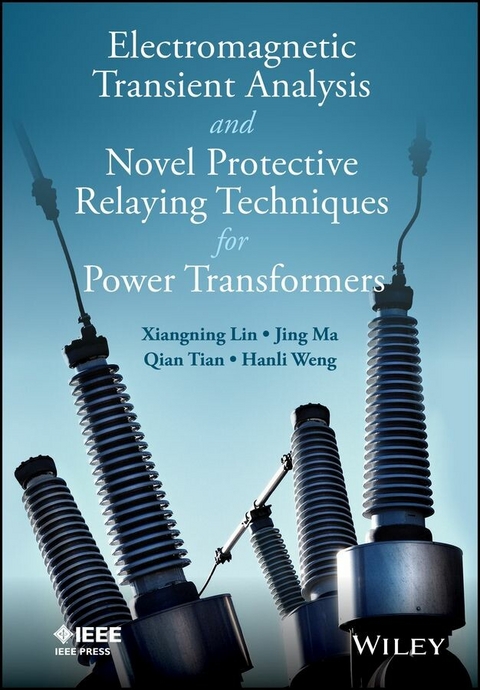
Electromagnetic Transient Analysis and Novel Protective Relaying Techniques for Power Transformers (eBook)
John Wiley & Sons (Verlag)
978-1-118-65385-2 (ISBN)
This book addresses the technical challenges of transformer malfunction analysis as well as protection. One of the current research directions is the malfunction mechanism analysis due to nonlinearity of transformer core and comprehensive countermeasures on improving the performance of transformer differential protection. Here, the authors summarize their research outcomes and present a set of recent research advances in the electromagnetic transient analysis, the application on power transformer protections, and present a more systematic investigation and review in this field. This research area is still progressing, especially with the fast development of Smart Grid. This book is an important addition to the literature and will enhance significant advancement in research. It is a good reference book for researchers in power transformer protection research and a good text book for graduate and undergraduate students in electrical engineering.
Chapter headings include: Transformer differential protection principle and existing problem analysis; Malfunction mechanism analysis due to nonlinearity of transformer core; Novel analysis tools on operating characteristics of Transformer differential protection; Novel magnetizing inrush identification schemes; Comprehensive countermeasures on improving the performance of transformer differential protection
- An advanced level examination of the latest developments in power transformer protection
- Presents a new and systematic view of power transformer protection, enabling readers to design new models and consider fresher design approaches
- Offers a set of approaches to optimize the power system from a microeconomic point of view
Xiangning Lin, Professor, College of Electrical and Electronic Engineering, Huazhong University of Science and Technology, China.
Prof. Lin was the first to discover the ultra-saturation phenomenon of power transformer and he designed operating characteristics analysis planes to make clear the advantages and disadvantages of existing differential protection of power transformer. He invented a variety of novel protection algorithms for the main protection of the power transformer. A series of papers were published in journals including IEEE Transactions on Power Systems and IEEE Transactions on Power Delivery. The work has been widely acknowledged and cited by international peers. He also pioneers the introduction of modern signal processing techniques to design the protection criteria for power transformer. He was the winner of the 2nd Class National Natural Science Award in 2009. He has published nearly 200 papers and books (in Chinese), he also owns over 15 patents.
Jing Ma, Associate Professor, School of Electrical and Electronic Engineering, North China Electric Power University, Beijing, China.
Prof. Ma was the first to apply the two-terminal network algorithm to the areas of power system protection. The work has been widely acknowledged and cited by international peers. He also proposed an approach based on grille fractal to solve the TA saturation problem, and the related paper has been published in the IEEE Transactions on Power Delivery. The research results were used in many practical engineering projects.
Dr. Qing Tian, Senior Engineer with the Maintenance and Test Center of EHV Transmission Co. Ltd, Southern Power Grid, Guangzhou, China.
Dr. Hanli Weng, Senior Engineer with Three-Gorge Hydropower Plant, China Yangtze Power Co., Ltd.
Both have been working in this area since 1995. Their main research fields include power system operation analysis and control, voltage and reactive power optimization, power system reliability and risk assessment and power system energy saving assessment and planning.
An advanced level examination of the latest developments in power transformer protection This book addresses the technical challenges of transformer malfunction analysis as well as protection. One of the current research directions is the malfunction mechanism analysis due to nonlinearity of transformer core and comprehensive countermeasures on improving the performance of transformer differential protection. Here, the authors summarize their research outcomes and present a set of recent research advances in the electromagnetic transient analysis, the application on power transformer protections, and present a more systematic investigation and review in this field. This research area is still progressing, especially with the fast development of Smart Grid. This book is an important addition to the literature and will enhance significant advancement in research. It is a good reference book for researchers in power transformer protection research and a good text book for graduate and undergraduate students in electrical engineering. Chapter headings include: Transformer differential protection principle and existing problem analysis; Malfunction mechanism analysis due to nonlinearity of transformer core; Novel analysis tools on operating characteristics of Transformer differential protection; Novel magnetizing inrush identification schemes; Comprehensive countermeasures on improving the performance of transformer differential protection An advanced level examination of the latest developments in power transformer protection Presents a new and systematic view of power transformer protection, enabling readers to design new models and consider fresher design approaches Offers a set of approaches to optimize the power system from a microeconomic point of view
Xiangning Lin, Professor, College of Electrical and Electronic Engineering, Huazhong University of Science and Technology, China. Prof. Lin was the first to discover the ultra-saturation phenomenon of power transformer and he designed operating characteristics analysis planes to make clear the advantages and disadvantages of existing differential protection of power transformer. He invented a variety of novel protection algorithms for the main protection of the power transformer. A series of papers were published in journals including IEEE Transactions on Power Systems and IEEE Transactions on Power Delivery. The work has been widely acknowledged and cited by international peers. He also pioneers the introduction of modern signal processing techniques to design the protection criteria for power transformer. He was the winner of the 2nd Class National Natural Science Award in 2009. He has published nearly 200 papers and books (in Chinese), he also owns over 15 patents. Jing Ma, Associate Professor, School of Electrical and Electronic Engineering, North China Electric Power University, Beijing, China. Prof. Ma was the first to apply the two-terminal network algorithm to the areas of power system protection. The work has been widely acknowledged and cited by international peers. He also proposed an approach based on grille fractal to solve the TA saturation problem, and the related paper has been published in the IEEE Transactions on Power Delivery. The research results were used in many practical engineering projects. Dr. Qing Tian, Senior Engineer with the Maintenance and Test Center of EHV Transmission Co. Ltd, Southern Power Grid, Guangzhou, China. Dr. Hanli Weng, Senior Engineer with Three-Gorge Hydropower Plant, China Yangtze Power Co., Ltd. Both have been working in this area since 1995. Their main research fields include power system operation analysis and control, voltage and reactive power optimization, power system reliability and risk assessment and power system energy saving assessment and planning.
1 Introduction: Transformer differential protection principle and existing problem analysis
1.1 Introduction
1.2 Fundamentals of transformer differential protection
1.3 Some problems about power transformer main protection
1.4 Analysis of Electromagnetic Transient and Adaptability of Second Harmonic Restraint Based Differential Protection of UHV Power Transformer
1.5 Study on comparisons among some waveform symmetry principle based transformer differential protection
1.6 Summary
2 Malfunction mechanism analysis due to nonlinearity of transformer core
2.1 Introduction
2.2 The ultra-saturation phenomenon of loaded transformer energization and its impacts on differential protection
2.3 Studies on the unusual maloperation of transformer differential protection during the nonlinear load switch-in
2.4 Analysis of a sort of unusual mal-operation of transformer differential protection due to removal of external fault
2.5 Analysis and countermeasure of abnormal operation behaviors of the differential protection of converter transformer
2.6 Summary
3 Novel analysis tools on operating characteristics of Transformer differential protection
3.1 Introduction
3.2 Studies on the operation behavior of differential protection during a loaded transformer energization
3.3 The Comparative investigation on current differential criteria between the one using phase current and the one using phase-phase current difference for the transformer using Y-delta connection
3.4 Comparative analysis on current percentage differential protections using a novel reliability evaluation criterion
3.5 Comparative studies on percentage differential criteria using phase current and superimposed phase current
3.6 A novel analysis methodology of differential protection operation behaviour
3.7 Summary
4 Novel magnetizing inrush identification schemes
4.1 Introduction
4.2 Studies for identification of the inrush based on improved correlation algorithm
4.3 A novel method for discrimination of internal faults and inrush currents by using waveform singularity factor
4.4 A new principle of discrimination between inrush current and internal fault current of transformer based on
self-correlation function
4.5 Identifying inrush current using sinusoidal proximity factor
4.6 A wavelet transform based sheme for power transformer inrush identification
4.7 A novel adaptive scheme of discrimination between internal faults and inrush currents of transformer using mathematical Morphology
4.8 Identifying transformer inrush current based on normalized grille curve
4.9 A novel algorithm for discrimination between inrush currents and internal faults based on equivalent instantaneous leakage inductance
4.10 A two terminal network-based method for discrimination between internal faults and inrush currents
4.11 Summary
5 Comprehensive countermeasures on improving the performance of transformer differential protection
5.1 Introduction
5.2 A method to eliminate the magnetizing inrush current of energized transformers
5.3 Identification of cross-country fault of power transformer for fast unblocking of differential protection
5.4 Adaptive scheme in the transformer main protection
5.5 A Series Multi-resolution Morphological Gradient based Criterion to Identify CT Saturation
5.6 A new adaptive method to identify CT saturation using grille fractal
5.7 Summary
Chapter 1
Principles of Transformer Differential Protection and Existing Problem Analysis
1.1 Introduction
With the development of the electric power industry, large capacity power transformers are more and more widely applied in power systems. As the heart of the whole power system, the performance of the transformer directly affects the continuous and stable operation of the whole power system. In particular, once a modern transformer of large capacity, high voltage, high cost and complicated structure is destroyed by a fault, a series of problems will emerge, such as wide-ranging impact, difficult and lengthy maintenance, and great economic loss. Statistics show that during the years 2001–2005, the average correct operating rate of transformers 220 kV and above is only up to 79.97%, far below the correct operating rate of line protection (more than 99%).
Differential protection is one of the foremost protection schemes used in the power transformer. The theoretical foundation of differential protection is Kirchhoff's current law (KCL), which is applied successfully in the protection of transmission lines and generators. However, there are many problems when it is necessary to identify transformer internal faults under various complicated operation conditions [1]. From the perspective of an electric circuit, the transformer's primary and secondary windings cannot be treated as the same node, with the voltage on each side being unequal. Besides, the two sides are not physically linked. In terms of basic principle, transformer differential protection is based on the balance of the steady magnetic circuit. However, this balance will be destroyed during the transient process and can only be rebuilt after the transient process is finished. Therefore, many unfavourable factors need to be taken into account in the implementation of transformer differential protection:
- Matching and error of the current transformer (CT) ratio.
- Transformer tap change.
- Transfer error of the CT increases during the transient process of the external fault current.
- Single-phase earth fault on the transformer's high voltage side via high resistance.
- Inter-turn short circuit with outgoing current.
- The magnetizing inrush.
With respect to the scenarios listed above, solutions to the first five mainly rely on the features of the differential protection. The tripping resulting from the inrush current needs to be blocked for the purpose of preventing mal-operation. In this section, various problems in current differential protection principles and inrush current blocking schemes are firstly studied and discussed. Then, some novel principles for transformer main protection are proposed and analyzed. Simulation and dynamic tests are carried out to verify the validity and feasibility of the novel principles. By comparative research, the development route of the transformer main protection technology is given.
Compared with EHV (Extra High Voltage) power systems, the electromagnetic environment of UHV (Ultra High Voltage) systems is more complex. Meanwhile, the configuration and parameters of an UHV transformer differ from an EHV transformer. In this case, the preconditions of applying transformer differential protection correctly rest with the modelling of the UHV power transformer reasonably and appropriate analysis of corresponding electromagnetic transients. The autotransformer is the main type of UHV transformer. However, the model of the autotransformer is not available in most simulation software. An ordinary countermeasure is to replace the autotransformer by the common transformer when executing electromagnetic transient simulations. In this case, the effect of magnetic coupling can be included but the electric relationship between the primary side and the secondary side cannot be involved. One of the existing models adopts the flux linkage as the state variable and includes the nonlinearity of the transformer core. It is clear in terms of concept but too complex to perform in many cases. In contrast, a new transient simulation model of the three-phase autotransformer is described, in which the controlled voltage and current sources are developed with the modified damping trapezoidal method, which is engaged to form the synthetic simulation model. In this case, both the efficiency and the precision of simulations are improved. However, this type of model will be more reasonable if it takes into account the nonlinearity of magnetizing impedance. Furthermore, the electromagnetic transient simulations in the UHV electromagnetic environment are new challenges, especially when including the UHV transmission line with distributed parameters.
Differential protection is usually the main protection of most power transformers. The key problem for the differential protection is how to distinguish between the inrush caused by unwanted tripping or clearing the external fault and fault currents rapidly [2–4]. The traditional methods of identifying the inrush are based on the theories of second harmonic restraint and dead angle. The flux saturation point becomes lower with the improvement of iron materials. The percentage of the second harmonic in the three-phase inrush current is probably lower than 15% in the case of higher residual magnetism and initial fault current satisfying certain constrains; the lowest might be under 7% with the relative dead angle smaller than 30°. The transformer differential protection cannot avoid the mal-operation regardless of whether second harmonic restraint and dead angle based blocking schemes are adopted. The theory of identifying the inrush using currents and voltages faces the problem of low sensitivity because of the difficulty of acquiring precisely the parameters of transformers. On the other hand, if the percentage of the second harmonic within the fault current is greater than 15%, this will cause a time delay in tripping of the protection based on the second harmonic criterion. This is due to the long-distance distributed capacitance and series compensation capacitance resonance in the high voltage power systems. The percentage of the harmonic will be larger if the characteristic of CT is not good (easy to saturate) and the differential protection cannot operate with the restraint ratio of 15%. Therefore, it is necessary to find a new criterion to identify the inrush for optimizing the characteristic of the differential protection of the power transformers.
1.2 Fundamentals of Transformer Differential Protection
1.2.1 Transformer Faults
Transformers are used widely in a variety of applications, from small-size distribution transformers serving one or more users to very large units that are the essential parts of the bulk power system. Moreover, a power transformer has a variety of features, including tap changers, phase shifters, and multiple windings, which requires special consideration in the protective system design.
Transformer faults are categorized into two classes: external faults and internal faults.
External faults are those that occur outside the transformer. These hazards present stresses on the transformer that may be of concern and may shorten the transformer life. These faults include: overloads; overvoltage; underfrequency; and external system short circuits. Most of the foregoing conditions are often ignored in specifying transformer relay protection, depending on how critical the transformer is and its importance in the system. The exception is protection against overfluxing, which may be provided by devices called ‘volts per hertz’ relays that detect either high voltage or underfrequency, or both, and will disconnect the transformer if these quantities exceed a given limit, which is usually 1.1 per unit.
Internal faults are those that occur within the transformer protection zone. This classification includes not only faults within the transformer enclosure but also external faults that occur inside the current transformer (CT) locations. Transformer internal faults are divided into two classifications for discussion; incipient faults and active faults.
Incipient faults are those that develop slowly but which may develop into major faults if the cause is not detected and corrected. They are of three kinds—transformer overheating, overfluxing, or overpressure—and usually develop slowly, often in the form of a gradual deterioration of insulation due to some causes. This deterioration may eventually become serious enough to cause a major arcing fault that will be detected by protective relays. If the condition can be detected before major damage occurs, the needed repairs can often be made more quickly and the unit placed back into service without a prolonged outage. Major damage may require shipping the unit to a manufacturing site for extensive repair, which results in an extended outage period.
Active faults are caused by the breakdown in insulation or other components that create a sudden stress situation that requires prompt action to limit the damage and prevent further destructive action. They occur suddenly and usually require fast action by protective relays to disconnect the transformer from the power system and limit the damage to the unit. For the most part, these faults are short circuits in the transformer, but other difficulties can also be cited that require prompt action of some kind. The following classifications of active faults are considered:
- Short circuits in Y-connected windings
- Grounded through a resistance
- Solidly grounded
- Ungrounded.
- Short circuits in...
| Erscheint lt. Verlag | 14.11.2014 |
|---|---|
| Reihe/Serie | IEEE Press |
| Wiley - IEEE | Wiley - IEEE |
| Sprache | englisch |
| Themenwelt | Technik ► Elektrotechnik / Energietechnik |
| Schlagworte | Comprehensive countermeasures on improving the performance of transformer differential protection • Electrical & Electronics Engineering • electromagnetic transient analysis • Elektrotechnik u. Elektronik • latest developments in power transformer protection • Leistungselektronik • malfunction mechanism analysis • Malfunction mechanism analysis due to nonlinearity of transformer core • nonlinearity of transformer core • Novel analysis tools on operating characteristics of Transformer differential protection • Novel magnetizing inrush identification schemes • Power Electronics • Smart Grid • technical challenges of transformer malfunction analysis and protection • Transformer differential protection principle and existing problem analysis |
| ISBN-10 | 1-118-65385-8 / 1118653858 |
| ISBN-13 | 978-1-118-65385-2 / 9781118653852 |
| Informationen gemäß Produktsicherheitsverordnung (GPSR) | |
| Haben Sie eine Frage zum Produkt? |
 EPUB (Adobe DRM)
Kopierschutz: Adobe-DRM
Adobe-DRM ist ein Kopierschutz, der das eBook vor Mißbrauch schützen soll. Dabei wird das eBook bereits beim Download auf Ihre persönliche Adobe-ID autorisiert. Lesen können Sie das eBook dann nur auf den Geräten, welche ebenfalls auf Ihre Adobe-ID registriert sind.
Details zum Adobe-DRM
Dateiformat: EPUB (Electronic Publication)
EPUB ist ein offener Standard für eBooks und eignet sich besonders zur Darstellung von Belletristik und Sachbüchern. Der Fließtext wird dynamisch an die Display- und Schriftgröße angepasst. Auch für mobile Lesegeräte ist EPUB daher gut geeignet.
Systemvoraussetzungen:
PC/Mac: Mit einem PC oder Mac können Sie dieses eBook lesen. Sie benötigen eine
eReader: Dieses eBook kann mit (fast) allen eBook-Readern gelesen werden. Mit dem amazon-Kindle ist es aber nicht kompatibel.
Smartphone/Tablet: Egal ob Apple oder Android, dieses eBook können Sie lesen. Sie benötigen eine
Geräteliste und zusätzliche Hinweise
Buying eBooks from abroad
For tax law reasons we can sell eBooks just within Germany and Switzerland. Regrettably we cannot fulfill eBook-orders from other countries.
aus dem Bereich