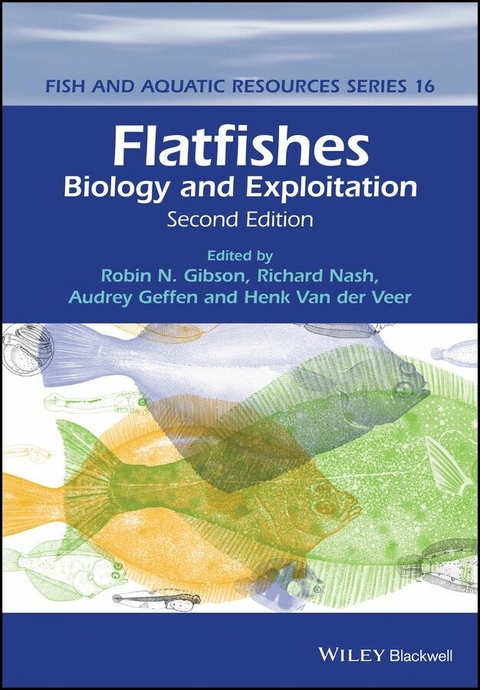
Flatfishes (eBook)
John Wiley & Sons (Verlag)
978-1-118-50117-7 (ISBN)
Fascinating and instantly recognizable, flatfishes are unique in their asymmetric postlarval body form. With over 800 extant species recognized and a distribution stretching around the globe, these fishes are of considerable research interest and provide a major contribution to commercial and recreational fisheries worldwide. This second edition of Flatfishes: Biology and Exploitation has been completely revised, updated and enlarged to respond to the ever-growing body of research. It provides:
• Overviews of systematics, distribution, life history strategies, reproduction, recruitment, ecology and behaviour
• Descriptions of the major fisheries and their management
• An assessment of the synergies between ecological and aquaculture research of flatfishes.
Carefully compiled and edited by four internationally-known scientists and with chapters written by many world leaders in the field, this excellent new edition of a very popular and successful book is essential reading for fish biologists, fisheries scientists, marine biologists, aquaculture personnel, ecologists, environmental scientists, and government workers in fisheries and fish and wildlife departments. Flatfishes: Biology and Exploitation, Second Edition, should be found in all libraries of research establishments and universities where life sciences, fish biology, fisheries, aquaculture, marine sciences, oceanography, ecology and environmental sciences are studied and taught.
Reviews of the First Edition
• A solid, up-to-date book that advanced students and research scientists with interests in fish biology will find interesting and useful. Aquaculture International
• A data-rich book that outlines much of what you might ever want to know about flatfishes. Fish & Fisheries
• Well presented with clear illustrations and a valuable source of information for those with a general interest in fish ecology or for the more specialist reader. You should make sure that your library has a copy. J Fish Biology
• An excellent and very practical overview of the whole, global flatfish scene. Anyone interested in flatfish at whichever stage of the economic food chain should invest in a copy immediately. Ausmarine
• Because of the high quality of each chapter, written by international experts, it is a valuable reference. Reviews in Fish Biology and Fisheries
Robin N. Gibson is an Honorary Research Fellow of the Scottish Association for Marine Science, Scottish Marine Institute, Oban, Scotland. His lifetime research interests have been in the ecology and behaviour of intertidal and shallow water marine fishes.
Richard D.M. Nash is a senior research scientist at the Institute of Marine Research, Bergen, Norway. His research is mainly concerned with recruitment processes and the early life history dynamics of marine fishes. He has particular research interests in the dynamics of nursery grounds.
Audrey J. Geffen is a professor in the Department of Biology, University of Bergen, Norway. Her research is primarily concerned with fish growth in natural and culture environments. A significant aspect of her work involves theoretical and applied research on the growth and formation of fish otoliths, analysing the structure and composition as a record of life history.
Henk W. van der Veer is a senior scientist at the Royal Netherlands Institute for Sea Research, The Netherlands. His main research topics are related to fish recruitment, concentrating on flatfishes and the functioning of coastal nursery areas. His work is strongly focussed on field observations supported by and embedded in ecological theory, especially the Dynamic Energy Budget theory.
Fascinating and instantly recognizable, flatfishes are unique in their asymmetric postlarval body form. With over 800 extant species recognized and a distribution stretching around the globe, these fishes are of considerable research interest and provide a major contribution to commercial and recreational fisheries worldwide. This second edition of Flatfishes: Biology and Exploitation has been completely revised, updated and enlarged to respond to the ever-growing body of research. It provides: Overviews of systematics, distribution, life history strategies, reproduction, recruitment, ecology and behaviour Descriptions of the major fisheries and their management An assessment of the synergies between ecological and aquaculture research of flatfishes. Carefully compiled and edited by four internationally-known scientists and with chapters written by many world leaders in the field, this excellent new edition of a very popular and successful book is essential reading for fish biologists, fisheries scientists, marine biologists, aquaculture personnel, ecologists, environmental scientists, and government workers in fisheries and fish and wildlife departments. Flatfishes: Biology and Exploitation, Second Edition, should be found in all libraries of research establishments and universities where life sciences, fish biology, fisheries, aquaculture, marine sciences, oceanography, ecology and environmental sciences are studied and taught. Reviews of the First Edition A solid, up-to-date book that advanced students and research scientists with interests in fish biology will find interesting and useful. Aquaculture International A data-rich book that outlines much of what you might ever want to know about flatfishes. Fish & Fisheries Well presented with clear illustrations and a valuable source of information for those with a general interest in fish ecology or for the more specialist reader. You should make sure that your library has a copy. J Fish Biology An excellent and very practical overview of the whole, global flatfish scene. Anyone interested in flatfish at whichever stage of the economic food chain should invest in a copy immediately. Ausmarine Because of the high quality of each chapter, written by international experts, it is a valuable reference. Reviews in Fish Biology and Fisheries
Robin N. Gibson is an Honorary Research Fellow of the Scottish Association for Marine Science, Scottish Marine Institute, Oban, Scotland. His lifetime research interests have been in the ecology and behaviour of intertidal and shallow water marine fishes. Richard D.M. Nash is a senior research scientist at the Institute of Marine Research, Bergen, Norway. His research is mainly concerned with recruitment processes and the early life history dynamics of marine fishes. He has particular research interests in the dynamics of nursery grounds. Audrey J. Geffen is a professor in the Department of Biology, University of Bergen, Norway. Her research is primarily concerned with fish growth in natural and culture environments. A significant aspect of her work involves theoretical and applied research on the growth and formation of fish otoliths, analysing the structure and composition as a record of life history. Henk W. van der Veer is a senior scientist at the Royal Netherlands Institute for Sea Research, The Netherlands. His main research topics are related to fish recruitment, concentrating on flatfishes and the functioning of coastal nursery areas. His work is strongly focussed on field observations supported by and embedded in ecological theory, especially the Dynamic Energy Budget theory.
Series editor's foreword
…flatfish, thirsting, trawled by grief
‘Falling on Grass’, by Elizabeth Biller Chapman
Fish researchers (a.k.a. fish freaks) like to explain, to the bemused bystander, how fish have evolved an astonishing array of adaptations; so much so that it can be difficult for such researchers to comprehend why anyone would study anything else. Yet fish are among the last wild creatures on our planet that are hunted by humans for sport or food. As a consequence, today we recognize that the reconciliation of exploitation with the conservation of biodiversity provides a major challenge to our current scientific knowledge and expertise. Even evaluating the tradeoffs that are needed is a difficult task. Moreover, solving this pivotal issue calls for a multidisciplinary consilience of fish physiology, biology and ecology with social sciences such as economics and anthropology in order to probe the frontiers of applied science. In addition to food, recreation (and inspiration for us fish freaks), it has, moreover, recently been realized that fish are essential components of aquatic ecosystems that provide vital services to human communities. Sadly, virtually all sectors of the stunning biodiversity of fishes are at risk from human activities. In freshwater, for example, the largest mass extinction event since the end of the dinosaurs occurred as the introduced Nile perch in Lake Victoria eliminated over 100 species of endemic haplochromine fish. But, at the same time, precious food and income from the Nile perch fishery was created in a miserably poor region. In the oceans, we have barely begun to understand the profound changes that have accompanied a vast expansion of human fishing over the past 100 years. The Wiley-Blackwell Series on Fish and Aquatic Resources is an initiative aimed at providing key, peer-reviewed texts in this fast-moving field.
Flatfishes, ubiquitous from the poles to the tropics, are instantly recognizable; yet some biologists regard them as just another advanced teleost, so why, we may ask, do they deserve a monograph and conferences all to themselves? In fact, flatfishes, defined as members of the monophyletic order of Pleuronectiformes, are endowed with a number of special and unique features (they underlie that instant recognition), and so your series editor is pleased to host this second edition of Flatfishes: Biology and Exploitation in the Fish and Aquatic Resources series. The first and second editions of this book grew out of a series of triennial international symposia on flatfishes held since 1990: there is now need for a second edition on account of significant advances in the science of flatfishes since the first edition was published in 2005. The second edition is a brainchild of a small team of eminent editors: Robin Gibson, Richard Nash, Audrey Geffen and Henk Van der Veer. The 17 chapters are authored by 37 experts in the field of flatfish biology from 11 countries.
When the oldest fossils appeared in the Eocene (53 million years BP), flatfishes already exhibited a diversity that suggests the order evolved in the Paleocene from perchlike marine ancestors. Today there are about 820 flatfish species in 123 genera, but relations within the group remain problematic. In this book systematics and biogeography are covered in two chapters (Munroe). Common and Linnaean names from the international fish database FishBase are used, except where recently revised.
During development each flatfish metamorphoses from a rounded, symmetrical fishlike larva to the characteristic flattened adult, with head skewed to remain horizontal as the fish lies on either its left or right side; one eye recapitulates early flatfish evolution and migrates to the upper side. Left- and right-handed eye position appears to be no guide to flatfish taxonomic relationships and the functional advantage of eye handedness remains a mystery. A chapter reviews the evolution and development of this dramatic asymmetry (Suzuki and Tanaka).
In a chapter on reproduction (Rijnsdorp, van Damme, and Witthames), we learn that, because flatfishes live in intimate contact with sediments, the effects of human pollutants on flatfish ecology are large. For example, oil spills reduce ovary development and fecundity, aromatic hydrocarbons and polychlorinated biphenyls in sediments produce smaller eggs, and some pesticides, polychlorinated biphenyls, phthalates and alkyl phenols mimic estrogen and disrupt female reproductive cycles or feminize males.
A chapter is devoted to the fascinating behaviour of flatfishes (Gibson, Stoner, and Ryer). Flatfishes employ a ‘swim-and-glide’ energy-saving locomotion by undulating the body. The 90° rotation in their body position means that flatfishes control vertical direction by changing the angle of the body, tail, and median fins; horizontal direction is altered, rather clumsily, by using the pectoral fin on the eyed side as a rudder. The characteristic flatfish camouflage serves both against detection by their prey and by their predators. Camouflage is achieved partly by very rapid second-by-second colour changes, images falling on the upper part of retina causing three types of chromatophore to expand and contact, and partly by slower changes over a number of weeks to the number and pigmentation of chromatophores, thereby altering the pattern of spots and flecks. All flatfishes can bury themselves rapidly in the substrate to aid camouflage. When this is done a muscular sac forces fluid into the orbit, causing the eyes to protrude above ground. Indeed this key feature of flatfish functional anatomy is diagnostic for the order. Flatfish eyes are independently mobile, providing 360° vision. Flatfishes are ambush predators; they may leave the bottom to capture prey in the water column and then become vulnerable to being eaten themselves. Some species avoid this problem by luring prey with a waggling pectoral fin, whereas a few species, like angler fish, have evolved specialized food-attracting lures. Prey are engulfed and sucked in by the back pressure from the highly protrusible advanced perch-pattern jaws.
A chapter covering the trophic ecology of flatfishes (Link, Smith, Packer, Fogarty and Langton) points out that flatfishes are largely piscivorous or eat benthic invertebrates like crustaceans and polychaete worms, so they generally have a trophic level of 3 or more. Some species specialize in eating the tips of bivalve siphons, especially when juvenile, whereas a few concentrate on echinoderms such as sand dollars and urchins. Flatfishes provide a tangible ‘ecosystem service’ for human benefit because they convert benthic production into a form suitable for consumption by higher predators and humans. Flatfishes are sought out as food by specialized predators such as sharks that can detect electrical impulses from their nervous systems.
Flatfishes have been eaten by humans for millennia; flatfish bones are found in ancient middens, flatfishes are portrayed in rock carvings and paintings from Europe to Australia, and clever, recurved hooks for catching large flatfishes are found among aboriginal peoples in the Pacific northwest and in northern Australia. Since the 1960s, almost 25% of all groundfish landings worldwide have consisted of flatfishes, and, in this book, the major Pacific, Atlantic and tropical flatfish fisheries each have their own chapters. Overall, the status of most fisheries is very poor and they are generally exploited way beyond levels of maximum sustainable production.
Atlantic flatfish fisheries (Walsh, Astarloa and Poos) paint a miserable story of overexploitation. The huge plaice fisheries of the early twentieth century have been severely depleted, Atlantic halibut is almost extinct and valuable sole, turbot and brill fisheries are reduced to shadows of their former glory. Species such the thin and watery-tasting Greenland ‘halibut’ (also misleading marketed as ‘turbot’) now dominate catches. The sad litany of stocks experiencing severe decline is accompanied by the realization that, over 80 years, these fisheries have been assessed and managed by some of the most advanced fisheries science in the world. As with other fish in the Atlantic, we have seen in the past an almost total failure of fisheries agencies to fulfil their mandate. However, in Europe, the jury is currently out on whether the corner has been turned. In the south Atlantic, flatfish stocks have been greatly overexploited, yet almost no good data exist with which to assess and manage the resources. An important exception to the generally dismal state of temperate flatfish resources is the Pacific halibut fishery, which has been managed conservatively by the International Pacific Halibut Commission for almost 100 years (see the chapter on Pacific flatfish fisheries by Wilderbuer, Leaman, and Zhang). Tropical flatfishes caught in fisheries (Munroe) tend to be small, taxonomically diverse and poorly known small individuals and species caught by commercial trawlers that generate huge and unreported amounts of discards.
Two new chapters for the second edition focus on flatfish life history strategies (Vinaigre and Cabral). The final chapter (Geffen, Pittman and Imsland) concentrates on the synergies between aquaculture and the biology of wild flatfishes.
This second edition continues to present timely and comprehensive ‘state-of-the-art’ reviews of flatfish biology, ecology, fisheries and aquaculture and readers will find all the components of synoptic synthesis concerning the role of flatfishes in today's depleted marine ecosystems. It therefore continues to provide a unique single source of reference on this...
| Erscheint lt. Verlag | 18.11.2014 |
|---|---|
| Reihe/Serie | Fish and Aquatic Resources |
| Fish and Aquatic Resources | Fish and Aquatic Resources |
| Sprache | englisch |
| Themenwelt | Naturwissenschaften ► Biologie ► Ökologie / Naturschutz |
| Naturwissenschaften ► Biologie ► Zoologie | |
| Technik | |
| Weitere Fachgebiete ► Land- / Forstwirtschaft / Fischerei | |
| Schlagworte | Aquaculture • Aquaculture, Fisheries & Fish Science • Aquakultur • Aquakultur, Fischereiwesen u. Fischforschung • Fish, Fisheries, Aquaculture, Fish biology, Teleosts, Flatfishes, Pleuronectiform, Marine biology, Marine ecology, Lateral asymmetry, Fish stocks, Commercial fisheries |
| ISBN-10 | 1-118-50117-9 / 1118501179 |
| ISBN-13 | 978-1-118-50117-7 / 9781118501177 |
| Informationen gemäß Produktsicherheitsverordnung (GPSR) | |
| Haben Sie eine Frage zum Produkt? |
 EPUB (Adobe DRM)
Kopierschutz: Adobe-DRM
Adobe-DRM ist ein Kopierschutz, der das eBook vor Mißbrauch schützen soll. Dabei wird das eBook bereits beim Download auf Ihre persönliche Adobe-ID autorisiert. Lesen können Sie das eBook dann nur auf den Geräten, welche ebenfalls auf Ihre Adobe-ID registriert sind.
Details zum Adobe-DRM
Dateiformat: EPUB (Electronic Publication)
EPUB ist ein offener Standard für eBooks und eignet sich besonders zur Darstellung von Belletristik und Sachbüchern. Der Fließtext wird dynamisch an die Display- und Schriftgröße angepasst. Auch für mobile Lesegeräte ist EPUB daher gut geeignet.
Systemvoraussetzungen:
PC/Mac: Mit einem PC oder Mac können Sie dieses eBook lesen. Sie benötigen eine
eReader: Dieses eBook kann mit (fast) allen eBook-Readern gelesen werden. Mit dem amazon-Kindle ist es aber nicht kompatibel.
Smartphone/Tablet: Egal ob Apple oder Android, dieses eBook können Sie lesen. Sie benötigen eine
Geräteliste und zusätzliche Hinweise
Buying eBooks from abroad
For tax law reasons we can sell eBooks just within Germany and Switzerland. Regrettably we cannot fulfill eBook-orders from other countries.
aus dem Bereich