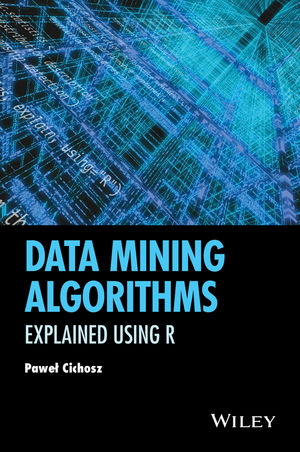
Data Mining Algorithms (eBook)
720 Seiten
Wiley (Verlag)
978-1-118-95080-7 (ISBN)
Data Mining Algorithms is a practical, technically-oriented guide to data mining algorithms that covers the most important algorithms for building classification, regression, and clustering models, as well as techniques used for attribute selection and transformation, model quality evaluation, and creating model ensembles. The author presents many of the important topics and methodologies widely used in data mining, whilst demonstrating the internal operation and usage of data mining algorithms using examples in R.
Pawel Cichosz, Department of Electronics and Information Technology, Warsaw University of Technology, Poland.
Preface
Data mining
Data mining has been a rapidly growing field of research and practical applications during the last two decades. From a somewhat niche academic area at the intersection of machine learning and statistics it has developed into an established scientific discipline and a highly valued branch of the computing industry. This is reflected by data mining becoming an essential part of computer science education as well as the increasing overall awareness of the term “data mining” among the general (not just computing-related) academic and business audience.
Scope
Various definitions of data mining may be found in the literature. Some of them are broad enough to include all types of data analysis, regardless of the representation and applicability of their results. This book narrows down the scope of data mining by adopting a heavily modeling-oriented perspective. According to this perspective the ultimate goal of data mining is delivering predictive models. The latter can be thought of as computationally represented chunks of knowledge about some domain of interest, described by the analyzed data, that are capable of providing answers to queries transcending the data, i.e., such that cannot be answered by just extracting and aggregating values from the data. Such knowledge is discovered from data by capturing and generalizing useful relationship patterns that occur therein.
Activities needed for creating predictive models based on data and making sure that they meet the application's requirements fall in the scope of data mining as understood in this book. Analytical activities which do not contribute to model creation—although they may still deliver extremely useful results—remain therefore beyond the scope of our interest. This still leaves a lot of potential contents to be covered, including not only modeling algorithms, but also techniques for evaluating the quality of predictive models, transforming data to make modeling algorithms easier to apply or more likely to succeed, selecting attributes most useful for model creation, and combining multiple models for better predictions.
Modeling view
The modeling view of data mining is by no means unique for this book. It is actually the most natural and probably the most wide-spread view of data mining. Nevertheless, it deserves some more attention in this introductory discussion, which is supposed to let the reader know what this book is about. In particular, it is essential to underline—and it will be repeatedly underlined on several other occasions throughout the book—that a useful data mining model is not merely a description of some patterns discovered in the data. In other words, it does not only and not mainly represent knowledge about the data, but also—and much more importantly—knowledge about the domain from which the data originates.
The domain can be considered a set of entities from the real world about which knowledge is supposed to be delivered by data mining. These can be people (such as customers, employees, patients), machines and devices (such as car engines, computers, or ATMs), events (such as car failures, purchases, or bank transactions), industrial processes (such as manufacturing electronic components, energy production, or natural resources exploitation), business units (such as stores or corporate departments), to name only a few typical possibilities. Such real-world entities—in this book referred to as instances—are, usually incompletely and imperfectly, described by a set of features—in this book referred to as attributes. A dataset is a subset of the domain, described by the set of available attributes, usually—assuming a tabular data representation—with rows corresponding to instances and columns corresponding to attributes. Data mining can then be viewed as an analytic process that uses one or more available datasets from the same domain to create one or more models for the domain, i.e., models that can be used to answer queries not just about instances from the data used for model creation, but also about any other instances from the same domain. More directly and technically, speaking, if some attributes are generally available (observable) and some attributes are only available on a limited dataset (hidden), then models can often be viewed as delivering predictions of hidden attributes wherever their true values are unavailable. The unavailable attribute values to be predicted usually represent properties or quantities that are hard and costly to determine, or (more typically) that become known later than are needed. The latter justifies the term “prediction” used when referring to a model's output. The attribute to be predicted is referred to as the target attribute, and the observable attributes that can be used for prediction are referred to as the input attributes.
Tasks
The most common types of predictive models—or queries they can be usedto answer—correspond to the following three major data mining tasks.
- Classification. Predicting a discrete target attribute (representing the assignment of instances to a fixed set of possible classes). This could be distinguishing between good and poor customers or products, legitimate and fraudulent credit card transactions or other events, assigning failure types and recommended repair actions to faulty technical devices, etc.
- Regression. Predicting a numeric target attribute which represents some quantity of interest. This could be an outcome or a parameter of an industrial process, an amount of money earned or spent, a cost or gain due to a business decision, etc.
- Clustering. Predicting the assignment of instances to a set of similarity-based clusters. Clusters are not predetermined, but discovered as part of the modeling process, to achieve possibly high intracluster similarity and possibly low intercluster similarity.
Most real-world data mining projects include one or more instantiations of these three generic tasks. Similarly, most of data mining research contributes, modifies, or evaluates algorithms for these three tasks. These are also the tasks on which this book is focused.
Origin
Data mining techniques have their roots in two fields: machine learning and statistics. With the former traditionally addressing the issue of acquiring knowledge or skill from supplied training information and the latter the issue of describing the data as well as identifying and approximating relationships occurring therein, they both have contributed modeling algorithms. They have also become increasingly closely related, which makes it difficult and actually unnecessary to put hard separating boundaries between them. With that being said, their common terminological and notational conventions remain partially different, and so do background profiles of researchers and practitioners in these fields. Wherever this difference matters, this book is much closer to machine learning than statistics, to the extent that the description of “strictly statistical” techniques—appearing rather sparingly—may be found oversimplified by statisticians. In particular, the formulations of major data mining tasks in Chapter 1 assume the inductive learning perspective.
The brief discussion of the modeling view of data mining presented in the previous section makes it possible to encounter this book's bias toward machine learning for the first time. The terms “domain,” “instance,” “attribute,” and “dataset,” in particular, have their counterparts that are more common in statistics, such as “population,” “observation,” “variable,” and “sample.”
Motivation
The book is intended to be a practical, technically oriented guide to data mining algorithms, focused on clearly explaining their internal operation and properties as well as major principles of their application. According to the general perspective of data mining adopted by the book, it encompasses all analytic processes performed to produce predictive models from available data and verify whether and to what extent they meet the application's requirements. The book will cover the most important algorithms for building classification, regression, and clustering models, as well as techniques used for attribute selection and transformation, model quality evaluation, and creating model ensembles.
The book will hopefully appeal to the reader, either already familiar with data mining to some extent or just approaching the field, by its practical and technical, utility-driven perspective, making it possible to quickly start gaining his or her own hands-on experience. The reader will be given an opportunity to become familiar with a number of data mining algorithms, presented in a systematic, coherent, and relatively easy to follow way. By studying their description and examples the reader will learn how they work, what properties they exhibit, and how they can be used.
The book is not intended to be a “data mining bible” providing a complete coverage of the area, but rather to selectively focus on a number of algorithms that:
- are known to work well for the most common data mining tasks,
- are good representatives of typical data mining techniques,
- can be well explained to the general technically educated audience without an excessive...
| Erscheint lt. Verlag | 17.11.2014 |
|---|---|
| Sprache | englisch |
| Themenwelt | Informatik ► Datenbanken ► Data Warehouse / Data Mining |
| Informatik ► Theorie / Studium ► Algorithmen | |
| Mathematik / Informatik ► Mathematik ► Analysis | |
| Mathematik / Informatik ► Mathematik ► Statistik | |
| Mathematik / Informatik ► Mathematik ► Wahrscheinlichkeit / Kombinatorik | |
| Technik | |
| Schlagworte | algorithms • Data Analysis • Data Mining • Data Mining Statistics • Datenanalyse • Statistical Software / R • Statistics • Statistik • Statistiksoftware / R |
| ISBN-10 | 1-118-95080-1 / 1118950801 |
| ISBN-13 | 978-1-118-95080-7 / 9781118950807 |
| Informationen gemäß Produktsicherheitsverordnung (GPSR) | |
| Haben Sie eine Frage zum Produkt? |
 EPUB (Adobe DRM)
Kopierschutz: Adobe-DRM
Adobe-DRM ist ein Kopierschutz, der das eBook vor Mißbrauch schützen soll. Dabei wird das eBook bereits beim Download auf Ihre persönliche Adobe-ID autorisiert. Lesen können Sie das eBook dann nur auf den Geräten, welche ebenfalls auf Ihre Adobe-ID registriert sind.
Details zum Adobe-DRM
Dateiformat: EPUB (Electronic Publication)
EPUB ist ein offener Standard für eBooks und eignet sich besonders zur Darstellung von Belletristik und Sachbüchern. Der Fließtext wird dynamisch an die Display- und Schriftgröße angepasst. Auch für mobile Lesegeräte ist EPUB daher gut geeignet.
Systemvoraussetzungen:
PC/Mac: Mit einem PC oder Mac können Sie dieses eBook lesen. Sie benötigen eine
eReader: Dieses eBook kann mit (fast) allen eBook-Readern gelesen werden. Mit dem amazon-Kindle ist es aber nicht kompatibel.
Smartphone/Tablet: Egal ob Apple oder Android, dieses eBook können Sie lesen. Sie benötigen eine
Geräteliste und zusätzliche Hinweise
Buying eBooks from abroad
For tax law reasons we can sell eBooks just within Germany and Switzerland. Regrettably we cannot fulfill eBook-orders from other countries.
aus dem Bereich