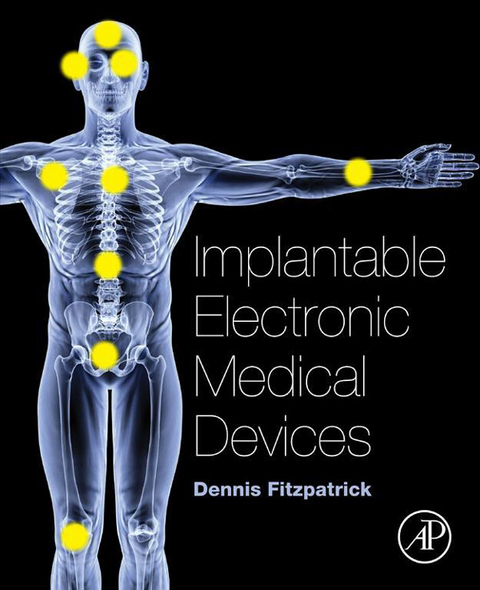
Implantable Electronic Medical Devices (eBook)
194 Seiten
Elsevier Science (Verlag)
978-0-12-416577-9 (ISBN)
Dr Fitzpatrick is a Chartered engineer and lecturer at the University of East Anglia teaching electrical and electronic engineering with a research interest in Biomedical Engineering. His primary research interest is in the use of Functional Electrical Simulation (FES) for the restoration of bladder function and restoration of gait in stroke and spinal cord injured patients. His research focuses on the design and development of custom designed implantable electrodes. His recent book, Analogue Design and Simulation using OrCAD Capture and PSpice, published by Elsevier, has sold worldwide to highly acclaimed reviews in numerous prestigious electronic engineering journals including EDN and Electronic Times, the book being officially endorsed by Cadence Design Systems. Dr Fitzpatrick has published other books in the field of Biomedical Engineering and is the Series editor for the Developments in Biomedical Engineering and Bioelectronics book series by Elsevier.
Implantable Electronic Medical Devices provides a thorough review of the application of implantable devices, illustrating the techniques currently being used together with overviews of the latest commercially available medical devices. This book provides an overview of the design of medical devices and is a reference on existing medical devices. The book groups devices with similar functionality into distinct chapters, looking at the latest design ideas and techniques in each area, including retinal implants, glucose biosensors, cochlear implants, pacemakers, electrical stimulation therapy devices, and much more. Implantable Electronic Medical Devices equips the reader with essential background knowledge on the application of existing medical devices as well as providing an introduction to the latest techniques being used. - A catalogue of existing implantable electronic medical devices- Up-to-date information on the design of implantable electronic medical devices- Background information and reviews on the application and design of up-to-date implantable electronic medical devices
Front Cover 1
Implantable Electronic Medical Devices 4
Copyright Page 5
Contents 6
Preface 10
1 Retinal Implants 12
1.1 Introduction 12
1.2 The Retina 13
1.3 Photoreceptor Cells 14
1.4 Bipolar and Ganglion Cells 17
1.5 Retinal Implants 18
1.6 Microelectrodes 19
1.7 Microphotodiodes 20
1.8 Argus II Retinal Prosthesis (Second Sight Medical Products) 21
1.9 Artificial Silicon Retina Implant, Optobionics 23
1.10 Alpha-IMS Implant by Retina Implant AG 24
1.11 Bionic Vision Australia 26
1.12 Boston Retinal Implant Project: Bionic Eye Technologies, Inc. and Visus Technologies, Inc. 28
Bibliography 29
2 Smart Contact Lens 30
2.1 Introduction 30
2.2 Measurement of IOP 31
2.3 Triggerfish from Sensimed 33
Bibliography 36
3 Phrenic Nerve Stimulation 38
3.1 Introduction 38
3.2 Atrotech Atrostim Phrenic Nerve Stimulator 40
3.3 Avery Biomedical Devices Breathing Pacemaker System 41
3.4 Synapse Biomedical Inc. NeuRx Diaphragm Pacing System 45
Bibliography 46
4 Glucose Biosensors 48
4.1 Introduction 48
4.2 Amperometric Glucose Sensor 51
4.2.1 Glucose Detector Based on Measurement of Hydrogen Peroxide 51
4.2.2 Glucose Detector Based on Measurement of Oxygen 54
4.3 Potentiostat Measurement of Glucose 54
4.4 Next Generation of Glucose Sensors 56
4.5 Implantable Glucose Sensor by GlySens 57
4.6 Implantable Continuous Glucose Monitoring GlySens 58
4.7 GlucoChip PositiveID Corporation and Receptors LLC 59
Bibliography 62
5 Cochlear Implants 64
5.1 Introduction 64
5.2 Types of Hearing Loss 66
5.3 Cochlear Implants 67
5.4 Cochlea Electrode Arrays 67
5.5 Speech Coding 68
5.6 Cochlear Implant Systems 68
5.7 Continuous Interleaved Sampling 71
5.8 HiRes120 72
5.9 Lifestyle™ Cochlear Implant Systems by Advanced Bionics™ 73
5.10 ClearVoice™ 73
5.11 n-of-m, Spectral Peak Extraction (SPEAK) and Advanced Combinational Encoder (ACE) 75
5.12 Nucleus® 6 System, Cochlear 77
5.13 Dual-Loop AGC 79
5.14 Fine Structure Processing 80
5.15 MAESTRO™ Cochlear Implant System by MED-EL 82
Bibliography 84
6 Pacemakers and Implantable Cardioverter Defibrillators 86
6.1 Introduction 86
6.2 Types of Pacemakers 90
6.3 Revised NASPE/BPEG Generic Code for Antibradycardia Pacing 91
6.4 Implantable Cardioverter Defibrillators 93
6.5 NASPE/BPEG Defibrillator Code 95
6.6 Implantable Cardioverter Design 96
6.7 Medtronic Micra Transcatheter Pacing System 99
6.8 Medtronic Viva and Evera 100
6.9 Sorin Group Kora 100 101
6.10 Biotronik 103
6.11 St Jude Medical Nanostim™ 104
6.12 St Jude Unify Quadra™ and Accent™ 105
6.13 Boston Scientific Ingenio™ and Incepta™ 106
6.14 Boston Scientific Subcutaneous ICD 107
Bibliography 108
7 Bladder Implants 110
7.1 Introduction 110
7.2 Detrusor Hyperreflexia 111
7.3 Detrusor Areflexia 112
7.4 Overactive Bladder Syndrome and Urine Retention 112
7.5 Sacral Anterior Root Stimulation 112
7.6 Finetech-Brindley Sacral Anterior Root Stimulators, Finetech Medical Ltd. 113
7.7 Medtronic InterStim® Therapy 115
Bibliography 117
8 Electrical Stimulation Therapy for Pain Relief and Management 118
8.1 Occipital Nerve Stimulation 118
8.2 St Jude Medical Implantable Pulse Generators for ONS of the Occipital Nerves 118
8.3 Boston Scientific Precision Spectra™ SCS System 119
9 Electrical Stimulation Therapy for Parkinson’s Disease and Dystonia 122
9.1 Introduction 122
9.2 Vercise™ Deep Brain Stimulator, Boston Scientific 123
9.3 Medtronic Activa PC+S DBS 124
9.4 St Jude Medical Brio™ DBS 126
10 Electrical Stimulation Therapy for Epilepsy 128
10.1 Introduction 128
10.2 Seizure-Detection Methods 129
10.3 NeuroPace RNS® Stimulator Neurostimulator 131
10.4 Cyberonics Inc. VNS 133
Bibliography 134
11 Peripheral Nerve Stimulation 136
11.1 Drop Foot Stimulators 136
11.1.1 Introduction 136
11.1.2 STIMuSTEP® Finetech Medical Ltd. 138
11.1.3 ActiGait®, Ottobock 139
11.2 Handgrip Stimulators 141
11.2.1 STIMuGRIP® Finetech Medical Ltd. 142
12 Lower Esophagus Stimulator 144
12.1 Introduction 144
12.2 EndoStim® Lower Esophagus Stimulator 145
13 Vagal Blocking Therapy 148
13.1 Introduction 148
13.2 EnteroMedics® VBLOC Vagal Blocking Therapy 148
14 Implantable Drug Delivery Systems 150
14.1 Introduction 150
14.2 Electromagnetic Micropumps 151
14.3 Osmotic Micropumps 152
14.4 Electro-osmotic Micropumps 154
14.5 Electrolysis Micropumps 154
14.6 Wireless Microchip Drug Delivery System by MicroCHIPS Inc. 155
14.7 CODMAN® 3000 Constant Flow Infusion System Implantable Pump by Codman & Shurtleff, Inc.
14.8 SynchroMed® II Infusion System by Medtronic 160
14.9 MIP Implantable from Debiotech™ 162
14.9.1 DebioStar™ 163
14.10 Ophthalmic MicroPump™ Replenish, Inc. 164
14.11 IntelliDrug™ System from IntelliDrug 167
Bibliography 168
15 Wireless Endoscopy Capsules 170
15.1 Introduction 170
15.2 PillCam® Capsule Endoscopy by Covidien GI Solutions 172
15.2.1 PillCam® SB 3 173
15.2.2 PillCam® COLON 2 174
15.2.3 PillCam® ESO 2 174
15.2.4 PillCam® patency 175
15.2.5 PillCam® Sensor Belt and Recorder 175
15.3 Sayaka EndoScope Capsule by RF SYSTEM Lab 177
15.4 MiroCam® Capsule Endoscope System from IntroMedic Co. 178
15.5 CapsoCam® Capsule Endoscope SV-2 from CapsoVision 183
15.6 EndoCapsule System EC-S10 by Olympus, Inc. 185
15.7 OMOM Capsule Endoscope System by Chongqing Jinshan Science & Technology (Group) Co., Ltd
Index 190
Retinal Implants
This chapter introduces the main anatomical features of the eye, the processes involved in vision and eye disorders, and diseases such as retinitis pigmentosa and age-related macular degeneration which can affect normal vision. The use of microelectrodes and microphotodiodes in retinal, subretinal, and suprachoroidal implants is introduced with an emphasis on the Argus II Retinal Prosthesis (Second Sight Medical Products); the Artificial Silicon Retina (Optobionics); Alpha-IMS (Retina Implant AG); Wide-View BVA and High-Acuity BVA (Bionic Vision Australia); and Boston Retinal Implant Project (Bionic Eye Technologies, Inc. and Visus Technologies, Inc.).
Keywords
Retina; retinitis pigmentosa; AMD; microphotodiodes; microelectrodes; epiretinal; subretinal; suprachoroidal
1.1 Introduction
Figure 1.1 shows the main anatomical features of the eye. In normal sight, light enters the eye through the pupil and is focused onto the retina at the back of the eye, stimulating photocells that translate the light into electrical signals. These electrical signals travel down the optic nerve to the visual centers in the brain where they are decoded and perceived as images. Progressive diseases of the eye that result in partial or total loss of vision include glaucoma, retinitis pigmentosa, and macular degeneration.
Figure 1.1 Structure of the eye.
Glaucoma results from an increase in the internal pressure of the eye, the effects of which are irreversible, eventually leading to loss of sight. However, if detected early, the onset of the disease can be managed with medical treatment or laser surgery. Measuring the intraocular pressure of the eye can help in detecting the early stages of the disease (see Chapter 2).
Retinitis pigmentosa is a genetic disorder resulting in the degeneration of the photoreceptor cells in the retina, leading to partial or complete loss of sight. Currently there is no cure, although gene therapy in which a virus is used to deliver sight-restoring therapeutic genes to the photoreceptors at the back of the eye may offer an alternative form of treatment in the future.
Age-related macular degeneration (AMD) is another disease of the retina, but it only affects a small area of the retina known as the macula which contains a small population of cone-type photoreceptor cells that are more responsive to bright light levels required for reading and viewing objects close up and in greater detail. The onset of AMD occurs in the later stages of life and only leads to a partial degeneration of sight.
Retinal implants are used to help people with degenerative retinal diseases such as retinitis pigmentosa and AMD where the optic nerve and the visual centers in the brain are still functioning but the patient has lost light or sight perception due to degeneration of the outer layer of the retinal photoreceptor cells. However, the cells in the inner retinal layer are relatively intact compared to the outer cells and it is the inner cells which form a neuronal ganglion interface to the optical nerve. Retinal implants will not benefit people who have been blind from birth because their optical visual neuronal circuits and visual processing centers in the brain have not been developed or conditioned to perceive vision.
1.2 The Retina
Light entering the eye through the lens is focused onto the retina which consists of a thin layer of transparent neural tissue located at the back of the eye. Near the center of the retina is a region known as the macula which has a high concentration of neural cells responsible for seeing detailed colors and represents the center of vision. At the center of the macula is a small depression or dimple known as the fovea which represents the absolute center of vision and highest color resolution attainable, providing the clearest and sharpest images. Subsequently, the eye continuously moves (saccades) such that the lens focuses images of interest onto the fovea for the highest image of color resolution.
The retina is made up of three main functional neural cell layers: photoreceptor cells, bipolar cells, and ganglion cells. Interspersed between the layers are the horizontal and amacrine neural cells as shown in Figure 1.2. The photoreceptor cells at the back of the retina transduce photon light energy into graded neural signals which are transmitted and processed via the bipolar and ganglion cell layers. It is the axons of the ganglion cells which together collectively form the optic nerve which leads to the visual processing centers in the brain.
Figure 1.2 Structure of the retinal layers.
1.3 Photoreceptor Cells
There are two types of photoreceptor cells: rods, which have the ability to detect color but are sensitive to low light levels (scotopic vision), and cones, which in bright light are sensitive to colors (photopic vision) in the visible spectrum. The rods and cones are made up of four segments (Figure 1.3): the outer segment, inner segment, cell body (nucleus), and synaptic terminals.
Figure 1.3 Photoreceptor cone and rod cells.
The outer segment in rods and cones consists of the outer membrane folding in on itself and stacking up to form disks. In the case of rods, the in-folded membranes become detached and the disks float inside the outer segment. Located on the disks are light-sensitive pigment proteins, rhodopsin in rods, and iodopsin in cones. The inner segment contains mitochondria which provide the energy required for chemical reactions and the cell body which contains the cell nucleus and other cell organelles essential to maintain cell functionality. The synaptic terminals provide for the transmission of glutamate neurotransmitters between neural cell synaptic bodies.
In rods, the outer segment is cylindrical, whereas for cones, the outer segment is conical in shape (Figure 1.4). Typical outside diameters for the inner and outer segments are 2 µm for rods and 6 µm for cones. The rods also contain a greater number of light-sensitive disks in the outer segment compared to cones, resulting in a greater sensitivity to light. There are typically 120 million rods compared to 6 million cones in the retina.
Figure 1.4 Structure differences between rods and cones. (http://www.ic.ucsc.edu/~bruceb/psyc123/Vision123.html.pdf.)
In rods, all the disks contain the same light-sensitive pigment, rhodopsin, which exhibits a peak absorption of light energy at a wavelength of 500 nm which lies within the blue-green region of the visual light spectrum. In cones, the light-sensitive iodopsin pigment occurs in three varieties due to differences in their amino acid sequence, each with different peak absorption wavelengths in the red (560 nm), blue (420 nm), and green (530 nm) regions of the visible light spectrum, respectively.
Although each cone contains three different opsin pigment types, there are three different types of defined cones: short-wave (blue light), medium-wave (green light), and long-wave (red light), each with a predominant opsin variety in the cone. The superimposition of the light absorption response of each opsin pigment will result in a peak response around the area of the defined cone color type. For example, the peak response of a long-wave cone will be shifted due to the superimposition of the individual blue and green opsin spectrum absorption responses, toward the yellow-green region of the visible spectrum as shown in Figure 1.5.
Figure 1.5 Electromagnetic spectrum of the human eye.
Figure 1.6 shows a rod photoreceptor cell with sodium- and potassium-specific ion channels in the outer membrane. In the absence of light, there will be a continuous flow of positively charged sodium ions into the cell and potassium ions out of the cell, collectively known as the “dark current.” This dynamic arrangement gives the photoreceptor cell a resting potential of approximately −30 to −40 mV. Neurotransmitters (glutamate) are also released from the synaptic terminals of the photoreceptor cell. When light photons strike the visual pigments in the disks, a series of chemical reactions involving enzyme activity causes the cell to hyperpolarize and reduce the release of synaptic neurotransmitters.
Figure 1.6 Induced ionic currents in photoreceptor cell.
1.4 Bipolar and Ganglion Cells
As shown in Figure 1.2, the bipolar and ganglion cell layers are interlaced with two other cell types, the horizontal and amacrine cells. The neural signals from the photoreceptor cells interface with the bipolar cells directly or indirectly via the horizontal cells, which in turn interface with other bipolar cells or other adjacent horizontal cells. Similarly, the bipolar cells interface with the ganglion cells directly or indirectly via the amacrine cells, which in turn interface with other ganglion cells and other adjacent amacrine cells.
There are two types of bipolar cells, both of which receive the glutamate neurotransmitter, but the ON-center bipolar cells will depolarize, whereas the OFF-center bipolar cells will hyperpolarize. This arrangement helps provide a spatial processing of the visual input derived from the photoreceptor cells. The bipolar cells provide one of many sensory inputs to the ganglion cells which are thought to be involved with temporal aspects of color vision being sensitive to speed of movement. The output synapses of the ganglion...
| Erscheint lt. Verlag | 5.11.2014 |
|---|---|
| Sprache | englisch |
| Themenwelt | Medizin / Pharmazie ► Physiotherapie / Ergotherapie ► Orthopädie |
| Technik ► Elektrotechnik / Energietechnik | |
| Technik ► Medizintechnik | |
| ISBN-10 | 0-12-416577-X / 012416577X |
| ISBN-13 | 978-0-12-416577-9 / 9780124165779 |
| Informationen gemäß Produktsicherheitsverordnung (GPSR) | |
| Haben Sie eine Frage zum Produkt? |
 EPUB (Adobe DRM)
Kopierschutz: Adobe-DRM
Adobe-DRM ist ein Kopierschutz, der das eBook vor Mißbrauch schützen soll. Dabei wird das eBook bereits beim Download auf Ihre persönliche Adobe-ID autorisiert. Lesen können Sie das eBook dann nur auf den Geräten, welche ebenfalls auf Ihre Adobe-ID registriert sind.
Details zum Adobe-DRM
Dateiformat: EPUB (Electronic Publication)
EPUB ist ein offener Standard für eBooks und eignet sich besonders zur Darstellung von Belletristik und Sachbüchern. Der Fließtext wird dynamisch an die Display- und Schriftgröße angepasst. Auch für mobile Lesegeräte ist EPUB daher gut geeignet.
Systemvoraussetzungen:
PC/Mac: Mit einem PC oder Mac können Sie dieses eBook lesen. Sie benötigen eine
eReader: Dieses eBook kann mit (fast) allen eBook-Readern gelesen werden. Mit dem amazon-Kindle ist es aber nicht kompatibel.
Smartphone/Tablet: Egal ob Apple oder Android, dieses eBook können Sie lesen. Sie benötigen eine
Geräteliste und zusätzliche Hinweise
Buying eBooks from abroad
For tax law reasons we can sell eBooks just within Germany and Switzerland. Regrettably we cannot fulfill eBook-orders from other countries.
aus dem Bereich