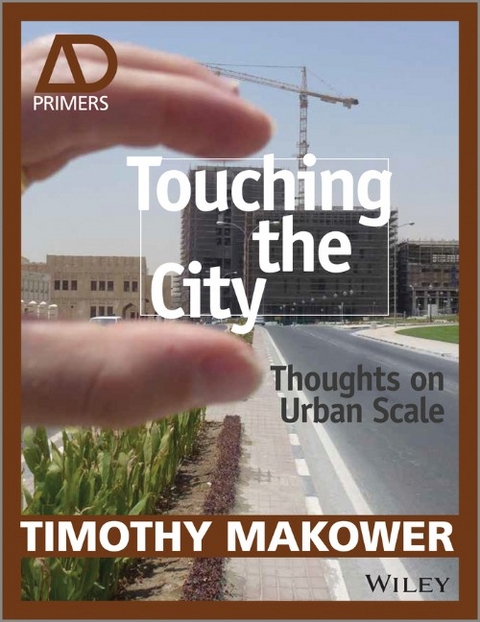
Touching the City (eBook)
John Wiley & Sons (Verlag)
978-1-118-73769-9 (ISBN)
Travelling from Detroit to Chandigarh, via New York, London, Paris, Rome and Doha, Tim Makower explores cities with the analytical eye of a designer and with the experiential eye of the urban dweller. Looking at historic cities, he asks what is good about them: what can we learn from the old to inform the new? The book zooms in from the macro scale of surfing Google Earth to micro moments such as finding fossils in a weathered wall. It examines the dynamics and movement patterns of cities, the making of streets and skylines, the formation of thresholds and facades, and it also touches on the process of design and the importance of drawing. As the book's title, Touching the City, suggests, it also emphasises the tactile – that the city is indeed something physical, something we can touch and be touched by, alive and ever changing.
Tim Makower is an architect and urbanist. He was educated at Cambridge and the Royal College of Art. He worked with Allies and Morrison for 25 years and became a partner there in 2006. He led many of their major projects of architecture and urban design, including projects in the UK such as the King's Cross Masterplan, Bankside, Liverpool One, St Andrews Bromley-by-Bow and in the Middle East, Msheireb, the National Archive of Qatar, Sidra Village and others. In 2012 he left Allies and Morrison to found Makower Architects, and he is now engaged in new projects which include the Al Rayyan Gate Masterplan, the Qatar Bio-Hub, the Regeneration Framework for Old Doha and the GORD Eco-Villa. He has been involved for many years in education in Qatar, the UK and also in the United States and has published numerous articles. From 2011 to 2012, he held the co-chair of architecture and urban design at Qatar University.
Scale in cities is relative and absolute. It has the ability to make us feel at home in the world or alien from it; connected or disconnected. Both large and small scale in cities can be beautiful; both are right, neither is wrong. Whilst accepting that prescription is no answer, 'getting the scale right' at an intuitive and sensual level is a fundamental part of the magic of architecture and urban design. Touching the City explores how scale is manifested in cities, exploring scale in buildings, in the space between them and in their details. It asks how scale makes a difference. Travelling from Detroit to Chandigarh, via New York, London, Paris, Rome and Doha, Tim Makower explores cities with the analytical eye of a designer and with the experiential eye of the urban dweller. Looking at historic cities, he asks what is good about them: what can we learn from the old to inform the new? The book zooms in from the macro scale of surfing Google Earth to micro moments such as finding fossils in a weathered wall. It examines the dynamics and movement patterns of cities, the making of streets and skylines, the formation of thresholds and facades, and it also touches on the process of design and the importance of drawing. As the book's title, Touching the City, suggests, it also emphasises the tactile that the city is indeed something physical, something we can touch and be touched by, alive and ever changing.
Tim Makower is an architect and urbanist. He was educated at Cambridge and the Royal College of Art. He worked with Allies and Morrison for 25 years and became a partner there in 2006. He led many of their major projects of architecture and urban design, including projects in the UK such as the King's Cross Masterplan, Bankside, Liverpool One, St Andrews Bromley-by-Bow and in the Middle East, Msheireb, the National Archive of Qatar, Sidra Village and others. In 2012 he left Allies and Morrison to found Makower Architects, and he is now engaged in new projects which include the Al Rayyan Gate Masterplan, the Qatar Bio-Hub, the Regeneration Framework for Old Doha and the GORD Eco-Villa. He has been involved for many years in education in Qatar, the UK and also in the United States and has published numerous articles. From 2011 to 2012, he held the co-chair of architecture and urban design at Qatar University.
Acknowledgements
Foreword: Scaling the XXL - Kees Christiaanse
Introduction
Chapter 1: On Scale and Size
Chapter 2: On Scale and Movement
Chapter 3: On Scale and Edges
Chapter 4: On Scale and Grain
Chapter 5: On Scale and Form
Chapter 6: On Scale, Skeletons and Surface
Chapter 7: On Scale and Detail
Conclusion: From Nature
Select Bibliography
Index
Picture Credits
"Makower achieves a very readable and practical summary of urban design for a full range of practitioners and anyone with an interest in the design of cities. The book is a call for re-thinking what we mean by rational and rigorous design that is good for people, applied with a common sense of scale." (Urban design, 2016)
Introduction
‘No pattern is an isolated entity. Each pattern can exist in the world, only to the extent that it is supported by other patterns: the larger patterns in which it is embedded, the patterns of the same size that surround it, and the smaller patterns which are embedded in it.’
Christopher Alexander, A Pattern Language, 19771
London from the air, 2012
Big shapes: river, Roman roads and parks.
Richard Rogers and Renzo Piano, Centre Pompidou and Place Beaubourg, Paris, 1977 (photographed in 2012)
Super-scaled machine meets fine-grain city: a fertile combination.
Allies and Morrison, Diwan Annex, Doha, 2013
Irresistible to touch: drawn by hand, cut by machine.
This book is about scale as it is manifested in cities. The word ‘scale’ can be defined as the ‘experience of size’. The book explores scale in cities, in the spaces between buildings, in buildings themselves and in their details. It seeks to ask how scale in the cities we inhabit can make us feel at home in the world or alien from it; connected or disconnected. Scale in cities is both relative and absolute. ‘Getting the scale right’ – although it is impossible to define such a thing – is a fundamental part of the magic of architecture and urban design. There are over-sized places, which make people feel small, and there are well-sized places, which can make people feel comfortable, and sometimes larger than life.
Scale comparison between Piazza della Rotonda and Piazza del Popolo, Rome: drawing by the author, 2014
Rome: a city of intimacy and grandeur.
Christopher Alexander, in his seminal manifesto on scale and touch, A Pattern Language, identifies a problem: ‘the languages which people have today are so brutal, and so fragmented, that most people no longer have any language to speak of at all – and what they do have is not based on human or natural considerations’.2 The beauty of his book, which seeks to address this problem by considering the connection between people and their built environment – the joining together of the fragmented world of experience – is that it connects not just from one thing to another, from outer to inner, but also from macro to micro; it zooms in.
Zooming In
So in what way does scale make a difference? There are the dangers of lumpiness and laziness in design which can arise from working too fast, and there is an economic paradox in the fact that developments which seek to cover too great an area in too little time – notionally benefiting from ‘economies of scale’ – can destroy their own value by ending up monotonous or characterless. As with cuisine, fast food has its limitations; slow food is more nutritious and generally more delicious. The same is true of urbanism. These conundrums are worthy of discussion. Of the many aspects of scale to be discussed in this book, two main points stand out. Firstly that scale matters, and is essential to good design and the understanding of cities. Secondly that both big and small are beautiful; both are right, neither is wrong; it all depends on their relationships.
Fast food, London
Not nourishing the body.
The book travels from Detroit via Paris, Doha, New York and other places to London, looking at cities both with the analytical eye of a designer and with the experiential eye of the ‘nine- or ninety-year-old’; the person on the street. It looks at old cities and asks what is good about them; what can we learn from the old to inform the new? Like Christopher Alexander’s A Pattern Language, the book zooms in from the macro scale of surfing Google Earth to micro moments such as finding fossils in a weathered wall. It examines the dynamics and movement patterns of cities, the making of streets and skylines, the formation of facades, and the honing of thresholds. It also touches on the process of design and the importance of drawing.
Fast urbanism, Doha
Not nourishing the community.
Makower Architects, Al Asmakh, Doha, 2014
The macro-strategy for Al Asmakh is to make the central spine – ‘Triple-A Street’ – into a linear public space, connecting into the heart of Msheireb, to the north.
Allies and Morrison, Qatar National Archive, Doha, 2011
The carved forms of the project were drawn over by hand, as if being sculpted by the pencil.
The title – Touching the City – reminds us that the city is indeed something physical, and it is alive. We can touch it and it can touch us. Rather than just being in it, we can be of it. To be able to touch a burnished brass door handle at one moment, to enjoy the crank of a wall or the bristling of chimneypots in the next, and to close our eyes, zoom right out and understand the entire shape of a city, both in time and space, is not only essential for a designer; it is valuable for all of us who experience the tactile nature of cities, both actually and metaphorically. The aim of this book is to talk about these things, which are formative in the making and re-making of cities over time, and so to push forward the debate: what place does scale have in the making of good cities for people?
In the early 1970s, when I was six or seven, in the days leading up to Christmas, when we were staying with my grandparents and I was sharing an attic room with my sister, before going to sleep I would describe out loud, into the darkness, models of towns from my imagination, impossibly detailed, all in motion; lights, cars, people; all crystal clear. These were the Christmas presents of my dreams. One of these models was a great city with tall buildings, a huge park and a railway station; another was a harbour town with a long jetty, a marketplace and a domed church; a third was a village on a hill with a castle and a manor house and a bridge across a small river valley. My sister would join in with the descriptions. In the darkness, we felt we could reach out and touch these models but we held off, because they were so fragile. Once I remember thinking I saw an aeroplane fly over one of the models, far below me.
Eliel Saarinen, Cranbrook Art Museum, Bloomfield Hills, Michigan, 1942
The door handle is part of a solid bronze casting. It brings together the functional, aesthetic and tactile language of the building.
Flying over a town, somewhere between Chicago and Kansas City, 2010
The Jefferson Ordnance rides regardless over a landscape of hills, rivers and historic paths; the irregular informs the regular.
Under the Table
‘There is a kind of play common to nearly every child; it is to get under a piece of furniture or some extemporized shelter of his or her own and exclaim that he or she is in a “house”.’ John Summerson, ‘Heavenly Mansions’, 19493
John Summerson in his seminal essay ‘Heavenly Mansions’ describes the child’s activity of playing with a doll’s house as a ‘strict analogy’ between the world of the child and that of adulthood. Nothing could be a truer example of this than my own experience with imaginary cities, towns and villages in my grandparents’ attic, although seen through the other end of the telescope. Summerson writes of the child playing under a table or with dolls and doll’s houses as follows: ‘he is placing either himself or the doll (a projection of himself) in a sheltered setting […] the pleasure he derives from it is a pleasure in the relationship between himself (or the doll) and the setting.’4
The table used by the author as a ‘house’ when he was a child
Sometimes its walls were made of linen sheets, and sometimes of adult legs.
He makes a connection between the ‘cosiness’ of the little house and the value of ‘ceremony’, as a signal for inner comfort in a world full of challenges; ‘for us the ceremonial idea is more important – the idea of neatness and serenity within, contrasting with wildness and confusion without’. He even refers to camping and sailing as ‘adult forms of play analogous to the “my house” pretences of a child. In both there is the fascination of the miniature shelter which excludes the elements by only a narrow margin and intensifies the sense of security in a hostile world.’5 However he does not mention that the child is seeking to be ‘larger than life’ (the child wants to grow up). The child in us all, however old we are, is seeking to transcend the everyday tangible world and, as with the large-scale model in the attic, to gain a perspective on life.
My main interest in writing this book is to think about, and to address, people who have not been educated or brainwashed in the subject of architecture or urban design but who are attuned to their environment and who know what they like. The universal relevance of Summerson’s point to our relationship with the city is that in all of us there is both a child and a giant....
| Erscheint lt. Verlag | 8.10.2014 |
|---|---|
| Reihe/Serie | Architectural Design Primer | Architectural Design Primer |
| Sprache | englisch |
| Themenwelt | Technik ► Architektur |
| Schlagworte | Ability • answer • Architecture • Architektur • Beautiful • Cities • City • Details • Detroit • difference • Explores • fundamental • Home • intuitive • Level • Magic • Part • Planning • Planung • prescription • scale • Sensual • space • Travelling • us feel • World • Wrong |
| ISBN-10 | 1-118-73769-5 / 1118737695 |
| ISBN-13 | 978-1-118-73769-9 / 9781118737699 |
| Informationen gemäß Produktsicherheitsverordnung (GPSR) | |
| Haben Sie eine Frage zum Produkt? |
 EPUB (Adobe DRM)
Kopierschutz: Adobe-DRM
Adobe-DRM ist ein Kopierschutz, der das eBook vor Mißbrauch schützen soll. Dabei wird das eBook bereits beim Download auf Ihre persönliche Adobe-ID autorisiert. Lesen können Sie das eBook dann nur auf den Geräten, welche ebenfalls auf Ihre Adobe-ID registriert sind.
Details zum Adobe-DRM
Dateiformat: EPUB (Electronic Publication)
EPUB ist ein offener Standard für eBooks und eignet sich besonders zur Darstellung von Belletristik und Sachbüchern. Der Fließtext wird dynamisch an die Display- und Schriftgröße angepasst. Auch für mobile Lesegeräte ist EPUB daher gut geeignet.
Systemvoraussetzungen:
PC/Mac: Mit einem PC oder Mac können Sie dieses eBook lesen. Sie benötigen eine
eReader: Dieses eBook kann mit (fast) allen eBook-Readern gelesen werden. Mit dem amazon-Kindle ist es aber nicht kompatibel.
Smartphone/Tablet: Egal ob Apple oder Android, dieses eBook können Sie lesen. Sie benötigen eine
Geräteliste und zusätzliche Hinweise
Buying eBooks from abroad
For tax law reasons we can sell eBooks just within Germany and Switzerland. Regrettably we cannot fulfill eBook-orders from other countries.
aus dem Bereich