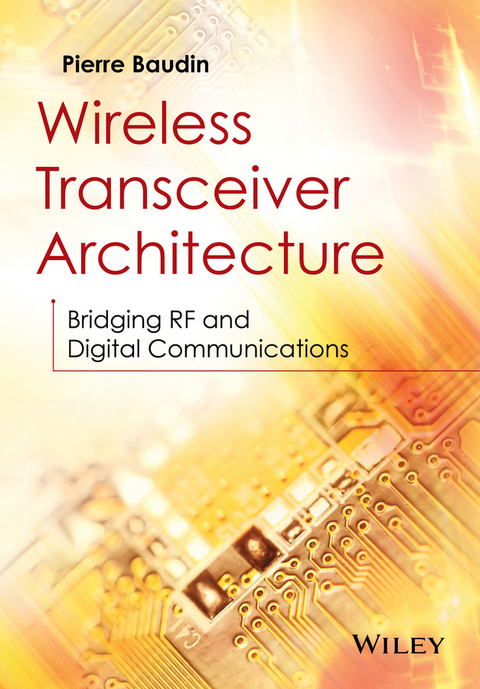
Wireless Transceiver Architecture (eBook)
Many books exist which concentrate on the physical implementation of the RF/analogue part of transceivers, such as the CMOS design, or on the digital signal processing required in the digital communication area. However, there is little material dedicated to the transceiver architecture and system design itself. Similarly, much of the existing literature focuses on the concepts useful for the dimensioning, but without much practical information on how to proceed (as would be required to start a project from scratch, as required by a beginner) and on the reasons for proceeding that way. This book redresses the balance. In it the author explains the why and the how about the architecture of transceivers and their dimensioning from the perspective of a RFIC architect, from within industry itself.
The first part looks at what is expected from a transceiver. The goal is to derive the minimum set of signal processing functions to be embedded in the system as well as the system constraints to be considered/fulfilled. Practically speaking, this part is composed of 3 chapters dedicated to digital communication theory, electromagnetism theory, and wireless networks organization through the coexistence with other users. The second part of the book considers the limitations of the physical implementation, using electronic devices, of the set of functions derived in the first part of the book. Those limitations have been sorted in 3 groups leading to 3 chapters dedicated to noise, nonlinearity and RF Impairments.
The third part of the book is fully dedicated to the transceiver system design and architecture in itself. The author explains how to dimension a transceiver that fulfils the requirements derived in the first part of the book whilst taking into account the implementation limitations reviewed in the second part. It also leads to 3 chapters dedicated to budgeting a transceiver, transceivers architectures, and algorithms for transceivers: i.e. how the use of dedicated algorithms can also help to overcome some limitations in given architectures. By the end of book the reader will be able to understand simple formulations, and results that can be used easily in a spread sheet tool to perform transceiver budgets. These derivations allow a deep understanding of the mechanisms in action in real physical implementations. The idea is that the reader can gain a good enough understanding of the problems encountered in practical situations in order to react correctly, providing a real understanding of the impact of each contributor to the overall degradation of the signal.
A fully comprehensive reference combining digital communications and RFIC (Radio Frequency Integrated Circuits) in one complete volume There are many books which focus on the physical implementation of the RF/analog part of transceivers, such as the CMOS design, or the signal processing involved in digital communications. However, there islittle material dedicated to transceiver architecture and system design. Similarly, much of the existing literature looks at concepts useful for dimensioning, yet offers little practical information on how to proceed for dimensioning a line-up from scratch, and on the reasons for proceeding that way. This book redresses the balance by explaining the architecture of transceivers and their dimensioning from the perspective of a RFIC architect from within industry. It bridges the gap between digital communication systems and radiofrequency integrated circuit design, covering wireless transceiver architecture and system design from both system level and circuit designer aspects. Covers digital communication theory, electromagnetism theory and wireless networks organization, from theories to implementation, for deriving the minimum set of constraints to be fulfilled by transceivers Details the limitations in the physical implementation of transceivers to be considered for their dimensioning, in terms of noise, nonlinearity, and RF impairments Presents transceiver architecture and system design in terms of transceivers budgets, transceivers architectures, and algorithms for transceivers
Pierre Baudin received his MSc degree in radiocommunications from the École Supérieure d'Électricité (Supélec) in 1994. He then served as a microwave R&D engineer working on electromagnetic stealth problems for the Commissariat à l'Énergie Atomique during military service. In 1995 he joined Thomson-CSF (now part of Thales) as an antenna designer working on antenna modeling, antenna array synthesis and signal processing for antenna arrays. In 2000 he joined STMicroelectronics, and then Renesas Electronics in 2007 (Renesas Mobile Corporation since 2010) to work as a RFIC and RF system architect in charge of multimode systems for cellular applications. He is now working as a consultant.
Foreword ix
Glossary xiv
I Somewhere between Maxwell and Shannon 1
Chapter 1. The digital communications point of view 3
1.1 Bandpass signal representation 4
1.2 Bandpass noise representation 36
1.3 Digital modulations examples 48
1.4 First transceivers architecture 73
Chapter 2. The Electromagnetism point of view 79
2.1 Free space radiation 79
2.2 Conducted propagation 107
2.3 The propagation channel 126
Chapter 3. The wireless standards point of view 161
3.1 Medium access strategies 161
3.2 Metrics for transmitters 169
3.3 Metrics for receivers 187
II Implementation limitations 205
Chapter 4. Noise 207
4.1 Analogue electronic noises 208
4.2 Noisy devices characterization 211
4.3 LO phase noise 259
4.4 Linear EVM 294
4.5 Quantization noise 298
4.6 Analogue vs. digital worlds conversions 322
Chapter 5. Nonlinearity 345
5.1 Smooth AM-AM conversion 346
5.2 Hard AM-AM conversion 440
5.3 AM-PM conversion, memory effect 449
5.4 Baseband devices 464
Chapter 6. RF Impairments 467
6.1 Frequency conversion 468
6.2 Gain and phase imbalance 489
6.3 Mixers implementation 508
6.4 Frequency planning 540
6.5 DC offset, LO leakage 548
III Transceivers dimensioning 553
Chapter 7. Transceivers budgets 555
7.1 Considered transceiver architecture 556
7.2 Budgeting a transmitter 557
7.3 Budgeting a receiver 599
Chapter 8. Transceivers architectures 661
8.1 Transmitters 661
8.2 Receivers 717
Chapter 9. Algorithms for transceivers 735
9.1 Transmit side 735
9.2 Receive side 774
Appendix 1. Correlations 799
Appendix 2. Stationarity 809
Appendix 3. Moments of normal random vectors 815
Bibliography 821
Index 829
1
The Digital Communications Point of View
When detailing how to dimension a transceiver, it can seem natural to first clarify what is expected from such a system. This means understanding both the minimum set of functions that need to be implemented in a transceiver line-up as well as the minimum performance expected from them. In practice, these requirements come from different topics which can be sorted into three groups. We can indeed refer to the signal processing associated with the modulations encountered in digital communications, to the physics of the medium used for the propagation of the information, and to the organization of wireless networks when considering a transceiver that belongs to such system, or alternatively its coexistence with such systems.
The last two topics are discussed in Chapter 2 and Chapter 3 respectively, while this chapter focuses on the consequences for transceiver architectures of the signal processing associated with the digital communications. In that perspective, a first set of functions to be embedded in such a system can be derived from the inspection of the relationship that holds between the modulating waveforms used in this area and the corresponding modulated RF signals to be propagated in the channel medium.
As a side effect, this approach enables us to understand how information that needs a complex baseband modulating signal to be represented can be carried by a simple real valued RF signal, thus leading to the key concept of the complex envelope. It is interesting to see that this concept allows us to define correctly classical quantities used to characterize RF signals and noise, in addition to its usefulness for performing analytical derivations. It is therefore used extensively throughout this book.
Finally, in this chapter we also review some particular modulation schemes that are representative of the different statistics that can be encountered in classical wireless standards. These schemes are then used as examples to illustrate subsequent derivations in this book.
1.1 Bandpass Signal Representation
1.1.1 RF Signal Complex Modulation
Digital modulating waveforms in their most general form are represented by a complex signal function of time in digital communications books [1]. But, even if we understand that this complex signal allows us to increase the number of bits per second that can be transmitted by working on symbols using this two-dimensional space, a question remains. The final RF signal that carries the information, like the RF current or voltage generated at the transmitter (TX) output, is a real valued signal like any physical quantity that can be measured. Accordingly, we may wonder how the information that needs a complex signal to be represented can be carried by such an RF signal. Any RF engineer would respond by saying that an electromagnetic wave has an amplitude and a phase that can be modulated independently. Nevertheless, we can anticipate the discussion in Chapter 2, and in particular in Section 2.1.2, by saying that there is nothing in the electromagnetic theory that requires this particular structure for the time dependent part of the electromagnetic field. In fact, the right argument remains that this time dependent part, like any real valued signal, can be represented by two independent quantities that can be interpreted as its instantaneous amplitude and its instantaneous phase as long as it is a bandpass signal. Here, “bandpass signal” means that the spectral content of the signal has no low frequency component that spreads down to the zero frequency. In other words, the spectrum of the RF signal considered, whose positive and negative sidebands are assumed centered around ± ωc, must be non-vanishing only for angular frequencies in [ − ωu − ωc, −ωc + ωl]∪[ + ωc − ωl, +ωc + ωu], with ωc, ωl and ωu defined as positive quantities, and with ωc > ωl.
To understand this behavior, let us consider the complex baseband signal expressed as
where p (t) and q (t) are respectively the real and imaginary parts of this complex signal. We can assume that the spectrum of this signal spreads over [ − ωl, +ωu]. Such baseband signals with a non-vanishing DC component in their spectrum are called lowpass signals in contrast to the bandpass signals as given above. If we now wish to shift the spectrum of this signal around the central carrier angular frequency + ωc, we have to convolve its spectrum with the Dirac delta distribution δ(ω − ωc). In the time domain, this means multiplying the signal by the Fourier transform of this Dirac delta distribution, i.e. the complex exponential [2]. This results in the complex signal sa(t) defined by
Suppose now that we take the real part of this signal. Using
we get the classical form of the resulting RF signal s(t) we are looking for,
But what is interesting to see is that even if we took only the real part of the upconverted initial complex lowpass signal transposed around + ωc, we have no loss of information compared to the initial complex baseband signal as long as ωc > ωl. Indeed, under that condition, the original complex modulating waveform can be reconstructed from the bandpass RF real signal s(t).
To understand this, let us first consider the spectral content of the resulting bandpass signal s(t). What would be a good mathematical tool to choose for the spectral analysis? Dealing with digital modulations that are randomly modulated most of the time, the natural choice would be to use the stochastic approach to derive the signal power spectral density. The problem with this approach is that the power spectral density (PSD) of a signal is only linked to the modulus of the Fourier transform of the original signal. It thus leads to a loss of information compared to the time domain signal. As a result, in some cases of interest in this book, we need to keep the simple Fourier transform representation in order to be able to discuss the phase relationship between different sidebands present in the spectrum. Here, by “sideband” we mean a non-vanishing portion of spectrum of finite frequency support. This phase relationship is indeed required to understand the underlying phenomenon involved in concepts as reviewed in this chapter, but also in Chapter 6, for instance, when dealing with frequency conversion and image rejection. The existence of such Fourier transforms can be justified thanks to the practical finite temporal support of the signals of interest that ensures a finite energy. This is indeed the practical use case when dealing with the post-processing of a finite duration measurement or simulation result. The signals we deal with are therefore assumed to have a finite temporal support and a finite energy, i.e. they are assumed to belong to L2[0, T], the space of square-integrable functions over the bounded interval [0, T]. Nevertheless, when dealing with a randomly modulated signal, this approach means that we consider only the spectral properties of a single realization of the process of interest. Thus, even if this direct Fourier analysis is suitable for discussing some signal processing operations involved in transceivers, the power spectral analysis should be considered when possible for taking into account the statistical properties of the modulating process of interest, as done in “Power spectral density” (Section 1.1.3).
Let us therefore derive the Fourier transform of s(t). As the aim is to make the link between the spectral representation of s(t) and that of , we can first expand the relationship between s(t) and the complex signal sa(t) given by equation (1.4). To do so, we use the general property that for any complex number , we have
where stands for the complex conjugate of . This means that we can write
Using the relationship between sa(t) and given by equation (1.2), we finally get that
It now remains to take the Fourier transform of this signal. For that, we can use two properties of the Fourier transform. The first states that for any signal, , the Fourier transform of the complex conjugate, , of such a signal can be related to that of through
We observe that this derivation remains valid when reduces to a real signal s(t). In that case, having s*(t) = s(t) leads to having S*( − ω) = S(ω). We then recover the classical property of real signals, i.e. the Hermitian symmetry of their spectrum. Then we can use the property that the Fourier transform of a product of signals is equal to the convolution of the Fourier transforms of each signal. Indeed, we get that
i.e. that
Thus, using the two properties above, we get that the Fourier transform of equation (1.7) reduces to
where1 stands...
| Erscheint lt. Verlag | 7.10.2014 |
|---|---|
| Sprache | englisch |
| Themenwelt | Technik ► Elektrotechnik / Energietechnik |
| Technik ► Nachrichtentechnik | |
| Schlagworte | Circuits • CMOS • communications • Comprehensive • Design • Drahtlose Kommunikation • Electrical & Electronics Engineering • Elektrotechnik u. Elektronik • existing • frequency integrated • Fully • islittle material • Literature • many • Mikrowellen- u. Hochfrequenztechnik u. Theorie • Mobile & Wireless Communications • Part • Processing • Radio • Reference • RFIC • RF / Microwave Theory & Techniques • Signal Processing • Signalverarbeitung • transceiver architecture • Transceivers • Volume |
| ISBN-13 | 9781118874790 / 9781118874790 |
| Informationen gemäß Produktsicherheitsverordnung (GPSR) | |
| Haben Sie eine Frage zum Produkt? |
 EPUB (Adobe DRM)
Kopierschutz: Adobe-DRM
Adobe-DRM ist ein Kopierschutz, der das eBook vor Mißbrauch schützen soll. Dabei wird das eBook bereits beim Download auf Ihre persönliche Adobe-ID autorisiert. Lesen können Sie das eBook dann nur auf den Geräten, welche ebenfalls auf Ihre Adobe-ID registriert sind.
Details zum Adobe-DRM
Dateiformat: EPUB (Electronic Publication)
EPUB ist ein offener Standard für eBooks und eignet sich besonders zur Darstellung von Belletristik und Sachbüchern. Der Fließtext wird dynamisch an die Display- und Schriftgröße angepasst. Auch für mobile Lesegeräte ist EPUB daher gut geeignet.
Systemvoraussetzungen:
PC/Mac: Mit einem PC oder Mac können Sie dieses eBook lesen. Sie benötigen eine
eReader: Dieses eBook kann mit (fast) allen eBook-Readern gelesen werden. Mit dem amazon-Kindle ist es aber nicht kompatibel.
Smartphone/Tablet: Egal ob Apple oder Android, dieses eBook können Sie lesen. Sie benötigen eine
Geräteliste und zusätzliche Hinweise
Buying eBooks from abroad
For tax law reasons we can sell eBooks just within Germany and Switzerland. Regrettably we cannot fulfill eBook-orders from other countries.
aus dem Bereich