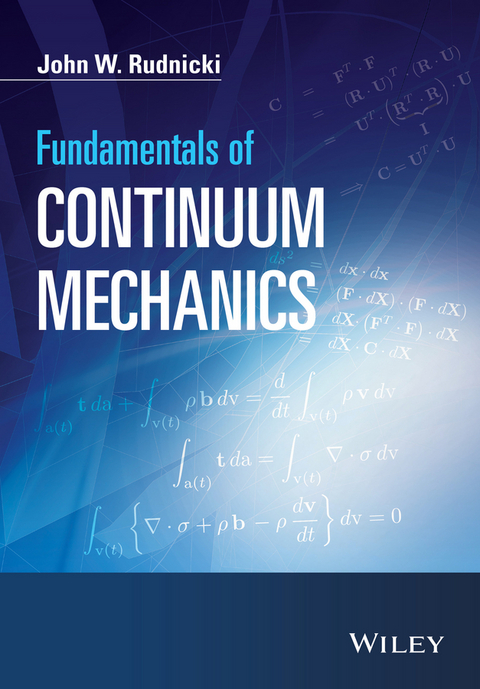
Fundamentals of Continuum Mechanics (eBook)
John Wiley & Sons (Verlag)
978-1-118-92767-0 (ISBN)
A concise introductory course text on continuum mechanics
Fundamentals of Continuum Mechanics focuses on the fundamentals of the subject and provides the background for formulation of numerical methods for large deformations and a wide range of material behaviours. It aims to provide the foundations for further study, not just of these subjects, but also the formulations for much more complex material behaviour and their implementation computationally.
This book is divided into 5 parts, covering mathematical preliminaries, stress, motion and deformation, balance of mass, momentum and energy, and ideal constitutive relations and is a suitable textbook for introductory graduate courses for students in mechanical and civil engineering, as well as those studying material science, geology and geophysics and biomechanics.
- A concise introductory course text on continuum mechanics
- Covers the fundamentals of continuum mechanics
- Uses modern tensor notation
- Contains problems and accompanied by a companion website hosting solutions
- Suitable as a textbook for introductory graduate courses for students in mechanical and civil engineering
John W. Rudnicki received his bachelor, master’s and PhD degrees from Brown University in the USA, the last in 1977. He has been on the faculty of Northwestern University since 1981, where he is now Professor of Civil and Environmental Engineering and Mechanical Engineering. He is a Fellow of the American Society of Mechanical Engineers. He has been awarded the Biot Medal from the American Society of Civil Engineers, the Brown Engineering Alumni Medal, the Daniel C. Drucker Medal from the American Society of Mechanical Engineers, and the Engineering Science Medal from the Society of Engineering Science. His research has been primarily in geomechanics, specifically the inelastic behavior and failure of geomaterials. He has been especially interested in deformation instabilities in brittle rocks and granular media, including their interactions with pore fluids, with applications to the mechanics of earthquakes and environment- and resource-related geomechanics
John W. Rudnicki received his bachelor, master's and PhD degrees from Brown University in the USA, the last in 1977. He has been on the faculty of Northwestern University since 1981, where he is now Professor of Civil and Environmental Engineering and Mechanical Engineering. He is a Fellow of the American Society of Mechanical Engineers. He has been awarded the Biot Medal from the American Society of Civil Engineers, the Brown Engineering Alumni Medal, the Daniel C. Drucker Medal from the American Society of Mechanical Engineers, and the Engineering Science Medal from the Society of Engineering Science. His research has been primarily in geomechanics, specifically the inelastic behavior and failure of geomaterials. He has been especially interested in deformation instabilities in brittle rocks and granular media, including their interactions with pore fluids, with applications to the mechanics of earthquakes and environment- and resource-related geomechanics
"Motivated students will benefit from this systematic, disciplined and concise treatment of the fundamentals of continuum mechanics. Many practitioners will also appreciate the logical organization, and the lucid descriptions of such matters as the distinctions between the various common stress and strain measures." (Pure and Applied Geophysics, 1 November 2015)
1
Vectors
Some physical quantities are described by scalars, e.g., density, temperature, kinetic energy. These are pure numbers, although they do have dimensions. It would make no physical sense to add a density, with dimensions of mass divided by length cubed, to kinetic energy, with dimensions of mass times length squared divided by time squared.
Vectors are mathematical objects that are associated with both a magnitude, described by a number, and a direction. An important property of vectors is that they can be used to represent physical entities such as force, momentum, and displacement. Consequently, the meaning of the vector is (in a sense we will make more precise) independent of how it is represented. For example, if someone punches you in the nose, this is a physical action that could be described by a force vector. The physical action and its result (a sore nose) are independent of the particular coordinate system we use to represent the force vector. Hence, the meaning of the vector is not tied to any particular coordinate system or description. For this reason, we will introduce vectors in coordinate-free form and defer description in terms of particular coordinate systems.
A vector u can be represented as a directed line segment, as shown in Figure 1.1. The length of the vector is its magnitude, and denoted by u or by |u|. Multiplying a vector by a positive scalar α changes the length of the vector but not its orientation. If α > 1, the vector αu is longer than u; if α < 1, αu is shorter than u. If α is negative, the orientation of the vector is reversed. It is always possible to form a vector of unit magnitude by choosing α = u− 1.
Figure 1.1 Multiplication of a vector by a scalar.
The addition of two vectors u and v can be written as
Although the same symbol is used as for ordinary addition, the meaning here is different. Vectors add according to the parallelogram law shown in Figure 1.2. If the “tails” of the vectors (the ends without arrows) are placed at a point, the sum is the diagonal of the parallelogram with sides formed by the vectors. Alternatively the vectors can be added by placing the “tail” of one at the “head” of the other. The sum is then the vector directed from the free “tail” to the free “head.” Implicit in both of these operations is the idea that we are dealing with “free” vectors. In order to add two vectors, they can be moved, keeping the length and orientation, so that the vectors can be connected head to tail. It is clear from the construction in Figure 1.2 that vector addition is commutative:
Figure 1.2 Addition of two vectors.
Note the importance of distinguishing vectors from scalars; without the bold face denoting vectors, equation (1.1) would be incorrect: the magnitude of w is not the sum of the magnitudes of u and v.
The parallelogram rule for vector addition follows from the nature of the physical quantities, e.g., velocity and force, that vectors represent. The rule for addition is an essential element of the definition of a vector that can distinguish them from other quantities that have both length and direction. For example, finite rotations about three orthogonal axes can be characterized by length and magnitude. Finite rotation cannot, however, be a vector because addition is not commutative. To see this, take a book with its front cover up and binding to the left. Looking down on the book, rotate it 90° counterclockwise. Now rotate the book 90° about a horizontal axis counterclockwise looking from the right. The binding should be on the bottom. Performing these two rotations in reverse order will orient the binding toward you.
Hoffmann (1975) relates the story of a tribe that thought spears were vectors because they had length and magnitude. To kill a deer to the northeast, they would throw two spears, one to the north and one to the east, depending on the resultant to strike the deer. Not surprisingly, there is no trace of this tribe, which only confirms the adage that “a little knowledge can be a dangerous thing.”
The procedure for vector subtraction follows from multiplication by a scalar and addition. To subtract v from u, first multiply v by − 1, then add − v to u:
There are two ways to multiply vectors: the scalar or dot product and the vector or cross product. The scalar product is given by
where θ is the angle between u and v. As indicated by the name, the result of this operation is a scalar. As shown in Figure 1.3, the scalar product is the magnitude of v multiplied by the projection of u onto v, or vice versa. The definition (1.2) combined with rules for vector addition and multiplication of a vector by a scalar yield the relation
where α and β are scalars and u1 and u2 are vectors.
Figure 1.3 Scalar product.
If θ = π in (1.2) the two vectors are opposite in sense, i.e., their arrows point in opposite directions. If θ = π/2 or − π/2, the scalar product is zero and the two vectors are orthogonal. Although the scalar product is zero neither u nor v is zero. If, however,
for any vector v then u = 0.
The other way to multiply vectors is the vector or cross product. The result is a vector
The magnitude is w = uvsin (θ), where θ is again the angle between u and v. As shown in Figure 1.4, the magnitude of the cross product is equal to the area of the parallelogram formed by u and v. As depicted in Figure 1.5, the direction of w is perpendicular to the plane formed by u and v and the sense is given by the right hand rule: If the fingers of the right hand are in the direction of u and then curled in the direction of v, the thumb of the right hand is in the direction of w. The three vectors u, v, and are said to form a right-handed system.
Figure 1.4 Magnitude of the vector or cross product.
Figure 1.5 Direction of vector or cross product.
The triple scalar product (u × v) · w is equal to the volume of the parallelepiped formed by u, v, and w if they are right-handed and the negative of the volume if they are not (Figure 1.6). The parentheses in this expression may be omitted because it makes no sense if the dot product is taken first: the result is a scalar and the cross product is an operation between two vectors.
Figure 1.6 Triple scalar product.
Now consider the triple vector product u ×(v × w). The vector v × w must be perpendicular to the plane containing v and w. Hence, the vector product of v × w with another vector u must result in a vector that is in the plane of v and w. Consequently, the result of this operation may be represented as
where α and β are scalars.
1.1 Examples
1.1.1
Show that if the triple scalar product vanishes
the three vectors are coplanar.
The scalar product u × v is perpendicular to u and v. If the triple scalar product vanishes, then w is perpendicular to u × v and hence is in the plane of u and v. Consequently, w can be expressed as a linear combination of the other two, e.g., w = αu + βv where α and β are scalars (as long as u and v are not collinear).
1.1.2
Show that if w = αu + βv the triple scalar product of the three vectors vanishes.
Substituting w into (1.6) yields zero because the scalar products of u × v with v and with u are zero.
Figure 1.7 Diagram for Problem 1.6.
Figure 1.8 Diagram for Problem 1.7.
Figure 1.9 Diagram for Problem 1.10.
Exercises
-
Explain (in words and/or diagrams) why
and that
where w = u × v.
-
Explain (in words and/or diagrams) why
but that a minus sign is introduced if the order of any two vectors is reversed.
-
Explain why u × (v × u) is orthogonal to u and show that α and β in (1.5) are then related by
where θ is the angle between u and v.
-
Prove that if (1.3) is satisfied for any vector v then u =...
| Erscheint lt. Verlag | 22.9.2014 |
|---|---|
| Sprache | englisch |
| Themenwelt | Naturwissenschaften ► Physik / Astronomie ► Mechanik |
| Technik ► Maschinenbau | |
| Schlagworte | Angewandte Mathematik • Applied mathematics • Assumptions • Bauingenieur- u. Bauwesen • Baustatik u. Baumechanik • Civil Engineering & Construction • continuous • Continuum • Course • Deformation • deformations • Festkörpermechanik • Festkörpermechanik • force • Framework • Free • Geometry • goal • Maschinenbau • Material • Materials • Mathematical • Mathematics • Mathematik • mechanical engineering • nevertheless • possible • Problem • Real • solid mechanics • Special • Structural Theory & Structural Mechanics • Transmission • Type • Types |
| ISBN-10 | 1-118-92767-2 / 1118927672 |
| ISBN-13 | 978-1-118-92767-0 / 9781118927670 |
| Informationen gemäß Produktsicherheitsverordnung (GPSR) | |
| Haben Sie eine Frage zum Produkt? |
 EPUB (Adobe DRM)
Kopierschutz: Adobe-DRM
Adobe-DRM ist ein Kopierschutz, der das eBook vor Mißbrauch schützen soll. Dabei wird das eBook bereits beim Download auf Ihre persönliche Adobe-ID autorisiert. Lesen können Sie das eBook dann nur auf den Geräten, welche ebenfalls auf Ihre Adobe-ID registriert sind.
Details zum Adobe-DRM
Dateiformat: EPUB (Electronic Publication)
EPUB ist ein offener Standard für eBooks und eignet sich besonders zur Darstellung von Belletristik und Sachbüchern. Der Fließtext wird dynamisch an die Display- und Schriftgröße angepasst. Auch für mobile Lesegeräte ist EPUB daher gut geeignet.
Systemvoraussetzungen:
PC/Mac: Mit einem PC oder Mac können Sie dieses eBook lesen. Sie benötigen eine
eReader: Dieses eBook kann mit (fast) allen eBook-Readern gelesen werden. Mit dem amazon-Kindle ist es aber nicht kompatibel.
Smartphone/Tablet: Egal ob Apple oder Android, dieses eBook können Sie lesen. Sie benötigen eine
Geräteliste und zusätzliche Hinweise
Buying eBooks from abroad
For tax law reasons we can sell eBooks just within Germany and Switzerland. Regrettably we cannot fulfill eBook-orders from other countries.
aus dem Bereich