Timothy Verstynen is assistant professor in the Department of Psychology and at the Center for the Neural Basis of Cognition at Carnegie Mellon University. Bradley Voytek is assistant professor of computational cognitive science and neuroscience at the University of California, San Diego. They are both members of the Zombie Research Society.
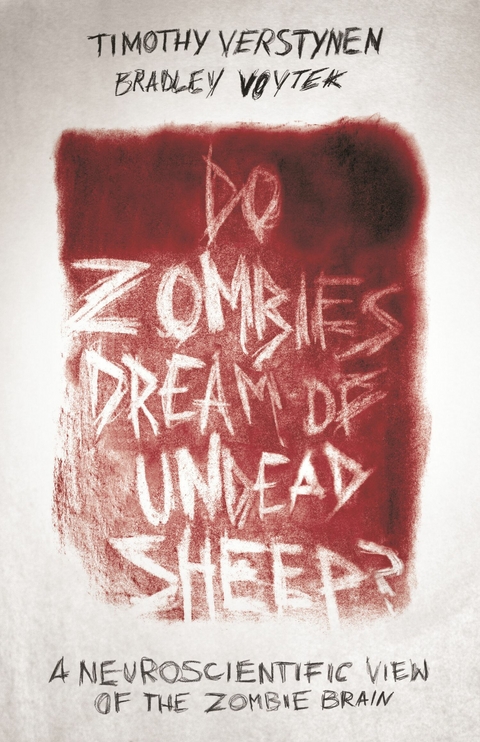
A look at the true nature of the zombie brainEven if you've never seen a zombie movie or television show, you could identify an undead ghoul if you saw one. With their endless wandering, lumbering gait, insatiable hunger, antisocial behavior, and apparently memory-less existence, zombies are the walking nightmares of our deepest fears. What do these characteristic behaviors reveal about the inner workings of the zombie mind? Could we diagnose zombism as a neurological condition by studying their behavior? In Do Zombies Dream of Undead Sheep?, neuroscientists and zombie enthusiasts Timothy Verstynen and Bradley Voytek apply their neuro-know-how to dissect the puzzle of what has happened to the zombie brain to make the undead act differently than their human prey.Combining tongue-in-cheek analysis with modern neuroscientific principles, Verstynen and Voytek show how zombism can be understood in terms of current knowledge regarding how the brain works. In each chapter, the authors draw on zombie popular culture and identify a characteristic zombie behavior that can be explained using neuroanatomy, neurophysiology, and brain-behavior relationships. Through this exploration they shed light on fundamental neuroscientific questions such as: How does the brain function during sleeping and waking? What neural systems control movement? What is the nature of sensory perception?Walking an ingenious line between seriousness and satire, Do Zombies Dream of Undead Sheep? leverages the popularity of zombie culture in order to give readers a solid foundation in neuroscience.
Timothy Verstynen is assistant professor in the Department of Psychology and at the Center for the Neural Basis of Cognition at Carnegie Mellon University. Bradley Voytek is assistant professor of computational cognitive science and neuroscience at the University of California, San Diego. They are both members of the Zombie Research Society.
| Erscheint lt. Verlag | 22.9.2014 |
|---|---|
| Zusatzinfo | 16 line illus. |
| Verlagsort | Princeton |
| Sprache | englisch |
| Themenwelt | Sachbuch/Ratgeber ► Natur / Technik |
| Geisteswissenschaften ► Psychologie ► Allgemeine Psychologie | |
| Naturwissenschaften ► Biologie ► Humanbiologie | |
| Naturwissenschaften ► Biologie ► Zoologie | |
| Technik | |
| Schlagworte | Action potential • Aggression • alien hand syndrome • Amnesia • anatomy • Anterograde amnesia • Aphasia • Arcuate fasciculus • Arousal • Atrophy • Attention Deficit Hyperactivity Disorder • auditory cortex • axon • basal ganglia • Basic science (psychology) • Behavior • brain damage • Brainstem • Capgras delusion • cerebellum • circulatory system • Cognition • Disease • eardrum • Electroencephalography • expressive aphasia • Eye • frontal lobe • Fusiform gyrus • Globus pallidus • Gyrus • hippocampus • Hormone • Human Brain • hypersexuality • hypothalamic–pituitary–adrenal axis • Hypothalamus • Injury • Lateralization of brain function • lesion • long-term memory • Magnetic Resonance Imaging • Memory • midbrain • Molecule • Motor Cortex • Muscle • Neocortex • Neuroglia • neuroimaging • Neurological disorder • Neurology • Neuron • Neuroscience • neuroscientist • neurosurgery • Neurotransmitter • occipital lobe • Orbitofrontal cortex • paralysis • parietal lobe • Parkinson's Disease • Phrenology • prefrontal cortex • primary motor cortex • Procedural memory • Processing (Chinese materia medica) • prosopagnosia • Psychiatry • rapid eye movement sleep • Receptive aphasia • Reticular activating system • retina • Scientist • Sense • Shaun of the Dead • sibling • Simultanagnosia • sleep disorder • spinal cord • Stimulation • Stimulus (physiology) • Striatum • Substantia Nigra • Subthalamic nucleus • Superior colliculus • Symptom • syndrome • temporal lobe • Thalamus • therapy • Thought • Toxoplasma gondii • Tuberomammillary nucleus • Ventrolateral preoptic nucleus • Visual cortex • Visual system • wakefulness • Wernicke's area • World War Z |
| ISBN-10 | 1-4008-5192-0 / 1400851920 |
| ISBN-13 | 978-1-4008-5192-8 / 9781400851928 |
| Informationen gemäß Produktsicherheitsverordnung (GPSR) | |
| Haben Sie eine Frage zum Produkt? |
 PDF (Wasserzeichen)
Größe: 1,8 MB
DRM: Digitales Wasserzeichen
Dieses eBook enthält ein digitales Wasserzeichen und ist damit für Sie personalisiert. Bei einer missbräuchlichen Weitergabe des eBooks an Dritte ist eine Rückverfolgung an die Quelle möglich.
Dateiformat: PDF (Portable Document Format)
Mit einem festen Seitenlayout eignet sich die PDF besonders für Fachbücher mit Spalten, Tabellen und Abbildungen. Eine PDF kann auf fast allen Geräten angezeigt werden, ist aber für kleine Displays (Smartphone, eReader) nur eingeschränkt geeignet.
Systemvoraussetzungen:
PC/Mac: Mit einem PC oder Mac können Sie dieses eBook lesen. Sie benötigen dafür einen PDF-Viewer - z.B. den Adobe Reader oder Adobe Digital Editions.
eReader: Dieses eBook kann mit (fast) allen eBook-Readern gelesen werden. Mit dem amazon-Kindle ist es aber nicht kompatibel.
Smartphone/Tablet: Egal ob Apple oder Android, dieses eBook können Sie lesen. Sie benötigen dafür einen PDF-Viewer - z.B. die kostenlose Adobe Digital Editions-App.
Buying eBooks from abroad
For tax law reasons we can sell eBooks just within Germany and Switzerland. Regrettably we cannot fulfill eBook-orders from other countries.
 EPUB (Adobe DRM)
Kopierschutz: Adobe-DRM
Adobe-DRM ist ein Kopierschutz, der das eBook vor Mißbrauch schützen soll. Dabei wird das eBook bereits beim Download auf Ihre persönliche Adobe-ID autorisiert. Lesen können Sie das eBook dann nur auf den Geräten, welche ebenfalls auf Ihre Adobe-ID registriert sind.
Details zum Adobe-DRM
Dateiformat: EPUB (Electronic Publication)
EPUB ist ein offener Standard für eBooks und eignet sich besonders zur Darstellung von Belletristik und Sachbüchern. Der Fließtext wird dynamisch an die Display- und Schriftgröße angepasst. Auch für mobile Lesegeräte ist EPUB daher gut geeignet.
Systemvoraussetzungen:
PC/Mac: Mit einem PC oder Mac können Sie dieses eBook lesen. Sie benötigen eine
eReader: Dieses eBook kann mit (fast) allen eBook-Readern gelesen werden. Mit dem amazon-Kindle ist es aber nicht kompatibel.
Smartphone/Tablet: Egal ob Apple oder Android, dieses eBook können Sie lesen. Sie benötigen eine
Geräteliste und zusätzliche Hinweise
Buying eBooks from abroad
For tax law reasons we can sell eBooks just within Germany and Switzerland. Regrettably we cannot fulfill eBook-orders from other countries.
aus dem Bereich