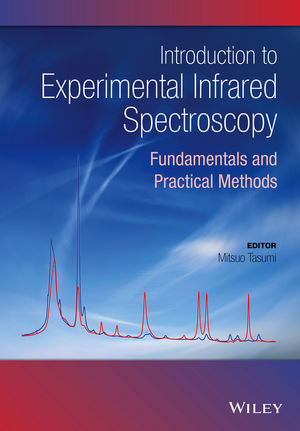
Introduction to Experimental Infrared Spectroscopy (eBook)
John Wiley & Sons (Verlag)
978-1-118-70354-0 (ISBN)
Infrared spectroscopy is generally understood to mean the science of spectra relating to infrared radiation, namely electromagnetic waves, in the wavelength region occurring intermediately between visible light and microwaves. Measurements of infrared spectra have been providing useful information, for a variety of scientific research and industrial studies, for over half a century; this is set to continue in the foreseeable future.
Introduction to Experimental Infrared Spectroscopy is intended to be a handy guide for those who have no, or limited, experience in infrared spectroscopic measurements but are utilising infrared-related methods for their research or in practical applications.
Written by leading researchers and experienced practitioners, this work consists of 22 chapters and presents the basic theory, methodology and practical measurement methods, including ATR, photoacoustic, IR imaging, NIR, 2D-COS, and VCD. The six Appendices will aid readers in understanding the concepts presented in the main text.
Written in an easy-to-understand way this book is suitable for students, researchers and technicians working with infrared spectroscopy and related methods.
Infrared spectroscopy is generally understood to mean the science of spectra relating to infrared radiation, namely electromagnetic waves, in the wavelength region occurring intermediately between visible light and microwaves. Measurements of infrared spectra have been providing useful information, for a variety of scientific research and industrial studies, for over half a century; this is set to continue in the foreseeable future. Introduction to Experimental Infrared Spectroscopy is intended to be a handy guide for those who have no, or limited, experience in infrared spectroscopic measurements but are utilising infrared-related methods for their research or in practical applications. Written by leading researchers and experienced practitioners, this work consists of 22 chapters and presents the basic theory, methodology and practical measurement methods, including ATR, photoacoustic, IR imaging, NIR, 2D-COS, and VCD. The six Appendices will aid readers in understanding the concepts presented in the main text. Written in an easy-to-understand way this book is suitable for students, researchers and technicians working with infrared spectroscopy and related methods.
Professor Mitsuo Tasumi has been an active researcher in the field of infrared and Raman spectroscopy for over 40 years. He obtained his degrees from the University of Tokyo, and did post-doctoral work at The University of Michigan and Politecnico di Milano. He is currently president of Saitama University. He has won many awards including: The Ellis R. Lippincott Award from the Optical Society of America, Society for Applied Spectroscopy, and Coblentz Society; (Outstanding Contributions to Vibrational Spectroscopy) (1999); The Purple Ribbon Medal from the Japanese Government (Studies on Physical Chemistry) (1999); Fellow of the Optical Society of America (2000); Honorary Membership Award from the Society for Applied Spectroscopy (2004); Fellow of the Society for Applied Spectroscopy (2004). He has, or is currently servingon the editorial boards of Journal of Molecular Structure; Vibrational Spectra and Structure; Spectrochimica Acta; Journal of Raman Spectroscopy; Comprehensive Polymer Science; Vibrational Spectroscopy, a Section of Analytica Chimica Acta; Biopolymers/Biospectroscopy. He has published numerous papers and book chapters and presented the prestigious "Raman-Mizushima Lecture" in 2006.
List of Contributors ix
Preface xi
Part I Fundamentals of Infrared Spectroscopic Measurements
1
1. Introduction to Infrared Spectroscopy 3
Mitsuo Tasumi
2. Sample Handling and Related Matters in Infrared Spectroscopic
Measurements 15
Akira Sakamoto
3. Quantitative Infrared Spectroscopic Analysis 29
Shukichi Ochiai
4. Principles of FT-IR Spectrometry 41
Koji Masutani
5. Hardware and Software in FT-IR Spectrometry 59
Koji Masutani
6. Computer Processing of Measured Infrared Spectra 83
Shukichi Ochiai
7. Chemometrics in Infrared Spectroscopic Analysis 97
Takeshi Hasegawa
Part II Practical Methods of Measurements 115
8. Reflection Measurements at Normal Incidence 117
Takeshi Hasegawa
9. External-Reflection Spectrometry for Thin Films and Surfaces
127
Takeshi Hasegawa
10. Reflection-Absorption Spectroscopy of Thin Layers on
Metal Surfaces 141
Koji Masutani and Shukichi Ochiai
11. Polarization-Modulation Spectrometry and its Application to
Reflection-Absorption Measurements 153
Koji Masutani
12. Diffuse-Reflection Measurements 169
Shukichi Ochiai
13. Attenuated Total Reflection Measurements 179
Shukichi Ochiai
14. Photoacoustic Spectrometry Measurements 199
Shukichi Ochiai
15. Emission Spectroscopic Measurements 209
Shukichi Ochiai
16. Infrared Microspectroscopic Measurements 223
Shukichi Ochiai and Hirofumi Seki
17. Infrared Microspectroscopic Imaging 241
Shigeru Shimada
18. Near-Infrared Spectroscopy 253
Masao Takayanagi
19. Far-Infrared Spectroscopy and Terahertz Time-Domain
Spectroscopy 269
Seizi Nishizawa
20. Time-Resolved Infrared Absorption Measurements 287
Akira Sakamoto
21. Two-Dimensional Correlation Spectroscopy 307
Shigeaki Morita, Hideyuki Shinzawa, Isao Noda, and Yukihiro
Ozaki
22. Vibrational Circular Dichroism 321
Yoshiaki Hamada
Part III Appendices 335
AppendixA The Speed, Frequency, Wavelength, and Wavenumber of an
Electromagnetic Wave 337
Mitsuo Tasumi
Appendix B Formulae Expressing the Electric Field of an
Electromagnetic Wave and Related Subjects 339
Mitsuo Tasumi
AppendixC Coherence of the Thermal Radiation 345
Mitsuo Tasumi
AppendixD Mathematical Methods in FT-IR Spectrometry 347
Mitsuo Tasumi
Appendix E Electromagnetic Pulse on the Time Axis and its
Spectrum 359
Mitsuo Tasumi
Appendix F Basic Concept of Two-Dimensional Correlation
Spectroscopy 363
Isao Noda
Index 375
"If your next assignment incorporates any aspect of infrared spectroscopy, then Introduction to experimental infrared spectroscopy: fundamentals and practical methods is for you. This book integrates both theory and practice to offer a comprehensive and balanced textbook." (Chemistry in Australia 2016)
Chapter 1
Introduction to Infrared Spectroscopy
Mitsuo Tasumi
Professor Emeritus, The University of Tokyo, Japan
1.1 Introduction
Infrared spectroscopy is a useful tool for molecular structural studies, identification, and quantitative analyses of materials. The advantage of this technique lies in its wide applicability to various problems in both the condensed phase and gaseous state. As described in the later chapters of this book, infrared spectroscopy is used in chemical, environmental, life, materials, pharmaceutical, and surface sciences, as well as in many technological applications. The purpose of this book is to provide readers with a practical guide to the experimental aspects of this versatile method.
In this chapter, introductory explanations are given on an infrared absorption spectrum and related basic subjects, which readers should understand before reading the later chapters, on the assumption that the readers have no preliminary knowledge of infrared spectroscopy.
As is well known, visible light is absorbed by various materials and the absorption of visible light is associated with the colors of materials. Blue materials absorb radiation with a red color, and red materials absorb radiation with a blue color. The wavelengths of radiation with a red color are longer than those with a blue color. A diagram showing quantitatively the absorption of visible light at different wavelengths from violet to red is called a visible absorption spectrum. The visible absorption spectrum closely reflects the color of the material from which the spectrum is measured.
The wavelengths of infrared radiation are longer than those of radiation with red color. Radiation with red color has the longest wavelengths among visible light, the wavelength of which increases from violet to red. Infrared radiation, though not detectable by human eyes, is absorbed by almost all materials. An infrared spectrum is a plot quantitatively showing the absorption of infrared radiation against the wavelength of infrared radiation. It is usually possible to observe an infrared absorption spectrum from any material except metals, regardless of whether the sample is in the gaseous, liquid, or solid state. This advantage makes infrared spectroscopy a most useful tool, utilized for many purposes in various fields.
Measurements of infrared spectra are mostly done for liquid and solid samples. In the visible absorption spectra of liquids and solids, only one or two broad bands are typically observed but infrared absorption spectra show at least several, often many relatively sharp absorption bands. Most organic compounds have a significant number of infrared absorption bands. This difference between the visible and infrared absorption spectra is due to the different origins for the two kinds of spectra. Visible absorption is associated with the states of electrons in a molecule. By contrast, infrared absorptions arise from the vibrational states of atoms in a molecule. In other words, the visible absorption spectrum is an electronic spectrum and the infrared spectrum is a vibrational spectrum. Vibrational motions of atoms in a molecule are called molecular vibrations.
At present, measurements of infrared spectra are widely performed in materials science, life science, and surface science. In these fields, the states of targets of research are usually liquids or solids. This book primarily aims at describing the fundamentals of infrared spectroscopy and practical methods of measuring infrared spectra from various samples in the liquid and solid states.
1.2 Fundamentals of Infrared Spectroscopy
A basic knowledge of infrared spectroscopy that readers should have before performing infrared measurements is briefly described in this section.
1.2.1 The Ordinate and Abscissa Axes of an Infrared Spectrum
It has been known for a long time that vapors, liquids, crystals, powder, glass, and many other substances absorb infrared radiation. The wavelength region of infrared radiation is not strictly defined but the wavelength regions generally accepted for near-infrared, mid-infrared, and far-infrared radiation are as follows: 700 nm to 2.5 µm for near-infrared, 2.5–25 µm for mid-infrared, and 25 µm to 1 mm for far-infrared.
The absorption intensity is taken as the ordinate axis of an infrared spectrum. The wavelength can be used as the abscissa axis of an infrared spectrum. At present, however, it is customary, in the mid-infrared region in particular, to use the wavenumber as the abscissa axis instead of the wavelength. The wavenumber is the number of light waves per unit length (usually 1 cm) and corresponds to the reciprocal of the wavelength. The wavenumber used as the abscissa axis of an infrared spectrum is always expressed in units of cm−1. In this book, the abscissa axis of an infrared spectrum is always designated as “Wavenumber/cm−1.” It should be mentioned, however, that the wavelength is often used as the abscissa axis in the near-infrared region, if a near-infrared spectrum is measured as an extension of a visible absorption spectrum.
There are publications in which the higher wavenumber (corresponding to the shorter wavelength) is placed on the left side of a spectrum, whereas it is placed on the right side in other cases. This inconsistency has occurred because infrared spectra published before the 1950s used the wavelength as the abscissa axis and placed the longer wavelength (corresponding to the lower wavenumber) on the right side. Following this tradition, many infrared spectra published since the 1960s also have placed the higher wavenumber on the left side and the lower wavenumber on the right side. In recent years, however, infrared spectra in publications which feature the direction of the abscissa axis oppositely have been increasing in number.
The wavenumber, which is the number of light waves per centimeter as mentioned above, corresponds to the frequency divided by the speed of light. Therefore, the wavenumber is proportional to the energy E of a photon as expressed in the following equation:
where is the Planck constant, the speed of light, and the wavenumber of infrared radiation. This proportionality between and is the reason why the wavenumber is now used as the abscissa axis of an infrared spectrum. In Appendix A relations closely associated with Equation (1.1) are explained in detail.
The above-mentioned wavelength regions of infrared radiation correspond to the wavenumber regions of about 14 000–4000 cm−1 for near-infrared, 4000–400 cm−1 for mid-infrared, and 400–10 cm−1 for far-infrared.
The wavenumber region of 400–10 cm−1 for far-infrared corresponds to the frequency region of or . This means that the far-infrared region approximately coincides with the terahertz frequency region. For this reason, the term terahertz spectroscopy is recently being increasingly used in place of far-infrared spectroscopy. However, the term far-infrared spectroscopy is considered a better designation because of its consistency with other optical spectroscopies.
1.2.2 The Intensity of Infrared Radiation
As infrared radiation is an electromagnetic wave, electromagnetic theory is applicable to it. In this theory, the intensity of an electromagnetic wave irradiating an area is defined as the average energy of radiation per unit area per unit time. In this book, according to the tradition of spectroscopy, the term intensity is used for this quantity. It is worth pointing out, however, that the term irradiance is increasingly used in other fields instead of “intensity.” This quantity is given in units of W m−2 (= J s−1 m−2), although its absolute value is rarely discussed in infrared spectroscopy except when lasers are involved. The intensity I is proportional to the time average of the square of the amplitude of the electric field E. In vacuum, I is expressed as
where and denote, respectively, the electric constant and the speed of light in vacuum, and the symbol means time average. This relationship will be mentioned later in Section 1.2.4.
1.2.3 Lambert–Beer's Law
Let us consider the absorption of infrared radiation which occurs when an infrared beam passes through a sample layer. As shown in Figure 1.1, a collimated infrared beam with intensity at wavenumber irradiates a sample with thickness at right angles to its surface. If the sample is transparent to the infrared beam, the infrared beam passes through the sample without losing its intensity. Here, reflection of the infrared beam at the surface of the sample is not considered. If the sample absorbs the infrared radiation of wavenumber , the infrared intensity decreases as the beam passes through the sample. If the amount of the absorption by the thin layer in Figure 1.1 is expressed by (the minus sign reflects the fact that is a negative quantity corresponding to an intensity decrease), the following equation holds.
where is a proportionality constant representing the magnitude of absorption (called the absorption coefficient) and is the intensity of the beam entering the thin layer . Integration of Equation (1.2) gives the following equation.
where the integration constant a...
| Erscheint lt. Verlag | 15.9.2014 |
|---|---|
| Sprache | englisch |
| Themenwelt | Naturwissenschaften ► Chemie ► Analytische Chemie |
| Technik | |
| Schlagworte | Akira • Bildgebende Verfahren i. d. Biomedizin • biomedical engineering • Biomedical Imaging • Biomedizintechnik • Chemie • Chemistry • contributors • ftir spectrometry • Infrared • Infrarotspektroskopie • Introduction • Ix • List • materials characterization • Materials Science • Materialwissenschaften • Matters • measurements • MITSUO • Part • Principles • Quantitative • sakamoto • Sample • Spectroscopic • spectroscopy • Spektroskopie • tasumi • Werkstoffprüfung • Werkstoffprüfung |
| ISBN-10 | 1-118-70354-5 / 1118703545 |
| ISBN-13 | 978-1-118-70354-0 / 9781118703540 |
| Informationen gemäß Produktsicherheitsverordnung (GPSR) | |
| Haben Sie eine Frage zum Produkt? |
 EPUB (Adobe DRM)
Kopierschutz: Adobe-DRM
Adobe-DRM ist ein Kopierschutz, der das eBook vor Mißbrauch schützen soll. Dabei wird das eBook bereits beim Download auf Ihre persönliche Adobe-ID autorisiert. Lesen können Sie das eBook dann nur auf den Geräten, welche ebenfalls auf Ihre Adobe-ID registriert sind.
Details zum Adobe-DRM
Dateiformat: EPUB (Electronic Publication)
EPUB ist ein offener Standard für eBooks und eignet sich besonders zur Darstellung von Belletristik und Sachbüchern. Der Fließtext wird dynamisch an die Display- und Schriftgröße angepasst. Auch für mobile Lesegeräte ist EPUB daher gut geeignet.
Systemvoraussetzungen:
PC/Mac: Mit einem PC oder Mac können Sie dieses eBook lesen. Sie benötigen eine
eReader: Dieses eBook kann mit (fast) allen eBook-Readern gelesen werden. Mit dem amazon-Kindle ist es aber nicht kompatibel.
Smartphone/Tablet: Egal ob Apple oder Android, dieses eBook können Sie lesen. Sie benötigen eine
Geräteliste und zusätzliche Hinweise
Buying eBooks from abroad
For tax law reasons we can sell eBooks just within Germany and Switzerland. Regrettably we cannot fulfill eBook-orders from other countries.
aus dem Bereich