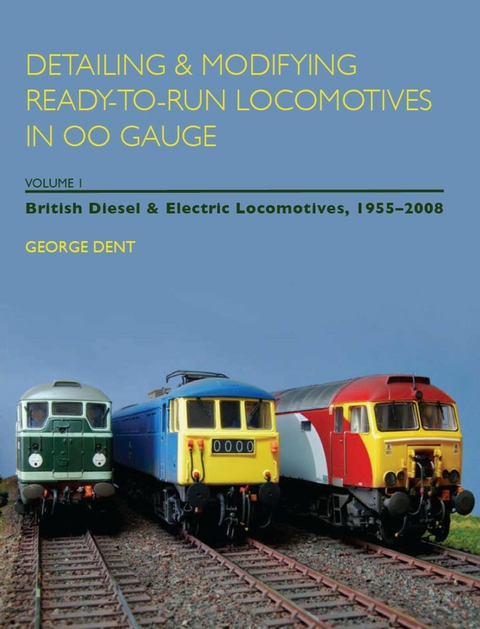
Detailing and Modifying Ready-to-Run Locomotives in 00 Gauge (eBook)
192 Seiten
Crowood (Verlag)
978-1-84797-851-6 (ISBN)
CHAPTER 1
Research
Many of us, when starting out in railway modelling, are driven by the desire to capture the essence of a certain moment or place. For me, it was travelling behind a pair of Class 37s between Shrewsbury and Dovey Junction in 1986. The remote landscape and lonely passing loops, plus the curiosity of each protracted station stop (the platforms being far too short to accommodate our train), all combined to leave a sharp imprint on the young mind of someone who had only known local urban train journeys in and around Merseyside.
Even before reaching our destination, I had resolved to build my first ‘real’ layout based on this route and I eventually settled on a representation of Welshpool, built along a shelf in my tiny bedroom. It was hardly an accurate recreation and the second-hand turnouts were a constant source of frustration, but it did set me along the road of layout construction and rolling stock enhancement. I never felt limited to running a particular range of locomotives or stock, although this was restricted to what I could afford with my pocket money. The odd seasonal gift, however, led to some un-prototypical traction and rolling stock finding its way through my own little bit of mid-Wales, although this didn’t bother me unduly at the time. This attitude stays with many of us throughout our modelling ‘careers’ and, if the hobby still brings enjoyment, then that is all that matters.
However, some feel called towards a higher degree of authenticity and the desire to push the boundaries of what is achievable in a scale model. This may not appeal to everyone, but there must surely be a collective desire for higher levels of detail and accuracy, as this is what appears to drive model manufacturers to strive for continuous improvement in their OO-gauge ranges. I accept that there may be some innovations that are industry-led (such as digital command control; DCC) but, on the whole, this is a consumer-driven business. Otherwise, I’m sure that manufacturers would still be pushing rather basic reproductions onto the market and saving themselves tens of thousands of pounds in research and development costs.
WHEN THE URGE STRIKES
Whether or not you’ve spent your hard-earned cash on the latest Bachmann Class 37, or are still hanging on to your Lima version, you may soon ask yourself if any improvements could be made. Alternatively, perhaps, it’s the realization that a particular locomotive is not (nor is likely to be) available off-the-shelf that has encouraged a desire to start tinkering.
Whatever improvements or modifications you may have envisaged, I wouldn’t recommend simply wielding a knife with gay abandon without first doing some research. This will stand you in good stead and, in this modern information age, there are plenty of outlets where an image of an individual locomotive can be found. Knowing where to look is the big secret, and the internet, in particular, has made life much easier; simply typing in the running number of a particular machine into a search engine (such as Google) will usually bring about some interesting results. There are some fantastic websites devoted to single locomotive classes that feature extensive image galleries, technical information, allocation histories and disposal details. See the Useful Sources Appendix for some examples.
The web is also home to many enthusiasts’ forums and societies, where like-minded people can get in touch and share their knowledge and experience. For those of a non-steam persuasion, DEMU (Diesel and Electric Modellers United) is probably the best port of call for anyone seeking help in this respect. Membership rates are cheap and there is a network of contacts and gatherings around the country, plus regular issues of the society’s journal UPDate.
There are, of course, plenty of magazine titles catering for the railway modeller, a couple of which concentrate solely on the diesel and electric (D&E) scene. Despite the post-steam era becoming much more popular, the only standalone D&E title of recent years, Modern Railway Modelling could not sustain a viable readership, even as a quarterly. Other D&E modelling titles are offered as pull-out supplements in Rail Express and Traction magazines.
For the general market, the ‘grandfather’ of all model railway magazines is Peco’s Railway Modeller, a long-standing and largely contribution-based publication that covers anything from ‘pre-Grouping’ steam to up-to-date subjects. A relatively new entrant is the eye-catching Hornby Magazine, produced by Ian Allan and, despite the name, does not concentrate solely on Hornby products. Its key subject area is the early (pre-1980s) BR epoch and the magazine exudes a very nostalgic atmosphere. My own title, Model Rail, tries to cover as many areas of railway interest as possible (in all scales) and is largely unique in also incorporating overseas subjects too. Other titles out there include British Railway Modelling and the finescale-promoting bi-monthly Model Railway Journal. Although I shouldn’t be promoting my rivals, all of these magazines are worth browsing through for D&E-related features and some welcome written enquiries by post or email.
If, like me, you’ve been hoarding magazines for decades but can never remember which issue a particular article appeared in, there are magazine indexes that are freely searchable on the internet. Assembling folders of magazine cuttings can be useful, organizing them by locomotive class and/or period. Untold pleasure can be had from this activity, especially on those long winter evenings (this is what happens when you get rid of your TV!) and it is a real boon when researching a modelling project.
At least 200 new book titles with a railway theme have emerged every year since 1990, a vast increase on the double-figure amounts of the pre-1980 period. There are many reasons for this publishing phenomenon, not least the reduction in production costs of recent years. Needless to say, however, whatever locomotive you may be modelling, it will doubtless have been the subject of several publications. It’s worth noting that volumes dealing expressly with a particular locomotive class are not the only books that are of use to the modeller. Indeed, the more generic ‘album’-style publications can also throw up lots of useful visual information, perhaps showing a particular engine at just the right time or with an interesting modification not seen elsewhere.
Many magazines cater for the model railway market, the majority of which have 4mm scale as their core subject. Some titles lean more towards either the steam/transition era or diesel and electric subjects, while others try to cover as many areas of the hobby as possible. Oh, and there’s also the overseas modelling titles!
There are plenty of titles devoted to ‘real’ trains, some of which specialize in the post-steam era. Up-to-date information can be found within their pages, along with historical essays on particular prototypes.
Railway book publishing has exploded in the past few decades and there are plenty of volumes from which to gain inspiration. Profile-type books are very useful for technical information, while the more generic album-style is also helpful.
Copies of old railway magazines are a treasure trove of useful contemporary information and can be picked up cheaply from second-hand book dealers or even junk shops. These issues from the 1960s are packed with details of the ‘new’ diesels and electrics being introduced on BR.
Armed with magazine cuttings and a range of books and photographs, the keen detailer is well equipped to produce an accurate model of a chosen prototype.
Dedicated railway and transport bookshops are to be found all over Britain, many of which offer mail order and internet-based shopping. Such outlets often specialize in second-hand or out-of-print volumes, and some can also track down copies of specific works for you. Publishers, such as Ian Allan and Midland Counties, also offer a direct shopping service. An often-overlooked source of information is your local authority’s public library, whose catalogue will probably be searchable online. If they don’t have the title you’re after, then making use of the inter-library loans system enables copies of specific books to be borrowed from other libraries for only a small charge. The library and archive at the National Railway Museum has recently undergone a radical overhaul and their collections are now much more accessible; they don’t just have boxes of historic drawings and documents, but also an excellent range of reference books, magazines and journals.
It helps to have a friend who owns a real locomotive! Many preservation societies are receptive to courteous modellers and there are plenty of open days in the calendar too. This is 47492 undergoing restoration.
SUBJECTS ‘IN THE FLESH’
Despite the plethora of printed material out there, sometimes there is no substitute for actually getting out and studying the real thing. However, this is not always appropriate, especially if your prototype no longer exists. The increased popularity of ‘diesel gala’ days at preserved railways can afford the opportunity of photographing certain classes in action. Remember, though, that preserved machines are not always in fully ‘authentic’ condition, commensurate with their heritage liveries or physical...
| Erscheint lt. Verlag | 30.6.2014 |
|---|---|
| Verlagsort | London |
| Sprache | englisch |
| Themenwelt | Sachbuch/Ratgeber ► Freizeit / Hobby ► Modellbau |
| Natur / Technik ► Fahrzeuge / Flugzeuge / Schiffe ► Schienenfahrzeuge | |
| Technik | |
| Wirtschaft | |
| ISBN-10 | 1-84797-851-7 / 1847978517 |
| ISBN-13 | 978-1-84797-851-6 / 9781847978516 |
| Informationen gemäß Produktsicherheitsverordnung (GPSR) | |
| Haben Sie eine Frage zum Produkt? |
 EPUB (Wasserzeichen)
DRM: Digitales Wasserzeichen
Dieses eBook enthält ein digitales Wasserzeichen und ist damit für Sie personalisiert. Bei einer missbräuchlichen Weitergabe des eBooks an Dritte ist eine Rückverfolgung an die Quelle möglich.
Dateiformat: EPUB (Electronic Publication)
EPUB ist ein offener Standard für eBooks und eignet sich besonders zur Darstellung von Belletristik und Sachbüchern. Der Fließtext wird dynamisch an die Display- und Schriftgröße angepasst. Auch für mobile Lesegeräte ist EPUB daher gut geeignet.
Systemvoraussetzungen:
PC/Mac: Mit einem PC oder Mac können Sie dieses eBook lesen. Sie benötigen dafür die kostenlose Software Adobe Digital Editions.
eReader: Dieses eBook kann mit (fast) allen eBook-Readern gelesen werden. Mit dem amazon-Kindle ist es aber nicht kompatibel.
Smartphone/Tablet: Egal ob Apple oder Android, dieses eBook können Sie lesen. Sie benötigen dafür eine kostenlose App.
Geräteliste und zusätzliche Hinweise
Buying eBooks from abroad
For tax law reasons we can sell eBooks just within Germany and Switzerland. Regrettably we cannot fulfill eBook-orders from other countries.
aus dem Bereich