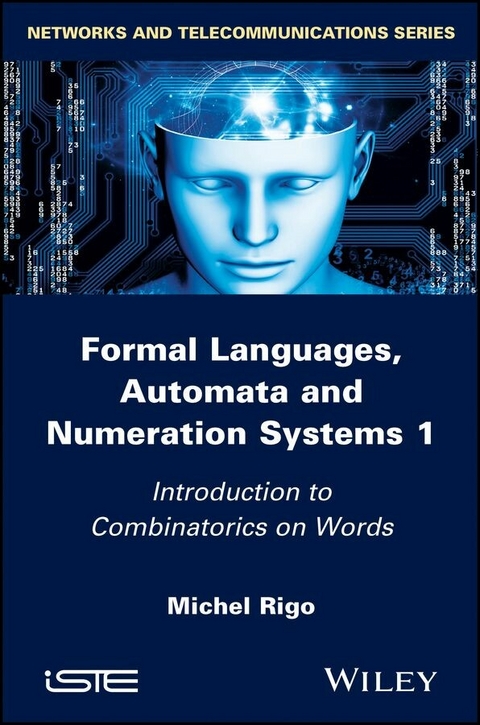
Formal Languages, Automata and Numeration Systems 1 (eBook)
John Wiley & Sons (Verlag)
978-1-119-00821-7 (ISBN)
Combinatorics on words deals with problems that can be stated in a non-commutative monoid, such as subword complexity of finite or infinite words, construction and properties of infinite words, unavoidable regularities or patterns. When considering some numeration systems, any integer can be represented as a finite word over an alphabet of digits. This simple observation leads to the study of the relationship between the arithmetical properties of the integers and the syntactical properties of the corresponding representations. One of the most profound results in this direction is given by the celebrated theorem by Cobham. Surprisingly, a recent extension of this result to complex numbers led to the famous Four Exponentials Conjecture. This is just one example of the fruitful relationship between formal language theory (including the theory of automata) and number theory.
Contents to include: • algebraic structures, homomorphisms, relations, free monoid • finite words, prefixes, suffixes, factors, palindromes
• periodicity and Fine–Wilf theorem
• infinite words are sequences over a finite alphabet
• properties of an ultrametric distance, example of the p-adic norm
• topology of the set of infinite words
• converging sequences of infinite and finite words, compactness argument
• iterated morphism, coding, substitutive or morphic words
• the typical example of the Thue–Morse word
• the Fibonacci word, the Mex operator, the n-bonacci words
• wordscomingfromnumbertheory(baseexpansions,continuedfractions,...) • the taxonomy of Lindenmayer systems
• S-adic sequences, Kolakoski word
• repetition in words, avoiding repetition, repetition threshold
• (complete) de Bruijn graphs
• concepts from computability theory and decidability issues
• Post correspondence problem and application to mortality of matrices
• origins of combinatorics on words
• bibliographic notes
• languages of finite words, regular languages
• factorial, prefix/suffix closed languages, trees and codes
• unambiguous and deterministic automata, Kleene’s theorem
• growth function of regular languages
• non-deterministic automata and determinization
• radix order, first word of each length and decimation of a regular language
• the theory of the minimal automata
• an introduction to algebraic automata theory, the syntactic monoid and the
syntactic complexity
• star-free languages and a theorem of Schu ̈tzenberger
• rational formal series and weighted automata
• context-free languages, pushdown automata and grammars
• growth function of context-free languages, Parikh’s theorem
• some decidable and undecidable problems in formal language theory
• bibliographic notes
• factor complexity, Morse–Hedlund theorem
• arithmetic complexity, Van Der Waerden theorem, pattern complexity • recurrence, uniform recurrence, return words
• Sturmian words, coding of rotations, Kronecker’s theorem
• frequencies of letters, factors and primitive morphism
• critical exponent
• factor complexity of automatic sequences
• factor complexity of purely morphic sequences
• primitive words, conjugacy, Lyndon word
• abelianisation and abelian complexity
• bibliographic notes
• automatic sequences, equivalent definitions
• a theorem of Cobham, equivalence of automatic sequences with constant
length morphic sequences
• a few examples of well-known automatic sequences
• about Derksen’s theorem
• some morphic sequences are not automatic
• abstract numeration system and S-automatic sequences
• k − ∞-automatic sequences
• bibliographic notes
• numeration systems, greedy algorithm
• positional numeration systems, recognizable sets of integers
• divisibility criterion and recognizability of N
• properties of k-recognizable sets of integers, ratio and difference of consec-
utive elements: syndeticity
• integer base and Cobham’s theorem on the base dependence of the recog-
nizability
• non-standard numeration systems based on sequence of integers
• linear recurrent sequences, Loraud and Hollander results
• Frougny’s normalization result and addition
• morphic numeration systems/sets of integers whose characteristic sequence
is morphic
• towards a generalization of Cobham’s theorem
• a few words on the representation of real numbers, β-integers, finiteness
properties
• automata associated with Parry numbers and numeration systems
• bibliographic notes
First order logic
• Presburger arithmetic and decidable theory
• Muchnik’s characterization of semi-linear sets
• Bu ̈chi’s theorem: k-recognizable sets are k-definable • extension to Pisot numeration systems
• extension to real numbers
• decidability issues for numeration systems
• applications in combinatorics on words
Formal Languages, Automaton and Numeration Systems presents readers with a review of research related to formal language theory, combinatorics on words or numeration systems, such as Words, DLT (Developments in Language Theory), ICALP, MFCS (Mathematical Foundation of Computer Science), Mons Theoretical Computer Science Days, Numeration, CANT (Combinatorics, Automata and Number Theory). Combinatorics on words deals with problems that can be stated in a non-commutative monoid, such as subword complexity of finite or infinite words, construction and properties of infinite words, unavoidable regularities or patterns. When considering some numeration systems, any integer can be represented as a finite word over an alphabet of digits. This simple observation leads to the study of the relationship between the arithmetical properties of the integers and the syntactical properties of the corresponding representations. One of the most profound results in this direction is given by the celebrated theorem by Cobham. Surprisingly, a recent extension of this result to complex numbers led to the famous Four Exponentials Conjecture. This is just one example of the fruitful relationship between formal language theory (including the theory of automata) and number theory.
Michel RIGO, Full professor, University of Liège, Department of Math., Belgium.
FOREWORD ix
INTRODUCTION xiii
CHAPTER 1. WORDS AND SEQUENCES FROM SCRATCH 1
1.1. Mathematical background and notation 2
1.1.1. About asymptotics 4
1.1.2. Algebraic number theory 5
1.2. Structures, words and languages 11
1.2.1. Distance and topology 16
1.2.2. Formal series 24
1.2.3. Language, factor and frequency 28
1.2.4. Period and factor complexity 33
1.3. Examples of infinite words 36
1.3.1. About cellular automata 43
1.3.2. Links with symbolic dynamical systems 46
1.3.3. Shift and orbit closure 59
1.3.4. First encounter with beta-expansions 62
1.3.5. Continued fractions 69
1.3.6. Direct product, block coding and exercises 70
1.4. Bibliographic notes and comments 77
CHAPTER 2. MORPHIC WORDS 85
2.1. Formal definitions 89
2.2. Parikh vectors and matrices associated with a morphism
96
2.2.1. The matrix associated with a morphism 98
2.2.2. The tribonacci word 99
2.3. Constant-length morphisms 107
2.3.1. Closure properties 117
2.3.2. Kernel of a sequence 119
2.3.3. Connections with cellular automata 120
2.4. Primitive morphisms 122
2.4.1. Asymptotic behavior 127
2.4.2. Frequencies and occurrences of factors 127
2.5. Arbitrary morphisms 133
2.5.1. Irreducible matrices 134
2.5.2. Cyclic structure of irreducible matrices 144
2.5.3. Proof of theorem 2.35 150
2.6. Factor complexity and Sturmian words 153
2.7. Exercises 159
2.8. Bibliographic notes and comments 163
CHAPTER 3. MORE MATERIAL ON INFINITE WORDS 173
3.1. Getting rid of erasing morphisms 174
3.2. Recurrence 185
3.3. More examples of infinite words 191
3.4. Factor Graphs and special factors 202
3.4.1. de Bruijn graphs 202
3.4.2. Rauzy graphs 206
3.5. From the Thue-Morse word to pattern avoidance 219
3.6. Other combinatorial complexity measures 228
3.6.1. Abelian complexity 228
3.6.2. k-Abelian complexity 237
3.6.3. k-Binomial complexity 245
3.6.4. Arithmetical complexity 249
3.6.5. Pattern complexity 251
3.7. Bibliographic notes and comments 252
BIBLIOGRAPHY 257
INDEX 295
SUMMARY OF VOLUME 2 303
"This nice book is devoted to a quickly growing field, at the frontier between theoretical computer science, combinatorics, and number theory." (Zentralblatt MATH, 2016)
| Erscheint lt. Verlag | 10.9.2014 |
|---|---|
| Reihe/Serie | ISTE | ISTE |
| Sprache | englisch |
| Themenwelt | Mathematik / Informatik ► Informatik ► Programmiersprachen / -werkzeuge |
| Mathematik / Informatik ► Informatik ► Theorie / Studium | |
| Technik ► Elektrotechnik / Energietechnik | |
| Schlagworte | Automata • cellular • Computer Architecture • Computerarchitektur • Computer Science • cyclic • Factor • Factors • First Encounter • Formale Sprache • infinite words • Informatik • Introduction • Irreducible • Ix • matrices • Matrix • Morphism • Morphisms • Number • Proof • Properties • Scratch • Sequence • Structures • symbolic dynamical |
| ISBN-10 | 1-119-00821-2 / 1119008212 |
| ISBN-13 | 978-1-119-00821-7 / 9781119008217 |
| Informationen gemäß Produktsicherheitsverordnung (GPSR) | |
| Haben Sie eine Frage zum Produkt? |
 PDF (Adobe DRM)
Kopierschutz: Adobe-DRM
Adobe-DRM ist ein Kopierschutz, der das eBook vor Mißbrauch schützen soll. Dabei wird das eBook bereits beim Download auf Ihre persönliche Adobe-ID autorisiert. Lesen können Sie das eBook dann nur auf den Geräten, welche ebenfalls auf Ihre Adobe-ID registriert sind.
Details zum Adobe-DRM
Dateiformat: PDF (Portable Document Format)
Mit einem festen Seitenlayout eignet sich die PDF besonders für Fachbücher mit Spalten, Tabellen und Abbildungen. Eine PDF kann auf fast allen Geräten angezeigt werden, ist aber für kleine Displays (Smartphone, eReader) nur eingeschränkt geeignet.
Systemvoraussetzungen:
PC/Mac: Mit einem PC oder Mac können Sie dieses eBook lesen. Sie benötigen eine
eReader: Dieses eBook kann mit (fast) allen eBook-Readern gelesen werden. Mit dem amazon-Kindle ist es aber nicht kompatibel.
Smartphone/Tablet: Egal ob Apple oder Android, dieses eBook können Sie lesen. Sie benötigen eine
Geräteliste und zusätzliche Hinweise
Buying eBooks from abroad
For tax law reasons we can sell eBooks just within Germany and Switzerland. Regrettably we cannot fulfill eBook-orders from other countries.
aus dem Bereich