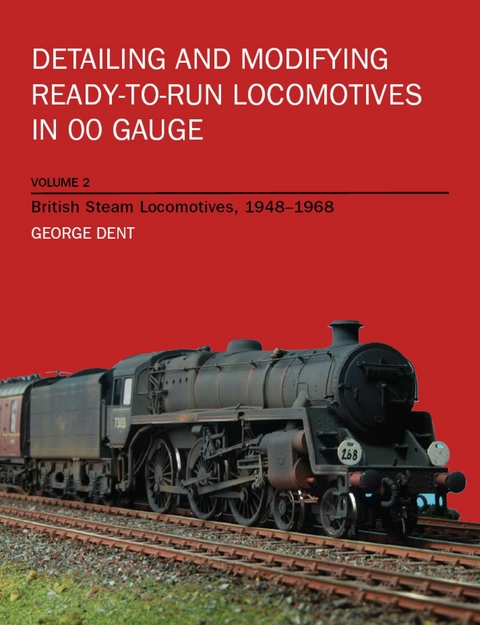
Detailing and Modifying Ready-to-Run Locomotives in 00 Gauge (eBook)
192 Seiten
Crowood (Verlag)
978-1-84797-852-3 (ISBN)
CHAPTER 1
Doing Your Homework
‘Think what you’re going to do before you do it’ was a motto that my old football coach used to shout at me, both repeatedly and with little effect. His constant berating was brought about by my seemingly random ball play, which left my team mates in a state of confusion. Although claiming that you’re working purely on instinct sounds romantic, it also smacks of being pretentious, especially when you’re a skinny full back playing only for Crosfield Chemicals.
Coach Terry Mac was not surprised when I quit the team to go away to Art College. In fact, he was very supportive. But I soon learned that even Jackson Pollock usually had a very good idea of what he was aiming to achieve before he opened his tins of paint. In modelling terms, doing your homework is an essential part of the process, whether you’re working on scenic, architectural or rolling stock subjects.
If you’re aiming to enhance a model, then you need to know: a) what it is you want to change or add; b) what you are going to use; and c) is it available, or will you have to make it yourself? While the solutions to b) and c) should be answered in the ensuing chapters, a) must be derived from delving into the history of that particular class of locomotive. Photographs are an obvious source of visual information, although they may not tell the full story. I’ve lost count of the times I’ve resolved to model a specific locomotive, but, after many hours spent trawling the Internet and library shelves, every image that arises seems to be of the same side of the machine, or does not show the one part I’m interested in. Therefore, for example, if you need to know whether ‘Terrier’ No.32670 had lost its Westinghouse pump by 1950, some further digging may be necessary.
History cards were kept by railway companies and formed something of a log book, detailing build dates, repair and overhaul information, shed allocations and disposal details and we are lucky that some of these have survived from BR ownership to enter personal or national archives. General arrangement (GA) drawings are also useful for overall dimensions and specifications, although many details shown can differ wildly from what was carried by each actual engine during a long service life. How likely was it that a fitter at Edgeley depot would shape a replacement copper pipe, during running repairs to an ‘8F’, exactly as it was shown on the GA plans?
The NRM’s new Search Engine facility is aimed at making what archives it has more readily available and, in addition, a new reading room has been commissioned overlooking the Great Hall exhibits. The British Library and Public Record Office (both in London) also hold an enormous amount of primary railway sources, as do most local Record Offices and smaller transport museums.
Modellers with specific regional or company interests may be well served by joining one of the numerous railway societies. For example, I’ve been a member of the Midland Railway Society for some years and the quarterly journal and newsletters offer up lots of interesting and useful titbits. There are similar groups catering for many of the pre-Grouping companies as well as each of the ‘Big Four’: LMS, LNER, GWR and SR. Regular lecture meetings, study centres and their own archives are usually freely available to other members. Many model railway societies also offer their own archives and/or libraries and it can certainly be worthwhile joining your local club.
Railway publishing has proved popular for generations and, in recent times of cheaper production costs, the number of new titles released every year is considerable. Album-style photographic collections are perfect for modellers, especially those containing colour images.
ARMCHAIR RESEARCH
Serious researchers and railway historians may have the time to spend in archives collating information from such sources, but what about us ‘regular’ modellers who have but a few evenings or weekends set aside to spruce up our latest locomotive acquisitions? Happily, there are countless books on the market (new and out of print) that contain much of the required information. However, be warned that some contain errors and, having read a few titles on the same subject matter, you may notice the odd contradictory remark. If authenticity is important to you, the best recommendation I can make is to obtain written and visual material from as many sources as possible before committing knife to plastic. Some people gain as much pleasure from the research element as from the actual practical work and, if the time is available, I do enjoy the challenge of searching for an elusive snippet of information.
Books with more of a technical aspect contain much information relevant to modellers. Some, such as these ‘Locomotive Profiles’ concentrating on LMS prototypes, include detailed plans and diagrams, as well as extensive statistics.
The Internet has undoubtedly made research easier, but it pays to be discerning before trusting anything as pure fact. There are, none the less, some excellent resources and forums where opinions and advice can be exchanged with other modellers (see the ‘Sources of Information’ section of the Appendix for some sample website addresses).
A browse across the shelves of a decent newsagent will reveal the popularity of railway-themed magazine titles intended for modellers or general enthusiasts. Many of these publications are aimed solely at steam fans, the nostalgia business being especially buoyant at the moment. Titles such as British Railways Illustrated, Steam World, BackTrack and Railway Bylines offer a photography-rich glimpse of what used to be. Heritage Railway and Steam Railway do likewise, but with a definite slant towards what’s happening in the steam preservation movement today. The long-running partwork, Locomotives Illustrated, has now left steam subjects behind in favour of ‘modern’ traction, but over the years it covered a plethora of locomotive types, each issue concentrating on a sole class, or a closely related family of engine types. Back copies of Locomotives Illustrated can still be found in transport bookshops, or direct from Ian Allan ltd (see the ‘Reference Material Sources’ section of the Appendix for the address).
Old copies of classic titles such as Trains Illustrated or Modern Railways can also be picked up at specialist retailers, or perhaps in ‘junk’ shops. I’ve been lucky enough to gather nearly a full set of the above titles (the former changed its name to the latter in the late 1960s) from 1959 to 1970 without paying more than 50 pence per copy. Indeed, I found a bag of six years’ worth in a charity shop priced at £2. As well as being an enjoyable read, they are packed with contemporary facts and figures such as engine allocations, repair and withdrawal statistics, plus a good assortment of photographs. Some public libraries have these titles in store and the NRM has its collection of journals available for reference.
There are plenty of railway magazine titles that cater purely for steam enthusiasts. BackTrack is a journal that charts all areas of railway history, from the beginnings to the very recent past, while others like Steam Railway concentrate on being the ‘clarion’ of the worldwide preservation movement. Looking at magazines contemporary to the days of working steam can provide a goldmine of information, just as today’s issues are indispensable for ‘modern image’ modellers.
In terms of modelling magazine titles there is, again, plenty of choice. The four main monthly titles – Railway Modeller, Model Rail, British Railway Modelling and Hornby Magazine – are joined by Model Railway Journal, a more specialized bimonthly publication aimed at ‘finescale’ modelling. The four main magazines all cover a broad range of subjects in terms of period, region and ability.
Other than looking at printed, archive or Internet-based sources for reference, there’s also the possibility of visiting a preserved railway or museum and viewing the real thing – that’s if an example of your subject type has made it into preservation. It must be remembered that the condition of a preserved locomotive will be different to when it ran fifty or sixty years ago, although most heritage movements take the issue of authenticity very seriously. Main-line registered steam traction will differ even further, as these engines must be fitted with modern safety features and air-braking equipment, although, where possible, operating groups strive to keep most of this gear out of view.
Museums and preserved railways are customer-focused organizations and, if you ask nicely, they will more than likely help out with whatever information you may require; if it’s possible, they may also provide access to a certain locomotive. If a visit is planned, be sure to take a camera, notebook and tape measure to record as many details as possible. Throughout the following chapters, the sort of detail modifications and additions that will be suggested should give an idea of what to look for on the prototype. Piping runs, size and location of equipment, livery variations and so on could be unique to individual machines within a specific timeframe, regardless of whether they were part of a large or small fleet.
In summary, the key to finding the right information lies in knowing where to look and, luckily enough for us, much of the hard work has already been done by numerous authors. There are so many books and...
| Erscheint lt. Verlag | 30.6.2014 |
|---|---|
| Verlagsort | London |
| Sprache | englisch |
| Themenwelt | Sachbuch/Ratgeber ► Freizeit / Hobby ► Modellbau |
| Natur / Technik ► Fahrzeuge / Flugzeuge / Schiffe ► Schienenfahrzeuge | |
| Technik | |
| Wirtschaft | |
| ISBN-10 | 1-84797-852-5 / 1847978525 |
| ISBN-13 | 978-1-84797-852-3 / 9781847978523 |
| Informationen gemäß Produktsicherheitsverordnung (GPSR) | |
| Haben Sie eine Frage zum Produkt? |
 EPUB (Wasserzeichen)
DRM: Digitales Wasserzeichen
Dieses eBook enthält ein digitales Wasserzeichen und ist damit für Sie personalisiert. Bei einer missbräuchlichen Weitergabe des eBooks an Dritte ist eine Rückverfolgung an die Quelle möglich.
Dateiformat: EPUB (Electronic Publication)
EPUB ist ein offener Standard für eBooks und eignet sich besonders zur Darstellung von Belletristik und Sachbüchern. Der Fließtext wird dynamisch an die Display- und Schriftgröße angepasst. Auch für mobile Lesegeräte ist EPUB daher gut geeignet.
Systemvoraussetzungen:
PC/Mac: Mit einem PC oder Mac können Sie dieses eBook lesen. Sie benötigen dafür die kostenlose Software Adobe Digital Editions.
eReader: Dieses eBook kann mit (fast) allen eBook-Readern gelesen werden. Mit dem amazon-Kindle ist es aber nicht kompatibel.
Smartphone/Tablet: Egal ob Apple oder Android, dieses eBook können Sie lesen. Sie benötigen dafür eine kostenlose App.
Geräteliste und zusätzliche Hinweise
Buying eBooks from abroad
For tax law reasons we can sell eBooks just within Germany and Switzerland. Regrettably we cannot fulfill eBook-orders from other countries.
aus dem Bereich