


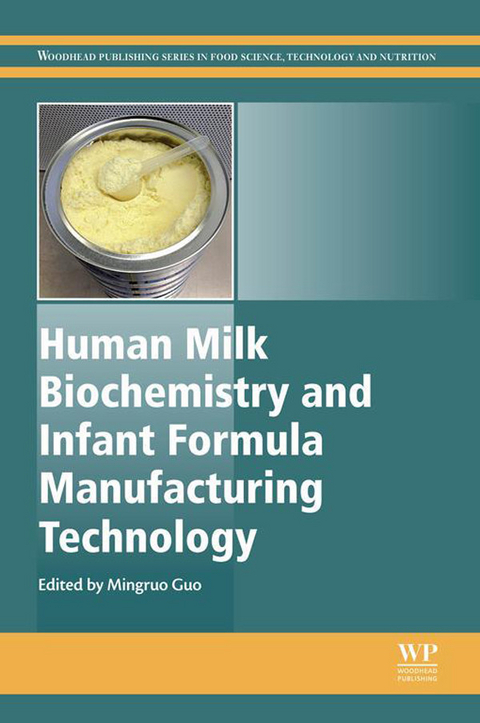
- The most up to date reference on infant formula processing technology
- Reviews both human milk biochemistry and infant formula processing technology for broad and applied coverage
- Focusses exclusively on infant formulae
Since infant formula substitutes for human milk, its composition must match that of human milk as closely as possible. Quality control of infant formula is also essential to ensure product safety, as infants are particularly vulnerable food consumers. This book reviews the latest research into human milk biochemistry and best practice in infant formula processing technology and quality control.The most up to date reference on infant formula processing technologyReviews both human milk biochemistry and infant formula processing technology for broad and applied coverageFocusses exclusively on infant formulae
Introduction: trends and issues in breastfeeding and the use of infant formula
M. Guo, University of Vermont, USA and Jilin University, People’s Republic of China
Abstract:
Human milk is the best food for infants since breast milk not only provides a source of nutrition, but also contains biological components that help infants to develop and grow normally. Modern infant formula is designed as human milk substitute for infant consumption under 1 year. In this chapter, the history of bottle-feeding, and its advantages and disadvantages compared with breastfeeding, are discussed. Trends and new developments in infant formula formulation and manufacturing are also reviewed.
Key words
human milk; infant formula; history; advantages; disadvantages; new developments
1.1 Introduction
Over the past century, attitudes to breastfeeding and alternative methods of feeding have varied widely. An analysis of breastfeeding (by year of birth of the mother) showed that of those born between 1911 and 1915 more than two-thirds breastfed their first child. By the middle of the century, of women born in 1946–1950, only about 25% breastfed. Breastfeeding showed a resurgence during the 1970s, with some reports showing an increase from 25% to 47% (in hospitals), and others indicating 25% increasing to 37% (Hirschman and Butler, 1981). Breastfeeding initiation continued to increase from 74.6% in 2008 to 76.9% of 2009 births (CDC, 2013). This trend may continue, due to the increasing awareness of the benefits of mother’s milk and the efforts in promoting breastfeeding. However, reported instances of parents attempting to buy human milk via internet sites at one end of the scale, and the establishment of human milk depots for hospitals in North America at the other, suggest that there are issues related to feeding at-risk infants that need to be addressed (Murphy, 2012).
1.2 Human milk and infant formula
1.2.1 Human milk
Breast milk was traditionally considered to have only one function: a source of infant nutrition. However, this assumption has recently been revised in the light of new evidence that human milk has a wide variety of other benefits. Breast milk contains bioactive agents that can help modify the functions of the gastrointestinal (GI) tract, and may have an effect on systemic circulation and the function of organ systems. It has therefore become more widely recognized as a biological fluid or a tissue (Guo, 2007). Breast milk production is stimulated by hormonal changes in the second and third trimesters of pregnancy. Immediately after birth, and for up to 4–5 days, colostrum is secreted, which has a very high protein content, is low in fat and carbohydrate, and has an alkaline pH. After 5 days, the milk changes to a transitional state that lasts for about 3 weeks, and after 3 weeks the milk is mature and does not change significantly for the remainder of lactation. Mature milk has less protein, more fat and carbohydrate, and the pH is slightly acidic (Packard, 1982).
1.2.2 Infant formula
Modern infant formula is an industrially produced, human milk substitute, designed for infant consumption. It is based on either cow or soy milk. Infant formula attempts to mimic the nutrient profile of human breast milk, and is the only other food that the medical community considers nutritionally acceptable for children under 1 year.
1.3 History of infant feeding
Infant feeding methods are similar throughout the world. Human breast milk is obviously the ideal source of nutrients for a newborn, particularly when the benefits of some of its components, which are still undefined, are taken into account. Traditionally, breast milk was the only nourishment given to babies until they were old enough to move on to solid food. Some exceptions occurred, such as maternal death or lactation failure, perhaps due to malnutrition. An Egyptian text, the Papyrus Ebers (Stevens et al., 2009), recorded this idea of alternative feeding as far back as 1550 BC. However, unless wet nursing was used, the chance of survival for infants fed alternative diets was historically very low.
1.3.1 Wet nursing
The earliest recorded form of non-mother infant feeding is wet nursing – a woman breastfeeding another’s child. This is recorded back to 2000 BC, and was still a widespread practice up until the twentieth century, being so common that it had its own contracts and laws. Over many centuries (roughly 950 BC to AD 1800) the aristocracy of many cultures used wet nursing as a method of choice, choosing to hire nurses to feed their babies (Stevens et al., 2009). Research into infant formula as an alternative feeding method began in the nineteenth century.
1.3.2 Medical developments: the nineteenth and twentieth centuries
During the nineteenth century, medical and government groups started to take an interest in infant feeding practices. Partly as a result of this, scientists became interested in the nutritional aspects of breast milk, with many attempts being made to formulate non-human milk to resemble human milk. The growth of the infant formula industry very closely matched the increasing scientific interest (Dykes, 2006). For example, around 1838, the German scientist Johann Simon carried out the first extensive milk analyses comparing the constituents of human and cows’ milk (Cone, 1981).
During the twentieth century the hospital replaced the home as the place where most women gave birth and recovered. In 2006 in the US, around 99% of births took place in hospitals (MacDorman et al., 2010). Due to the increasing numbers of maternity patients, hospitals began looking to make the timing of feeds more precise. This has been linked to difficulties in mother–infant interactions, and to women becoming more uncomfortable and insecure about the process of breastfeeding (Dykes, 2006). As scientists continued to investigate the process, the quality and availability of breast milk was brought into question. As Wolf (Wolf, 2000) noted: ‘the notion that human lactation is an unreliable body function became a cultural truth that has persisted unabated to the current day.’
Commercial interests
In 1865, ‘Liebig’s formula,’ based on cow’s milk with additional wheat and malt flour plus potassium bicarbonate, was developed by the chemist Justus von Liebig (Radbill, 1981; Stevens et al., 2009). This product utilized various developments in food preservation, particularly for milk, some of which are shown in Table 1.1. Liebig’s formula opened up the market for infant food and. By 1883 there were 27 patented brands of infant food, usually powders containing sugar, starches, and dextrin that were designed to be added to milk (Wickes, 1953b). Infant requirements for protein, vitamins, and minerals were not generally understood at this time, and these early products were lacking in nutrients (Radbill, 1981).
Table 1.1
Early developments allowing for the production of commercial infant formula
| 1810 | Nicholas Appert developed sterilized food in sealed containers |
| 1835 | William Newton patented evaporated milk |
| 1847 | Grimsdale Patent for evaporated milk |
| 1853 | Gale Borden added sugar to evaporated milk and sold it as Eagle Brand condensed milk |
| 1866 | Nestlé produced condensed milk |
| 1885 | An unsweetened condensed milk was developed by John B. Myerling, labeled as ‘evaporated milk’ |
| 1915 | Gerstenberger (US) developed an artificial milk made from animal and vegetable fats |
Source: Compiled from sonstegard et al., 1983; stevens et al., 2009.
By the late 1920s, soy flour-based formulas were commercially available for infants with a cow’s milk allergy (Stevens et al., 2009). The usage and sales of soy formula vary geographically worldwide; however, infant formula sales range from 10% to 25% in the US (McCarver et al., 2011; DHHS, 2010). As in the case of milk-based formula, soy formula initially lacked vital nutrients, particularly vitamins (Stevens et al., 2009). Due to these deficiencies, which became noticeable as more people turned to formula feeding, the Department of Federal Regulations developed regulations specifically concerned with improving the nutritional content of infant formula. Milk contains live cells and bioactive compounds that either cannot be added to formula or do not have the necessary shelf life. However, other nutrients can be added successfully. Overall, social and scientific changes have encouraged the development of increasingly complex infant formulas, and women have been encouraged to believe these are best for their children. This trend can be cited as one of the major causes of the precipitous decline in the role of breastfeeding in infant nutrition.
Normalizing infant formula use in the twentieth century
As outlined earlier, at the beginning of the twentieth century the breastfeeding rate was 90%, but that was before the major cultural swing toward the use of infant...
| Erscheint lt. Verlag | 12.8.2014 |
|---|---|
| Sprache | englisch |
| Themenwelt | Technik ► Lebensmitteltechnologie |
| ISBN-10 | 0-85709-915-9 / 0857099159 |
| ISBN-13 | 978-0-85709-915-0 / 9780857099150 |
| Informationen gemäß Produktsicherheitsverordnung (GPSR) | |
| Haben Sie eine Frage zum Produkt? |
 PDF (Adobe DRM)
Größe: 3,1 MB
Kopierschutz: Adobe-DRM
Adobe-DRM ist ein Kopierschutz, der das eBook vor Mißbrauch schützen soll. Dabei wird das eBook bereits beim Download auf Ihre persönliche Adobe-ID autorisiert. Lesen können Sie das eBook dann nur auf den Geräten, welche ebenfalls auf Ihre Adobe-ID registriert sind.
Details zum Adobe-DRM
Dateiformat: PDF (Portable Document Format)
Mit einem festen Seitenlayout eignet sich die PDF besonders für Fachbücher mit Spalten, Tabellen und Abbildungen. Eine PDF kann auf fast allen Geräten angezeigt werden, ist aber für kleine Displays (Smartphone, eReader) nur eingeschränkt geeignet.
Systemvoraussetzungen:
PC/Mac: Mit einem PC oder Mac können Sie dieses eBook lesen. Sie benötigen eine
eReader: Dieses eBook kann mit (fast) allen eBook-Readern gelesen werden. Mit dem amazon-Kindle ist es aber nicht kompatibel.
Smartphone/Tablet: Egal ob Apple oder Android, dieses eBook können Sie lesen. Sie benötigen eine
Geräteliste und zusätzliche Hinweise
Buying eBooks from abroad
For tax law reasons we can sell eBooks just within Germany and Switzerland. Regrettably we cannot fulfill eBook-orders from other countries.
 EPUB (Adobe DRM)
Kopierschutz: Adobe-DRM
Adobe-DRM ist ein Kopierschutz, der das eBook vor Mißbrauch schützen soll. Dabei wird das eBook bereits beim Download auf Ihre persönliche Adobe-ID autorisiert. Lesen können Sie das eBook dann nur auf den Geräten, welche ebenfalls auf Ihre Adobe-ID registriert sind.
Details zum Adobe-DRM
Dateiformat: EPUB (Electronic Publication)
EPUB ist ein offener Standard für eBooks und eignet sich besonders zur Darstellung von Belletristik und Sachbüchern. Der Fließtext wird dynamisch an die Display- und Schriftgröße angepasst. Auch für mobile Lesegeräte ist EPUB daher gut geeignet.
Systemvoraussetzungen:
PC/Mac: Mit einem PC oder Mac können Sie dieses eBook lesen. Sie benötigen eine
eReader: Dieses eBook kann mit (fast) allen eBook-Readern gelesen werden. Mit dem amazon-Kindle ist es aber nicht kompatibel.
Smartphone/Tablet: Egal ob Apple oder Android, dieses eBook können Sie lesen. Sie benötigen eine
Geräteliste und zusätzliche Hinweise
Buying eBooks from abroad
For tax law reasons we can sell eBooks just within Germany and Switzerland. Regrettably we cannot fulfill eBook-orders from other countries.
aus dem Bereich


