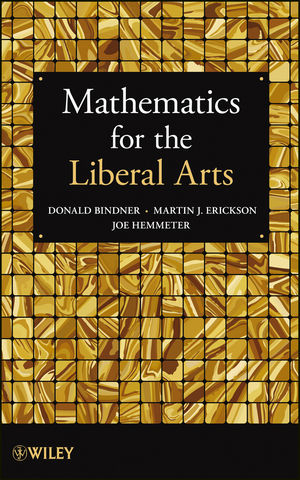
Mathematics for the Liberal Arts (eBook)
John Wiley & Sons (Verlag)
978-1-118-37174-9 (ISBN)
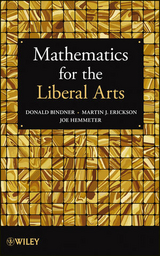
Mathematics for the Liberal Arts provides a comprehensible and precise introduction to modern mathematics intertwined with the history of mathematical discoveries. The book discusses mathematical ideas in the context of the unfolding story of human thought and highlights the application of mathematics in everyday life.
Divided into two parts, Mathematics for the Liberal Arts first traces the history of mathematics from the ancient world to the Middle Ages, then moves on to the Renaissance and finishes with the development of modern mathematics. In the second part, the book explores major topics of calculus and number theory, including problem-solving techniques and real-world applications. This book emphasizes learning through doing, presents a practical approach, and features:
- A detailed explanation of why mathematical principles are true and how the mathematical processes work
- Numerous figures and diagrams as well as hundreds of worked examples and exercises, aiding readers to further visualize the presented concepts
- Various real-world practical applications of mathematics, including error-correcting codes and the space shuttle program
- Vignette biographies of renowned mathematicians
- Appendices with solutions to selected exercises and suggestions for further reading
Mathematics for the Liberal Arts is an excellent introduction to the history and concepts of mathematics for undergraduate liberal arts students and readers in non-scientific fields wishing to gain a better understanding of mathematics and mathematical problem-solving skills.
DONALD BINDNER, PhD, is Assistant Professor in the Department of Mathematics and Computer Science at Truman State University.
MARTIN J. ERICKSON, PhD, is Professor of Mathematics in the Department of Computer Science at Truman State University and the author or coauthor of numerous books on mathematical topics.
JOE HEMMETER, PhD, is a freelance software developer and a past professor of mathematics at both the University of Delaware and Truman State University.
DONALD BINDNER, PhD, is Assistant Professor in the Department of Mathematics and Computer Science at Truman State University. MARTIN J. ERICKSON, PhD, is Professor of Mathematics in the Department of Computer Science at Truman State University and the author or coauthor of numerous books on mathematical topics. JOE HEMMETER, PhD, is a freelance software developer and a past professor of mathematics at both the University of Delaware and Truman State University.
Preface xi
PART I MATHEMATICS IN HISTORY
1 The Ancient Roots of Mathematics 3
1.1 Introduction 3
1.2 Ancient Mesopotamia and Egypt 7
1.3 Early Greek Mathematics: The First Theorists 20
1.4 The Apex: Third Century Hellenistic Mathematics 42
1.5 The Slow Decline 58
2 The Growth of Mathematics to 1600 73
2.1 China 74
2.2 India 89
2.3 Islam 102
2.4 European Mathematics Awakens 120
3 Modern Mathematics 139
3.1 The 17th Century: Scientific Revolution 140
3.2 The 18th Century: Consolidation 156
3.3 The 19th Century: Expansion 170
3.4 The 20th and 21st Centuries: Explosion 193
3.5 The Future 217
II TWO PILLARS OF MATHEMATICS
4 Calculus 221
4.1 What Is Calculus? 221
4.2 Average and Instantaneous Velocity 222
4.3 Tangent Line to a Curve 226
4.4 The Derivative 232
4.5 Formulas for Derivatives 235
4.6 The Product Rule and Quotient Rule 241
4.7 The Chain Rule 248
4.8 Slopes and Optimization 253
4.9 Applying Optimization Methods 259
4.10 Differential Notation and Estimates 266
4.11 Marginal Revenue, Cost, and Profit 270
4.12 Exponential Growth 276
4.13 Periodic Functions of Trigonometry 287
4.14 The Fundamental Theorem of Calculus 293
4.15 The Riemann Integral 297
4.16 Signed Areas and Other Integrals 301
4.17 Application: Rocket Science 306
4.18 Infinite Sums 311
4.19 Exponential Growth and Doubling Times 317
4.20 Beyond Calculus 321
5 Number Theory 323
5.1 What Is Number Theory? 323
5.2 Divisibility 324
5.3 Irrational Numbers 329
5.4 Greatest Common Divisors 331
5.5 Primes 336
5.6 Relatively Prime Integers 339
5.7 Mersenne and Fermat Primes 343
5.8 The Fundamental Theorem of Arithmetic 345
5.9 Diophantine Equations 350
5.10 Linear Diophantine Equations 354
5.11 Pythagorean Triples 358
5.12 An Introduction to Modular Arithmetic 361
5.13 Congruence 366
5.14 Arithmetic with Congruences 370
5.15 Division with Congruences; Finite Fields 374
5.16 Fermat's Last Theorem 381
5.17 Unfinished Business 383
A Answers to Selected Exercises 385
B Suggested Reading 401
Index 405
CHAPTER 2
THE GROWTH OF MATHEMATICS TO 1600
[The universe] cannot be read until we have learnt the language and become familiar with the characters in which it is written. It is written in mathematical language, and the letters are triangles, circles and other geometrical figures, without which means it is humanly impossible to comprehend a single word.
GALILEO GALILEI (1564–1642)
So far, we have looked at the ancient roots of mathematics, primarily around the Mediterranean Sea. In this chapter we will look further east, to the two great Asian cultures of China and India, before returning to Western Asia and Europe. The mathematics developed in these cultures was in each case influenced by others, although less so in the case of China. We will trace some of the connections among the different traditions, but must acknowledge up front that much remains unknown about this fascinating topic.
2.1 China
The Master said: Learning without thinking is useless. Thinking without learning is dangerous.
CONFUCIUS (551–479 BCE)
China.1
Major Chinese dynasties, from the Qin to the Ming.
History to 1600: An Overview
China is dominated by two great river systems. The Yellow River and the Yangtze River both originate in the Tibetan Plateau, and flow eastward to the Pacific Ocean. The Yellow River is in northern China, the Yangtze further south.
The earliest known Chinese civilizations arose in the Yellow River valley. By 4500 BCE villagers there were growing millet and raising pigs. The earliest known writing dates from the Shang dynasty (c. 1550–1046 BCE), on “oracle bones”—animal bones and turtle shells sometimes used for divination—and on bronze. The scribes also wrote on bamboo strips, but these didn’t last very long. The Shang dynasty only encompassed a small area in northern China.
The successor to the Shang was the Zhou dynasty (c. 1046–256 BCE), a semifeudal society with a somewhat larger geographical extent. Work on an early version of the Great Wall of China, intended to protect the northern border against invasion by nomads, commenced in the 8 th century BCE. Culture flourished in the 6 th century BCE, with the founding of several academies of scholars. The most famous philosopher of this time was Confucius (Kung Fu-zi, “Master Kung”), who valued education, loyalty, moderation, and his version of the Golden Rule: “What you do not wish for yourself, do not do to others.” Also dating from this period is the Taoism of Lao-Tzu, a more mystical philosophy and an important influence on early Chinese science.
After the Zhou dynasty was the short-lived but important Qin dynasty (221–206 BCE). This dynasty was initiated by one of the most remarkable rulers of any time and place, Qin Shi Huangdi (“First August and Divine Emperor of Qin”). Qin united all of China for the first time. He reorganized the government, destroying the power of the feudal lords, and he established a central bureaucracy. He engaged in massive infrastructure projects, building roads and irrigation systems, constructing a canal linking the Yangtze and Pearl River systems in the south, and completing the Great Wall in Inner Mongolia. The current Great Wall was built later on the foundations of this one. The construction of the wall cost the lives of thousands of workers and helped lead to the end of the Qin dynasty a few years after its founder’s death.
Qin Shi Huangdi standardized the Chinese system of weights and measures, and the Chinese written language too. After this time, regardless of the local spoken language, educated Chinese used the same written characters. The emperor distrusted scholars and banned private ownership of books. For his tomb, he employed about 700,000 workers over a period of more than 30 years to build a massive underground palace in wood, clay, and bronze. In 1974 local farmers made a remarkable discovery at his tomb. He had “protected” his underground palace with an army of 8000 life-size soldiers and horses modeled in clay. The army was complete with generals and chariots, and each soldier was unique. Qin Shi Huangdi died at age 49 in 210 BCE. His dynasty was overthrown four years later.
The Han dynasty (206 BCE–220 CE) succeeded the Qin. The most notable period in this dynasty was the rule of Emperor Wu, which lasted over 50 years, from 140-87 BCE. During this time, Wu extended his empire from Vietnam in the south to northern Korea, and westward into central Asia. The Silk Road became a major trading route, reaching all the way to Rome. Chinese culture flourished. In the year 2 CE, a census put the population of China at almost 60 million people. Sometime in the first century paper was invented. Education, based on Confucianism, became the route to advancement in the bureaucracy, via a new civil service examination system. This system was maintained, with brief disruptions, into the 20th century.
The period after the Han dynasty (220–598 CE) was a time of political disunity, characterized by a succession of short-lived dynasties and invasions from the north. In fact, much of Chinese history was characterized by invasions from the north; the Great Wall was built and rebuilt in an effort to protect against northern invaders. Although the wall was not always successful, the invaders did not replace the native Chinese culture, instead typically adopting it themselves.
There were several notable developments in this period, which comprised the Three Kingdoms Period (220–265) and the Northern and Southern Dynasties (265–589). One was the invention of paired stirrups in western China, which made the cavalry a more effective fighting force. This was also the time that the first porcelains were made. Although Buddhism was first imported from India in the Han dynasty, it became more important in these centuries. Also in this time, there was a great migration of people from northern China to the south, many as refugees. Thus the southern, rice-growing region of China became more important.
The empire was restored in the short-lived Sui dynasty (589–618). Like the Qin dynasty, the Sui is noted for its huge projects and its unpopularity. In addition to work on the Great Wall, the Sui reportedly conscripted five million peasants to work on the Grand Canal linking the Yangtze valley to northern China. This canal, over 1 0 0 0 miles long and still the longest in the world, was used mainly to transport grain from the south to the north.
Block printing was invented around 600. In this method, a wooden block was carved in such a way that the desired characters stood out. The block was then coated with ink and pressed upon paper or other substance. With this method the same page could be printed repeatedly.
Next up was the T’ang dynasty (618–907), one of the high points in Chinese civilization. Poetry and the fine arts flourished. The capital at Chang’an was the largest city in the world, with almost two million people. The Imperial Academy was founded in 754 to prepare scholars for public service. The curriculum was based on classical Confucian literature. Gunpowder was invented in the 8 th century.
After the T’ang ensued a half-century of disunity, ending with the establishment of the Song dynasty (960–1279), another brilliant period. The Song rule of northern China was somewhat tenuous; a northern invasion forced them to move their capital south to Hangzhou. Nonetheless, the arts, trade, and urban culture flourished. Agricultural production doubled. Tea and cotton cultivation expanded. Neo-Confucianism expanded its influence at the expense of Buddhism.
A couple of important advances in shipping date from the Song dynasty. One is the stempost rudder, which provided increased maneuverability for sailing ships. Another is the magnetic compass, which may actually have been invented earlier but was first widely used in shipping in this time.
Movable type printing also dates from the Song dynasty. In block printing an entire page is carved at one time. The new method involved carving individual characters, which then could be assembled into a page for printing. The characters could be reused.
Starting around 1200 the Mongols under Genghis Khan built one of the greatest empires ever, covering most of northern and western Asia, stretching into Eastern Europe and the Middle East. His empire was larger in area and population than the Roman empire. Kublai Khan, Genghis’s grandson, moved the capital of his empire to what is now Beijing, in 1264. From there, he completed the conquest of southern China, and formed the Yuan dynasty (1279–1368).
Chinese contacts with the West increased during Mongol rule. Moslems, Tibetan Buddhists, Nestorian Christians, and Roman Catholics were all invited to China. The most famous European visitor was the Venetian Marco Polo, who visited Kublai Khan in Beijing 1275–1292 and wrote about this amazing place upon his return to Europe, which was at the time backward compared to China. Chinese mathematics attained its greatest achievements at this time.
The foreign rule of the Yuan was never popular, and it was overthrown by an ex-Buddhist monk named Zhu Yuanzhang, who established the Ming dynasty (1368–1644). The Ming rulers rebuilt the Great Wall and built a new southern capital at Nanjing.
In the early 14th century, there was a remarkable series of naval expeditions launched from China, seven in all, led by the eunuch Zheng He (c. 1371–1433). These preceded by several decades the more famous European voyages of exploration. Zheng He traveled throughout the...
| Erscheint lt. Verlag | 21.8.2014 |
|---|---|
| Sprache | englisch |
| Themenwelt | Mathematik / Informatik ► Mathematik ► Allgemeines / Lexika |
| Technik | |
| Schlagworte | Analysis • Calculus • Mathematics • mathematics, history, history of mathematics, mathematical history, liberal arts • Mathematik • Number Theory • Zahlentheorie |
| ISBN-10 | 1-118-37174-7 / 1118371747 |
| ISBN-13 | 978-1-118-37174-9 / 9781118371749 |
| Informationen gemäß Produktsicherheitsverordnung (GPSR) | |
| Haben Sie eine Frage zum Produkt? |
 EPUB (Adobe DRM)
Kopierschutz: Adobe-DRM
Adobe-DRM ist ein Kopierschutz, der das eBook vor Mißbrauch schützen soll. Dabei wird das eBook bereits beim Download auf Ihre persönliche Adobe-ID autorisiert. Lesen können Sie das eBook dann nur auf den Geräten, welche ebenfalls auf Ihre Adobe-ID registriert sind.
Details zum Adobe-DRM
Dateiformat: EPUB (Electronic Publication)
EPUB ist ein offener Standard für eBooks und eignet sich besonders zur Darstellung von Belletristik und Sachbüchern. Der Fließtext wird dynamisch an die Display- und Schriftgröße angepasst. Auch für mobile Lesegeräte ist EPUB daher gut geeignet.
Systemvoraussetzungen:
PC/Mac: Mit einem PC oder Mac können Sie dieses eBook lesen. Sie benötigen eine
eReader: Dieses eBook kann mit (fast) allen eBook-Readern gelesen werden. Mit dem amazon-Kindle ist es aber nicht kompatibel.
Smartphone/Tablet: Egal ob Apple oder Android, dieses eBook können Sie lesen. Sie benötigen eine
Geräteliste und zusätzliche Hinweise
Buying eBooks from abroad
For tax law reasons we can sell eBooks just within Germany and Switzerland. Regrettably we cannot fulfill eBook-orders from other countries.
aus dem Bereich