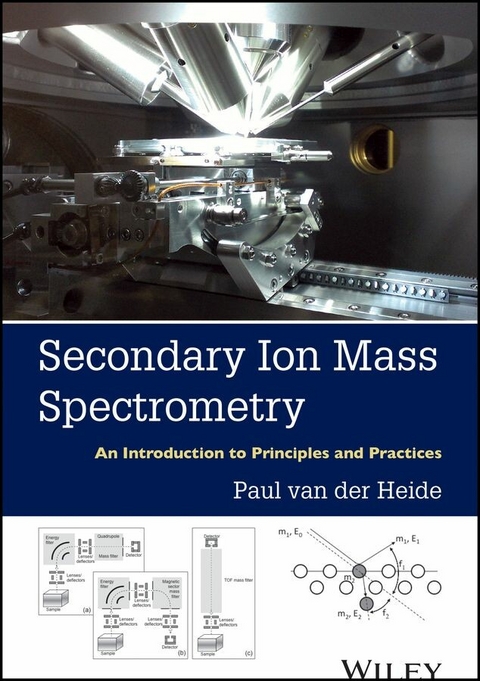
Secondary Ion Mass Spectrometry (eBook)
John Wiley & Sons (Verlag)
978-1-118-91677-3 (ISBN)
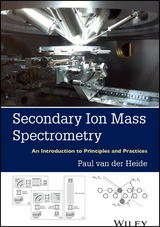
• Introduces SIMS along with the highly diverse fields (Chemistry, Physics, Geology and Biology) to it is applied using up to date illustrations
• Introduces the accepted fundamentals and pertinent models associated with elemental and molecular sputtering and ion emission
• Covers the theory and modes of operation of the instrumentation used in the various forms of SIMS (Static vs Dynamic vs Cluster ion SIMS)
• Details how data collection/processing can be carried out, with an emphasis placed on how to recognize and avoid commonly occurring analysis induced distortions
• Presented as concisely as believed possible with All sections prepared such that they can be read independently of each other
Paul van der Heide is a recognized leader in surface analysis with emphasis on the application of Secondary Ion Mass Spectrometry (SIMS). This interest started during his PhD (completed in 1992 at the University of Auckland) which involved the design and construction of a magnetic sector SIMS instrument. Paul has since been heavily involved in the application and development of SIMS at the University of Western Ontario, the University of Houston (where he also filled in various Professor level positions), Samsung Austin Semiconductor, and most recently at GlobalFoundries (NY). Paul has -100 publications with this representing his 2nd book.
Serves as a practical reference for those involved in Secondary Ion Mass Spectrometry (SIMS) Introduces SIMS along with the highly diverse fields (Chemistry, Physics, Geology and Biology) to it is applied using up to date illustrations Introduces the accepted fundamentals and pertinent models associated with elemental and molecular sputtering and ion emission Covers the theory and modes of operation of the instrumentation used in the various forms of SIMS (Static vs Dynamic vs Cluster ion SIMS) Details how data collection/processing can be carried out, with an emphasis placed on how to recognize and avoid commonly occurring analysis induced distortions Presented as concisely as believed possible with All sections prepared such that they can be read independently of each other
Paul van der Heide is a recognized leader in surface analysis with emphasis on the application of Secondary Ion Mass Spectrometry (SIMS). This interest started during his PhD (completed in 1992 at the University of Auckland) which involved the design and construction of a magnetic sector SIMS instrument. Paul has since been heavily involved in the application and development of SIMS at the University of Western Ontario, the University of Houston (where he also filled in various Professor level positions), Samsung Austin Semiconductor, and most recently at GlobalFoundries (NY). Paul has ~100 publications with this representing his 2nd book.
Forward x
Preface xi
Acknowledgements xiv
List of physical constants xiv
Chapter 1: Introduction
1.1 Matter and the Mass Spectrometer
1.2 Secondary Ion Mass Spectrometry
1.3 Summary
Section I
Chapter 2: Properties of atoms, ions, molecules and solids
2.1 The Atom
2.2 Electronic structure of atoms and ions
2.3 Summary
Chapter 3: Current understanding of sputtering and ion formation
3.1 The fundamentals of SIMS
3.2 Sputtering
3.3 Ionization/neutralization
3.4 Summary
Section II
Chapter 4: Instrumentation
4.1 The science of measurement
4.2 Hardware
4.3 Summary
Chapter 5: Data collection
5.1 The art of measurement
5.2 Sample preparation and handling
5.3 Data collection
5.4 Data conversion
5.5 Summary
Appendix
i) Periodic table of the elements
ii) Isotope masses, natural isotope abundances, atomic weights and mass densities of the elements
iii) 1st and 2nd Ionization potentials and electron affinities of the elements
iv) Work-functions of elemental solids
v) SIMS detection limits of selected elements
vi) Charged particle beam transport
vii) Statistical properties
viii) SIMS instrument designs
ix) Additional SIMS methods of interest
x) Additional spectrometric/spectroscopic techniques
xi) Additional microscopic techniques
xii) Diffraction / reflection techniques
Technique acronym list
Abbreviations commonly used in SIMS
Glossary of terms
Questions and answers
References
Index
Notes
"It is well worth owning if you want to learn about this exciting surface science technique for studying materials." (IEEE Electrical Engineering magazine, 1 May 2015)
"The entire book, and especially the second part, is a good reference work for users of D-SIMS and S-SIMS and for those working in other methods in analytical chemistry and the applied scientific fields, including the biosciences, where SIMS is now becoming a major experimental method." (Anal Bioanal Chem, 21 February 2015)
Chapter 1
Introduction
1.1 Matter and The Mass Spectrometer
The world we live in is a highly customized environment tailored to maximize our comfort level. This comfort level (which pertains to our well-being, environment, security, transportation, information access, etc.) is acquired through our capacity to fabricate materials that do not exist in nature. This capacity is aided through our ability to understand what has been fabricated, how this interacts with its environment, and how this can be tailored to our needs. This understanding is provided through the act of analysis.
Our ability to customize our environment is something that can be said for almost every age the human race has progressed through. Indeed, some eras are associated with the material developed. Examples include the Bronze Age (∼3300 BCE to ∼1200 BCE) and the Iron Age (∼1200 BCE to ∼500 CE). Two more recent examples of this customization include the use of Carbon for creating plastics and Silicon for constructing computer chips in what is now referred to as the computer or information age.
Indeed, plastics have become one of the most ubiquitous materials in today's everyday life. Plastics, fabricated from crude oil, are composed of a Carbon backbone formed from n repeating units (n = an integer >1) of some monomer (a molecule that binds to other molecules or atoms), hence the name polymer. For example, Polyethylene is defined as (C2H2)n, Polypropylene as (C3H6)n, and Polyvinylchloride (PVC) as (C2H3Cl)n. Some applications of these three examples are as follows:
- Polyethylene is used in manufacturing plastic bags, bottles, containers, and so on.
- Polypropylene is used in packaging/labeling materials, textiles, bottles, and so on.
- PVC is used in manufacturing specific types of tubing, signs, furniture, and so on.
In addition, there are many more types of plastics and applications.
The element below carbon in the periodic table is that of silicon. When purified from sand (one source), this is the basis of the solid-state semiconductor industry, as we know it today. Indeed, owing to the increasing prevalence of Complementary Metal Oxide Semiconductor (CMOS)-based integrated circuits and the ever-decreasing size of the transistor (over a billion transistors can now be squeezed into a single cm-by-cm-sized chip), more silicon-based transistors have been manufactured than anything else summed over the entire history of mankind.
Interestingly enough, the element below Silicon in the periodic table has played a pivotal role in the continued scaling of transistor dimensions. This stems from the fact that introducing Germanium into substitutional sites within the Silicon lattice induces strain, which, in turn, enhances charge mobilities. Post CMOS-based devices, on the other hand, may be Graphene based. Note: Graphene is an allotrope of Carbon (allotropes are composed of the same elements but have different geometric structures).
Our ability to fabricate a material that exhibits properties specifically tailored to the desired need has arisen from the knowledge attained from the way in which matter interacts with each other and its environment. The common definition of matter is anything that has mass and volume (Barker 1870). According to this definition, all matter is composed of atoms irrespective of the phase (solid, liquid, or gas) it exists in (Note: We do not directly interact with the fourth state of matter, otherwise referred to as plasma).
The physical properties of matter can be defined by the knowledge of the following:
- the type of atoms present, i.e. which elements are present,
- the bonds between the atoms,
- the molecular or crystalline structure.
Atoms are the smallest divisible unit of mass that exists under the conditions we live in. Each element displays a different chemical reactivity (Note: Atoms can only be broken down in high-energy plasmas, energetic sub-atomic particle collisions, etc.). Most atoms, however, do not like to exist as individual entities, rather they prefer to combine with other atoms. Some examples include N2, O2, and CO2 as is present in the air, NaCl in table salt, and more complex combinations present in plastics, semiconductors, and so on.
As first realized in 1909 (Rutherford 1911), atoms are composed of a dense nucleus, which is made up of protons and neutrons around which electrons orbit. The reactivity of an atom is defined by the electrons. The number of electrons in a neutral atom is defined by the number of protons (the number of protons equal the number of electrons in neutral atoms) with the number of protons defining the element (Carbon has six protons). The number of neutrons is generally equal to the number of protons, but it can differ.
Atoms with the same number of protons but with a different number of neutrons are referred to as isotopes, with the mass of the specific atom defined by the sum of the protons and neutrons. For example, Carbon 12 (mass equals 12 u) has six protons and six neutrons. Its chemical symbol is . Carbon 13 (), on the other hand, has six protons and seven neutrons. Isotopic mass is covered in Section 2.1.1.1.
Although isotopes of the same element display the same reactivity, their ratio can provide insight into adsorption/diffusion characteristics, past events/environments, and the date at which any such events occurred. The study of the latter is termed Chronology. The ability to derive such information stems from the fact that isotope ratios change in a predictable manner over time owing to what are referred to as fractionation effects. This ability and the ability to date materials are discussed further in Sections 1.2.3.
The existence of naturally occurring isotopes was first reported by J.J. Thomson in 1913 (Thomson 1913) and later confirmed by F.W. Aston in 1919 using Magnetic Sector-based Mass Spectrometry (Aston 1922).
Magnetic Sector-based Mass Spectrometry separates the isotopes of the elements by passing the monoenergetic beam of ions (atoms that have had an electron removed or added such that it has a charge) through a magnetic field placed normal (perpendicular) to the ion beam's initial direction of travel. This causes the deflection of the beam based on the mass-to-charge ratio (m/q) of the ion as illustrated in Figure 1.1. Note: This ratio is also specified as (m/z). If all ions have the same charge, as is the case in Figure 1.1, the deflection is then simply dependent on the mass of the ion. As the vast majority of an atom's mass is defined by the protons and neutrons within the respective nuclei, Mass Spectrometry provides a method for separating the isotopes and hence the elements/molecules of different masses. All forms of Mass Spectrometry can thus be viewed as scales for weighing individual atoms or combinations thereof, i.e. molecules.
Figure 1.1 Cross-sectional image of how the isotopic constituents of a Ti+ ion beam are separated while passing through a Magnetic Sector mass filter. Note: The magnetic field direction is perpendicular to the trajectory plane of the beam, i.e. perpendicular to the page and q = 1. The original instruments recorded mass separated images on photographic plates, as is shown.
Mass Spectrometry has become a highly effective technique for elucidating the type and amount of any isotope, element, or molecule present within unknown samples in the gaseous state or made to be gaseous state (originally liquid). Secondary Ion Mass Spectrometry (SIMS) is a variant of Mass Spectrometry that is used in the chemical analysis of solid or made to be solid (frozen) materials. SIMS is discussed further in Section 1.2.
1.2 Secondary Ion Mass Spectrometry
SIMS now represents a fully commercialized technology that is widely used in both industry and academia for defining the isotopic, elemental, or molecular composition over highly localized microscopic regions within the surface and/or near the surface region (just below) of any solid. In specialized cases, frozen liquids can also be examined. As noted in Appendix A.10, an ion spectrometry is one that derives their information by recording ions as opposed to electrons or photons.
The popularity of SIMS stems, in part, from:
- The ability to detect all of the elements within the periodic table (H–U) and combinations thereof, i.e. those that make up molecules. In many cases, this information can be collected quasi-simultaneously from the same surface/volume.
- The detection limits provided (the ability to detect small concentrations, which in the case of SIMS can extend down to sub parts per billion levels), along with the associated sensitivity (the ability to detect small concentration differences) and the dynamic range (the ability to measure signals over some range, which in SIMS extends to ∼109 when using multiple detectors).
- The ability to map the distribution of any isotope or collection thereof (this ability can be used to replicate elemental or molecular distributions) on or within any solid to spatial and depth resolution values of 1 µm or less (10 nm represents the ultimate physical limit in SIMS) and ∼1 nm, respectively.
- The minimal sample preparation procedures required before analysis (in most cases, no preparation is...
| Erscheint lt. Verlag | 19.8.2014 |
|---|---|
| Sprache | englisch |
| Themenwelt | Naturwissenschaften ► Chemie ► Analytische Chemie |
| Technik | |
| Schlagworte | Analytical Chemistry • Analytische Chemie • Chemie • Chemistry • Dünne Schichten, Oberflächen u. Grenzflächen • Dünne Schichten, Oberflächen u. Grenzflächen • Electrical & Electronics Engineering • Elektrotechnik u. Elektronik • Halbleiter • Massenspektrometrie • Materials Science • Materialwissenschaften • Secondary Ion Mass Spectrometry, Surface Analysis, Materials Analysis, Isotopic distribution analysis, elemental distribution analysis, molecular distribution analysis • semiconductors • Thin Films, Surfaces & Interfaces |
| ISBN-10 | 1-118-91677-8 / 1118916778 |
| ISBN-13 | 978-1-118-91677-3 / 9781118916773 |
| Informationen gemäß Produktsicherheitsverordnung (GPSR) | |
| Haben Sie eine Frage zum Produkt? |
 EPUB (Adobe DRM)
Kopierschutz: Adobe-DRM
Adobe-DRM ist ein Kopierschutz, der das eBook vor Mißbrauch schützen soll. Dabei wird das eBook bereits beim Download auf Ihre persönliche Adobe-ID autorisiert. Lesen können Sie das eBook dann nur auf den Geräten, welche ebenfalls auf Ihre Adobe-ID registriert sind.
Details zum Adobe-DRM
Dateiformat: EPUB (Electronic Publication)
EPUB ist ein offener Standard für eBooks und eignet sich besonders zur Darstellung von Belletristik und Sachbüchern. Der Fließtext wird dynamisch an die Display- und Schriftgröße angepasst. Auch für mobile Lesegeräte ist EPUB daher gut geeignet.
Systemvoraussetzungen:
PC/Mac: Mit einem PC oder Mac können Sie dieses eBook lesen. Sie benötigen eine
eReader: Dieses eBook kann mit (fast) allen eBook-Readern gelesen werden. Mit dem amazon-Kindle ist es aber nicht kompatibel.
Smartphone/Tablet: Egal ob Apple oder Android, dieses eBook können Sie lesen. Sie benötigen eine
Geräteliste und zusätzliche Hinweise
Buying eBooks from abroad
For tax law reasons we can sell eBooks just within Germany and Switzerland. Regrettably we cannot fulfill eBook-orders from other countries.
aus dem Bereich