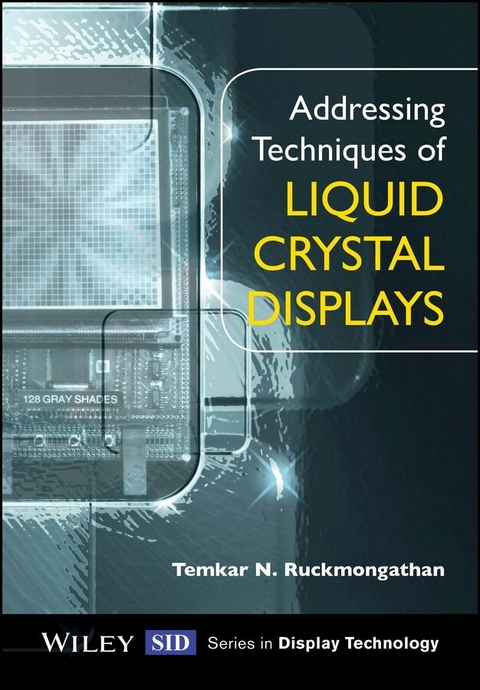
Addressing Techniques of Liquid Crystal Displays (eBook)
352 Seiten
Wiley (Verlag)
978-1-118-70636-7 (ISBN)
Unique reference source that can be used from the beginning to end of a design project to aid choosing an appropriate LCD addressing technique for a given application
This book will be aimed at design engineers who are likely to embed LCD drivers and controllers in many systems including systems on chip. Such designers face the challenge of making the right choice of an addressing technique that will serve them with best performance at minimal cost and complexity. Readers will be able to learn about various methods available for driving matrix LCDs and the comparisons at the end of each chapter will aid readers to make an informed design choice.
The book will address the various driving techniques related to LCDs. Due to the non-linear response of the liquid crystal to external voltages, different driving methods such as passive and active matrix driving can be utilized. The associated theoretical basis of these driving techniques is introduced, and this theoretical analysis is supplemented by information on the implementation of drivers and controllers to link the theory to practice.
- Written by an experienced research scientist with over 30 years in R&D in this field.
- Acts as an exhaustive review and comparison of techniques developed for passive-matrix addressing of twisted nematic and super-twisted nematic (STN) LCDs.
- Discusses the trend towards 'High Definition' displays and that a hybrid approach to drive matrix LCDs (combination of active and passive matrix addressing) will be the future of LCD addressing.
- Contains the author’s recent work on Bit-Slice Addressing that is useful for fast responding LCDs, as well as a chapter on driving ferroelectric LCDs
- Provides an objective comparison that will enable designers to make an informed choice of an addressing technique for a specific application.
- Includes examples of the practical applications of addressing techniques.
- Organised in a way that each chapter can be read independently; with the basic knowledge and historical background gained from the introductory chapters, adequate for understanding the techniques that are presented in the remaining chapters making it a self-contained reference.
Temkar N. Ruckmongathan, Raman Research Institute, Bangalore, India Dr. Ruckmongathan is a Senior Professor at the Raman Research Institute, Bangalore, India. He has over 30 years' experience of research and development in the area of addressing techniques for driving LCDs. Professor Ruckmongathan has authored approximately 50 publications on driving matrix LCD. He has 16 US and European patents.
2
Liquid Crystal Displays
2.1 Matrix Displays
A display is an important interface between man and machine. The picture element (pixel) (Lyon, 2006) is the smallest element in a display. Pixels are tightly packed into a two-dimensional (2D) array that resembles a matrix, a rectangular array of pixels arranged in row and columns. A display consists of a large number of pixels – a few hundred to a few million pixels depending on the gadget that incorporates the display device. Information on a display device depends on the collective state of the pixels and some degree of correlation exists between neighbouring pixels. However, the pixel is the smallest element that can be driven to a state without affecting the state of other pixels. A pixel in a colour display consists of three or four subpixels that are driven independently of each other and the collective state of subpixels is the state of a pixel that determines the colour and intensity of the pixel. Each pixel in a display has at least two terminals that are useful to activate the pixel (i.e. drive the pixel).
Numeric displays in watches, calculators, multimeters, thermometers, weighing machines, etc., have a small number of pixels and in these displays each pixel is connected to a driver so that the pixel can be switched ‘ON’ or ‘OFF’ depending on the number to be displayed. However, such direct driving of pixels is not practical when the number of pixels is large. For example, consider a display with pixels arranged in 480 rows and 640 columns. It is a standard display format that is referred to as a vector graphics array (VGA). The number of drivers is large if each of all the 30 700 pixels in a monochromatic VGA display has to be driven with dedicated individual drivers for each pixel.
If the number of connections from the drivers to the pixels is large it is not practical to have so many wires connecting the pixels and drivers. The number of connections and the number of drivers increase linearly with the number of pixels and the number of drivers and interconnections is multiplied by a factor of three in a colour display. For example, a low resolution colour graphics array (CGA) format demands 240 rows of colour pixels with 320 pixels in each row. Each colour pixel consists of three pixels of a primary colour (red, green and blue) and therefore a display will have about 0.23 million (230 400) pixels. An equal number of connections is necessary if each pixel is connected to a driver. The number of connections is too large and it is not practical to drive the pixels directly when the number of pixels in a display is large, as in graphic displays that are used to display images. A group of pixels can share a driver to reduce the number of connections between pixels and the corresponding drivers.
A common lead that connects a number of pixels to a driver is referred to as an address line and it reduces the number of drivers as well as the number of connections to the display. A matrix display is a two-dimensional array of pixels and one lead of each pixel in a row is connected to a row address line and similarly the second lead of each pixel in a column is connected to a column address line. Each pixel in a matrix display is uniquely identified with a row address line and a column address line. A drastic reduction in the number of drivers is achieved with this approach in a matrix display. Drivers of one set of address lines, for example row drivers, are used to select all pixels in a row. Hence, the address line that is used to select all pixels connected to an address line is also referred to as a scanning electrode. Drivers that are used to control the state of pixels in a selected address line are referred to as data drivers. Matrix displays with a larger number of columns as compared to the number of rows are popular. It is advantageous to scan the matrix display with a lower number of address lines. Hence, drivers that are used to scan the display are usually referred to as row drivers and the data drivers are referred to as column drivers.
However, we can also select all pixels in a column with a column driver and the row drivers can be employed simultaneously to drive all pixels in the selected column. The number of drivers reduces to 1120 (480 + 640) for a monochromatic VGA display as compared to 307 200 (480 × 640) drivers if each pixel in the display is driven with a dedicated driver. Similarly, the number of drivers and interconnections reduces to 1680 (240 row drivers and 1440 data drivers) in a CGA display. Hence, each pixel in a matrix display can be driven with a small number of address lines as compared to direct driving of each pixel. It is similar to a random access memory (RAM) wherein a large number of memory cells are addressed with a smaller number of decoded address lines. A random access memory has a much lower number of address lines as compared to the matrix display because rows and columns are coded as binary numbers and each row or a column is selected using its address, which is a binary number. Such a reduction is feasible in RAM because just one or a few bits (e.g. a byte or a nibble) are accessed at a time. A display device has to display all pixels simultaneously at a high frame rate and therefore pixel-by-pixel addressing is not feasible in most displays.
In summary, a matrix display with N rows and M columns can address a maximum of (N × M) pixels with (N + M) drivers. The number of connections to the display is a minimum when the number of rows is equal to the number of columns. In other words, the number of connections to the display is a minimum when the number of address lines is an integer that is equal to or close to the square root of the number of pixels. For example, if the number of pixels is 1000 then the square root of 1000 is about 31.6. The number of connections to the display is a minimum when the pixels are arranged and interconnected to form a 32 × 32 matrix. A further reduction in the number of drivers and interconnections can be achieved by using an unconventional interconnection scheme. For example, x address lines can address x(x – 1) polarity-dependent pixels in, for example, a light emitting diode (LED) (Gillessen et al., 1981). In the case of an LCD, x(x – 1)/2 pixels can be addressed if the number of pixels is small (Kmetz, 1982). Multilevel addressing is feasible by stacking a few displays in front of each other to reduce the number of drivers. Pixels in each of these panels are addressed by electrical means and optical means of addressing is used in the third dimension to combine the results of addressing the individual panels in the stack (Sherr, 1972).
2.2 Display Fonts and Formats
The quality of images reproduced on a display depends on the number of pixels per unit distance and the viewing distance, that is the distance between the display and the eyes in addition to the original quality of the image. A display has to reproduce an image without any degradation in quality as compared to the original image. A person with normal vision can resolve two points that subtend an angle of 1 minute of arc at the eye (Hartidge, 1922). This translates to a minimum of 12 pixels/mm when a display is viewed at a distance of 250 mm. The display in some mobile phones has such a high resolution (∼300 pixels per inch). Such a high density of pixels is not easy to achieve in some display technologies. For example, each pixel in a plasma display panel (PDP) is isolated from its neighbouring pixels and therefore it is not feasible to fabricate a PDP with a high pixel density due to various process- related factors.
Displays with a high density of pixels may be too expensive for some applications. For example, we need a cluster of about 900 pixels to display an alphanumeric character or a symbol in order to achieve the high resolution of a printed text. The cost of the display, drive electronics and the associated circuits is proportional to the size of the display and the resolution. It is not necessary to have a large number of pixels in numeric and alphanumeric displays. We can use some standard fonts to reduce the number of pixels and consequently the number of drivers, cost, reliability, etc. (Sherr, 1979). A seven segment font is a standard font that is used to display numbers in calculators, instrument panels, thermometers, etc. At least 14 to 16 segments are necessary to display alphabets in addition to numerals. A dot matrix font with 5 rows and 3 columns (5 × 3 dot matrix font) of pixels is also useful to display numbers. A dot matrix of 7 rows and 5 columns (7 × 5 dot matrix font) or a larger matrix size is used to display alphanumeric information. Several fonts that are useful to display alphanumeric information are listed in Table 2.1; however, some of these fonts are no longer popular.
Table 2.1 Fonts and formats for numbers and alphabets (alphanumeric fonts)
| No. | Fonts | Number of segments or elements | Format | Application | Comments |
| 1 | Seven segments | 7 segments and a numeric dot | Tilted to right | Calculators/ digital watches | Numbers and a few symbols |
| 2 | Star burst pattern | 13 to 16 segments | Tilted to right | Programmable calculators | Alphabets and numbers |
| 3 | Dot matrix | 3 × 5, 5 × 5, 7 × 5, 9... |
| Erscheint lt. Verlag | 14.8.2014 |
|---|---|
| Reihe/Serie | Wiley Series in Display Technology |
| Wiley Series in Display Technology | Wiley Series in Display Technology |
| Sprache | englisch |
| Themenwelt | Technik ► Elektrotechnik / Energietechnik |
| Schlagworte | active matrix LCD driver • bistable LCD • Bit-Slice Addressing • Bit-Slice LCDs • Electrical & Electronics Engineering • Electrical Engineering - Displays • Electronic materials • Elektronische Displays • Elektronische Materialien • Elektrotechnik u. Elektronik • embedded LCD controllers • embedded LCD drivers • fast responding LCDs • ferroelectric LCDs • Flüssigkristallanzeige • Flüssigkristallanzeige • LCD • LCD addressing • LCD addressing methods • LCD addressing techniques • LCD controllers • LCD design • LCD drivers • LCD driving methods • LCD driving techniques • LCD engineering • LCD matrix addressing • LCD matrix addressing techniques • LCDs • Liquid Crystal Displays • Materials Science • Materialwissenschaften • passive matrix LCD driver • Signal Processing • Signalverarbeitung • super-twisted nematic LCDs • Temkar Ruckmongathan • TFT LCDs • twisted nematic LCDs |
| ISBN-10 | 1-118-70636-6 / 1118706366 |
| ISBN-13 | 978-1-118-70636-7 / 9781118706367 |
| Informationen gemäß Produktsicherheitsverordnung (GPSR) | |
| Haben Sie eine Frage zum Produkt? |
 EPUB (Adobe DRM)
Kopierschutz: Adobe-DRM
Adobe-DRM ist ein Kopierschutz, der das eBook vor Mißbrauch schützen soll. Dabei wird das eBook bereits beim Download auf Ihre persönliche Adobe-ID autorisiert. Lesen können Sie das eBook dann nur auf den Geräten, welche ebenfalls auf Ihre Adobe-ID registriert sind.
Details zum Adobe-DRM
Dateiformat: EPUB (Electronic Publication)
EPUB ist ein offener Standard für eBooks und eignet sich besonders zur Darstellung von Belletristik und Sachbüchern. Der Fließtext wird dynamisch an die Display- und Schriftgröße angepasst. Auch für mobile Lesegeräte ist EPUB daher gut geeignet.
Systemvoraussetzungen:
PC/Mac: Mit einem PC oder Mac können Sie dieses eBook lesen. Sie benötigen eine
eReader: Dieses eBook kann mit (fast) allen eBook-Readern gelesen werden. Mit dem amazon-Kindle ist es aber nicht kompatibel.
Smartphone/Tablet: Egal ob Apple oder Android, dieses eBook können Sie lesen. Sie benötigen eine
Geräteliste und zusätzliche Hinweise
Buying eBooks from abroad
For tax law reasons we can sell eBooks just within Germany and Switzerland. Regrettably we cannot fulfill eBook-orders from other countries.
aus dem Bereich