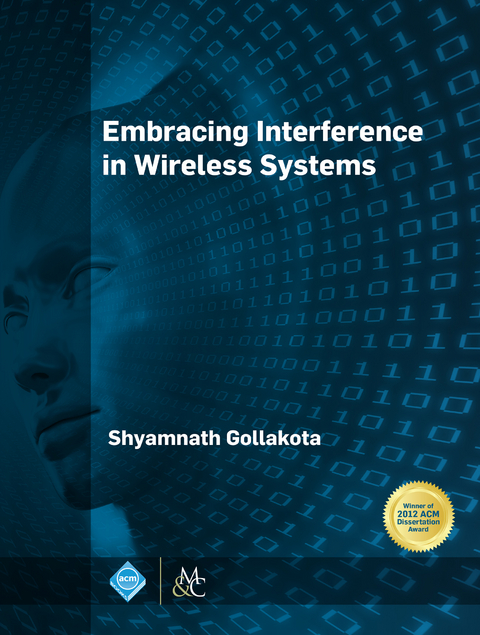
Embracing Interference in Wireless Systems (eBook)
173 Seiten
Association for Computing Machinery and Morgan & Claypool Publishers (Verlag)
978-1-62705-476-8 (ISBN)
same time, their signals interfere, resulting in a collision. In traditional
networks, collisions cause the loss of the transmitted information. For this
reason, wireless networks have been designed with the assumption that
interference is intrinsically harmful and must be avoided.
This book, a revised version of the author's award-winning Ph.D.
dissertation, takes an alternate approach: Instead of viewing interference
as an inherently counterproductive phenomenon that should to be avoided, we
design practical systems that transform interference into a harmless, and
even a beneficial phenomenon. To achieve this goal, we consider how wireless
signals interact when they interfere, and use this understanding in our
system designs. Specifically, when interference occurs, the signals get
mixed on the wireless medium. By understanding the parameters of this
mixing, we can invert the mixing and decode the interfered packets; thus,
making interference harmless. Furthermore, we can control this mixing
process to create strategic interference that allow decodability at a
particular receiver of interest, but prevent decodability at unintended
receivers and adversaries. Hence, we can transform interference into a
beneficial phenomenon that provides security.
Building on this approach, we make four main contributions: We present the
first WiFi receiver that can successfully reconstruct the transmitted
information in the presence of packet collisions. Next, we introduce a WiFi
receiver design that can decode in the presence of high-power
cross-technology interference from devices like baby monitors, cordless
phones, microwave ovens, or even unknown technologies. We then show how we
can harness interference to improve security. In particular, we develop the
first system that secures an insecure medical implant without any
modification to the implant itself. Finally, we present a solution that
establishes secure connections between any two WiFi devices, without having
users enter passwords or use pre-shared secret keys.
| Erscheint lt. Verlag | 1.6.2014 |
|---|---|
| Reihe/Serie | ACM Books | ACM Books |
| Sprache | englisch |
| Themenwelt | Mathematik / Informatik ► Informatik ► Netzwerke |
| Mathematik / Informatik ► Informatik ► Theorie / Studium | |
| Technik ► Elektrotechnik / Energietechnik | |
| Technik ► Nachrichtentechnik | |
| ISBN-10 | 1-62705-476-6 / 1627054766 |
| ISBN-13 | 978-1-62705-476-8 / 9781627054768 |
| Informationen gemäß Produktsicherheitsverordnung (GPSR) | |
| Haben Sie eine Frage zum Produkt? |
 EPUB (Adobe DRM)
Kopierschutz: Adobe-DRM
Adobe-DRM ist ein Kopierschutz, der das eBook vor Mißbrauch schützen soll. Dabei wird das eBook bereits beim Download auf Ihre persönliche Adobe-ID autorisiert. Lesen können Sie das eBook dann nur auf den Geräten, welche ebenfalls auf Ihre Adobe-ID registriert sind.
Details zum Adobe-DRM
Dateiformat: EPUB (Electronic Publication)
EPUB ist ein offener Standard für eBooks und eignet sich besonders zur Darstellung von Belletristik und Sachbüchern. Der Fließtext wird dynamisch an die Display- und Schriftgröße angepasst. Auch für mobile Lesegeräte ist EPUB daher gut geeignet.
Systemvoraussetzungen:
PC/Mac: Mit einem PC oder Mac können Sie dieses eBook lesen. Sie benötigen eine
eReader: Dieses eBook kann mit (fast) allen eBook-Readern gelesen werden. Mit dem amazon-Kindle ist es aber nicht kompatibel.
Smartphone/Tablet: Egal ob Apple oder Android, dieses eBook können Sie lesen. Sie benötigen eine
Geräteliste und zusätzliche Hinweise
Buying eBooks from abroad
For tax law reasons we can sell eBooks just within Germany and Switzerland. Regrettably we cannot fulfill eBook-orders from other countries.
aus dem Bereich