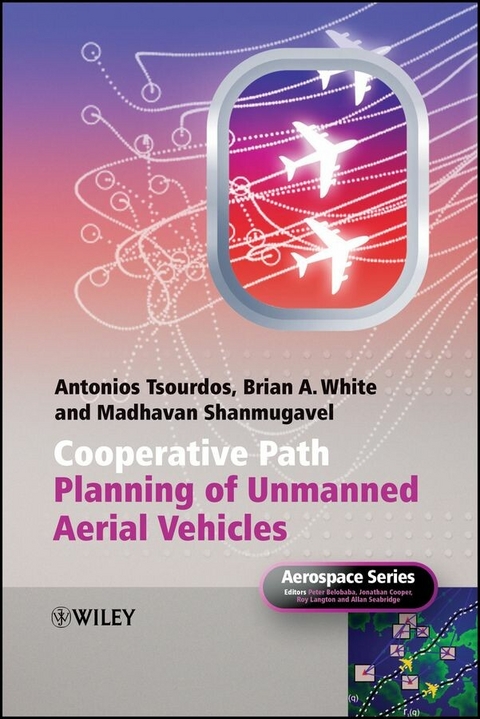
Cooperative Path Planning of Unmanned Aerial Vehicles (eBook)
John Wiley & Sons (Verlag)
978-0-470-97464-3 (ISBN)
Focussing on the path planning of multiple UAVs for simultaneous arrival on target, Cooperative Path Planning of Unmanned Aerial Vehicles also offers coverage of path planners that are applicable to land, sea, or space-borne vehicles.
Cooperative Path Planning of Unmanned Aerial Vehicles is authored by leading researchers from Cranfield University and provides an authoritative resource for researchers, academics and engineers working in the area of cooperative systems, cooperative control and optimization particularly in the aerospace industry.
Antonios Tsourdos is a Reader in Autonomous Systems and Control and Head of the Guidance and Control Group at Cranfield. His research areas include UAV Autonomy, UAV Path Planning, Coordinated Guidance, Cooperative Control, UAV Swarm, Autonomous Sensors Network, Sensor and Data Fusion, and Vehicle Health Management. He has authored many scientific research papers and has served as a guest editor for journal special issues on 'multi-vehicle systems cooperative control with applications'; 'advances in missile guidance and control: theory and practice', and cooperative control approaches for multiple mobile robots'.
Brian A White, now Professor Emeritus at Cranfield, was until recently Head of the Department of Aerospace, Power and Sensors and also Head of the Guidance and Control Group at Cranfield. His areas of expertise are robust control, non-linear control, estimation, observer applications, inertial navigation, guidance design, soft computing and sensor and data fusion. He has published widely in the control science field, mainly on autopilot design and guidance. He has managed significant contracts in the area of guidance. He has organized and run numerous invited sessions at major control conferences and co-edited a special issue of the IFAC journal Control Engineering Practice on Control in Defence Systems. He has served as associate editor for the IMechE Journal of Aerospace Engineering (Part G), IMechE Journal of Systems and Control Engineering (Part I), and the Journal of Nonlinear Studies.
Madhavan Shanmugavel is a Research Officer within the Guidance and Control Group at Cranfield.
An invaluable addition to the literature on UAV guidance and cooperative control, Cooperative Path Planning of Unmanned Aerial Vehicles is a dedicated, practical guide to computational path planning for UAVs. One of the key issues facing future development of UAVs is path planning: it is vital that swarm UAVs/ MAVs can cooperate together in a coordinated manner, obeying a pre-planned course but able to react to their environment by communicating and cooperating. An optimized path is necessary in order to ensure a UAV completes its mission efficiently, safely, and successfully. Focussing on the path planning of multiple UAVs for simultaneous arrival on target, Cooperative Path Planning of Unmanned Aerial Vehicles also offers coverage of path planners that are applicable to land, sea, or space-borne vehicles. Cooperative Path Planning of Unmanned Aerial Vehicles is authored by leading researchers from Cranfield University and provides an authoritative resource for researchers, academics and engineers working in the area of cooperative systems, cooperative control and optimization particularly in the aerospace industry.
Antonios Tsourdos is a Reader in Autonomous Systems and Control and Head of the Guidance and Control Group at Cranfield. His research areas include UAV Autonomy, UAV Path Planning, Coordinated Guidance, Cooperative Control, UAV Swarm, Autonomous Sensors Network, Sensor and Data Fusion, and Vehicle Health Management. He has authored many scientific research papers and has served as a guest editor for journal special issues on 'multi-vehicle systems cooperative control with applications'; 'advances in missile guidance and control: theory and practice', and cooperative control approaches for multiple mobile robots'. Brian A White, now Professor Emeritus at Cranfield, was until recently Head of the Department of Aerospace, Power and Sensors and also Head of the Guidance and Control Group at Cranfield. His areas of expertise are robust control, non-linear control, estimation, observer applications, inertial navigation, guidance design, soft computing and sensor and data fusion. He has published widely in the control science field, mainly on autopilot design and guidance. He has managed significant contracts in the area of guidance. He has organized and run numerous invited sessions at major control conferences and co-edited a special issue of the IFAC journal Control Engineering Practice on Control in Defence Systems. He has served as associate editor for the IMechE Journal of Aerospace Engineering (Part G), IMechE Journal of Systems and Control Engineering (Part I), and the Journal of Nonlinear Studies. Madhavan Shanmugavel is a Research Officer within the Guidance and Control Group at Cranfield.
About the Authors.
Series Preface.
Preface.
Acknowledgements.
List of Figures.
List of Tables.
Nomenclature.
1. Introduction.
1.1 Path Planning Formulation.
1.2 Path Planning Constraints.
1.3 Cooperative Path Planning and Mission Planning.
1.4 Path Planning - An Overview.
1.5 The Road Map Method.
1.6 Probabilistic Methods.
1.7 Potential Field.
1.8 Cell Decomposition.
1.9 Optimal Control.
1.10 Optimization Techniques.
1.11 Trajectories for Path Planning.
1.12 Outline of the Book.
References.
2. Path Planning in Two Dimensions.
2.1 Dubins Paths.
2.2 Designing Dubins Path using Analytical Geometry.
2.3 Existence of Dubins Paths.
2.4 Length of Dubins Paths.
2.5 Design of Dubins Paths using Principles of Differential
Geometry.
2.6 Path of Continuous Curvature.
2.7 Producing Flyable Clothoid Paths.
28 Producing Flyable Pythagorean Hodograph Paths (2D).
References.
3. Path Planning in Three Dimensions.
3.1 Dubins Paths in Three Dimensions Using Differential
Geometry.
3.2 Path Length - Dubins 3D.
3.3 Pythagorean Hodograph Paths - 3D.
3.4 Design of Flyable Paths Using PH Curves.
References.
4. Collision Avoidance.
4.1 Research into Obstacle Avoidance.
4.2 Obstacle Avoidance for Mapped Obstacles.
4.3 Obstacle Avoidance of Unmapped Static Obstacles.
4.4 Algorithmic Implementation.
References.
5. Path-Following Guidance.
5.1 Path Following the Dubins Path.
5.2 Linear Guidance Algorithm.
5.3 Nonlinear Dynamic Inversion Guidance.
5.4 Dynamic Obstacle Avoidance Guidance.
References.
6. Path Planning for Multiple UAVs.
6.1 Problem Formulation.
6.2 Simultaneous Arrival.
6.3 Phase I: Producing Flyable Paths.
6.4 Phase II: Producing Feasible Paths.
6.5 Phase III: Equalizing Path Length.
6.6 Multiple Path Algorithm.
6.7 Algorithm Application for Multiple UAVs.
6.8 2D Pythagorean Hodograph Paths.
6.9 3D Dubins Paths.
6.10 3D Pythagorean Hodograph Paths.
References.
Appendix A Differential Geometry.
Appendix B. Pythagorean Hodograph.
Index.
List of Figures
| 1.1 | A block diagram approach to path planning |
| 1.2 | Autopilot and guidance control loops |
| 1.3 | Curvature and torsion |
| 1.4 | Hierarchy of mission planning |
| 1.5 | Existing approach to path planning |
| 1.6 | The road map method |
| 1.7 | Visibility graph |
| 1.8 | Voronoi diagram: polygonal fences around obstacles |
| 1.9 | Cell decomposition |
| 2.1 | CLC and CCC types of Dubins path |
| 2.2 | Tangent circles |
| 2.3 | Dubins path with external tangent |
| 2.4 | Dubins path with internal tangent |
| 2.5 | Block diagram of path planner to generate the shortest flyable paths |
| 2.6 | Dubins paths with as a free variable. The start turn is either clockwise or anticlockwise. Four possible turns on each tangent circle produce eight paths |
| 2.7 | Dubins arc geometry |
| 2.8 | Set of Dubins paths over a range of |
| 2.9 | Set of Dubins path lengths over a range of |
| 2.10 | Dubins path |
| 2.11 | Curvature profiles of Dubins and clothoid paths |
| 2.12 | Path with clothoid arc geometry |
| 2.13 | Euler interpolation |
| 2.14 | Comparison of a Dubins path with a Pythagorean hodograph path. The Dubins path () is the shortest path but it lacks the curvature continuity. The PH path () has continuity but is longer for the same curvature bound |
| 2.15 | Evolution of a PH path from the tangent continuity into curvature continuity |
| 3.1 | Three-dimensional Dubins manoeuvre conditions |
| 3.2 | Three-dimensional Dubins manoeuvre of a UAV |
| 3.3 | Spatial PH path with tube |
| 4.1 | Obstacle avoidance in 2D |
| 4.2 | Single-obstacle Dubins |
| 4.3 | Single-obstacle Dubins line intersection |
| 4.4 | Single-obstacle Dubins line solution |
| 4.5 | Single-obstacle Dubins line solution limit condition for the same rotation direction |
| 4.6 | Single-obstacle Dubins line solution limit condition for opposed rotation direction |
| 4.7 | Single-obstacle Dubins intersecting line solution with the same rotation direction |
| 4.8 | Fail condition for same rotation direction |
| 4.9 | Fail condition for opposed rotation direction |
| 4.10 | Solution for scaling start arc segment |
| 4.11 | Arc intersection |
| 4.12 | Arc intersection tangent vectors |
| 4.13 | Arc intersection sufficient conditions |
| 4.14 | Arc scaling for maximum-curvature intersection |
| 4.15 | Arc scaling for minimum-curvature intersection |
| 4.16 | Solution set for arc intersection |
| 4.17 | Multiple obstacle environment |
| 4.18 | Multiple obstacle intersection trajectories |
| 4.19 | Clockwise Dubins trajectory |
| 4.20 | Multiple obstacle multiple trajectories for clockwise trajectory |
| 4.21 | Multiple obstacle concave trajectory for anticlockwise trajectory |
| 4.22 | Multiple obstacle complete trajectory set |
| 4.23 | Complete trajectory set for 15 obstacles |
| 4.24 | Threat handling by intermediate pose |
| 4.25 | UAVs in a static cluttered environment |
| 4.26 | Dubins flyable paths of two UAVs in a cluttered environment |
| 4.27 | Re-planning the Dubins path of UAV2 by curvature adjustment |
| 4.28 | Re-planning the Dubins path of UAV2 using an intermediate waypoint |
| 4.29 | Five UAVs each with four waypoints in cluttered space |
| 4.30 | Initial paths (only tangent continuity)—PH 2D in cluttered space |
| 4.31 | Flyable paths—PH 2D in cluttered space |
| 4.32 | Feasible (safe and flyable) paths—PH 2D in cluttered space |
| 4.33 | Paths of equal lengths—PH 2D in cluttered space |
| 4.34 | Obstacle avoidance in 3D |
| 4.35 | Path planning with obstacle avoidance in 3D |
| 4.36 | Obstacle avoidance in 3D (2D projection) |
| 5.1 | Guidance geometry |
| 5.2 | Carrot guidance |
| 5.3 | Linear guidance trajectory |
| 5.4 | Nonlinear guidance trajectory |
| 5.5 | Basic geometry for collision of UAV and aircraft |
| 5.6 | Basic geometry for collision avoidance of UAV and aircraft |
| 5.7 | Sightline geometry for single UAV and aircraft |
| 5.8 | Sightline miss geometry for single UAV and aircraft |
| 5.9 | Geometry for single UAV and aircraft |
| 5.10 | Chord intersection for sector definition |
| 5.11 | Velocity geometry |
| 5.12 | Relative position geometry |
| 5.13 | Collision condition for single UAV and two aircraft |
| 5.14 | Sightline miss geometry for single UAV and two aircraft |
| 5.15 | Chord intersection for multiple conflict resolution |
| 5.16 | Avoidance algorithm trajectories for multiple aircraft |
| 6.1 | UAV safety and communication range spheres |
| 6.2 | Multiple UAVs scenario: are flight paths, are poses. Suffix represents the th UAV or path. Shaded regions are obstacles/threats |
| 6.3 | Path planner for flyable paths |
| 6.4 | Safety constraints for collision avoidance |
| 6.5 | UAV shortest flyable paths—Dubins 2D |
| 6.6 | Paths of equal length—Dubins 2D |
| 6.7 | Separation distance for paths of first four combinations—Dubins 2D |
| 6.8 | Separation distance for paths of second four combinations—Dubins 2D |
| 6.9 | Separation distance for paths of last two combinations—Dubins 2D |
| 6.10 | Initial flyable paths of UAVs—clothoid 2D. All UAVs have different path lengths and the paths are intersecting with one another |
| 6.11 | Final paths of UAVs (paths of equal lengths)—clothoid 2D |
| 6.12 | PH paths of equal lengths |
| 6.13 | PH Paths of UAVs, equal lengths elevated at constant altitude |
| 6.14 | Flyable paths of UAVs—Dubins 3D |
| 6.15 | Paths of equal lengths—Dubins 3D |
| 6.16 | Paths of equal length (UAV1 and UAV2)—Dubins 3D |
| 6.17 | Paths of equal length (UAV1 and UAV3)—Dubins 3D |
| 6.18 | Paths of equal length (UAV2 and UAV3)—Dubins 3D |
| 6.19 | Flight path intersections. The intersections are given in each plane for each UAV. The intersections are calculated numerically. This is to avoid the possibility of complex points during the intersection between lines and circles. The following safety conditions are tested individually on all planes: (i) minimum separation distance, and (ii) non-intersection at equal lengths |
| 6.20 | Curvature and torsion variations with respect to path length, tangent-continuous path—UAV1. The path does not meet the... |
| Erscheint lt. Verlag | 9.11.2010 |
|---|---|
| Reihe/Serie | Aerospace Series |
| Aerospace Series (PEP) | Aerospace Series (PEP) |
| Mitarbeit |
Herausgeber (Serie): Peter Belobaba, Jonathan Cooper, Roy Langton, Allan Seabridge |
| Sprache | englisch |
| Themenwelt | Technik ► Fahrzeugbau / Schiffbau |
| Technik ► Luft- / Raumfahrttechnik | |
| Technik ► Maschinenbau | |
| Schlagworte | Aeronautic & Aerospace Engineering • Control Systems Technology • drone • drones • Electrical & Electronics Engineering • Elektrotechnik u. Elektronik • Flugzeug • Luft- u. Raumfahrttechnik • Maschinenbau • mechanical engineering • Regelungstechnik • UAV • Unmanned Aerial Vehicles |
| ISBN-10 | 0-470-97464-8 / 0470974648 |
| ISBN-13 | 978-0-470-97464-3 / 9780470974643 |
| Informationen gemäß Produktsicherheitsverordnung (GPSR) | |
| Haben Sie eine Frage zum Produkt? |
 EPUB (Adobe DRM)
Kopierschutz: Adobe-DRM
Adobe-DRM ist ein Kopierschutz, der das eBook vor Mißbrauch schützen soll. Dabei wird das eBook bereits beim Download auf Ihre persönliche Adobe-ID autorisiert. Lesen können Sie das eBook dann nur auf den Geräten, welche ebenfalls auf Ihre Adobe-ID registriert sind.
Details zum Adobe-DRM
Dateiformat: EPUB (Electronic Publication)
EPUB ist ein offener Standard für eBooks und eignet sich besonders zur Darstellung von Belletristik und Sachbüchern. Der Fließtext wird dynamisch an die Display- und Schriftgröße angepasst. Auch für mobile Lesegeräte ist EPUB daher gut geeignet.
Systemvoraussetzungen:
PC/Mac: Mit einem PC oder Mac können Sie dieses eBook lesen. Sie benötigen eine
eReader: Dieses eBook kann mit (fast) allen eBook-Readern gelesen werden. Mit dem amazon-Kindle ist es aber nicht kompatibel.
Smartphone/Tablet: Egal ob Apple oder Android, dieses eBook können Sie lesen. Sie benötigen eine
Geräteliste und zusätzliche Hinweise
Buying eBooks from abroad
For tax law reasons we can sell eBooks just within Germany and Switzerland. Regrettably we cannot fulfill eBook-orders from other countries.
aus dem Bereich