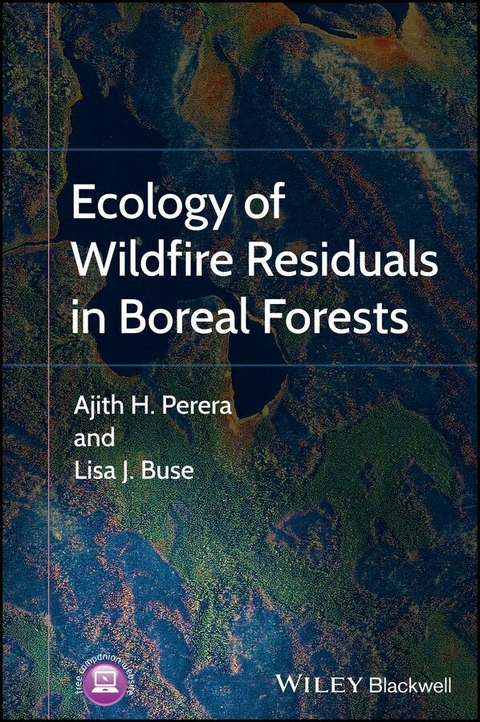
Ecology of Wildfire Residuals in Boreal Forests (eBook)
John Wiley & Sons (Verlag)
978-1-118-87058-7 (ISBN)
This book will draw attention to the residuals in pan-boreal forest fires and synthesize the state of knowledge. It will do so by: (a) Examining the concept of fire residuals from different perspectives, (b) Reviewing the growing body of scientific literature on the topic, (c) Conceptualizing the process of residual formation in relation to scale of fire disturbance, (d) Discussing the roles of fire residuals in ecological processes, (e) Describing approaches and methods of studying fire residuals, (f) Compiling and summarizing what is known about fire residual vegetation with respect to their extent, spatial patterns, and temporal changes, (g) Discussing how the knowledge of fire residuals is applied in forest management, including social perspective, and (h) Synthesizing the state of knowledge, identifying its uncertainties and gaps, and proposing research hypotheses. The authors use pan-boreal scientific literature on boreal fire residuals as well as fire behaviour, fire ecology, habitat ecology, and geochemical processes. For readers this book will be a reference for knowledge to date and a meta-analysis of research trends during the past few decades. In addition, the authors judiciously include views constructed from their observations and research experience, from boreal Canada, when they synthesize and conceptualize the knowledge. They also incorporate information extracted from their discussions and interactions with North American and European ecologists, forest managers, and conservationists to provide insight to different views and perspectives on the fire residuals of the boreal forest system. This book will inform researchers and students who study boreal forest ecology, as well as policymakers and forest managers who apply forest ecological knowledge in forest management.
This book provides a review and coalescence of the current knowledge of boreal forest fire residuals, which at present is sporadic and has not been unified or synthesized. Moreover, these are presently viewed myopically and parochially, rather than holistically. The intent of the synthesis is to identify knowledge uncertainties and gaps and propose topics for future research. Most importantly, it brings together fire behaviour, ecological scale, vegetation ecology, and conservation biology to conceptualize forest fire residuals. Although focused on boreal forests, the contents and principles presented are also be pertinent to other large-scale fire driven forest systems, such as dry montane forests in North America and Australian eucalypt forests. This book will add to the current knowledge base by providing a source of significant literature to-date, an in-depth examination of baseline concepts of forest fire residuals, as well as questions and research ideas to address the identified gaps. The timing is ideal because the knowledge base is beginning to expand and the interest in the topic is increasing: such a synthesis would provide an important foundation for future advances in this very relevant topical area. The book is a compact, yet comprehensive, dissertation of remnant vegetation in boreal forest fires with respect to their formation, role in ecological processes, applied importance, and a synthesis of state-of-the-knowledge and future research directions. The scope is boreal forests worldwide, including North America, Europe, and Asia. Brief TOC: Why the interest in boreal fire residuals; what are fire residuals; how are fire residuals formed; what are the ecological roles of the fire residuals; what is the role of residuals in forest management applications; synthesis, knowledge, uncertainties and research needs.Ajith H. Perera is a senior research scientist and leads the Forest Landscape Ecology Program at the Ontario Forest Research Institute in Ontario, Canada. He has over twenty-five years of research experience in landscape ecology, much of it focused on understanding patterns and processes of boreal forest fire regimes. He has
authored many scientific publications, including several books.
Lisa J. Buse is a forest biologist who specializes in knowledge transfer at the Ontario Forest Research Institute. She has over twenty years of experience in communicating forestry sciences to practitioners, especially on forest landscape ecology including wildfire disturbances in boreal Ontario. She has also published many scientific publications and co-edited three books.
Ajith H. Perera is a senior research scientist and leads the Forest Landscape Ecology Program at the Ontario Forest Research Institute in Ontario, Canada. He has over twenty-five years of research experience in landscape ecology, much of it focused on understanding patterns and processes of boreal forest fire regimes. He has authored many scientific publications, including several books. Lisa J. Buse is a forest biologist who specializes in knowledge transfer at the Ontario Forest Research Institute. She has over twenty years of experience in communicating forestry sciences to practitioners, especially on forest landscape ecology including wildfire disturbances in boreal Ontario. She has also published many scientific publications and co-edited three books.
Acknowledgments xi
About the companion website xiii
1 Introduction 1
The boreal forest biome 2
Geographical distribution 4
Distinguishing features 6
Boreal wildfires 9
Major characteristics 9
Ecological significance 11
Goals and scope of the book 12
References 14
2 Formation of wildfire residuals 18
Factors that affect the formation of residuals 19
Boreal forest communities 20
Boreal wildfires 31
Residual formation and distribution 40
Spatial heterogeneity in fire behavior 41
Process of residual formation 44
Summary 59
References 61
3 Types of wildfire residuals and their extent 65
Types of wildfire residuals 66
A post-wildfire scene 66
Past descriptions of wildfire residuals 71
Abundance and extent of wildfire residuals 79
Snag residuals 80
Live tree residuals 81
Residual patches 84
Changes in residuals after wildfires 88
Snag residuals 88
Live tree residuals 89
Residual patches 92
Toward improved definitions and assessment 93
Reasons for improvement 93
Definitions of wildfire residuals 95
Improved study approaches 103
Summary 107
References 113
4 Ecological roles of wildfire residuals 119
Ecological processes involving snag residuals 121
Invasion by beetles 121
Colonization by woodpeckers 132
Occupation by other bird species 140
Forest regeneration 142
Roles of the residual patches 148
Providing temporary shelter 149
Supplementing the recovery 151
Creating heterogeneity 161
Ecological significance 161
Wildfire residuals and the carbon cycle 162
Wildfire residuals and nutrient and hydrological cycles 165
Summary 168
References 173
5 Role of wildfire residuals in forest management
applications 184
Restoring wildfire residuals 185
Ecological expectations 186
Considerations for application 187
Challenges and uncertainties 190
Emulating wildfire disturbance 191
Background 191
Emulating wildfire residuals by forest harvest 193
Expectations and uncertainties 197
Salvage logging 202
Background 202
Ecological consequences 204
Practical considerations 212
Uncertainties 217
Summary 220
References 222
6 Ecology of boreal wildfire residuals - a summary and
synthesis 227
Wildfire residuals and their occurrence 227
Residual vegetation types 228
Spatial patterns of residuals 231
Ecological roles of wildfire residuals 235
Snag residuals 235
Residual patches 236
A conceptual view 237
Knowledge uncertainties 239
Management applications and wildfire residuals 240
Salvage logging 240
Emulating wildfire disturbances 240
Restoring wildfire residuals 242
Suppressing fire 243
Research needs on wildfire residuals 243
Advancing research methods 243
Expanding research topics 244
Conclusion 245
Index 247
Chapter 2
Formation of wildfire residuals
Factors that affect the formation of residuals
Residual formation and distribution
What factors may explain the occurrence of post-fire residual vegetation in boreal forests? That is the question we explore in this chapter in the context of boreal forest communities and boreal wildfires. Even though the boreal biome includes a wide range of geographical and climatic conditions across three continents, some commonalities exist in the pan-global boreal forest communities, terrain, ecological processes, and major natural disturbances (Shugart et al. 1992). For example, as we described in Chapter 1, wildfires burn a large total area annually throughout this biome, and the frequency of wildfire occurrence is high. Furthermore, boreal wildfires can be intense, their individual spatial signatures can be large, and they almost always contain residual vegetation. Our focus here is the formation of those wildfire residuals. We explore the many types of residual vegetation, their extent, and their spatial distribution in the next chapter.
Any discussion of the formation of wildfire residuals in boreal forest landscapes must involve three topics: the forest communities that sustain the wildfires by providing fuel, and that eventually constitute the wildfire residuals; the wildfire behavior and the thermal energy generated during the fire, which causes mortality of some or all of the vegetation; and finally, the spatial patterns of the wildfire residuals.
To address these topics, we have organized this chapter to answer two major questions: what factors affect the formation of wildfire residuals, and how are those residuals formed and spatially distributed during wildfires? Our treatment of boreal forest communities and wildfire processes will provide only an introduction to these topics, and is therefore not exhaustive or authoritative. Indeed, such an exercise is beyond the scope of this book. To learn more, we recommend several excellent texts that provide a more comprehensive discussion of the topic of boreal vegetation (e.g., Larsen 1980, Scott 1995) and boreal wildfires (e.g., Wein and MacLean 1983, Johnson 1992, Goldammer and Furyaev 1996). Also, we caution that much variability exists across the boreal regions in the specific details of both vegetation and fire events. Our attempt here may therefore appear to be an oversimplification and generalization. We hope that readers will understand that, rather than trying to account for all possible exceptions, we have instead tried to find generalities that are valid across the boreal region.
Factors that affect the formation of residuals
To understand how wildfire residuals form, familiarity with the types of boreal forest community and the behavior of wildfires is required. The former provides insights into the characteristics of the combustible material that will sustain a wildfire and the characteristics of the potential residuals. The latter provides insights into how the residuals form and how they are spatially distributed within a wildfire footprint—the spatial boundary that encompasses all fire processes. By addressing only boreal forest communities and wildfire behavior, we do not neglect the importance of climate, weather, and the geo-environment (e.g., geology, topography, soil moisture regime) in forming residuals. For example, they may change fire behavior or modify the factors that determine the composition of the residuals (Figure 2.1). Indeed, we address climate and geo-environmental variables when we discuss residual formation and the factors that influence this process.
Figure 2.1 An abstract depiction of the major factors that affect the formation of residuals in boreal wildfires. These factors operate at different ecological scales. For example, long-term climate and the local geo-environment produce changes in the types of forest communities, whereas short-term local weather and the local geo-environmental conditions directly affect the behavior of a given fire.
Boreal forest communities
Boreal forests are characterized by relatively few tree species that dominate the vegetation. These species belong to eight genera that are common throughout the range of boreal forests around the world: the conifers spruce (Picea), fir (Abies), pine (Pinus), and larch (Larix) and the hardwoods poplar (Populus), birch (Betula), alder (Alnus), and willow (Salix). The dominant species in each genus change from region to region, but a given species typically has a broad geographical range within its continent. Larsen (1980) summarized their distribution based on longitude (Table 2.1).
Table 2.1 Major tree species in the world's boreal forests and their longitudinal limits (adapted from Larsen 1980).
| Genus | Continent (range of longitudes) |
| North America (55–160°W) | Northern Europe (5–40°E) | Western Siberia (40–120°E) | Eastern Siberia (120–170°W) |
| Conifers |
| Picea (spruce) | glauca mariana | abies (syn. excelsa) | obovata | obovata jezoensis |
| Abies (fir) | balsamea | sibirica | nephrolepis |
| lasiocarpa | sachalinensis |
| Pinus (pine) | banksiana | sylvestris | sylvestris | sylvestris |
| contorta | sibirica | pumila |
| cembra |
| Larix (larch) | laricina | sibirica sukaczewii | gmelinii (syn. dahurica) |
| Hardwoods |
| Populus (poplar) | tremuloides balsamifera | tremula | tremula | tremula suaveolens |
| Betula (birch) | papyrifera | pubescens | pubescens | ermanii |
| kenaica | pendula (syn. verrucosa) kusmisscheffii | pendula (syn. verrucosa) | platyphylla |
| Alnus (alder) | incana (ssp. tenuifolia) | incana |
| viridis (ssp. crispa, ssp. rugosa) | viridis (ssp. crispa) | viridis (ssp. fruticosa) | viridis (ssp. fruticosa) |
| Salix (willow) | Salix spp. | Salix spp. | Salix spp. | Salix spp. |
Within these broad geographic distribution patterns, the regional distribution of tree species and their associated vegetation communities change in response to variations in geology, local climate, and topography, as has been documented for North America (e.g., Larsen 1980, Scott 1995), Fennoscandia (e.g., Esseen et al. 1997), and Siberia (e.g., Wein and MacLean 1983). One main factor that determines the local occurrence of tree species appears to be soil moisture (Table 2.2), and the direct effects of other factors, such as soil nutrient content, may be less evident (Larsen 1980). Both Wein and MacLean (1983) and Esseen et al. (1997) noted that in boreal forests in general, pines dominate the drier sites, and spruces and firs dominate the moister sites.
Table 2.2 Association of the major coniferous species with soil moisture regimes across the major boreal forest regions (summarized from Larsen 1980, Wein and MacLean 1983, and Esseen et al. 1997).
| Soil moisture regime | Region |
| Western North America | Eastern North America | Northern Europe | Western Siberia | Eastern Siberia |
| Dry | Pinus contorta | Pinus banksiana | Pinus sylvestris | Pinus cembra |
| Moist | Picea mariana Picea glauca | Picea mariana Picea glauca Abies balsamea | Picea abies | Picea abies | Picea obovata |
| Wet | Picea mariana | Larix laricina Picea mariana | Picea abies Larix spp. | Picea obovata Larix sibirica Abies sibirica Larix... |
| Erscheint lt. Verlag | 21.7.2014 |
|---|---|
| Sprache | englisch |
| Themenwelt | Naturwissenschaften ► Biologie ► Botanik |
| Naturwissenschaften ► Biologie ► Ökologie / Naturschutz | |
| Naturwissenschaften ► Geowissenschaften ► Geografie / Kartografie | |
| Technik | |
| Schlagworte | Agriculture • Ãkologie / Pflanzen • Angewandte Ãkologie • Angewandte Ökologie • Applied Ecology • Biome • Biowissenschaften • Boreal • boreal wildfires • Ecological • fires • focus • Forest • forestry • Forstwirtschaft • Globally • importance • important • Integral • intense • intense wildfires • known • Landwirtschaft • Life Sciences • Managers • Ökologie / Pflanzen • Patterns • phenomenon academics • plant ecology • policymakers • remnants • Strategies • Study |
| ISBN-10 | 1-118-87058-1 / 1118870581 |
| ISBN-13 | 978-1-118-87058-7 / 9781118870587 |
| Informationen gemäß Produktsicherheitsverordnung (GPSR) | |
| Haben Sie eine Frage zum Produkt? |
 EPUB (Adobe DRM)
Kopierschutz: Adobe-DRM
Adobe-DRM ist ein Kopierschutz, der das eBook vor Mißbrauch schützen soll. Dabei wird das eBook bereits beim Download auf Ihre persönliche Adobe-ID autorisiert. Lesen können Sie das eBook dann nur auf den Geräten, welche ebenfalls auf Ihre Adobe-ID registriert sind.
Details zum Adobe-DRM
Dateiformat: EPUB (Electronic Publication)
EPUB ist ein offener Standard für eBooks und eignet sich besonders zur Darstellung von Belletristik und Sachbüchern. Der Fließtext wird dynamisch an die Display- und Schriftgröße angepasst. Auch für mobile Lesegeräte ist EPUB daher gut geeignet.
Systemvoraussetzungen:
PC/Mac: Mit einem PC oder Mac können Sie dieses eBook lesen. Sie benötigen eine
eReader: Dieses eBook kann mit (fast) allen eBook-Readern gelesen werden. Mit dem amazon-Kindle ist es aber nicht kompatibel.
Smartphone/Tablet: Egal ob Apple oder Android, dieses eBook können Sie lesen. Sie benötigen eine
Geräteliste und zusätzliche Hinweise
Buying eBooks from abroad
For tax law reasons we can sell eBooks just within Germany and Switzerland. Regrettably we cannot fulfill eBook-orders from other countries.
aus dem Bereich