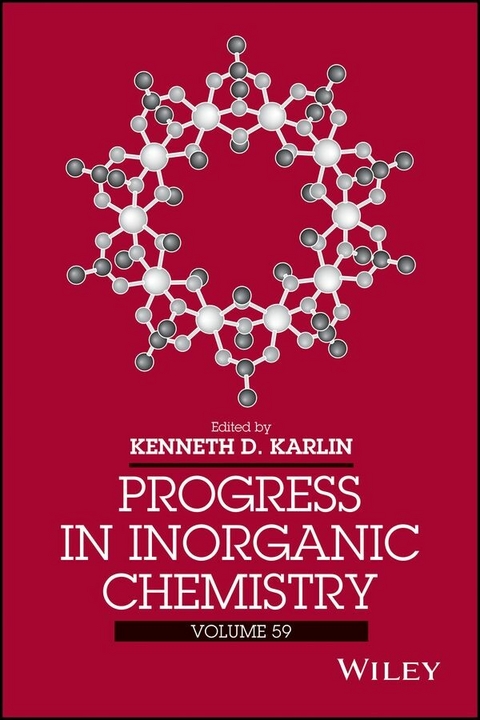
Progress in Inorganic Chemistry (eBook)
360 Seiten
Wiley (Verlag)
978-1-118-87003-7 (ISBN)
This series provides inorganic chemists and materials scientists with a forum for critical, authoritative evaluations of advances in every area of the discipline. Volume 59 continues to report recent advances with a significant, up-to-date selection of contributions by internationally-recognized researchers.
The chapters of this volume are devoted to the following topics:
• Iron Catalysis in Synthetic Chemistry
• A New Paradigm for Photodynamic Therapy Drug Design: Multifunctional, Supramolecular DNA Photomodification Agents Featuring Ru(II)/Os(II) Light Absorbers Coupled to Pt(II) or Rh(III) Bioactive Sites
• Selective Binding of Zn2+ Complexes to Non-Canonical Thymine or Uracil in DNA or RNA.
• Progress Toward the Electrocatalytic Production of Liquid Fuels from Carbon Dioxide
• Monomeric Dinitrosyl Iron Complexes: Synthesis and Reactivity
• Interactions of Nitrosoalkanes/arenes, Nitrosamines, Nitrosothiols, and Alkyl Nitrites with Metals
• Aminopyridine Iron and Manganese Complexes as Molecular Catalysts for Challenging Oxidative Transformations
Kenneth D. Karlin, PhD, is the Ira Remsen Professor of Chemistry at Johns Hopkins University. He received his PhD from Columbia University. Dr. Karlin’s bioinorganic research focuses on coordination chemistry relevant to biological and environmental processes, involving copper or heme (porphyrin-iron) complexes. Dr. Karlin’s main approach involves synthetic modeling, i.e. biomimetic chemistry. He is the winner of the prestigous F. Albert Cotton Award in Synthetic Inorganic Chemistry and the Sierra Nevada Distinguished Chemist Award, both awarded in 2009.
Kenneth D. Karlin, PhD, is the Ira Remsen Professor of Chemistry at Johns Hopkins University. He received his PhD from Columbia University. Dr. Karlin's bioinorganic research focuses on coordination chemistry relevant to biological and environmental processes, involving copper or heme (porphyrin-iron) complexes. Dr. Karlin's main approach involves synthetic modeling, i.e. biomimetic chemistry. He is the winner of the prestigous F. Albert Cotton Award in Synthetic Inorganic Chemistry and the Sierra Nevada Distinguished Chemist Award, both awarded in 2009.
Chapter 1 Iron Catalysis in Synthetic Chemistry 1
SUJOY RANA, ATANU MODAK, SOHAM MAITY, TUHIN PATRA, AND DEBABRATA
MAITI
Chapter 2 A New Paradigm for Photodynamic Therapy Drug Design:
Multifunctional, Supramolecular DNA Photomodification Agents
Featuring Ru(II)/Os(II) Light Absorbers Coupled to Pt(II) or
Rh(III) Bioactive Sites 189
JESSICA D. KNOLL AND KAREN J. BREWER
Chapter 3 Selective Binding of Zn2ii Complexes to
Non-Canonical Thymine or Uracil in DNA or RNA 245
KEVIN E. SITERS, STEPHANIE A. SANDER, AND JANET R.
MORROW
Chapter 4 Progress Toward the Electrocatalytic Production of
Liquid Fuels from Carbon Dioxide 299
JOEL ROSENTHAL
Chapter 5 Monomeric Dinitrosyl Iron Complexes: Synthesis and
Reactivity 339
CAMLY T. TRAN, KELSEY M. SKODJE, AND EUNSUK KIM
Chapter 6 Interactions of Nitrosoalkanes/arenes, Nitrosamines,
Nitrosothiols, and Alkyl Nitrites with Metals 381
NAN XU AND GEORGE B. RICHTER-ADDO
Chapter 7 Aminopyridine Iron and Manganese Complexes as
Molecular Catalysts for Challenging Oxidative Transformations
447
ZOEL CODOLA, JULIO LLORET-FILLOL, AND MIQUEL COSTAS
Subject Index 533
Cumulative Index 561
Iron Catalysis in Synthetic Chemistry
Sujoy Rana, Atanu Modak, Soham Maity, Tuhin Patra, and Debabrata Maiti
Department of Chemistry, Indian Institute of Technology Bombay, Powai, Mumbai, India
CONTENTS
- I. Introduction
- II. Addition Reactions
- III. The C—C Bond Formations VIA C—H Functionalization
- IV. The C—H Bond Oxidation
- V. Cross-Coupling Reactions
- A. Alkenyl Derivatives as Coupling Partners
- B. Aryl Derivatives as Coupling Partners
- C. Alkyl Derivatives as Coupling Partners
- D. Acyl Derivatives as Coupling Partners
- E. Iron-Catalyzed C—O, C—S, and C—N Cross-Coupling Reaction
- F. Iron-Catalyzed Mizoraki–Heck Reaction
- G. Iron-Catalyzed Negishi Coupling Reaction
- H. Suzuki–Miyaura Coupling Reaction
- I. Sonogashira Reaction
- J. Mechanism of Cross-Coupling Reactions
- K. Hydrocarboxylation
- L. Enyne Cross-Coupling Reaction
- VI. Direct C—N Bond Formation VIA C—H Oxidation
- VII. Iron-Catalyzed Amination
- VIII. Sulfoxidations and Synthesis of Sulfoximines, Sulfimides, and Sulfoximides
- IX. Reduction Reactions
- A. Hydrosilylation of Alkenes
- B. Hydrosilylation of Aldehydes and Ketones
- C. Hydrogenation of C—C Unsaturated Bonds
- D. Hydrogenation of Ketones
- E. Hydrogenation of Imines
- F. Reduction of Nitroarene to Anilines
- G. Hydrogenation of Carbon Dioxide and Bicarbonate
- H. Amide Reduction
- I. Reductive Aminations
- X. Trifluoromethylation
- XI. Conclusion
- Acknowledgments
- Abbreviations
- References
I. Introduction
During the last few decades, transition metal catalysts, especially those on precious metals [e.g., palladium (Pd), rhodium (Rh), iridium (Ir), and ruthenium (Ru)] have proven to be efficient for a large number of applications. The success of transition metal based organometallic catalysts lies in the easy modification of their environment by ligand exchange. A very large number of different types of ligands can coordinate to transition metal ions. Once the ligands are coordinated, the reactivity of the metals may change dramatically. However, the limited availability of these metals, in order of decreasing risk (depletion): Au > Ir, Rh, Ru > Pt, Re, Pd), as well as their high price (Fig. 1) and significant toxicity, makes it desirable to search for more economical and environmental friendly alternatives. A possible solution to this problem could be the increased use of catalysts based on first-row transition metals, especially iron (Fe) (1). In contrast to synthetic precious metal catalysts, iron takes part in various biological systems as an essential key element and electron-transfer reactions.
Figure 1. Comparison of prices for different transition metals (Sigma Aldrich).
Due to its abundance, inexpensiveness, and environmentally benign nature, use of iron has increased significantly in the last two decades for synthetic transformation both in asymmetric synthesis and reaction methodology. This development encouraged us to summarize the use of iron catalysis in organic synthesis, which includes cycloadditions, C—C, C—N bond formation, redox, and other reactions. This chapter has been divided into different sections based on the reaction type.
II. Addition Reactions
A. Cycloadditions
1. The [2 + 2] Cycloaddition
In 2001, Itoh and co-workers (2) demonstrated the [2 + 2] cyclodimerization of trans-anethol catalyzed by alumina supported iron(III) perchlorate. A C2 symmetric cyclobutane derivative was obtained in excellent yield (92%) at room temperature (rt), though longer reaction time was required. They applied the same catalytic system for the cycloaddition of styrenes and quinones. However, 2,3-dihydrobenzofuran derivatives were obtained in excellent yields in place of the desired [2 + 2] cycloadduct (Scheme 1) (3). Earlier, in 1982, Rosenblum and Scheck (4) showed that the CpFe(CO)2 cation, where Cp = cyclopentadienyl, could afford the unsaturated bicycle through the reaction of alkenes and methyl tetrolate, though the yields obtained were inferior.
Scheme 1. Early examples of iron-catalyzed [2 + 2] cycloaddition.
Significant improvement in iron-catalyzed [2 + 2] cycloaddition was achieved in 2006 by Chirik and co-workers (5). They reported an intramolecular [2 + 2] cycloaddition of the dienes resulting in the formation of [0.2.3] heptane derivatives catalyzed by a bis(imino)-pyridine iron(II) bis(dinitrogen) complex and only cis product was obtained. Further, labeling experiments confirmed the reaction to be stereospecific. A number of dienes containing different amine and ester functional groups reacted efficiently, but the presence of secondary amine and an SiMe2 group inhibited the reaction. This reaction can also be performed in the dark, clearly indicating the process to be thermally driven, rather than a photochemical one. A mechanism of this catalytic process was proposed where iron is assumed to maintain its ferrous oxidation state throughout the reaction with the help of redox active iPrPDI ligand (Scheme 2).
Scheme 2. Plausible mechanism involving the iron(II) oxidation state [PDI = (N,N′,E,N,N′,E)-N,N′-(1,1′)-(pyridine-2,6-diyl)bis(ethan-1-yl-1-ylidine))bis(2,6-diisopropylaniline)].
A combination of ethylene and butadiene resembles a thermally allowed [4 + 2] cycloaddition reaction, namely, the Diels–Alder reaction. Using their redox-active bis(imino)-pyridine supported iron catalysts, Chirik and co-workers (6) reported the more challenging [2 + 2] cycloaddition from the same set of starting materials that furnished vinylcyclobutane in an excellent 95% yield. The protocol turned out to be substrate specific, as with insertion of a methyl group in the 2- position of diene, no cycloadduct was observed; rather it resulted in a 1,4-addition product. To shed light on their plausible mechanism, several labeling experiments were carried out with different substrates. They were successful in intercepting one iron metallocyclic intermediate, which resulted from ethylene insertion into the coordinated diene. The same species was also prepared by reacting vinylcyclobutane, the product of the [2 + 2] cycloaddition, with the iron catalyst. Thus the reaction proved to be reversible with iron metallocycle as an intermediate, and the backward reaction demonstrated a rare example of sp3–sp3 C—C bond activation with an iron catalyst under mild conditions. Isolation of the metallocycle intermediate and labeling experiments led to a proposed mechanism for [2 + 2] cycloaddition and 1,4-addition. The reaction initiated by displacement of dinitrogen ligands by diene an η4 complex, and ethylene insertion, which furnished the isolable metallocycle intermediate. In the next step, butadiene-induced reductive-elimination resulted in vinylcyclobutane along with regeneration of an iron butadiene intermediate. However, with isoprene, β-hydrogen elimination followed by C—H reductive elimination resulted in the 1,4-addition product (Scheme 3).
Scheme 3. Proposed mechanism for [2 + 2] cycloaddition of ethylene and butadiene.
2. The [3 + 2]...
| Erscheint lt. Verlag | 22.7.2014 |
|---|---|
| Reihe/Serie | Progress in Inorganic Chemistry |
| Progress in Inorganic Chemistry | Progress in Inorganic Chemistry |
| Sprache | englisch |
| Themenwelt | Naturwissenschaften ► Biologie ► Biochemie |
| Naturwissenschaften ► Chemie ► Anorganische Chemie | |
| Technik ► Maschinenbau | |
| Schlagworte | Advances • Anorganische Chemie • area • authoritative • Bioanorganische Chemie • bioinorganic chemistry • Chemie • Chemistry • Chemists • Continues • Critical • Discipline • Edge • Evaluations • every • Forum • inorganic • Inorganic Chemistry • internationallyrecognized • Materials Science • Materialwissenschaften • Progress • Recent Advances • Reporting • Scientific • series • significant • Tradition • Volume |
| ISBN-10 | 1-118-87003-4 / 1118870034 |
| ISBN-13 | 978-1-118-87003-7 / 9781118870037 |
| Informationen gemäß Produktsicherheitsverordnung (GPSR) | |
| Haben Sie eine Frage zum Produkt? |
 EPUB (Ohne DRM)
Digital Rights Management: ohne DRM
Dieses eBook enthält kein DRM oder Kopierschutz. Eine Weitergabe an Dritte ist jedoch rechtlich nicht zulässig, weil Sie beim Kauf nur die Rechte an der persönlichen Nutzung erwerben.
Dateiformat: EPUB (Electronic Publication)
EPUB ist ein offener Standard für eBooks und eignet sich besonders zur Darstellung von Belletristik und Sachbüchern. Der Fließtext wird dynamisch an die Display- und Schriftgröße angepasst. Auch für mobile Lesegeräte ist EPUB daher gut geeignet.
Systemvoraussetzungen:
PC/Mac: Mit einem PC oder Mac können Sie dieses eBook lesen. Sie benötigen dafür die kostenlose Software Adobe Digital Editions.
eReader: Dieses eBook kann mit (fast) allen eBook-Readern gelesen werden. Mit dem amazon-Kindle ist es aber nicht kompatibel.
Smartphone/Tablet: Egal ob Apple oder Android, dieses eBook können Sie lesen. Sie benötigen dafür eine kostenlose App.
Geräteliste und zusätzliche Hinweise
Buying eBooks from abroad
For tax law reasons we can sell eBooks just within Germany and Switzerland. Regrettably we cannot fulfill eBook-orders from other countries.
aus dem Bereich