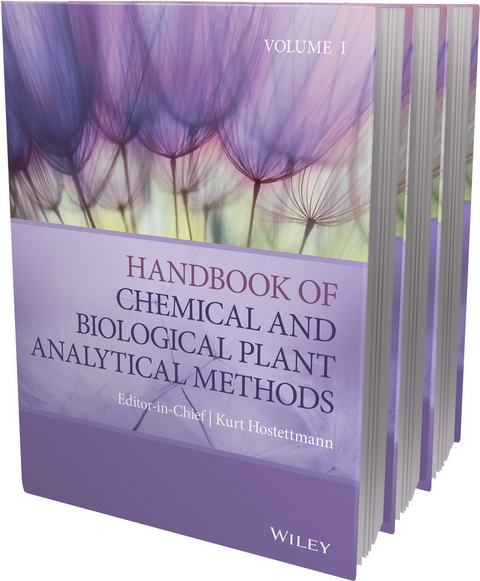
Handbook of Chemical and Biological Plant Analytical Methods (eBook)
John Wiley & Sons (Verlag)
978-1-118-87498-1 (ISBN)
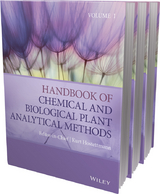
Plants and plant-derived compounds and drugs are becoming more and more popular with increasing numbers of scientists researching plant analysis. The quality control of herbal drugs is also becoming essential to avoid severe health problems, and in the future many more new drugs will be developed from plant sources.
This three-volume Handbook, featuring 47 detailed review articles, is unique as it deals with chemical and biological methodologies for plant analysis. It presents the most important and most accurate methods which are available for plant analysis.
This comprehensive work is divided into six sections as follows:
Sample preparation and identification - discussing plant selection and collection, followed by extraction and sample preparation methodologies.
Extraction and sample preparation methodologies
Instrumentation for chemical analysis - several instrumentations for chemical plant analysis are presented with an emphasis on hyphenated techniques, e.g. the coupling between HPLC and mass spectroscometry, and HPLC with NMR.
Strategies for selective classes of compounds - coverage of the most interesting classes of compounds such as polysaccharides, saponins, cardiotonic glycosides, alkaloids, terpenoids, lipids, volatile compounds and polyphenols ( flavonoids, xanthones, coumarins, naphthoquinones, anthraquinones, proanthocyanidins, etc.).
Biological Analysis - includes phenotyping, DNA barcoding techniques, transcriptome analysis , microarray, metabolomics and proteomics.
Drugs from Plants - covers the screening of plant extracts and strategies for the quick discovery of novel bioactive natural products. Safety assessment of herbal drugs is highly dependent on outstanding chromatographic and spectroscopic methods which are also featured here.
This Handbook introduces to scientists involved in plant studies the current knowledge of methodologies in various fields of chemically- and biochemically-related topics in plant research.
The content from this Handbook will publish online within the Encyclopedia of Analytical Chemistry via Wiley Online Library: http://www.wileyonlinelibrary.com/ref/eac
Benefit from the introductory offer, valid until 30 November 2014!
Introductory price: £425.00 / $695.00 / ?550.00
List price thereafter: £495.00 / $795.00 / ?640.00
Kurt Hostettmann is the editor of Handbook of Chemical and Biological Plant Analytical Methods, 3 Volume Set, published by Wiley.
Shilin Chen is the editor of Handbook of Chemical and Biological Plant Analytical Methods, 3 Volume Set, published by Wiley.
Andrew Marston is the editor of Handbook of Chemical and Biological Plant Analytical Methods, 3 Volume Set, published by Wiley.
Hermann Stuppner is the editor of Handbook of Chemical and Biological Plant Analytical Methods, 3 Volume Set, published by Wiley.
Plants and plant-derived compounds and drugs are becoming more and more popular with increasing numbers of scientists researching plant analysis. The quality control of herbal drugs is also becoming essential to avoid severe health problems, and in the future many more new drugs will be developed from plant sources. This three-volume Handbook, featuring 47 detailed review articles, is unique as it deals with chemical and biological methodologies for plant analysis. It presents the most important and most accurate methods which are available for plant analysis. This comprehensive work is divided into six sections as follows: Sample preparation and identification discussing plant selection and collection, followed by extraction and sample preparation methodologies. Extraction and sample preparation methodologies Instrumentation for chemical analysis - several instrumentations for chemical plant analysis are presented with an emphasis on hyphenated techniques, e.g. the coupling between HPLC and mass spectroscometry, and HPLC with NMR. Strategies for selective classes of compounds coverage of the most interesting classes of compounds such as polysaccharides, saponins, cardiotonic glycosides, alkaloids, terpenoids, lipids, volatile compounds and polyphenols ( flavonoids, xanthones, coumarins, naphthoquinones, anthraquinones, proanthocyanidins, etc.). Biological Analysis - includes phenotyping, DNA barcoding techniques, transcriptome analysis , microarray, metabolomics and proteomics. Drugs from Plants covers the screening of plant extracts and strategies for the quick discovery of novel bioactive natural products. Safety assessment of herbal drugs is highly dependent on outstanding chromatographic and spectroscopic methods which are also featured here. This Handbook introduces to scientists involved in plant studies the current knowledge of methodologies in various fields of chemically- and biochemically-related topics in plant research. The content from this Handbook will publish online within the Encyclopedia of Analytical Chemistry via Wiley Online Library: http://www.wileyonlinelibrary.com/ref/eac Benefit from the introductory offer, valid until 30 November 2014! Introductory price: 425.00 / $695.00 / 550.00 List price thereafter: 495.00 / $795.00 / 640.00
Kurt Hostettmann is the editor of Handbook of Chemical and Biological Plant Analytical Methods, 3 Volume Set, published by Wiley. Shilin Chen is the editor of Handbook of Chemical and Biological Plant Analytical Methods, 3 Volume Set, published by Wiley. Andrew Marston is the editor of Handbook of Chemical and Biological Plant Analytical Methods, 3 Volume Set, published by Wiley. Hermann Stuppner is the editor of Handbook of Chemical and Biological Plant Analytical Methods, 3 Volume Set, published by Wiley.
Contributors
- Iqbal Ahmad Department of Agricultural Microbiology, Aligarh Muslim University, Aligarh, India
- Nadja Arens Department of Physiology and Cell Biology, Leibniz Institute of Plant Genetics and Crop Plant Research, Gatersleben, Germany
- Yoshinori Asakawa Faculty of Pharmaceutical Sciences, Tokushima Bunri University, Yamashiro-cho, Tokushima, Japan
- Frédéric Ausseil Institut de Recherche Pierre Fabre, Toulouse, France
- Carlo Bicchi Dipartimento di Scienza e Tecnologia del Farmaco, Università di Torino, Torino, Italy
- Anna R. Bilia Department of Chemistry, University of Florence, Sesto Fiorentino (Firenze), Italy
- Wolfgang Blaschek Department of Pharmaceutical Biology, University of Kiel, Kiel, Germany
- Nadine Bohni School of Pharmaceutical Sciences, University of Geneva, University of Lausanne, Geneva, Switzerland
- Cecilia Cagliero Dipartimento di Scienza e Tecnologia del Farmaco, Università di Torino, Torino, Italy
- Valérie Camel AgroParisTech, Paris, France
- Swaranjit Singh Cameotra Institute of Microbial Technology, Chandigarh, India
- Raquel A. P. Castanheiro Centro de Química Medicinal da Universidade do Porto (CEQUIMED- UP), CIIMAR, Departamento de Química, Faculdade de Farmácia, Universidade do Porto, Porto, Portugal
- Haimei Chen Institute of Medicinal Plant Development, Chinese Academy of Medical Science, Beijing, PR China
- Shilin Chen The National Engineering Laboratory for Breeding of Endangered Medicinal Materials, Institute of Medicinal Plant Development, Chinese Academy of Medical Sciences & Peking Union Medical College, Beijing, PR China
- Philippe Christen School of Pharmaceutical Sciences, University of Geneva, University of Lausanne, Geneva, Switzerland
- Chiara Cordero Dipartimento di Scienza e Tecnologia del Farmaco, Università di Torino, Torino, Italy
- David J. Craik The University of Queensland, Brisbane, Queensland, Australia
- Charlotte D'Souza The University of Queensland, Brisbane, Queensland, Australia
- Denise Dagnino Grupo Metabolômica, Universidade Estadual do Norte Fluminense, Campos dos Goytacazes, Brazil
- Bruno David Institut de Recherche Pierre Fabre, Toulouse, France
- Bieke Dejaegher Department of Analytical Chemistry and Pharmaceutical Technology (FABI), Vrije Universiteit Brussel (VUB), Brussels, Belgium
- Sagar Deshpande Jacobs University Bremen, School of Engineering and Science, Chemistry, Bremen, Germany
- Stefanie Doell Department of Physiology and Cell Biology, Leibniz Institute of Plant Genetics and Crop Plant Research, Gatersleben, Germany
- Nahed El-Najjar Department of Physiology and Biophysics, Weill Cornell Medical College, Doha, Qatar
- Hala Gali-Muhtasib Department of Biology, American University of Beirut, Beirut, Lebanon
- Markus Ganzera Institute of Pharmacy, Pharmacognosy, University of Innsbruck, Innsbruck, Austria
- Elisabeth Ginko University of Vienna, Vienna, Austria
- Kazimierz Głowniak Department of Pharmacognosy with Medicinal Plant Unit, Medical University of Lublin, Lublin, Poland
- Maria J. Gonçalves Center for Neuroscience and Cell Biology, Department of Zoology, University of Coimbra, Coimbra, Portugal and Center of Pharmaceutical Studies, Faculty of Pharmacy, University of Coimbra, Coimbra, Portugal
- Ana M. González-Paramás Facultad de Farmacia, Universidad de Salamanca, Salamanca, Spain
- Sarina Grutsch University of Innsbruck and Center for Molecular Biosciences Innsbruck (CMBI), Institute of Organic Chemistry, Innsbruck, Austria
- M. Kamal B. Gunaherath The Open University of Sri Lanka, Nugegoda, Sri Lanka
- A. Leslie Gunatilaka The University of Arizona, Tucson, AZ, USA
- Qiaosheng Guo Institute of Chinese Medicinal Materials, Nanjing Agricultural University, Nanjing, Jiangsu, PR China
- Irina A. Guschina School of Biosciences, Cardiff University, Cardiff, UK
- Maria Halabalaki Division of Pharmacognosy and Natural Products Chemistry, Department of Pharmacy, University of Athens, Athens, Greece
- John L. Harwood School of Biosciences, Cardiff University, Cardiff, UK
- Christian W. Huck Leopold-Franzens University, Innsbruck, Austria
- Rafiq Islam Department of Natural Sciences, Northwest Missouri State University, Maryville, MO, USA
- Rakesh Jaiswal Jacobs University Bremen, School of Engineering and Science, Chemistry, Bremen, Germany
- Mohamed G. E. Karar Jacobs University Bremen, School of Engineering and Science, Chemistry, Bremen, Germany
- Beatrice Kaufmann School of Pharmaceutical Sciences, University of Geneva, University of Lausanne, Geneva, Switzerland
- Mohd Sajjad Ahmad Khan Institute of Microbial Technology, Chandigarh, India
- Anake Kijjoa ICBAS-Instituto de Ciências Biomèdicas de Abel Salazar and CIIMAR, Universidade do Porto, Porto, Portugal
- Eirini Kouloura Division of Pharmacognosy and Natural Products Chemistry, Department of Pharmacy, University of Athens, Athens, Greece
- Mariusz Kowalczyk Institute of Soil Science and Plant Cultivation, State Research Institute, Pulawy, Poland
- Liselotte Krenn Department of Pharmacognosy, University of Vienna, Vienna, Austria
- Christoph Kreutz University of Innsbruck and Center for Molecular Biosciences Innsbruck (CMBI), Institute of Organic Chemistry, Innsbruck, Austria
- Anja Krüger Institute of Pharmacy, Pharmacognosy, University of Innsbruck, Innsbruck, Austria
- Justyna Krzyzanowska Institute of Soil Science and Plant Cultivation, State Research Institute, Pulawy, Poland
- Nikolai Kuhnert Jacobs University Bremen, School of Engineering and Science, Chemistry, Bremen, Germany
- Jianqin Li Institute of Medicinal Plant Development, Chinese Academy of Medical Science, Beijing, PR China
- Erica Liberto Dipartimento di Scienza e Tecnologia del Farmaco, Università di Torino, Torino, Italy
- Chang Liu Institute of Medicinal Plant Development, Chinese Academy of Medical Science, Beijing, PR China
- Shanfa Lu Institute of Medicinal Plant Development, Chinese Academy of Medical Sciences & Peking Union Medical College, Beijing, PR China
- Agnieszka Ludwiczuk Department of Pharmacognosy with Medicinal Plant Unit, Medical University of Lublin, Lublin, Poland
- Hongmei Luo The National Engineering Laboratory for Breeding of Endangered Medicinal Materials, Institute of Medicinal Plant Development, Chinese Academy of Medical Sciences & Peking Union Medical College, Beijing, PR China
- Ana P. Martins Center of Pharmaceutical Studies, Faculty of Pharmacy, Health Science Campus, University of Coimbra, Coimbra, Portugal
- Marius F. Matei Jacobs University Bremen, School of Engineering and Science, Chemistry, Bremen, Germany
- Veronika R. Meyer Swiss Federal Laboratories for Materials Science and Technology, Laboratory for Protection and Physiology, St. Gallen, Switzerland
- Mohammed J. Meziani Department of Natural Sciences, Northwest Missouri State University, Maryville, MO, USA
- Somayeh Mirsadeghi Department of Chemistry, Islamic Azad University, Varamin Pishva Branch, Varamin, Iran
- Hans-Peter Mock Department of Physiology and Cell Biology, Leibniz Institute of Plant Genetics and Crop Plant Research, Gatersleben, Germany
- Abdul Mottaleb Center for Innovation and Entrepreneurship, Northwest Missouri State University, Maryville, MO, USA and Department of Natural Sciences, Northwest Missouri State University, Maryville, MO, USA
- Susan E. Northfield The University of Queensland, Brisbane, Queensland, Australia
- Wieslaw Oleszek Institute of Soil Science and Plant Cultivation, State Research Institute, Pulawy, Poland
- Brás Heleno de Oliveira Federal University of Paraná, Curitiba, Brazil
- Xiaohui Pang...
| Erscheint lt. Verlag | 15.7.2014 |
|---|---|
| Mitarbeit |
Chef-Herausgeber: Kurt Hostettmann |
| Sprache | englisch |
| Themenwelt | Medizin / Pharmazie ► Gesundheitsfachberufe |
| Medizin / Pharmazie ► Medizinische Fachgebiete ► Pharmakologie / Pharmakotherapie | |
| Naturwissenschaften ► Biologie ► Biochemie | |
| Naturwissenschaften ► Biologie ► Botanik | |
| Naturwissenschaften ► Chemie ► Analytische Chemie | |
| Technik | |
| Schlagworte | Analytical Chemistry • Analytische Chemie • Articles • Biowissenschaften • Botanik • Botanik / Biochemie • Chemical • Chemie • Chemistry • compounds • Control • Deals • Drug Discovery & Development • Drugs • Essential • Future • Health • herbal • increasing • Life Sciences • many • Methodologies • Methods • New • Numbers • Plant • plant biochemistry • Popular • Problems • quality • researching • Review • scientists • Sources • Unique • Wirkstoffforschung • Wirkstoffforschung u. -entwicklung |
| ISBN-10 | 1-118-87498-6 / 1118874986 |
| ISBN-13 | 978-1-118-87498-1 / 9781118874981 |
| Informationen gemäß Produktsicherheitsverordnung (GPSR) | |
| Haben Sie eine Frage zum Produkt? |
 EPUB (Adobe DRM)
Kopierschutz: Adobe-DRM
Adobe-DRM ist ein Kopierschutz, der das eBook vor Mißbrauch schützen soll. Dabei wird das eBook bereits beim Download auf Ihre persönliche Adobe-ID autorisiert. Lesen können Sie das eBook dann nur auf den Geräten, welche ebenfalls auf Ihre Adobe-ID registriert sind.
Details zum Adobe-DRM
Dateiformat: EPUB (Electronic Publication)
EPUB ist ein offener Standard für eBooks und eignet sich besonders zur Darstellung von Belletristik und Sachbüchern. Der Fließtext wird dynamisch an die Display- und Schriftgröße angepasst. Auch für mobile Lesegeräte ist EPUB daher gut geeignet.
Systemvoraussetzungen:
PC/Mac: Mit einem PC oder Mac können Sie dieses eBook lesen. Sie benötigen eine
eReader: Dieses eBook kann mit (fast) allen eBook-Readern gelesen werden. Mit dem amazon-Kindle ist es aber nicht kompatibel.
Smartphone/Tablet: Egal ob Apple oder Android, dieses eBook können Sie lesen. Sie benötigen eine
Geräteliste und zusätzliche Hinweise
Buying eBooks from abroad
For tax law reasons we can sell eBooks just within Germany and Switzerland. Regrettably we cannot fulfill eBook-orders from other countries.
aus dem Bereich