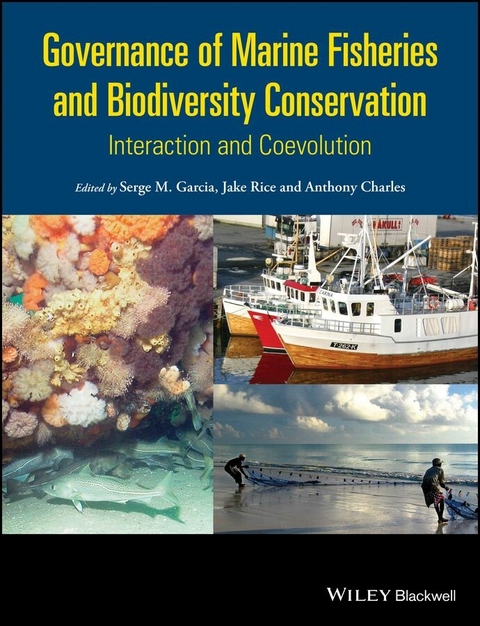
Governance of Marine Fisheries and Biodiversity Conservation (eBook)
1414 Seiten
John Wiley & Sons (Verlag)
978-1-118-39263-8 (ISBN)
The book opens with chapters setting the historical context for the two marine governance streams, and framing the book’s exploration of whether, as the streams increasingly interact, there will be merger or collision, convergence or co-evolution. The concluding chapter synthesizes the insights from throughout the book, relative to the questions posed in the opening chapters. It also draws conclusions about future needs and directions in the governance of marine fisheries and biodiversity, vital to the future of the world’s oceans.
With cutting edge chapters written by many leading international experts in fisheries management and biodiversity conservation, and edited by three leading figures in this crucially important subject, Governance of Marine Fisheries and Biodiversity Conservation is an essential purchase for fisheries scientists, economists, resource managers and policymakers, and all those working in fields of biodiversity conservation, marine ecology, and coastal livelihoods. Libraries in all universities and research establishments where environmental and/or marine studies, conservation, ocean policy and law, biological and life sciences, and fisheries management are studied and taught, should have copies of this most important book.
Serge M. Garcia is the former Research Director of the French Institute of Research for Development (IRD) and former Director of the FAO Fisheries Management Division. Now retired, he chairs the Fisheries Expert Group of the IUCN Commission on Ecosystem Management (IUCN-CEM-FEG) established under the coordination of the European Bureau of Conservation and Development (EBCD).
Jake Rice is Chief Scientist, Department of Fisheries and Oceans, Government of Canada (DFO) and senior Canadian science advisor on international marine conservation and sustainable use policy. He has over 250 scientific and technical publications, in 32 years in the Science sector of DFO. He has been active as a scientific expert and in delegations to CBD, FAO, IPCC and various UN working groups. He is the vice chair of IUCN-CEM-FEG.
Anthony Charles is Director of the School of the Environment and Professor in the School of Business at Saint Mary’s University (Halifax, Canada). He is a Pew Fellow in Marine Conservation, and leads the international Community Conservation Research Network. His work focuses on marine resource management, economics and policy, coastal communities and small-scale fisheries. He is an active member of the IUCN-CEM-FEG.
Governance of Marine Fisheries and Biodiversity Conservation explores governance of the world s oceans with a focus on the impacts of two inter-connected but historically separate streams of governance: one for fisheries, the other for biodiversity conservation. Chapters, most co-authored by leading experts from both streams, investigate the interaction of these governance streams from ecological, economic, social and legal perspectives, with emphasis on policies, institutions processes, and outcomes on scales from the global to the local community, and with coverage of a range of themes and regions of the world. The book opens with chapters setting the historical context for the two marine governance streams, and framing the book s exploration of whether, as the streams increasingly interact, there will be merger or collision, convergence or co-evolution. The concluding chapter synthesizes the insights from throughout the book, relative to the questions posed in the opening chapters. It also draws conclusions about future needs and directions in the governance of marine fisheries and biodiversity, vital to the future of the world s oceans. With cutting edge chapters written by many leading international experts in fisheries management and biodiversity conservation, and edited by three leading figures in this crucially important subject, Governance of Marine Fisheries and Biodiversity Conservation is an essential purchase for fisheries scientists, economists, resource managers and policymakers, and all those working in fields of biodiversity conservation, marine ecology, and coastal livelihoods. Libraries in all universities and research establishments where environmental and/or marine studies, conservation, ocean policy and law, biological and life sciences, and fisheries management are studied and taught, should have copies of this most important book.
Serge M. Garcia is the former Research Director of the French Institute of Research for Development (IRD) and former Director of the FAO Fisheries Management Division. Now retired, he chairs the Fisheries Expert Group of the IUCN Commission on Ecosystem Management (IUCN-CEM-FEG) established under the coordination of the European Bureau of Conservation and Development (EBCD). Jake Rice is Chief Scientist, Department of Fisheries and Oceans, Government of Canada (DFO) and senior Canadian science advisor on international marine conservation and sustainable use policy. He has over 250 scientific and technical publications, in 32 years in the Science sector of DFO. He has been active as a scientific expert and in delegations to CBD, FAO, IPCC and various UN working groups. He is the vice chair of IUCN-CEM-FEG. Anthony Charles is Director of the School of the Environment and Professor in the School of Business at Saint Mary's University (Halifax, Canada). He is a Pew Fellow in Marine Conservation, and leads the international Community Conservation Research Network. His work focuses on marine resource management, economics and policy, coastal communities and small-scale fisheries. He is an active member of the IUCN-CEM-FEG.
"A significant strength of the book is its multidisciplinary approach combined with the contributors' collective hands-on experience. Together they offer considerable insights and rich descriptions. Each chapter offers new insights in the topic, and no chapter is redundant. Because of the book's richness of perspectives and its structure, it is excellent for looking up various topics of interest, whether the reader is a newcomer to the field or is knowledgeable in areas of the book. The book is therefore suitable for anyone addressing fisheries governance and/or biodiversity conservation." (Marine Biology Research, 25 June 2015)
'A significant strengh of the book is its multidisciplinary approach combined with the contributors' collective hands-on experience. (...) Because of the book's richness of perspectives and its structure, it is excellent for looking up various topics of interest, whether the reader is a newcomer to the field or is knowledgeable in areas of the book. (...) the book is an accomplishment in that it has managed to include perspectives from a range of disciplines, providing a unique richness of perspectives and detailed descriptions of management bodies, instruments, frameworks, concepts, ideas, regulations and laws. It is a valuable book for anyone addressing fisheries governance and/or biodiversity conservation and a must for a wide range of libraries.'
Kjellrun Hiis Hauge, Marine Biology Research, 2015
Notes on contributors
Armada, N. MSc in Hydrobiology and Fisheries Science, Hamburg University. Fisheries biologist with over 30 years of experience in fisheries resources assessment and management. Former faculty member of the College of Fisheries and Ocean Sciences of the University of the Philippines. He is currently the fisheries management advisor of the project Ecosystems Improved for Sustainable Fisheries (ECOFISH) Project of USAID, a project designed to improve management of important fisheries resources of the eight key biodiversity areas in the Philippines. nbarmada@gmail.com
Augustyn, J. PhD, Zoology (Marine biology). Chief Director: Fisheries Research and Development, Department of Agriculture Forestry and Fisheries, South Africa. Chair of the Ecosystem Advisory Committee of the Benguela Current Commission and International Commission for the Conservation of Atlantic Tunas (ICCAT) Panel 3 on Temperate Tunas. He recently chaired the FAO Technical Consultation on Flag State Performance. He has broad experience of regional organizations in Southern Africa and has authored and co-authored several papers and presentations in international fora on the Ecosystem Approach to Fisheries. Member of the Fisheries Expert Group of the IUCN Commission on Ecosystem Management (IUCN/CEM/FEG). cjaugustyn@yahoo.com
Bavinck, M. PhD. Specialized in coastal and marine geography and in legal pluralism, and focuses largely on South Asia. He has authored two monographs and two edited volumes on fisheries governance, in addition to a large number of academic articles on related topics. He is presently an Associate professor in the Department of Human Geography, Planning and International Development Studies, University of Amsterdam. He is also the co-founder and co-director of the Centre for Maritime Research (MARE). j.m.bavinck@uva.nl
Béné, C. PhD Department of Ecology, University of Paris VI, France. Research Fellow in the Vulnerability and Poverty Reduction team at the Institute of Development Studies in UK. He is a socio-economist and policy analyst by training with 15 years of experience in sub-Sahara Africa, South and Southeast Asia, Caribbean, and South America. His research focuses on poverty, vulnerability and governance in relation to the socio-political economy of natural resources-dependent communities in developing countries. c.bene@ids.ac.uk
Beslier, S. Master in Public Law and Political Science (Paris, France) and graduated from the Navy School for the Administration of Maritimes Affairs (Bordeaux, France). 39 years of practical and senior management in maritime and fisheries administration, both in the French Maritime Affairs Administration and the European Commission services. Former chair of the board of the European Fisheries Control Agency. Member of the Fisheries Expert Group of the IUCN Commission on Ecosystem Management (IUCN/CEM/FEG) as a legal expert. serge.beslier@yahoo.fr
Cabanban, A.S. PhD. Marine ichthyologist based in Manila, Philippines. She was a Lecturer at Silliman University, Philippines and Associate Professor at the Universiti Malaysia Sabah, Malaysia from 1979 to 2006. She has assisted in coordinating activities in the East Asian Seas region at the United Nations Environment Programme in 1994-1996 and 2002 and managed for 2. 5 years a conservation program of the World Wide Fund for Nature, Malaysia. She is involved intermittently in the past 17 years in designing, implementing, executing, and evaluating of projects of the Global Environment Facility. Member of the Fisheries Expert Group of the IUCN Commission on Ecosystem Management (IUCN/CEM/FEG). annadel.cabanban@gmail.com
Camilleri, M. PhD. Fishery Liaison Officer within the FAO Fisheries and Aquaculture Policy and Economics Division. Graduated in Fisheries and Ocean Science from the University of Plymouth (UK) in 1995 where he went on to obtain a PhD in fisheries management. He is a member and chartered biologist of the Society of Biology (UK). Served as Consultant to the Maltese Government and Head of the Malta Centre for Fisheries Sciences between 1998 and 2007. Joined FAO in 2007 taking up a post within the Secretariat of the General Fisheries Commission for the Mediterranean before moving to his current position in Italy. matthew.camilleri@fao.org
Campbell, L.M. PhD in Geography (University of Cambridge, UK). She has studied on marine fisheries, protected species, coastal development, and conservation in Latin America, the Caribbean, and North Carolina, USA. She is a Rachel Carson Associate Professor, Marine Affairs and Policy, Nicholas School of Environment and Duke University Marine Laboratory. Member of the IUCN’s Marine Turtle Specialist Group and Commission on Environment, Economic, and Social Policy and Editor of the journal Conservation and Society. lisa.m.campbell@duke.edu
Charles, A. PhD. Natural science and Engineering. At Saint Mary’s University for over 25 years, holding a dual appointment as Director of the School of the Environment at Saint Mary’s University (Canada), and Professor in the Sobey School of Business and the Environmental Science Department. Lead researcher of the Community Conservation Research Network. Pew Fellow in Marine Conservation, Senior Research Fellow of the International Ocean Institute and Past President of the International Institute of Fisheries Economics and Trade. Within Canada, he was formerly a research scientist with the Department of Fisheries and Oceans (DFO), later served on the DFO Science Advisory Council and was founding Director of Canada’s Ocean Management Research Network. Author/co-author of books on sustainable fishery systems, integrated fish farming, coastal fisheries of Latin America and the Caribbean, Canadian marine fisheries, community fisheries management and human dimensions of the ecosystem approach to fisheries. Member of the Fisheries Expert Group of the IUCN Commission on Ecosystem Management (IUCN/CEM/FEG). Tony.Charles@smu.ca; http://smu-facweb.smu.ca/vcharles
Christie, P. PhD. Environmental sociology and marine policy. Professor, School of Marine and Environmental Affairs and Jackson School of International Studies, University of Washington. His research focuses on the social ecological dimensions of marine and coastal policy in the Southeast Asia, Latin America, and the United States. Prior to his academic work, he was involved in the implementation of a community-based marine protected area in the Philippines as a Peace Corps Volunteer. His Pew Fellowship in Marine Conservation focused on governance factors affecting the success of Philippine MPAs and translating this research into practical solutions. He is Editor-in-Chief of the journal Coastal Management. patrickc@uw.edu
Deupmann, P. Masters Degree in Marine and Environmental Law of the University of Cape Town, Masters Degree in Dutch Law of the University of Amsterdam, where he also obtained an M.A. Legal officer, Development Law Service, Food and Agriculture Organization of the United Nations. With the FAO since 2007. Presently in the Development Law Service. Peter is specialized in marine and inland fisheries and aquaculture as well as in biological diversity related issues. Peter.Deupmann@fao.org
De Young, C. MS on environmental and natural resource economics from West Virginia University, USA (1997). Environmental and natural resource economist, Food and Agriculture Organization of the United Nations (FAO). She has a particular interest in promoting discussions on the social and economic contributions of the aquatic systems as part of integrated management efforts. Most of her 11-year tenure at the FAO has related to the development of fisheries management plans and strategies and supporting the ecosystem approach to fisheries. Understanding human choices and drivers of change, the benefits derived from the sector as well as the sector’s impacts on the aquatic systems have always been central to her work. cassandra.deyoung@fao.org
Drobenko, B. Doctor in Public Law (1990). University Professor and Director of the “Campus de la mer ». His area of competence covers the Law of the Sea, environment, and coastal urban development law. He is presently in the French Université du littoral de la Côte d’Opale Lille, France). bernard.drobenko@univ-littoral.fr
Freestone, D. Doctor of Laws, LL.D University of Hull (1999). Professor. Executive Director of the Sargasso Sea Alliance led by the Government of Bermuda, and Visiting Scholar at The George Washington University Law School. He is former Head of the International Environment Law Group and Deputy General Counsel at The World Bank. He is the founding Editor of the International Journal of Marine and Coastal Law, and has published some 20 books and more than 150 articles on the law of the sea and international and marine environmental law issues He is the winner of the 2007 Haub Prize for Environmental Law. dfreestone@sargassoalliance.org
Garcia, S.M. Doctorate in Science of the University of Marseille (France, 1976). Specialized in population dynamics and management (Penaeid shrimps; demersal resources). Long research and management experience in the tropics. Former research Director in IRD (France) before moving to FAO in 1979 where he held the positions of Chief...
| Erscheint lt. Verlag | 15.7.2014 |
|---|---|
| Sprache | englisch |
| Themenwelt | Naturwissenschaften ► Biologie ► Ökologie / Naturschutz |
| Technik | |
| Wirtschaft | |
| Weitere Fachgebiete ► Land- / Forstwirtschaft / Fischerei | |
| Schlagworte | Ãkonomie u. Management in Fischereiwesen u. Aquakultur • Aquaculture, Fisheries & Fish Science • Aquakultur, Fischereiwesen u. Fischforschung • biodiversity • Biodiversity conservation • Community • conservation • Ecological • Experts • Explores • Fischerei • Fischfang • Fisch u. Fischfang • Fish & Fisheries • fisheries • Fisheries & Aquaculture Economics & Management • focus • Global • Governance • governance streams • impacts • interaction • investigate • leading • Local • Marine • Oceans • Ökonomie u. Management in Fischereiwesen u. Aquakultur • scales • Streams • Worlds |
| ISBN-10 | 1-118-39263-9 / 1118392639 |
| ISBN-13 | 978-1-118-39263-8 / 9781118392638 |
| Informationen gemäß Produktsicherheitsverordnung (GPSR) | |
| Haben Sie eine Frage zum Produkt? |
 EPUB (Adobe DRM)
Kopierschutz: Adobe-DRM
Adobe-DRM ist ein Kopierschutz, der das eBook vor Mißbrauch schützen soll. Dabei wird das eBook bereits beim Download auf Ihre persönliche Adobe-ID autorisiert. Lesen können Sie das eBook dann nur auf den Geräten, welche ebenfalls auf Ihre Adobe-ID registriert sind.
Details zum Adobe-DRM
Dateiformat: EPUB (Electronic Publication)
EPUB ist ein offener Standard für eBooks und eignet sich besonders zur Darstellung von Belletristik und Sachbüchern. Der Fließtext wird dynamisch an die Display- und Schriftgröße angepasst. Auch für mobile Lesegeräte ist EPUB daher gut geeignet.
Systemvoraussetzungen:
PC/Mac: Mit einem PC oder Mac können Sie dieses eBook lesen. Sie benötigen eine
eReader: Dieses eBook kann mit (fast) allen eBook-Readern gelesen werden. Mit dem amazon-Kindle ist es aber nicht kompatibel.
Smartphone/Tablet: Egal ob Apple oder Android, dieses eBook können Sie lesen. Sie benötigen eine
Geräteliste und zusätzliche Hinweise
Buying eBooks from abroad
For tax law reasons we can sell eBooks just within Germany and Switzerland. Regrettably we cannot fulfill eBook-orders from other countries.
aus dem Bereich