


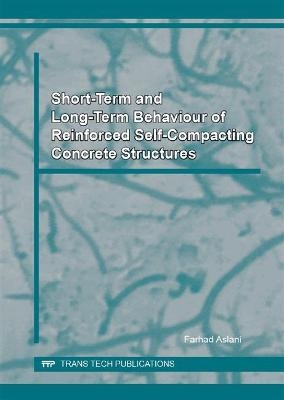
Short-Term and Long-Term Behaviour of Reinforced Self-Compacting Concrete Structures
Seiten
2014
Trans Tech Publications Ltd (Hersteller)
978-3-03795-998-5 (ISBN)
Trans Tech Publications Ltd (Hersteller)
978-3-03795-998-5 (ISBN)
- Titel ist leider vergriffen;
keine Neuauflage - Artikel merken
Self-Compacting Concrete (SCC) refers to a 'highly flow-able, non-segregating concrete that can be spread into place, fill the form work, and encapsulate the reinforcement without the aid of any mechanical consolidation. In this study, cracking caused by external loads in reinforced SCC and FRSCC slabs is examined experimentally and analytically.
Volume is indexed by Thomson Reuters BCI (WoS).
Self-Compacting Concrete (SCC) refers to a 'highly flow-able,non-segregating concrete that can be spread into place, fill the formwork,and encapsulate the reinforcement without the aid of any mechanicalconsolidation. SCC is regarded as one of the most promising developments inconcrete technology due to significant advantages over Conventional Concrete(CC). In this study cracking caused by external loads in reinforced SCC andFRSCC slabs is examined experimentally and analytically. The mechanismsassociated with the flexural cracking due to the combined effects ofconstant sustained service loads and shrinkage are observed. One of theprimary objectives of this study is to develop analytical models thataccurately predict the hardened mechanical properties of SCC and FRSCC.Subsequently, these models have been successfully applied to simulatetime-dependent cracking of SCC and FRSCC one-way slabs.
Volume is indexed by Thomson Reuters BCI (WoS).
Self-Compacting Concrete (SCC) refers to a 'highly flow-able,non-segregating concrete that can be spread into place, fill the formwork,and encapsulate the reinforcement without the aid of any mechanicalconsolidation. SCC is regarded as one of the most promising developments inconcrete technology due to significant advantages over Conventional Concrete(CC). In this study cracking caused by external loads in reinforced SCC andFRSCC slabs is examined experimentally and analytically. The mechanismsassociated with the flexural cracking due to the combined effects ofconstant sustained service loads and shrinkage are observed. One of theprimary objectives of this study is to develop analytical models thataccurately predict the hardened mechanical properties of SCC and FRSCC.Subsequently, these models have been successfully applied to simulatetime-dependent cracking of SCC and FRSCC one-way slabs.
| Reihe/Serie | Materials Science Foundations ; Volume 77 |
|---|---|
| Verlagsort | Zurich |
| Sprache | englisch |
| Maße | 125 x 142 mm |
| Gewicht | 200 g |
| Themenwelt | Technik ► Bauwesen |
| Technik ► Maschinenbau | |
| ISBN-10 | 3-03795-998-3 / 3037959983 |
| ISBN-13 | 978-3-03795-998-5 / 9783037959985 |
| Zustand | Neuware |
| Informationen gemäß Produktsicherheitsverordnung (GPSR) | |
| Haben Sie eine Frage zum Produkt? |
Mehr entdecken
aus dem Bereich

aus dem Bereich
Freischaltcode (2023)
Pearson (Hersteller)
CHF 163,50
Online Resource (2024)
Pearson Education Limited (Hersteller)
CHF 82,65


