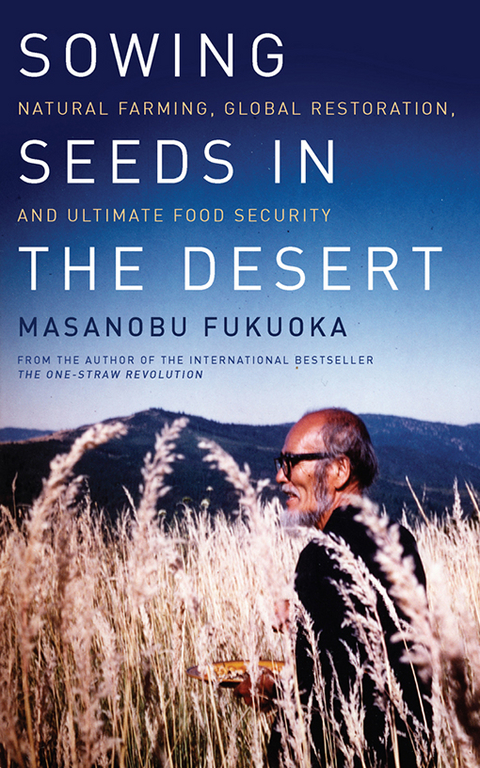
Sowing Seeds in the Desert (eBook)
216 Seiten
Chelsea Green Publishing (Verlag)
978-1-60358-419-7 (ISBN)
1. The call to natural farming
2. Reconsidering human knowledge
3. Healing a world in crisis
4. Global desertification
5. Revegetating the earth through natural methods
6. Travels on the west coast of the United States
lt;p> ForeWord Reviews-
Small-scale and urban farming as well as sustainable living and organic food purchasing are so prevalent right now that these practices are moving from a foodie trend to a fundamental shift in our food system. One of the people to thank for that momentum is Masanobu Fukuoka, whose The One-Straw Revolution became a must-read for organic farmers and their supporters around the world. Before his death in 2008, Fukuoka spent decades working on natural farming techniques that he felt could benefit the world. He didn’t plow his field, use fertilizer, or flood his rice fields, in keeping with the methods traditional to many indigenous cultures. Commonly referred to as ‘Do-Nothing Farming,’ his techniques are part of a wider philosophy about respecting nature’s own principles and rhythms. The success of his work sent Fukuoka from his small village in Japan to speaking engagements across the world, where he spent a great deal of time addressing issues of limited resources in areas like Africa, India, and Southeast Asia. In this, his last major book, Fukuoka draws from those experiences to create, once again, a timeless work that has the ability to create a revolution in agriculture. Beyond Fukuoka’s important philosophy, his book is a lyrical, lovely valentine to nature. He’s passionate about bringing other people to the near-enlightenment state in which he lived, where every single leaf moved him to appreciation. Expertly argued and backed by experience, anecdotes, and simple logic, Fukuoka’s last work shines just as brightly as his first.
Kirkus Reviews-
From the late author of bestseller The One Straw Revolution (1978) comes a similar book about a philosophical approach to natural farming."The fundamental concept of a natural farm," writes Fukuoka (The Natural Way of Farming, 1985, etc.), "begins with intuitively grasping nature's original form, where many varieties of plants and animals live together as a harmonious whole, joyfully and in mutual benefit." In this English translation of the author's last work (first published in Japan in 1996), he decries the "indiscriminate deforestation and large-scale agriculture carried out in order to support the materialistic cultures of the developed countries." This process has created a condition called "desertification," the inability of the soil to grow anything. Because humans have lost their connection with nature, Fukuoka advocates foregoing harmful modern methods of farming in favor of a simpler approach. Based primarily on the success of his farm in Japan, the author believes the solution lies in aerial distribution of a large variety of plants via clay seed pellets, the use of cover crops, and a no-tilling approach to the soil. By seeding a wide variety of species in the desert, nature will select those plants best suited for a particular location. These plants will flourish, drawing water from deep within the earth and thereby allowing other plants and trees to prosper. Taking his philosophy to Africa, India and the United States, among other places, Fukuoka demonstrated that, given sufficient time, seeding fallow earth with vegetables, plants and trees created a lush setting. More a spiritual analysis of farming methods than a hands-on approach, the book still provides viable and simple solutions to the world's increased need for productive land. An enlightened method for reclaiming the barren soils of the world.
Booklist-
The vision of the late Japanese farmer and philosopher Fukuoka, a pioneer in natural farming techniques and author of the now classic The One-Straw Revolution (1978), extends far beyond agriculture. In his final book, a far-reaching treatise on ‘earth stewardship,’ he considers dragonflies, Darwin, and even a meeting with Einstein’s niece as he reflects on the best possible future for human society. At times Fukuoka’s prose can be striking in its simplicity as when he writes, ‘In nature there are no beneficial or harmful insects,’ and furthermore, ‘this is a human construct akin to saying the right hand is good and the left hand is bad.’ Fukuoka never wastes a word or thought, insisting the reader consider all aspects of how we grow our food everywhere in the world and how the food industry manipulates supply and demand for gross profit in ways both economically and socially damaging. Fukuoka’s techniques have been and still are world-changing; the challenge now is to continue practicing them without the master here to lead the way.
Publishers Weekly-
Renowned Japanese agriculturist and philosopher Fukuoka’s (The One-Straw Revolution) final work calls on modern-day farmers to reconsider their methods and heed the needs of the land. Navigating work with international organizations—particularly in Africa, South Asia, and the United States—he illuminates regional disparities in environmental and agricultural thought and practice. Through trial-and-error and years of acute observation, Fukuoka developed a pioneering vision to ‘avoid unnecessary work, especially work that was created as an adverse side effect of previous actions.’ He describes these misguided experiments and failures, such as leaving an orchard completely on its own, as ‘not natural farming; it was abandonment.’ In clarifying popular misconceptions about organic and natural farming, he advises that we must not focus on cash crops, because ‘there is no good or bad among life-forms on earth.’ Only by the co-existence of myriad micro-organisms and vegetation will we be able to preserve and maintain our land. More important, the best farming was simple, ‘rather than the modern approach of applying increasingly complex techniques to remake nature entirely for the benefit of human beings.’ Though elimination of mechanization might be tough for modern agriculturalists to swallow, Fukuoka’s last message provides a spiritually and environmentally enriching alternative to the farming conditions we know today.
| Erscheint lt. Verlag | 28.5.2012 |
|---|---|
| Zusatzinfo | Black and white reproductions of original brush and ink drawings |
| Verlagsort | White River Junction |
| Sprache | englisch |
| Themenwelt | Naturwissenschaften ► Biologie ► Ökologie / Naturschutz |
| Naturwissenschaften ► Geowissenschaften | |
| Technik ► Lebensmitteltechnologie | |
| Weitere Fachgebiete ► Land- / Forstwirtschaft / Fischerei | |
| Schlagworte | Colorado River • Colorado River water cuts • desert agriculture • Desertification • Drought • Food insecurity • Natural Farming • permaculture • The Ultimatum of God Nature • The Ultimatum of God, Nature • water crisis • water shortage |
| ISBN-10 | 1-60358-419-6 / 1603584196 |
| ISBN-13 | 978-1-60358-419-7 / 9781603584197 |
| Informationen gemäß Produktsicherheitsverordnung (GPSR) | |
| Haben Sie eine Frage zum Produkt? |
 EPUB (Adobe DRM)
Kopierschutz: Adobe-DRM
Adobe-DRM ist ein Kopierschutz, der das eBook vor Mißbrauch schützen soll. Dabei wird das eBook bereits beim Download auf Ihre persönliche Adobe-ID autorisiert. Lesen können Sie das eBook dann nur auf den Geräten, welche ebenfalls auf Ihre Adobe-ID registriert sind.
Details zum Adobe-DRM
Dateiformat: EPUB (Electronic Publication)
EPUB ist ein offener Standard für eBooks und eignet sich besonders zur Darstellung von Belletristik und Sachbüchern. Der Fließtext wird dynamisch an die Display- und Schriftgröße angepasst. Auch für mobile Lesegeräte ist EPUB daher gut geeignet.
Systemvoraussetzungen:
PC/Mac: Mit einem PC oder Mac können Sie dieses eBook lesen. Sie benötigen eine
eReader: Dieses eBook kann mit (fast) allen eBook-Readern gelesen werden. Mit dem amazon-Kindle ist es aber nicht kompatibel.
Smartphone/Tablet: Egal ob Apple oder Android, dieses eBook können Sie lesen. Sie benötigen eine
Geräteliste und zusätzliche Hinweise
Buying eBooks from abroad
For tax law reasons we can sell eBooks just within Germany and Switzerland. Regrettably we cannot fulfill eBook-orders from other countries.
aus dem Bereich