Low-Energy Lunar Trajectory Design (eBook)
John Wiley & Sons (Verlag)
978-1-118-85531-7 (ISBN)
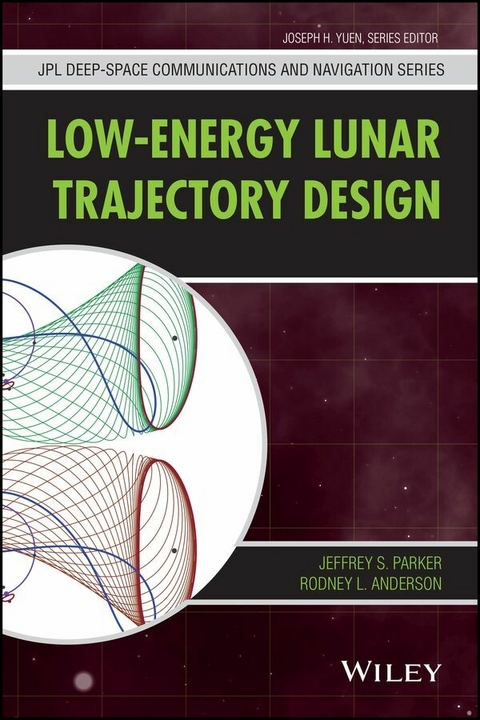
Based on years of research conducted at the NASA Jet Propulsion Laboratory, Low-Energy Lunar Trajectory Design provides high-level information to mission managers and detailed information to mission designers about low-energy transfers between Earth and the moon. The book answers high-level questions about the availability and performance of such transfers in any given month and year. Low-energy lunar transfers are compared with various other types of transfers, and placed within the context of historical missions.
Using this book, designers may reconstruct any transfer described therein, as well as design similar transfers with particular design parameters.
An Appendix, 'Locating the Lagrange Points,' and a useful list of terms and constants completes this technical reference.
- Surveys thousands of possible trajectories that may be used to transfer spacecraft between Earth and the moon, including transfers to lunar libration orbits, low lunar orbits, and the lunar surface
- Provides information about the methods, models, and tools used to design low-energy lunar transfers
- Includes discussion about the variations of these transfers from one month to the next, and the important operational aspects of implementing a low-energy lunar transfer
- Additional discussions address navigation, station-keeping, and spacecraft systems issues
Jeffrey S. Parker, Ph.D., was a member of the technical staff at the Jet Propulsion Laboratory (JPL) from 2008 to 2012. Currently Dr. Parker is an Assistant Professor of Astrodynamics at CU-Boulder. His research interests are focused on astrodynamics, space exploration, and autonomous spacecraft operations.
Rodney L. Anderson, Ph.D., is a member of the JPL technical staff, where he is involved in mission design and navigation and develops new methods for trajectory design. His research interests are focused on the application of dynamical systems theory to astrodynamics and mission design.
Based on years of research conducted at the NASA Jet Propulsion Laboratory, Low-Energy Lunar Trajectory Design provides high-level information to mission managers and detailed information to mission designers about low-energy transfers between Earth and the moon. The book answers high-level questions about the availability and performance of such transfers in any given month and year. Low-energy lunar transfers are compared with various other types of transfers, and placed within the context of historical missions. Using this book, designers may reconstruct any transfer described therein, as well as design similar transfers with particular design parameters. An Appendix, Locating the Lagrange Points, and a useful list of terms and constants completes this technical reference. Surveys thousands of possible trajectories that may be used to transfer spacecraft between Earth and the moon, including transfers to lunar libration orbits, low lunar orbits, and the lunar surface Provides information about the methods, models, and tools used to design low-energy lunar transfers Includes discussion about the variations of these transfers from one month to the next, and the important operational aspects of implementing a low-energy lunar transfer Additional discussions address navigation, station-keeping, and spacecraft systems issues
Jeffrey S. Parker, Ph.D., was a member of the technical staff at the Jet Propulsion Laboratory (JPL) from 2008 to 2012. Currently Dr. Parker is an Assistant Professor of Astrodynamics at CU-Boulder. His research interests are focused on astrodynamics, space exploration, and autonomous spacecraft operations. Rodney L. Anderson, Ph.D., is a member of the JPL technical staff, where he is involved in mission design and navigation and develops new methods for trajectory design. His research interests are focused on the application of dynamical systems theory to astrodynamics and mission design.
Foreword xi
Preface xiii
Acknowledgments xv
Authors xxi
1 Introduction and Executive Summary 1
1.1 Purpose 1
1.2 Organization 1
1.3 Executive Summary 2
1.4 Backgound 11
1.5 The Lunar Transfer Problem 12
1.6 Historical Missions 14
1.7 Low-Energy Lunar Transfers 23
2 Methodology 27
2.1 Methodology Introduction 27
2.2 Physical Data 28
2.3 Time Systems 29
2.4 Coordinate Frames 32
2.5 Models 35
2.6 Low-Energy Mission Design 41
2.7 Tools 114
3 Transfers to Lunar Libration Orbits 117
3.1 Executive Summary 117
3.2 Introducuton 120
3.3 Direct Transfers Between Earth and Lunar Libration Orbits 122
3.4 Low-Energy Transfers Between Earth and Lunar Libration Orbits 161
3.5 Three-Body Orbit Transfers 221
4 Transfers to Low Lunar Orbits 227
4.1 Executive Summary 227
4.2 Introduction 229
4.3 Direct Transfers Between Earth and Low Lunar Orbit 231
4.4 Low-Energy Transfers Between Earth and Low Lunar Orbit 233
4.5 Transfers Between Lunar Libration Orbits and Low Lunar Orbits 258
4.6 Transfers Between Low Lunar Orbits and the Lunar Surface 258
5 Transfers to the Lunar Surface 263
5.1 Executive Summary 263
5.2 Introduction for Transfers to the Lunar Surface 265
5.3 Methodology 267
5.4 Analysis of Planar Transfers between the Earth and the Lunar Surface 268
5.5 Low-Energy Spatial Transfers Between the Earth and the Lunar Surface 277
5.6 Transfers Between Lunar Libration Orbits and the Lunar Surface 294
5.7 Transfers Between Low Lunar Orbits and the Lunar Surface 298
5.8 Conclusions Regardingh Transfers to the Lunar Surface 298
6 Operations 299
6.1 Operations Executive Summary 299
6.2 Operations Introduction 300
6.3 Launch Sites 301
6.4 Launch Vehicles 301
6.5 Designing a Launch Period 304
6.6 Navigation 332
6.7 Spacecraft Systems Design 349
Appendix A: Locating the Lagrange Points 351
References 359
ACKNOWLEDGMENTS
We would like to thank many people for their support writing this book, including people who have written or reviewed portions of the text, as well as people who have provided insight from years of experience flying spacecraft missions to the Moon and elsewhere. It is with sincere gratitude that we thank Ted Sweetser for his selfless efforts throughout this process, providing the opportunity for us to perform this work, and reviewing each section of this manuscript as it has come together. We would like to thank A1 Cangahuala, Joe Guinn, Roby Wilson, and Amy Attiyah for their valuable feedback and thorough review of this work in each of its stages. We would also like to thank Tim McElrath for his feedback, insight, and excitement as we considered different aspects of this research.
We would like to give special thanks to several people who provided particular contributions to sections of the book. We thank Ralph Roncoli for his assistance with Sections 2.3 and 2.4, as well as his feedback throughout the book. Kate Davis assisted with Sections 2.6.3 and 2.6.11.3, most notably with the discussions of Poincaré sections. Roby Wilson provided particular assistance with Section 2.6.5 on the subject of the multiple shooting differential corrector. We would like to sincerely thank Andrew Peterson for his contribution to the development of Chapter 4. Finally, George Born and Martin Lo provided guidance for this research as it developed in its early stages, leading to the authors’ dissertations at the University of Colorado at Boulder.
Jeffrey Parker’s Ph.D. dissertation (J. S. Parker, Low-Energy Ballistic Lunar Transfers, Ph.D. Thesis, University of Colorado, Boulder, 2007) provides the backbone to this manuscript and much of the dissertation has been repeated and amplified in this book. Much of the additional material that appears in this manuscript has been presented by the authors at conferences and published in journals. Such material has been reprinted here, with some significant alterations and additions. Finally, a number of additional journal articles and conference proceedings directly contributed to each chapter in the following list. In addition to the listing below, they are cited in the text where the related material appears.
Chapter 2:
- J. S. Parker, K. E. Davis, and G. H. Born, “Chaining Periodic Three-Body Orbits in the Earth–Moon System,” ACTA Astronautica, vol. 67, pp. 623–638, 2010.
- M. W. Lo, and J. S. Parker, “Chaining Simple Periodic Three-Body Orbits,” AAS/AIAA Astrodynamics Specialist Conference (Lake Tahoe, California), Paper No. AAS 2005-380, August 7–11, 2005, vol. 123, Advances in Astronautical Sciences (B. G. Williams, L. A. D’Amario, K. C. Howell, and F. R. Hoots, editors), AAS/AIAA, Univelt Inc., San Diego, CA, 2006.
- R. B. Roncoli, Lunar Constants and Models Document, JPL D-32296 (internal document), Jet Propulsion Laboratory, California Institute of Technology, Pasadena, California, September 23, 2005.
- R. L. Anderson and J. S. Parker, “Survey of Ballistic Transfers to the Lunar Surface,” Journal of Guidance, Control, and Dynamics, vol. 35, no. 4, pp. 1256–1267, July–August 2012.
Chapter 3:
- J. S. Parker, “Monthly Variations of Low-Energy Ballistic Transfers to Lunar Halo Orbits,” AIAA/AAS Astrodynamics Specialist Conference, (Toronto, Ontario, Canada), Paper No. AIAA 2010-7963, August 2–5, 2010.
- J. S. Parker, “Targeting Low-Energy Ballistic Lunar Transfers,” AAS George H. Born Special Symposium, (Boulder, Colorado), May 13–14, 2010, American Astronautical Society, 2010.
- J. S. Parker, “Targeting Low-Energy Ballistic Lunar Transfers,” Journal of Astronautical Sciences, vol. 58, no. 3, pp. 311–334, July–September, 2011.
- J. S. Parker, “Low-Energy Ballistic Transfers to Lunar Halo Orbits,” AAS/AIAA Astrodynamics Specialist Conference, (Pittsburgh, Pennsylvania, Paper No. AAS 09-443, August 9–13, 2009, Advances in Astronautical Sciences, Astrodynamics 2009 (A. V. Rao, A. Lovell, F. K. Chan, and L. A. Cangahuala, editors), vol. 135, pp. 2339–2358, 2010.
- J. S. Parker, and G. H. Born, “Modeling a Low-Energy Ballistic Lunar Transfer Using Dynamical Systems Theory,” AIAA Journal of Spacecraft and Rockets, vol. 45, no. 6, pp. 1269–1281, November–December 2008.
- J. S. Parker and G. H. Born, “Direct Lunar Halo Orbit Transfers,” Journal of the Astronautical Sciences, vol. 56, issue 4, pp. 441–476, October–December 2008.
- J. S. Parker and G. H. Born, “Direct Lunar Halo Orbit Transfers,” AAS/AIAA Spaceflight Mechanics Conference (Sedona, Arizona, January 28–February 1, 2007), Paper No. AAS 07-229, Advances in Astronautical Science, vol. 127, pp. 1923–1945, 2007.
- J. S. Parker, “Families of Low-Energy Lunar Halo Transfers,” AAS/AIAA Spaceflight Dynamics Conference, (Tampa, Florida, January 22–26, 2006) Paper No. AAS 06-132, (S. R. Vadali, L. A. Cangahuala, J. P. W. Schumacher, and J. J. Guzman, editors), vol. 124 of Advances in Astronautical Sciences, San Diego, CA, AAS/AIAA, Univelt Inc., 2006.
- J. S. Parker and M. W. Lo, “Shoot the Moon 3D,” Paper AAS 05-383, AAS/AIAA Astrodynamics Conference held August 7–10, 2005, South Lake Tahoe, California, (originally published in) AAS publication, Astrodynamics 2005 (edited by B. G. Williams, L. A. D’Amario, K. C. Howell, and F. R. Hoots) American Astronautical Society (AAS) Advances in the Astronautical Sciences, vol. 123, pp. 2067–2086, 2006, American Astronautical Society Publications Office, San Diego, California (Web Site: http://www.univelt.com), pp. 2067–2086.
Chapter 4:
- J. S. Parker and R. L. Anderson, “Targeting Low-Energy Transfers to Low Lunar Orbit,” Astrodynamics: Proceedings of the 2011 AAS/AIAA Astrodynamics Specialist Conference, (Girdwood, Alaska, July 31–August 4), Paper AAS 11-459, edited by H. Schaub, B. C. Gunter, R. P. Russell, and W. T. Cerven, Vol. 142, Advances in the Astronautical Sciences, American Astronautical Society, Univelt Inc., San Diego, California, pp. 847–866, 2012.
- J. S. Parker, R. L. Anderson, and A. Peterson, “A Survey of Ballistic Transfers to Low Lunar Orbit,” 21st AAS/AIAA Space Flight Mechanics Meeting, (February 13–17, 2011, New Orleans, Louisiana), Paper AAS 11-277, Vol. 140, Advances in the Astronautical Sciences (edited by M. K. Jah, Y. Guo, A. L. Bowes, and P. C. Lai), American Astronautical Society, Univelt Inc., San Diego, California, pp. 2461–2480, 2011.
Chapter 5:
- R. L. Anderson, and J. S. Parker, “Survey of Ballistic Transfers to the Lunar Surface,” Journal of Guidance, Control, and Dynamics, vol. 35, no. 4, pp. 1256–1267, July–August 2012.
- R. L. Anderson and J. S. Parker, “Comparison of Low-Energy Lunar Transfer Trajectories to Invariant Manifolds,” Celestial Mechanics and Dynamical Astronomy, vol. 115, DOI 10.10075 10569-012-9466-3, pp. 311–331, published online February 16, 2013.
- R. L. Anderson, and J. S. Parker, “Comparison of Low-Energy Lunar Transfer Trajectories to Invariant Manifolds,” AAS/AIAA Astrodynamics Specialist Conference (Girdwood, Alaska, July 31–August 4, 2011), Paper AAS 11-423, edited by H. Schaub, B. C. Gunter, R. P. Russell, and W. T. Cerven, Vol. 142, Advances in the Astronautical Sciences, American Astronautical Society, Univelt Inc., San Diego, California, pp. 333–352, 2012.
- R. L. Anderson, and J. S. Parker, “A Survey of Ballistic Transfers to the Lunar Surface,” Proceedings of the 21st AAS/AIAA Space Flight Mechanics Meeting (New Orleans, Louisiana, February 13–17, 2011), Paper AAS 11-278, edited by M. K. Jah, Y. Guo, A. L. Bowes, and P. C. Lai, Vol. 140, Advances in the Astronautical Sciences, vol. 140, American Astronautical Society, Univelt Inc., San Diego, California, pp. 2481–2500, 2011.
Chapter 6:
- J. S. Parker, “Targeting Low-Energy Ballistic Lunar Transfers,” Journal of Astronautical Sciences, vol. 58, no. 3, pp. 311–334, July–September, 2011.
- J. S. Parker and R. L. Anderson, “Targeting Low-Energy Transfers to Low Lunar Orbit,” Astrodynamics 2011: Proceedings of the AAS/AIAA Astrodynamics Specialist Conference (Girdwood, Alaska, July 31–August 4, 2011), Paper AAS 11-459, edited by H. Schaub, B. C. Gunter, R. P. Russell, and W. T. Cerven, Vol. 142, Advances in the Astronautical Sciences, American Astronautical Society, Univelt Inc., San Diego, California, pp. 847–866, 2012.
- J. S. Parker, “Targeting Low-Energy Ballistic Lunar Transfers,” AAS 09-443, AAS George H. Born Special Symposium (Boulder, Colorado, May 13–14), American Astronautical Society, 2010.
A large portion of the research in this book, and the compilation of related research documentation from other sources, were carried out at the Jet Propulsion Laboratory, California Institute of Technology, under a contract with the National Aeronautics and Space Administration. This work has been supported through funding by the Multi-mission...
| Erscheint lt. Verlag | 25.6.2014 |
|---|---|
| Reihe/Serie | JPL Deep-Space Communications and Navigation Series |
| JPL Deep-Space Communications and Navigation Series | JPL Deep-Space Communications and Navigation Series |
| Mitarbeit |
Herausgeber (Serie): Joseph H. Yeun |
| Sprache | englisch |
| Themenwelt | Technik ► Luft- / Raumfahrttechnik |
| Technik ► Maschinenbau | |
| Schlagworte | Aeronautic & Aerospace Engineering • Answers • Availability • Between • Book • Design • Designers • Electrical & Electronics Engineering • Elektrotechnik u. Elektronik • Fernerkundung • highlevel • Information • Jet Propulsion • Laboratory • lowenergy • Luft- u. Raumfahrttechnik • Lunar • Maschinenbau • mechanical engineering • mission managers • Nasa • Performance • provides • questions • Remote Sensing • Research • Trajectory • Transfers • year • years |
| ISBN-10 | 1-118-85531-0 / 1118855310 |
| ISBN-13 | 978-1-118-85531-7 / 9781118855317 |
| Informationen gemäß Produktsicherheitsverordnung (GPSR) | |
| Haben Sie eine Frage zum Produkt? |
 EPUB (Adobe DRM)
Kopierschutz: Adobe-DRM
Adobe-DRM ist ein Kopierschutz, der das eBook vor Mißbrauch schützen soll. Dabei wird das eBook bereits beim Download auf Ihre persönliche Adobe-ID autorisiert. Lesen können Sie das eBook dann nur auf den Geräten, welche ebenfalls auf Ihre Adobe-ID registriert sind.
Details zum Adobe-DRM
Dateiformat: EPUB (Electronic Publication)
EPUB ist ein offener Standard für eBooks und eignet sich besonders zur Darstellung von Belletristik und Sachbüchern. Der Fließtext wird dynamisch an die Display- und Schriftgröße angepasst. Auch für mobile Lesegeräte ist EPUB daher gut geeignet.
Systemvoraussetzungen:
PC/Mac: Mit einem PC oder Mac können Sie dieses eBook lesen. Sie benötigen eine
eReader: Dieses eBook kann mit (fast) allen eBook-Readern gelesen werden. Mit dem amazon-Kindle ist es aber nicht kompatibel.
Smartphone/Tablet: Egal ob Apple oder Android, dieses eBook können Sie lesen. Sie benötigen eine
Geräteliste und zusätzliche Hinweise
Buying eBooks from abroad
For tax law reasons we can sell eBooks just within Germany and Switzerland. Regrettably we cannot fulfill eBook-orders from other countries.
aus dem Bereich