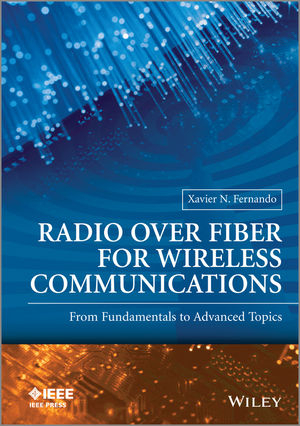
Radio over Fiber for Wireless Communications (eBook)
John Wiley & Sons (Verlag)
978-1-118-79703-7 (ISBN)
A comprehensive evaluation of Fi-Wi, enabling readers to design links using channel estimation and equalization algorithms
This book provides a detailed study of radio over fiber (ROF) based wireless communication systems, otherwise called fiber wireless (Fi-Wi) systems. This is an emerging hot topic where the abundant bandwidth of optical fiber is directly combined with the flexibility and mobility of wireless networks to provide broadband connectivity. Its application is increasing because of the growing demand for broadband wireless services. In such a system the transmission of the radio signals over a fiber is an important task. This book provides substantial material on the radio over fiber part of the complete fiber-wireless system, including new research results on the compensation methods.
The early chapters provide fundamental knowledge required for a non-expert engineering professional as well as senior/graduate level students to learn this topic from scratch. The latter part of the book covers advanced topics useful for researchers and senior students. Therefore, this book provides a comprehensive understanding of the system for readers who will gain enough knowledge to design Fi-Wi links of their own by learning how to develop Fi-Wi channel estimation and equalization algorithms. This concept is completely novel in current literature and has been patented by the author.
Readers are expected to have a basic understanding of fiber optics and wireless communications to easily follow the book and to appreciate the concepts. Basics of the Fi-Wi system and signal processing approaches are clearly explained. It covers a multidisciplinary topic and acts as a bridge between optical and wireless communication domains. In the increasingly demanding telecommunications profession, engineers are expected to have knowledge in both optical and wireless communications and expected design combined/hybrid systems. Hence, the book is written in such a way that both optical and wireless professionals will be able to easily understand and perceive the concepts.
- follows a logical process from basic principles through to advanced topics, providing a wide range of interest for researchers, practicing engineers, students, and those required to build such networks
- explains detailed system design concepts and the limitations and advantages in each configuration, appealing to design engineers, and largely avoiding system specifics
- demonstrates the author’s exclusive patent, showing how to develop baseband signal processing algorithms for Fi-Wi systems, which is a key requirement for the successful deployment of Fi-Wi systems
- contains tables, numerical examples and case studies, facilitating a good quantitative understanding of the topic
Xavier Fernando, Professor and Director, Ryerson Communications Laboratory, Department of Electrical and Computer Engineering, Ryerson University, Toronto, Canada. Xavier Fernando has been working Fi-Wi systems for over 15 years. He did his PhD in this area at the University of Calgary in affiliation with TRLabs. His PhD work has been patented and won the Canadian best paper award in 2001. He joined Ryerson University in 2001 where now he is a full professor. Professor Fernando is an IEEE Communications Society Distinguished Lecturer and the Chair of the IEEE Toronto Section, Canada. He has been working in multiple aspects of wireless communications, having a special interest in radio over fiber systems. He has delivered invited talks worldwide including at the Cambridge University (UK), National Research Council (Canada), Athens Institute of Technology (Greece), Indian Institute of Science (India) and Princeton University (USA) on radio over fiber systems. He has co-authored close to 100 research articles, two patents and few non-disclosure agreements.
A comprehensive evaluation of Fi-Wi, enabling readers to design links using channel estimation and equalization algorithms This book provides a detailed study of radio over fiber (ROF) based wireless communication systems, otherwise called fiber wireless (Fi-Wi) systems. This is an emerging hot topic where the abundant bandwidth of optical fiber is directly combined with the flexibility and mobility of wireless networks to provide broadband connectivity. Its application is increasing because of the growing demand for broadband wireless services. In such a system the transmission of the radio signals over a fiber is an important task. This book provides substantial material on the radio over fiber part of the complete fiber-wireless system, including new research results on the compensation methods. The early chapters provide fundamental knowledge required for a non-expert engineering professional as well as senior/graduate level students to learn this topic from scratch. The latter part of the book covers advanced topics useful for researchers and senior students. Therefore, this book provides a comprehensive understanding of the system for readers who will gain enough knowledge to design Fi-Wi links of their own by learning how to develop Fi-Wi channel estimation and equalization algorithms. This concept is completely novel in current literature and has been patented by the author. Readers are expected to have a basic understanding of fiber optics and wireless communications to easily follow the book and to appreciate the concepts. Basics of the Fi-Wi system and signal processing approaches are clearly explained. It covers a multidisciplinary topic and acts as a bridge between optical and wireless communication domains. In the increasingly demanding telecommunications profession, engineers are expected to have knowledge in both optical and wireless communications and expected design combined/hybrid systems. Hence, the book is written in such a way that both optical and wireless professionals will be able to easily understand and perceive the concepts. follows a logical process from basic principles through to advanced topics, providing a wide range of interest for researchers, practicing engineers, students, and those required to build such networks explains detailed system design concepts and the limitations and advantages in each configuration, appealing to design engineers, and largely avoiding system specifics demonstrates the author s exclusive patent, showing how to develop baseband signal processing algorithms for Fi-Wi systems, which is a key requirement for the successful deployment of Fi-Wi systems contains tables, numerical examples and case studies, facilitating a good quantitative understanding of the topic
Xavier Fernando, Professor and Director, Ryerson Communications Laboratory, Department of Electrical and Computer Engineering, Ryerson University, Toronto, Canada. Xavier Fernando has been working Fi-Wi systems for over 15 years. He did his PhD in this area at the University of Calgary in affiliation with TRLabs. His PhD work has been patented and won the Canadian best paper award in 2001. He joined Ryerson University in 2001 where now he is a full professor. Professor Fernando is an IEEE Communications Society Distinguished Lecturer and the Chair of the IEEE Toronto Section, Canada. He has been working in multiple aspects of wireless communications, having a special interest in radio over fiber systems. He has delivered invited talks worldwide including at the Cambridge University (UK), National Research Council (Canada), Athens Institute of Technology (Greece), Indian Institute of Science (India) and Princeton University (USA) on radio over fiber systems. He has co-authored close to 100 research articles, two patents and few non-disclosure agreements.
Chapter 1
Introduction
1.1 Motivation
The demand for wireless communication services is increasing steadily. According to an estimate by the Global Technology, Media and Telecom (GTMT) team, the number of global mobile phone users is expected to reach 7.6 billion by 2020, up by 41% from 5.4 billion users in 2011. In other words, wireless user penetration will be close to 99% of the global population in 2020, up from 87% in 2011.
The reason for this increase in demand is twofold. First, there is a sustained increment in the number of subscribers. On top of that, the bandwidth demand of most of these subscribers also shows a rapid increase, at an even higher rate than the increment in number of subscribers. The proliferation of smart phones and tablets that enable multimedia services has led to this trend. For example, the average smart phone usage grew 81% just in 2012. Image transfer and video streaming, as well as innovative cloud services, reach an increasing number of customers. Machine-to-machine (M2M) communications and the rapid emergence of the internet of things(IoT) further contribute to the bandwidth quest. Global mobile data traffic grew 70% in 2012, which was nearly 12 times the size of the entire global Internet in 2000 [1]. In the future, the amount of data traffic will grow at a pace never seen before. Many recent forecasts project mobile data traffic to grow more than 24-fold between 2010 and 2015, and much higher beyond 2015 [2]. To catch up with the need and to remain competitive, network operators need to increase the broadband capability of their networks fast. This poses a big challenge for wireless communication system designers. Researchers have been working on innovative systems that will provide several Gbit/s over the air interface [3].
Typically, the current macro cells with relatively long wireless channels cannot support very high bit rates. It is well known that the distance between a wireless transmitter and receiver will impose an upper limit on the bit rate the channel can support for a given transmission power. Long wireless channels will have high path loss, resulting from free-space loss, shadowing, refraction, diffraction, reflection, and absorption effects limiting the bit rate. Widespread research has shown that at extremely high bit rates (very low energy per bit), the air interface has to be significantly shorter in order to have a reasonable power link budget [4]. The value of the wireless channel path-loss exponent ranges from 1.5 to 4 (where 2 is for propagation in free space and 4 is for relatively lossyenvironments). In some environments, such as buildings, stadiums, and other indoor environments, the path-loss exponent can reach values in the range of 4 to 6. In addition, a long air interface would have a long multipath delay spread that would result in higher intersymbol interference or frequency-selective fading.
For these reasons, several solutions are being investigated for future 4G and 5G networks to shorten the air interface and provide broadband services [2]. It is obvious that a large number of radio access points is required to shorten the wireless channels, which is happening in many places. The challenge is to feed these radio access points. Traditionally, point-to-point microwave links have remained a popular choice for interconnecting remote radio access points since they can be deployed rapidly and cost-effectively. However, the rising number of remote access points often associated with broadband wireless access networks has been outweighing these advantages. System designers are looking for new technologies, often by optical means. Free-space optical links are sometimes used as a substitute for point-to-point microwave links. However, too many issues—such as sensitivity to alignment and weather fluctuations–limit the practical usefulness of free-space optical links.
1.1.1 The ROF System
In this book we study the radio over fiber technology as an effective solution for feeding broadband radio access points. ROF refers to the technique by which radio frequency signals are transmitted over optical fiber to provide wireless communication services. Note that ROF is essentially an analog communication scheme, though confusion may arise since wireless links carry digital data. Therefore, it is perhaps more technically precise to define analog optical links as ones where the laser is always on or the optical modulation depth is sufficiently small that small signal analysis of the various link devices is possible. This is in contrast to digital optical links in which the optical modulation depth approaches 100% or the laser is turned on and off depending on the modulating data sequence.
These systems are also called fiber-wireless systems.1 In Fi-Wi systems, the abundant bandwidth of optical fiber is effectively used to provide broadband wireless access by shortening the wireless channel and bringing the radio signal closer to the user.
An ROF Fi-Wi system is realized by modulating the optical carrier by RF signal(s) belonging to wireless networks. Although RF signal transmission over fiber is done in some other applications such as cable television networks and satellite base stations, the term ROF is used exclusively in connection with Fi-Wi communication systems in the literature. We shall follow the same terminology. A simple ROF Fi-Wi architecture is shown in Fig. 1.1, where the RF signal from a central base station (CBS) first travels via an optical fiber to a remote antenna and then reaches the user via the wireless channel. This order is reversed in the uplink direction. This is a cost-effective way to set up micro/picocellular radio architecture. A number of base stations is replaced by a single central base station and many low-cost radio access points (RAPs).
Figure 1.1 Simple Fi-Wi access scheme with point-to-point fiber links
There are several advantages of ROF transmission for remote microcell set up. One important advantage is that minimal modification is required at the base station since the RF signal is transmitted to the remote antenna as is, after all the signal processing, coding (DSP), and modulation stages. This architecture will also allow the remote radio access point to be a simple and inexpensive module performing electrical-to-optical conversions, optical-to-electrical conversions, and related RF or optical processing only. In other words, the RAP need not perform baseband signal-processing or frequency-translation operations. Note that often the RAP needs to be installed in places where space is limited, in addition to being inexpensive.
It is well known that optical-fiber links have enough bandwidth to transmit radio waves up to tens of GHz with little distortion. The fiber also offers very low attenuation (the theoretical lower limit is 0.2 dB/km), which would allow multi-GHz radio signals to be transported over several kilometers with very low loss. In contrast to electrical wires, the loss in the optical fiber is a function of the optical wavelength and does not depend on the frequency of the radio signal being transported. Therefore, due to the abundant bandwidth and frequency-independent low-loss properties, multiple RF carriers can readily be frequency division (or subcarrier) multiplexed and transmitted via a single optical fiber (or a single wavelength). Such an arrangement is shown in Fig. 1.2. The RF-modulated optical signal traveling in the fiber is both immune to and will not cause electromagnetic interference with signals outside the fiber. All these factors make the optical fiber the best unparalleled transportation link for RF signals.
Figure 1.2 Fi-Wi access scheme with a fiber bus network
Although there are several advantages of ROF Fi-Wi schemes, a few design issues and technical challenges need to be addressed before widespread deployment of Fi-Wi networks. Some issues are better addressed by wireless engineers in the electrical domain while other issues are better addressed by photonic engineers in the optical domain. However, a basic knowledge of both optical and wireless communication systems is needed to get an overall understanding and superior solutions. This book covers the design issues from a system engineer's point of view, describing the fundamental elements of an ROF link, how it affects the wireless link performance, and some possible solutions.
Research into ROF Fi-Wi started in the early 1990s to provide wirelessaccess to subway stations. Until recently, Fi-Wi systems had mostly been considered for special areas like tunnels, mines, and subway stations, where outdoor macro radio base stations do not provide coverage. In addition, crowded places like campus premises, supermarkets, airport concourses, and downtown core areas can also be served cost-effectively by ROF Fi-Wi systems [5].
The real power of the ROF-based Fi-Wi solution to provide rapid wireless access was realized during the Sydney Olympics of 2000. ROF technology was used to rapidly set up a microcellular network for the Olympics venue with more than 500 indoor and outdoor microcells. Three GSM operators shared this infrastructure and multistandard (900 and 1800 MHz GSM bands) radio access was supported in a subcarrier-multiplexed manner. Each remote antenna unit provided up to km coverage area. The network capacity was reallocated dynamically as the crowd moved from stadium to stadium. More than 500,000 wireless calls were made just on the opening day using this ROF infrastructure. Its success demonstrated the potential of ROF systems in mainstream wireless networks....
| Erscheint lt. Verlag | 16.6.2014 |
|---|---|
| Reihe/Serie | IEEE Press |
| Wiley - IEEE | Wiley - IEEE |
| Sprache | englisch |
| Themenwelt | Technik ► Elektrotechnik / Energietechnik |
| Technik ► Nachrichtentechnik | |
| Schlagworte | abundant • algorithms • bandwidth • Book • Budget • calculations • Communication • Communication Technology - Networks • directly • Drahtlose Kommunikation • Electrical & Electronics Engineering • Elektrotechnik u. Elektronik • Evaluation • fiber • fiber wireless fiwi • FiWi • flexibility • Hot • Kommunikationsnetz • Kommunikationsnetze • Links • Mobile & Wireless Communications • Optical fiber • Otherwise • Power • provide • Radio • Readers • Signal Processing • Signalverarbeitung • Study • Systems • topic • Wireless |
| ISBN-10 | 1-118-79703-5 / 1118797035 |
| ISBN-13 | 978-1-118-79703-7 / 9781118797037 |
| Informationen gemäß Produktsicherheitsverordnung (GPSR) | |
| Haben Sie eine Frage zum Produkt? |
 EPUB (Adobe DRM)
Kopierschutz: Adobe-DRM
Adobe-DRM ist ein Kopierschutz, der das eBook vor Mißbrauch schützen soll. Dabei wird das eBook bereits beim Download auf Ihre persönliche Adobe-ID autorisiert. Lesen können Sie das eBook dann nur auf den Geräten, welche ebenfalls auf Ihre Adobe-ID registriert sind.
Details zum Adobe-DRM
Dateiformat: EPUB (Electronic Publication)
EPUB ist ein offener Standard für eBooks und eignet sich besonders zur Darstellung von Belletristik und Sachbüchern. Der Fließtext wird dynamisch an die Display- und Schriftgröße angepasst. Auch für mobile Lesegeräte ist EPUB daher gut geeignet.
Systemvoraussetzungen:
PC/Mac: Mit einem PC oder Mac können Sie dieses eBook lesen. Sie benötigen eine
eReader: Dieses eBook kann mit (fast) allen eBook-Readern gelesen werden. Mit dem amazon-Kindle ist es aber nicht kompatibel.
Smartphone/Tablet: Egal ob Apple oder Android, dieses eBook können Sie lesen. Sie benötigen eine
Geräteliste und zusätzliche Hinweise
Buying eBooks from abroad
For tax law reasons we can sell eBooks just within Germany and Switzerland. Regrettably we cannot fulfill eBook-orders from other countries.
aus dem Bereich