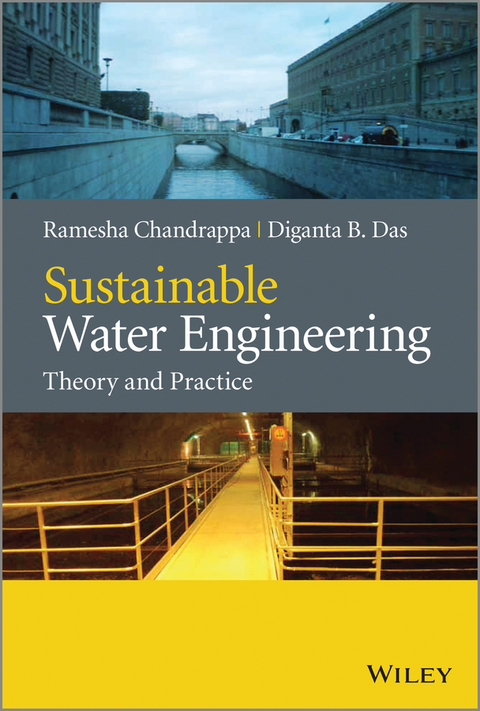
Sustainable Water Engineering (eBook)
John Wiley & Sons (Verlag)
978-1-118-54102-9 (ISBN)

Ensuring safe and plentiful supplies of potable water (both now and for future generations) and developing sustainable treatment processes for wastewater are among the world’s greatest engineering challenges. However, sustainability requires investment of money, time and knowledge. Some parts of the world are already working towards this goal but many nations have neither the political will nor the resources to tackle even basic provision and sanitation. Combining theory and practice from the developing and developed worlds with high- and low-tech, high- and low-cost solutions, this book discusses fundamental and advanced aspects of water engineering and includes:
- water resource issues including climate change, water scarcity, economic and financial aspects
- requirements for sustainable water systems
- fundamentals of treatment and process design
- industrial water use and wastewater treatment
- sustainable effluent disposal
- sustainable construction principles
With integrated theory, design and operation specifications for each treatment process, this book addresses the extent to which various treatment methods work in theory as well as how cost effective they are in practice. It provides a nontechnical guide on how to recover and reuse water from effluent, which is suitable for those in water resource management, environmental planning, civil and chemical engineering.
Ramesha Chandrappa, Karnataka State Pollution Control Board, India
Diganta B. Das, Department of Chemical Engineering, Loughborough University, UK
Ensuring safe and plentiful supplies of potable water (both now and for future generations) and developing sustainable treatment processes for wastewater are among the world s greatest engineering challenges. However, sustainability requires investment of money, time and knowledge. Some parts of the world are already working towards this goal but many nations have neither the political will nor the resources to tackle even basic provision and sanitation. Combining theory and practice from the developing and developed worlds with high- and low-tech, high- and low-cost solutions, this book discusses fundamental and advanced aspects of water engineering and includes: water resource issues including climate change, water scarcity, economic and financial aspects requirements for sustainable water systems fundamentals of treatment and process design industrial water use and wastewater treatment sustainable effluent disposal sustainable construction principles With integrated theory, design and operation specifications for each treatment process, this book addresses the extent to which various treatment methods work in theory as well as how cost effective they are in practice. It provides a nontechnical guide on how to recover and reuse water from effluent, which is suitable for those in water resource management, environmental planning, civil and chemical engineering.
Ramesha Chandrappa, Karnataka State Pollution Control Board, India Diganta B. Das, Department of Chemical Engineering, Loughborough University, UK
Glossary
- Acidity:
-
The capacity of wastewater or water to neutralize bases.
- Activated sludge:
-
Sludge generated in wastewater by the growth of microbes in aeration tanks. In other words it is flocculated sludge of micro-organisms.
- Advanced primary treatment:
-
Primary treatment using additives before treatment to augment settling.
- Aeration:
-
The process of adding air to water.
- Aerobic processes:
-
Biological treatment processes in the presence of oxygen.
- Aqua-privy:
-
Watertight tank placed immediately below the latrine floor where excreta drop directly into the water tank through a pipe.
- Algae:
-
Variety of plant without distinct functional plant tissue.
- Algal bloom:
-
Increase in algae population in water.
- Alkalinity:
-
A measure of a substance's ability to neutralize acid.
- Alumina:
-
Synthetically produced aluminium oxide that is used as a starting material for the production of aluminium metal.
- Anaerobic processes:
-
Biological treatment processes that occur in the absence of oxygen.
- Anoxic denitrification:
-
This process is also known as anaerobic denitrification. In this process nitrate nitrogen is converted to nitrogen gas biologically in the absence of oxygen.
- Aquifer:
-
Water stored in the saturated zone below the water table.
- Attached-growth processes:
-
The biological treatment processes in which the microbes are attached to media.
- Autotroph:
-
Organism that uses carbon dioxide as the only carbon source.
- Backflow prevention:
-
Preventing the reverse flow of water in water supply system.
- Backflush valve:
-
three-way diaphragm valves used in filtration applications.
- Backpressure:
-
Pressure opposing the free flow of liquid/gas; it can suck foreign substances into the water-supply system.
- Backsiphonage:
-
Backflow due to a differential pressure that sucks foreign substances into the water-supply system.
- Batch reactor:
-
Reactors that are operated in batches.
- Biochemical oxygen demand (BOD):
-
Measure of the quantity of oxygen used by microbes to degrade organic matter.
- Biodegradability:
-
Capable of being decomposed by living things, especially micro-organisms.
- Biodiversity:
-
Overall diversity of organisms in the world.
- Biogas:
-
Mixture of gases released from anaerobic digestion.
- Biological wastewater treatment:
-
wastewater treatment using living organisms.
- Biological nutrient removal:
-
The term applied to the removal of nitrogen and phosphorus in biological treatment processes.
- Biosolids:
-
The nutrient-rich organic materials from the treatment of sludge.
Or
Organic, rich material left over from aerobic wastewater treatment.
Or
Treated sludge from wastewater treatment.
- Blackwater:
-
Wastewater with high organic and pathogen content, consisting of urine, faeces, flushing water, anal cleansing water and greywater.
- Boiler feed water:
-
Water fed to a boiler for the generation of steam.
- Borehole latrine:
-
The borehole latrine is an excreta disposal system where a borehole is combined with a slab as well as a superstructure.
- Borewell:
-
Wells made by drilling boreholes in the earth.
- Bottle irrigation:
-
The bottle is first filled with water and then placed in the ground next to the plant and water is made to trickle through it.
- Brackish water:
-
Water containing less salt than salt water and more salt than fresh water.
- Brownwater:
-
Water consists of faeces and flushwater.
- Bund:
-
Embankment constructed from soil.
- Capnophilic:
-
Organisms that require increased carbon dioxide.
- Carbonaceous BOD:
-
BOD exerted by carbon fraction of organic matter.
- Carbon sequestration:
-
The elimination of atmospheric carbon dioxide by biological or geological processes.
- Chemical oxygen demand (COD):
-
Standard technique to measure the amount of organic compounds that cannot be oxidized biologically in water.
- Chlorination:
-
A process in a water-treatment system where chlorine or a chlorine compound is added to kill harmful micro-organisms such as bacteria.
- Clarifier:
-
A tank used for reducing the concentration of suspended solids present in a liquid.
- Cluster wastewater system:
-
Wastewater collection and treatment system, which serves some of the dwellings in the community but less than the entire community.
- Coagulation:
-
A process of aggregation of colloidal suspended solids by floc-forming chemicals.
- Combined sewer:
-
Combining the storm drainage with municipal sewer systems.
- Constructed wetlands:
-
Wetlands designed and constructed to treat wastewater.
- Cross-connection:
-
The result of a connection between contaminated and noncontaminated water in a water network.
- Dead zone:
-
Low-oxygen (hypoxic) areas in the oceans.
- Decentralized wastewater treatment:
-
A system divided into groups or clusters where wastewater is treated independently instead of a centralized system.
- Denitrification:
-
Microbiological process where nitrities/nitrates are reduced to nitrogen gas, or, removing nitrate biologically and converting it to nitrogen gas.
- Desalination:
-
Process of removing salt from water.
- Detention time:
-
The time required for a liquid to pass through a tank at a given rate of flow.
- Dewatering:
-
Removing water from sludge for further handling and disposal.
- Direct surface groundwater recharge:
-
Groundwater recharge to the aquifer via soil percolation.
- Disinfection byproduct:
-
Chemical byproducts, formed after disinfection.
- Downstream ecosystem:
-
Ecosystem of a lower watercourse.
- Drip irrigation:
-
Irrigation in which plants are irrigated through special drip pipes.
- Drying bed:
-
Shallow ponds with drainage layers used for the separation of the liquid and solid fraction of sludge.
- Dual flush toilet:
-
Flush toilet designed with two handles/buttons to flush different levels of water to save water.
- Economic instruments:
-
Fiscal and other economic incentives along with disincentives to include environmental costs as well as benefits.
- Ecosystem services:
-
The services provided by ecosystem like habitat for flora and fauna, biological diversity, oxygen production, biogeochemical cycles and so forth.
- End-of-pipe approach:
-
Waste-treatment methods conducted at the end of the process stream.
- Enteropathogenic serotypes:
-
E. coli strains that can cause harmful effects to human beings when consumed in contaminated drinking water.
- Eukaryotes:
-
Organisms whose cells contain a nucleus as well as other organelles enclosed within membranes.
- Eutrophication:
-
A process of transformation from nutrient-deficit conditions to nutrient-rich conditions, leading to algal blooms in water bodies.
- Factor of safety (safety factor):
-
Capacity of a system beyond the expected loads.
- Facultative processes:
-
Biological treatment process in which the microbes can function in the absence or presence of oxygen.
- Filamentous organism:
-
Threadlike bacteria serving as the backbone of floc formation.
- Floc:
-
Particulate or bacterial clumps formed during wastewater treatment.
- Flocculation:
-
The process of forming flocs.
- Fog harvesting:
-
Collecting fog for anthropogenic activities.
- Food to micro-organism ratio (F/M):
-
Amount of food (BOD) available to micro-organisms per unit weight microbes (usually analysed for mixed liquor volatile suspended solids).
- Free water surface wetland:
-
A constructed wetland exposed directly to the air.
- Green infrastructure:
-
Also known as blue-green infrastructure which highlights the importance of natural environment when making decisions about planning the use of land.
- Grey water:
-
Wastewater from baths, sink and wash that can be recycled for in situ consumption.
- Grit chamber:
-
A chamber or tank in which primary influent is slowed down to remove inorganic solids.
- Groundwater:
-
Available natural water found underground in the soil or in between rocks.
- Headworks:
-
Structure at the head of a waterway. In the context of water/wastewater treatment, the commencement of the treatment.
- Heavy metal:
-
Heavy metals...
| Erscheint lt. Verlag | 16.6.2014 |
|---|---|
| Sprache | englisch |
| Themenwelt | Naturwissenschaften ► Biologie ► Ökologie / Naturschutz |
| Naturwissenschaften ► Chemie ► Organische Chemie | |
| Technik | |
| Schlagworte | already • Aspects • Chemie • Chemistry • earth sciences • fundamental • Future • Generations • Geowissenschaften • goal • High • Industrial Chemistry • Investment • Issues • Management von Wasservorräten • Management von Wasservorräten • many • MONEY • nations • plentiful • Political • potable • Practice • processes • requires • SAFE • Supplies • Sustainable Treatment • Technische u. Industrielle Chemie • theory • towards • Wasserchemie • Water • water chemistry • Water resource management • World • Worlds |
| ISBN-10 | 1-118-54102-2 / 1118541022 |
| ISBN-13 | 978-1-118-54102-9 / 9781118541029 |
| Informationen gemäß Produktsicherheitsverordnung (GPSR) | |
| Haben Sie eine Frage zum Produkt? |
 EPUB (Adobe DRM)
Kopierschutz: Adobe-DRM
Adobe-DRM ist ein Kopierschutz, der das eBook vor Mißbrauch schützen soll. Dabei wird das eBook bereits beim Download auf Ihre persönliche Adobe-ID autorisiert. Lesen können Sie das eBook dann nur auf den Geräten, welche ebenfalls auf Ihre Adobe-ID registriert sind.
Details zum Adobe-DRM
Dateiformat: EPUB (Electronic Publication)
EPUB ist ein offener Standard für eBooks und eignet sich besonders zur Darstellung von Belletristik und Sachbüchern. Der Fließtext wird dynamisch an die Display- und Schriftgröße angepasst. Auch für mobile Lesegeräte ist EPUB daher gut geeignet.
Systemvoraussetzungen:
PC/Mac: Mit einem PC oder Mac können Sie dieses eBook lesen. Sie benötigen eine
eReader: Dieses eBook kann mit (fast) allen eBook-Readern gelesen werden. Mit dem amazon-Kindle ist es aber nicht kompatibel.
Smartphone/Tablet: Egal ob Apple oder Android, dieses eBook können Sie lesen. Sie benötigen eine
Geräteliste und zusätzliche Hinweise
Buying eBooks from abroad
For tax law reasons we can sell eBooks just within Germany and Switzerland. Regrettably we cannot fulfill eBook-orders from other countries.
aus dem Bereich