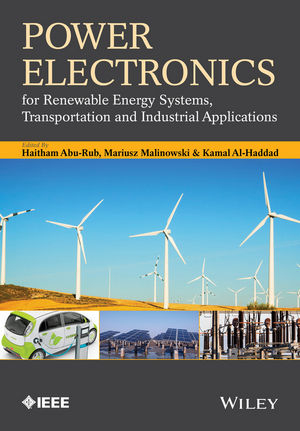
Power Electronics for Renewable Energy Systems, Transportation and Industrial Applications (eBook)
John Wiley & Sons (Verlag)
978-1-118-75550-1 (ISBN)
Compiles current research into the analysis and design of power electronic converters for industrial applications and renewable energy systems, presenting modern and future applications of power electronics systems in the field of electrical vehicles
With emphasis on the importance and long-term viability of Power Electronics for Renewable Energy this book brings together the state of the art knowledge and cutting-edge techniques in various stages of research. The topics included are not currently available for practicing professionals and aim to enable the reader to directly apply the knowledge gained to their designs. The book addresses the practical issues of current and future electric and plug-in hybrid electric vehicles (PHEVs), and focuses primarily on power electronics and motor drives based solutions for electric vehicle (EV) technologies. Propulsion system requirements and motor sizing for EVs is discussed, along with practical system sizing examples. Key EV battery technologies are explained as well as corresponding battery management issues. PHEV power system architectures and advanced power electronics intensive charging infrastructures for EVs and PHEVs are detailed. EV/PHEV interface with renewable energy is described, with practical examples. This book explores new topics for further research needed world-wide, and defines existing challenges, concerns, and selected problems that comply with international trends, standards, and programs for electric power conversion, distribution, and sustainable energy development. It will lead to the advancement of the current state-of-the art applications of power electronics for renewable energy, transportation, and industrial applications and will help add experience in the various industries and academia about the energy conversion technology and distributed energy sources.
- Combines state of the art global expertise to present the latest research on power electronics and its application in transportation, renewable energy and different industrial applications
- Offers an overview of existing technology and future trends, with discussion and analysis of different types of converters and control techniques (power converters, high performance power devices, power system, high performance control system and novel applications)
- Systematic explanation to provide researchers with enough background and understanding to go deeper in the topics covered in the book
Haitham Abu-Rub is currently a professor at Texas A&M University at Qatar. His main research interests are energy conversion systems, including renewable and electromechanical systems. He has published more than 200 journal and conference papers, coauthored four books, supervised several lucrative research projects, and is also an editor of several international journals such as in the IEEE Transactions on Sustainable Energy. He is currently leading various potential projects on photovoltaic and hybrid renewable power generation systems with different types of converters.
Mariusz Malinowski is currently with the Institute of Control and Industrial Electronics (ICIE) at Warsaw University of Technology (WUT). He has authored more than 100 technical papers and is the holder of two implemented patents. Dr. Malinowski is also an Associate Editor for the IEEE Transactions on Industrial Electronics, IEEE Transactions on Power Electronics, and previously edited the IEEE Industrial Electronics Magazine. He was the recipient of the Siemens Prize (2002, 2007) and the Polish Minister of Science and Higher Education Awards (2003, 2008). He also received IEEE IES David Irwin Early Career Award for 'Outstanding research and development of modulation and control for industrial electronics converters' in 2011.
Kamal Al-Haddad has been a professor with the École de Technologie Supérieure's Electrical Engineering Department since 1990. He has supervised 90 Ph.D. and M.Sc.A. students working in the field of power electronics for various industrial systems, including modelling, simulation, control, and packaging. He has also coauthored more than 400 transactions and conference papers, transferred 21 technologies to the industry, and is accredited with codeveloping the SimPowerSystem toolbox. Kamal Al-Haddad is currently a fellow member of the Canadian Academy of Engineering, IEEE-IES President Elect 2014-2015, IEEE Transactions on Industrial Informatics Associate Editor, and director of ETS-GREPCI research group.
Compiles current research into the analysis and design of power electronic converters for industrial applications and renewable energy systems, presenting modern and future applications of power electronics systems in the field of electrical vehicles With emphasis on the importance and long-term viability of Power Electronics for Renewable Energy this book brings together the state of the art knowledge and cutting-edge techniques in various stages of research. The topics included are not currently available for practicing professionals and aim to enable the reader to directly apply the knowledge gained to their designs. The book addresses the practical issues of current and future electric and plug-in hybrid electric vehicles (PHEVs), and focuses primarily on power electronics and motor drives based solutions for electric vehicle (EV) technologies. Propulsion system requirements and motor sizing for EVs is discussed, along with practical system sizing examples. Key EV battery technologies are explained as well as corresponding battery management issues. PHEV power system architectures and advanced power electronics intensive charging infrastructures for EVs and PHEVs are detailed. EV/PHEV interface with renewable energy is described, with practical examples. This book explores new topics for further research needed world-wide, and defines existing challenges, concerns, and selected problems that comply with international trends, standards, and programs for electric power conversion, distribution, and sustainable energy development. It will lead to the advancement of the current state-of-the art applications of power electronics for renewable energy, transportation, and industrial applications and will help add experience in the various industries and academia about the energy conversion technology and distributed energy sources. Combines state of the art global expertise to present the latest research on power electronics and its application in transportation, renewable energy and different industrial applications Offers an overview of existing technology and future trends, with discussion and analysis of different types of converters and control techniques (power converters, high performance power devices, power system, high performance control system and novel applications) Systematic explanation to provide researchers with enough background and understanding to go deeper in the topics covered in the book
Haitham Abu-Rub is currently a professor at Texas A&M University at Qatar. His main research interests are energy conversion systems, including renewable and electromechanical systems. He has published more than 200 journal and conference papers, coauthored four books, supervised several lucrative research projects, and is also an editor of several international journals such as in the IEEE Transactions on Sustainable Energy. He is currently leading various potential projects on photovoltaic and hybrid renewable power generation systems with different types of converters. Mariusz Malinowski is currently with the Institute of Control and Industrial Electronics (ICIE) at Warsaw University of Technology (WUT). He has authored more than 100 technical papers and is the holder of two implemented patents. Dr. Malinowski is also an Associate Editor for the IEEE Transactions on Industrial Electronics, IEEE Transactions on Power Electronics, and previously edited the IEEE Industrial Electronics Magazine. He was the recipient of the Siemens Prize (2002, 2007) and the Polish Minister of Science and Higher Education Awards (2003, 2008). He also received IEEE IES David Irwin Early Career Award for "Outstanding research and development of modulation and control for industrial electronics converters" in 2011. Kamal Al-Haddad has been a professor with the École de Technologie Supérieure's Electrical Engineering Department since 1990. He has supervised 90 Ph.D. and M.Sc.A. students working in the field of power electronics for various industrial systems, including modelling, simulation, control, and packaging. He has also coauthored more than 400 transactions and conference papers, transferred 21 technologies to the industry, and is accredited with codeveloping the SimPowerSystem toolbox. Kamal Al-Haddad is currently a fellow member of the Canadian Academy of Engineering, IEEE-IES President Elect 2014-2015, IEEE Transactions on Industrial Informatics Associate Editor, and director of ETS-GREPCI research group.
Chapter 1 Energy, Global Warming and Impact of Power Electronics in the Present Century
Chapter 2 Challenges of the Current Energy Scenario: The Power Electronics Contribution
Chapter 3 An Overview on Distributed Generation and Smart Grid Concepts and Technologies.
Chapter 4 Recent advances in power semiconductor technology
Chapter 5 AC-Link Universal Power Converters: A New Class of Power Converters for Renewable Energy and Transportation
Chapter 6 High Power Electronics - Key Technology for Wind Turbines
Chapter 7 Photovoltaic Energy Conversion Systems
Chapter 8 Controllability Analysis of Renewable Energy Systems
Chapter 9 Universal operation of small/medium size renewable energy systems
Chapter 10 Properties and Control of a Doubly Fed Induction Machine
Chapter 11 AC-DC-AC converters for distributed power generation systems
Chapter 12 Power Electronics for More Electric Aircraft
Chapter 13 Electric and Plug-in Hybrid Electric Vehicles
Chapter 14 Multilevel Converter/Inverter Topologies and Applications
Chapter 15 Multi-phase Matrix Converter Topologies and Control
Chapter 16 Boost Pre-Regulators for Power Factor Correction in Single-Phase Rectifiers
Chapter 17 Active Power Filter
Chapter 18-A Hardware-in-the-Loop Systems with Power Electronics- a Powerful Simulation Tool
Chapter 18-B Real-Time Simulation of Modular Multi-Level Converters MMC
Chapter 19 Model Predictive Speed Control of Electrical Machines
Chapter 20 The Electrical drive systems with the current source converter
Chapter 21 Common mode voltage and bearing currents in PWM inverters - causes, effects, and prevention
Chapter 22 High-Power Drive Systems For Industrial Applications -Practical Examples
Chapter 23 Modulation and Control of Single-Phase Grid-Side Converters
Chapter 24 Impedance Source Inverters
Preface
It is our pleasure to present this book on up-to-date power electronics technologies and advancements in their use in renewable energy, transportation systems, and various industrial applications.
We have written this book in response to the current lack of relevant research available to researchers, professionals, and students. It is our hope that we successfully convey our passion for this field in a manner that is easy to follow textually and visually. We have chosen to write this as a joint initiative because of the expertise needed in an all-encompassing research on power electronic systems.
In this book we cover a wide range of power electronic components, renewable energy systems, smart grids, distributed generations, transportation systems, and other industrial areas. This work fills a gap in engineering literature and contributes to a better understanding and further application of power electronic systems. Power electronic components and applications are among the fastest growing engineering areas today and are key in responding to our current environmental constraints and energy demands. This book integrates material in order to answer current problems and offer solutions for the growing commercial and domestic power demands.
The book discusses several aspects of current research, and the participation of the world's top scientists solidifies the book's credibility, including IEEE life fellows Prof. Bimal K. Bose and Prof. Joachim Holtz. Other scientists who participated in the writing of this book include Professors Frede Blaabjerg, Leopoldo G. Franquelo, Carlo Cecati, Hamid A. Toliyat, Bin Wu, Fang Zheng Peng, Ralf M. Kennel, and Jose Rodriguez.
The book is divided into three main parts: (1) The Impact of Power Electronics for Emerging Technologies (Chapters 1–5), (2) Power Electronics for Distributed Power Generation Systems (Chapters 6–11), and (3) Power Electronics for Transportations and Industrial Applications (Chapters 12–24).
Chapter 1 offers a brief but comprehensive review of the world's energy resources and climate change problems because of fossil fuel burning, along with possible solutions or mitigation methods. The author concludes with a discussion of the impact of power electronics that have on energy conservation, renewable energy systems, bulk storage of energy, and electric/hybrid vehicles in the present century.
Chapter 2 focuses on the contribution of power electronics to achieve efficient energy transmission and distribution, enable a high penetration of renewables in the power system, and develop more electrical transportation systems. This chapter also addresses flexible AC transmission system (FACTS) devices; high-voltage direct current (HVDC) transmission systems; power electronics converters for wind, photovoltaic (PV), and ocean sources; power conversion for electric vehicles; and energy storage systems.
Chapter 3 gives an overview of the main technologies, features, and problems of distributed generation and smart grids. This chapter gives a short but comprehensive overview of these emerging topics.
Chapter 4 presents recent advances in power semiconductors technology, focusing specifically on wide bandgap transistors. The authors offer a short introduction to state-of-the-art silicon power devices and the characteristics of the various SiC power switches. Design considerations of gate- and base-drive circuits for various SiC power switches, along with experimental results of their switching performance, are presented in details alongside a discussion of their applications.
In Chapter 5, the authors categorize AC-link universal power converters within a new class of power converters, and demonstrate how they can interface multiple loads and sources while remaining a single-stage converter.
Chapter 6 expands on technological developments and market trends in wind power application. The authors review a variety of wind turbine concepts, as well as power converter solutions, and offer an explanation of control methods, grid demands, and emerging reliability challenges.
Chapter 7 presents a comprehensive overview of grid-connected PV systems, including power curves, grid-connected configurations, different converter topologies (both single and three phases), control schemes, maximum power point tracking (MPPT), and anti-islanding detection methods. The chapter focuses on the mainstream solutions available in the PV industry, in order to establish the current state of the art in PV converter technology. In addition, the authors offer a discussion of recently introduced concepts on multilevel converter-based PV systems for large-scale PV plants, along with trends, challenges, and possible future scenarios of PV converter technology.
In Chapter 8, the authors demonstrate that the components of renewable energy systems, including interfacing filters, are first selected to ensure steady optimum performance operation, after which controllers are designed and implemented to ensure stability, high dynamic performance, and robustness to disturbance and parameter variations. The controllability analysis of an interior permanent magnet (IPM) wind turbine generator connected to the grid through a filter interface is analyzed, and the stability of the nonlinear system and the study of the zero dynamics provide insights into potential constraints on controller structure and dynamics.
Chapter 9 points out that the role of the power converter's control is fundamental and involves a number of issues: power flow control, synchronization with the main grid, reactive power capability, voltage regulation at the point of common coupling and power quality constraints. In addressing these matters, the authors focus on PV and small wind turbine systems, as well as the management of the transition among grid connection, stand-alone operation, and synchronization.
Chapter 1 describes the main properties and control methods of the doubly fed induction machine, which are related to both grid-connected and stand-alone operation modes. The chapter presents the properties of a wind turbine equipped with a doubly fed induction machine, and offers a short description of wind turbine aerodynamics, wind turbine superior control, and steady-state performance of wind turbine.
Chapter 1 is devoted to various topologies of AC–DC–AC converters and their design. It offers an in-depth discussion of classical three-phase/three-phase transistor-based AC–DC–AC converters (two-level and three-level diode-clamped converters (DCCs) and flying capacitors converters (FCC)) and simplified AC–DC–AC converters (two-level and three-level three-phase/one-phase and three-phase/three-phase DCC).
Chapter 12 describes how More Electric Aircraft (MEA) technology is continually evolving and being widely recognized as the future technology for the aerospace industry. This chapter provides a brief description of the electrical power generation, conversion, and distribution in conventional aircrafts and in more electric aircrafts, such as Airbus 380 and Boeing 787. The author also discusses more electric architectures, power distribution strategies, more electric engine concepts, and the effect of high-voltage operation at high altitudes.
Chapter 13 presents the structure and basic design aspects of electric vehicles (EVs) and plug-in hybrid electric vehicles (PHEVs), as well as future trends in EV manufacturing. The authors also discuss the integration of EVs with green, renewable energy sources and introduce the design of such systems.
Chapter 14 is dedicated to explaining multilevel converters/inverters and describing their pros and cons regarding their most suitable applications. The chapter presents how multilevel inverters are applied to static var generation (SVG), static synchronous compensator (STATCOM), and FACTS devices. The authors further explore magnetic-less multilevel DC–DC converters and analyze the multilevel converters' fault tolerance and reliability.
Chapter 15 elaborates on the theoretical and analytical aspects of multi-phase matrix converters, encompassing existing and emerging topologies and control. The authors also discuss various control algorithms for efficient operation.
Chapter 16 presents a detailed analysis of three boost-type preregulators commonly used for power factor correction in single-phase rectifiers: the single-switch basic boost, the two-switch asymmetric half-bridge boost, and the interleaved dual-boost topology. The authors also illustrate the mathematical modeling approach, applying it to the first two topologies. In so doing, the authors are able to demonstrate the effectiveness of these converters associated with their respective control systems.
Chapter 17 looks at how power electronics applications have penetrated multiple areas of modern life, thereby increasing nonlinear loads in comparison with linear loads. Simultaneously, power electronics-based loads are sensitive to harmonic distortion, which leads to a discussion of active power filters that can be employed to cancel or mitigate harmonics and their effects.
In Chapter 18A, the discussion provided proves that the so-called virtual machine (VM) is a hardware-in-the-loop (HiL) system allowing an inverter to be tested at real power levels without the need for installing and operating real machines as the VM has the same characteristics as a real induction motor or even a synchronous motor. Different machines and their respective load conditions can be emulated by software, meaning that the drive inverter under test can operate in its normal mode.
Chapter 18B also relates to...
| Erscheint lt. Verlag | 2.6.2014 |
|---|---|
| Reihe/Serie | IEEE Press |
| Wiley - IEEE | Wiley - IEEE |
| Sprache | englisch |
| Themenwelt | Technik ► Elektrotechnik / Energietechnik |
| Schlagworte | Active/hybrid filters • and HVDC transmission systems • Components & Devices • Distributed generation and Smart Grids • electric aircraft • Electrical & Electronics Engineering • Electric and hybrid electric vehicles • Electric Drive • electric power systems • Elektrische Energietechnik • Elektrotechnik u. Elektronik • Energie • Energy • Erneuerbare Energie • FACTS devices • Komponenten u. Bauelemente • Leistungselektronik • Power Converter Topologies • Power Electronics • Power electronics control • renewable energy • Semiconductor technology and silicon carbide • solar and wind energy |
| ISBN-10 | 1-118-75550-2 / 1118755502 |
| ISBN-13 | 978-1-118-75550-1 / 9781118755501 |
| Informationen gemäß Produktsicherheitsverordnung (GPSR) | |
| Haben Sie eine Frage zum Produkt? |
 EPUB (Adobe DRM)
Kopierschutz: Adobe-DRM
Adobe-DRM ist ein Kopierschutz, der das eBook vor Mißbrauch schützen soll. Dabei wird das eBook bereits beim Download auf Ihre persönliche Adobe-ID autorisiert. Lesen können Sie das eBook dann nur auf den Geräten, welche ebenfalls auf Ihre Adobe-ID registriert sind.
Details zum Adobe-DRM
Dateiformat: EPUB (Electronic Publication)
EPUB ist ein offener Standard für eBooks und eignet sich besonders zur Darstellung von Belletristik und Sachbüchern. Der Fließtext wird dynamisch an die Display- und Schriftgröße angepasst. Auch für mobile Lesegeräte ist EPUB daher gut geeignet.
Systemvoraussetzungen:
PC/Mac: Mit einem PC oder Mac können Sie dieses eBook lesen. Sie benötigen eine
eReader: Dieses eBook kann mit (fast) allen eBook-Readern gelesen werden. Mit dem amazon-Kindle ist es aber nicht kompatibel.
Smartphone/Tablet: Egal ob Apple oder Android, dieses eBook können Sie lesen. Sie benötigen eine
Geräteliste und zusätzliche Hinweise
Buying eBooks from abroad
For tax law reasons we can sell eBooks just within Germany and Switzerland. Regrettably we cannot fulfill eBook-orders from other countries.
aus dem Bereich