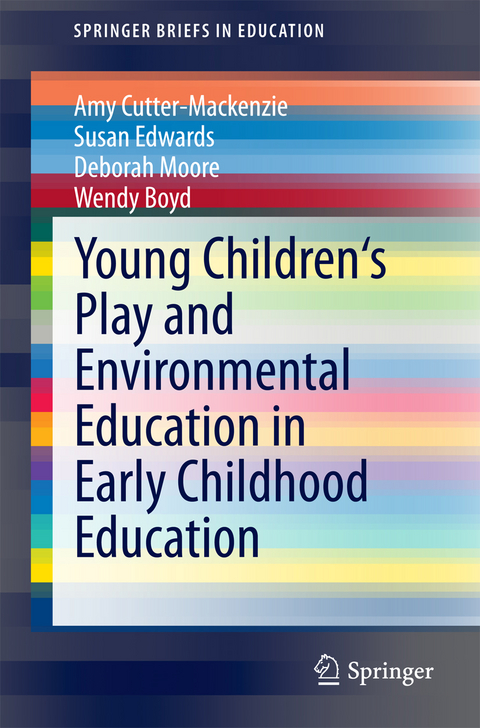
Young Children's Play and Environmental Education in Early Childhood Education (eBook)
88 Seiten
Springer International Publishing (Verlag)
978-3-319-03740-0 (ISBN)
In an era in which environmental education has been described as one of the most pressing educational concerns of our time, further insights are needed to understand how best to approach the learning and teaching of environmental education in early childhood education. In this book we address this concern by identifying two principles for using play-based learning early childhood environmental education. The principles we identify are the result of research conducted with teachers and children using different types of play-based learning whilst engaged in environmental education. Such play-types connect with the historical use of play-based learning in early childhood education as a basis for pedagogy.
In the book ‘Beyond Quality in ECE and Care’ authors Dahlberg, Moss and Pence implore readers to ask critical questions about commonly held images of how young children come to construct themselves within social institutions. In similar fashion, this little book problematizes the taken-for-grantedness of the childhood development project in service to the certain cultural narratives. Cutter-Mackenzie, Edwards, Moore and Boyd challenge traditional conceptions of play-based learning through the medium of environmental education. This book signals a turning point in social thought grounded in a relational view of (environmental) education as experiential, intergenerational, interspecies, embodied learning in the third space. As Barad says, such work is based in inter-actions that can account for the tangled spaces of agencies. Through the deceptive simplicity of children’s play, the book stimulates deliberation of the real purposes of pedagogy and of schooling.
Paul Hart, University of Regina, Canada
Acknowledgments 5
Contents 6
Figures 8
Tables 9
1 A Challenge for Early Childhood Environmental Education? 10
Abstract 10
1.1…Introduction 10
1.2…Play-Based Learning in Early Childhood Environmental Education 11
1.3…Project Overview 12
1.4…Children as Active Participants 15
1.5…Conclusion 15
References 16
2 Play-Based Learning in Early Childhood Education 18
Abstract 18
2.1…Introduction 18
2.2…Historical Theoretical and Philosophical Informants to Early Childhood Education 20
2.3…Developmentally Appropriate Practice in Early Childhood Education 25
2.4…Postdevelopmental Perspectives on Early Childhood Education 26
2.5…Conclusion 30
References 30
3 Environmental Education and Pedagogical Play in Early Childhood Education 34
Abstract 34
3.1…Introduction 34
3.2…Environmental Education in Early Childhood 36
3.3…Biophilia and Biophobia 38
3.4…Pedagogical Play in Early Childhood Education 40
3.5…Conclusion 43
References 44
4 Jeanette: Pond Life 47
Abstract 47
4.1…Jeanette and the Cornish College Early Learning Centre 47
4.2…Focusing on Pond Life 50
4.3…Open-Ended Play 51
4.4…Modelled-Play 52
4.5…Purposefully-Framed Play 54
4.6…Pedagogical Play and Environmental Education 55
4.7…Conclusion 58
References 60
5 Josh: Small Is Beautiful 61
Abstract 61
5.1…Josh and the St Kilda and Balaclava Kindergarten 61
5.2…Open-Ended Play 62
5.3…Modelled-Play 64
5.4…Purposefully-Framed Play 65
5.5…Pedagogical Play and Environmental Education 67
5.6…Chapter Conclusion 69
Reference 70
6 Robyn: Worms Underground 71
Abstract 71
6.1…Introducing Robyn and Hallam Kindergarten 71
6.2…Purposefully-Framed Play 72
6.3…Modelled-Play 74
6.4…Open-Ended Play 75
6.5…Pedagogical Play and Environmental Education 77
6.6…Conclusion 81
References 82
7 A Challenge Reconsidered: Play-Based Learning in Early Childhood Environmental Education 83
Abstract 83
7.1…Introduction 83
7.2…Two Principles for Using Play-Based Learning in Early Childhood Environmental Education 85
7.3…Re-considering Play-Based Learning in Early Childhood Environmental Education? 86
7.4…Conclusion 88
References 89
About the Authors 90
Author Index 92
Subject Index 94
| Erscheint lt. Verlag | 18.1.2014 |
|---|---|
| Reihe/Serie | SpringerBriefs in Education | SpringerBriefs in Education |
| Zusatzinfo | XI, 88 p. 16 illus. |
| Verlagsort | Cham |
| Sprache | englisch |
| Themenwelt | Geisteswissenschaften ► Psychologie |
| Sozialwissenschaften ► Pädagogik ► Vorschulpädagogik | |
| Technik | |
| Schlagworte | biodiversity • biophilia • biophobia • Conceptual Knowledge • early childhood curriculum • Early childhood education • Early learning • Environmental education • environmental learning • modelled play • natural world • open ended play • play-based learning • play-based learning as a basis for pedagogy • purposefully framed play • sustainability • sustainable practices |
| ISBN-10 | 3-319-03740-4 / 3319037404 |
| ISBN-13 | 978-3-319-03740-0 / 9783319037400 |
| Informationen gemäß Produktsicherheitsverordnung (GPSR) | |
| Haben Sie eine Frage zum Produkt? |
 PDF (Wasserzeichen)
DRM: Digitales Wasserzeichen
Dieses eBook enthält ein digitales Wasserzeichen und ist damit für Sie personalisiert. Bei einer missbräuchlichen Weitergabe des eBooks an Dritte ist eine Rückverfolgung an die Quelle möglich.
Dateiformat: PDF (Portable Document Format)
Mit einem festen Seitenlayout eignet sich die PDF besonders für Fachbücher mit Spalten, Tabellen und Abbildungen. Eine PDF kann auf fast allen Geräten angezeigt werden, ist aber für kleine Displays (Smartphone, eReader) nur eingeschränkt geeignet.
Systemvoraussetzungen:
PC/Mac: Mit einem PC oder Mac können Sie dieses eBook lesen. Sie benötigen dafür einen PDF-Viewer - z.B. den Adobe Reader oder Adobe Digital Editions.
eReader: Dieses eBook kann mit (fast) allen eBook-Readern gelesen werden. Mit dem amazon-Kindle ist es aber nicht kompatibel.
Smartphone/Tablet: Egal ob Apple oder Android, dieses eBook können Sie lesen. Sie benötigen dafür einen PDF-Viewer - z.B. die kostenlose Adobe Digital Editions-App.
Buying eBooks from abroad
For tax law reasons we can sell eBooks just within Germany and Switzerland. Regrettably we cannot fulfill eBook-orders from other countries.
aus dem Bereich