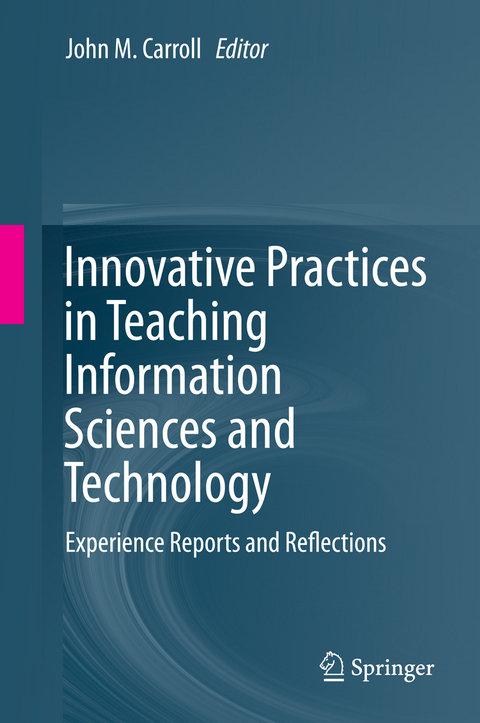
Innovative Practices in Teaching Information Sciences and Technology (eBook)
238 Seiten
Springer International Publishing (Verlag)
978-3-319-03656-4 (ISBN)
University teaching and learning has never been more innovative than it is now.
This has been enabled by a better contemporary understanding of teaching and learning. Instructors now present situated projects and practices to their students, not just foundational principles. Lectures and structured practice are now often replaced by engaging and constructivist learning activities that leverage what students know about, think about and care about.
Teaching innovation has also been enabled by online learning in the classroom, beyond the classroom and beyond the campus. Learning online is perhaps not the panacea sometimes asserted but it is a disruptively rich and expanding set of tools and techniques that can facilitate engaging and constructivist learning activities. It is becoming the new normal in university teaching and learning.
The opportunity and the need for innovation in teaching and learning are together keenest in information technology itself: Computer and Information Science faculty and students are immersed in innovation. The subject matter of these disciplines changes from one year to the next; courses and curricula are in constant flux. And indeed each wave of disciplinary innovation is assimilated into technology tools and infrastructures for teaching new and emerging concepts and techniques.
Innovative Practices in Teaching Information Sciences and Technology: Experience Reports and Reflections describes a set of innovative teaching practices from the faculty of Information Sciences and Technology at Pennsylvania State University. Each chapter is a personal essay describing practices, implemented by one or two faculty that challenge assumptions and push beyond standard practice at the individual faculty and classroom level. These are innovations that instructors elsewhere may find directly accessible and adaptable.
Taken as a set, this book is a case study of teaching innovation as a part of faculty culture. Innovation is not optional in information technology; it inheres in both the disciplinary subject matter and in teaching. But it is an option for instructors to collectively embrace innovation as a faculty. The chapters in this book taken together, embody this option and provide a partial model to faculties for reflecting on and refining their own collective culture of teaching innovation.
Introduction.- The Karate Kid Method of Problem Based Learning.- Hungry Wolves, Creepy Sheepies: The Gamification of the Programmer's Classroom.- Teaching and Learning in Technical IT Courses.- Towards an Egalitarian Pedagogy for the Millennial Generation: A Reflection.- Higher Education Classroom Community Game: Together We Are Smarter.- The Tinker Toy Challenge – Peeking Under the Cloak of Invisibility in Information System Design.- Learning by Design.- Teaching Structured Analytical Thinking with Data using Visual-analytic Tools.- The Analytic Decision Game.- Cyber Forensic War Room: An Immersion into IT Aspects of Public Policy.- Semester Projects on Human-Computer Interaction as Service and Outreach.- Enterprise Integration: An Experiential Learning Model.- Immersive Learning.- Leveraging Mobile Technology to Enhance both Competition and Cooperation in an Undergraduate.- Teaching Information Security with Virtual Laboratories.- Using Video to Establish Immediacy with Students in Distance Education Courses.- Reflections on Blended Learning.- Chronicles of the Partially Distributed Team Project: Learning to Teach Students to Collaborate in Global Teams.
| Erscheint lt. Verlag | 27.1.2014 |
|---|---|
| Zusatzinfo | VIII, 238 p. 30 illus. |
| Verlagsort | Cham |
| Sprache | englisch |
| Themenwelt | Geisteswissenschaften |
| Mathematik / Informatik ► Informatik | |
| Sozialwissenschaften ► Pädagogik | |
| Technik | |
| Schlagworte | Active learning • Collaborative Learning • Culture of Teaching Innovation • Experience Reports • Teaching Innovation in Computer Science |
| ISBN-10 | 3-319-03656-4 / 3319036564 |
| ISBN-13 | 978-3-319-03656-4 / 9783319036564 |
| Informationen gemäß Produktsicherheitsverordnung (GPSR) | |
| Haben Sie eine Frage zum Produkt? |
 PDF (Wasserzeichen)
DRM: Digitales Wasserzeichen
Dieses eBook enthält ein digitales Wasserzeichen und ist damit für Sie personalisiert. Bei einer missbräuchlichen Weitergabe des eBooks an Dritte ist eine Rückverfolgung an die Quelle möglich.
Dateiformat: PDF (Portable Document Format)
Mit einem festen Seitenlayout eignet sich die PDF besonders für Fachbücher mit Spalten, Tabellen und Abbildungen. Eine PDF kann auf fast allen Geräten angezeigt werden, ist aber für kleine Displays (Smartphone, eReader) nur eingeschränkt geeignet.
Systemvoraussetzungen:
PC/Mac: Mit einem PC oder Mac können Sie dieses eBook lesen. Sie benötigen dafür einen PDF-Viewer - z.B. den Adobe Reader oder Adobe Digital Editions.
eReader: Dieses eBook kann mit (fast) allen eBook-Readern gelesen werden. Mit dem amazon-Kindle ist es aber nicht kompatibel.
Smartphone/Tablet: Egal ob Apple oder Android, dieses eBook können Sie lesen. Sie benötigen dafür einen PDF-Viewer - z.B. die kostenlose Adobe Digital Editions-App.
Buying eBooks from abroad
For tax law reasons we can sell eBooks just within Germany and Switzerland. Regrettably we cannot fulfill eBook-orders from other countries.
aus dem Bereich