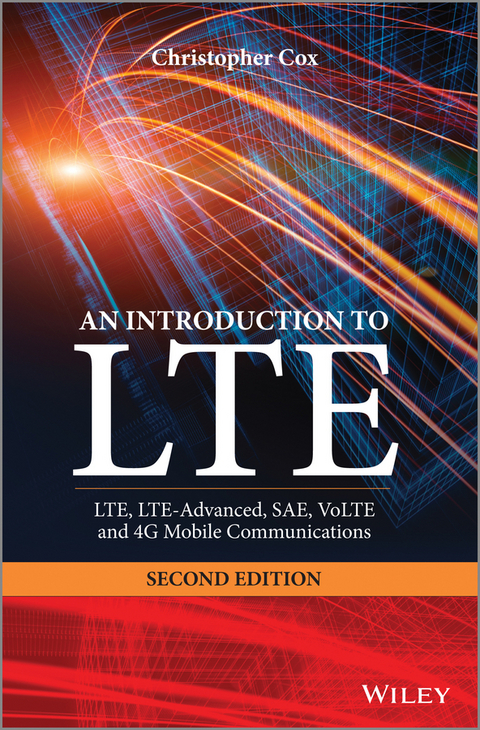
An Introduction to LTE (eBook)
John Wiley & Sons (Verlag)
978-1-118-81801-5 (ISBN)
Following on from the successful first edition (March 2012), this book gives a clear explanation of what LTE does and how it works. The content is expressed at a systems level, offering readers the opportunity to grasp the key factors that make LTE the hot topic amongst vendors and operators across the globe. The book assumes no more than a basic knowledge of mobile telecommunication systems, and the reader is not expected to have any previous knowledge of the complex mathematical operations that underpin LTE.
This second edition introduces new material for the current state of the industry, such as the new features of LTE in Releases 11 and 12, notably coordinated multipoint transmission and proximity services; the main short- and long-term solutions for LTE voice calls, namely circuit switched fallback and the IP multimedia subsystem; and the evolution and current state of the LTE market. It also extends some of the material from the first edition, such as inter-operation with other technologies such as GSM, UMTS, wireless local area networks and cdma2000; additional features of LTE Advanced, notably heterogeneous networks and traffic offloading; data transport in the evolved packet core; coverage and capacity estimation for LTE; and a more rigorous treatment of modulation, demodulation and OFDMA. The author breaks down the system into logical blocks, by initially introducing the architecture of LTE, explaining the
techniques used for radio transmission and reception and the overall operation of the system, and concluding with more specialized topics such as LTE voice calls and the later releases of the specifications. This methodical approach enables readers to move on to tackle the specifications and the more advanced texts with confidence.
Christopher Cox is a professional technical trainer and consultant in mobile telecommunications. He is an expert in the technical and radio network planning aspects of LTE and UMTS, and regularly delivers training courses about them to audiences drawn from equipment manufacturers, network operators and consultancies worldwide. He has a degree in Physics and a PhD in Radio Astronomy from the University of Cambridge and 20 years' experience in scientific and technical consultancy, telecommunications and training.
Following on from the successful first edition (March 2012), this book gives a clear explanation of what LTE does and how it works. The content is expressed at a systems level, offering readers the opportunity to grasp the key factors that make LTE the hot topic amongst vendors and operators across the globe. The book assumes no more than a basic knowledge of mobile telecommunication systems, and the reader is not expected to have any previous knowledge of the complex mathematical operations that underpin LTE. This second edition introduces new material for the current state of the industry, such as the new features of LTE in Releases 11 and 12, notably coordinated multipoint transmission and proximity services; the main short- and long-term solutions for LTE voice calls, namely circuit switched fallback and the IP multimedia subsystem; and the evolution and current state of the LTE market. It also extends some of the material from the first edition, such as inter-operation with other technologies such as GSM, UMTS, wireless local area networks and cdma2000; additional features of LTE Advanced, notably heterogeneous networks and traffic offloading; data transport in the evolved packet core; coverage and capacity estimation for LTE; and a more rigorous treatment of modulation, demodulation and OFDMA. The author breaks down the system into logical blocks, by initially introducing the architecture of LTE, explaining thetechniques used for radio transmission and reception and the overall operation of the system, and concluding with more specialized topics such as LTE voice calls and the later releases of the specifications. This methodical approach enables readers to move on to tackle the specifications and the more advanced texts with confidence.
Christopher Cox is a professional technical trainer and consultant in mobile telecommunications. He is an expert in the technical and radio network planning aspects of LTE and UMTS, and regularly delivers training courses about them to audiences drawn from equipment manufacturers, network operators and consultancies worldwide. He has a degree in Physics and a PhD in Radio Astronomy from the University of Cambridge and 20 years' experience in scientific and technical consultancy, telecommunications and training.
List of Abbreviations
| 16-QAM | 16 quadrature amplitude modulation |
| 1G | First generation |
| 1xRTT | 1x radio transmission technology |
| 2G | Second generation |
| 3G | Third generation |
| 3GPP | Third Generation Partnership Project |
| 3GPP2 | Third Generation Partnership Project 2 |
| 4G | Fourth generation |
| 64-QAM | 64 quadrature amplitude modulation |
| AAA | Authentication, authorization and accounting |
| ABMF | Account balance management function |
| ABS | Almost blank subframe |
| ACK | Positive acknowledgement |
| ACM | Address complete message |
| ADC | Analogue to digital converter |
| AES | Advanced Encryption Standard |
| AF | Application function/Assured forwarding |
| AKA | Authentication and key agreement |
| AM | Acknowledged mode |
| AMBR | Aggregate maximum bit rate |
| AMR | Adaptive multi rate |
| AMR-WB | Wideband adaptive multi rate |
| ANDSF | Access network discovery and selection function |
| ANM | Answer message |
| API | Application programming interface |
| APN | Access point name |
| APN-AMBR | Per APN aggregate maximum bit rate |
| ARIB | Association of Radio Industries and Businesses |
| ARP | Allocation and retention priority |
| ARQ | Automatic repeat request |
| AS | Access stratum/Application server |
| ASME | Access security management entity |
| ATCF | Access transfer control function |
| ATGW | Access transfer gateway |
| ATIS | Alliance for Telecommunications Industry Solutions |
| AuC | Authentication centre |
| AVP | Attribute value pair/Audio visual profile |
| AWS | Advanced Wireless Services |
| B2BUA | Back to back user agent |
| BBERF | Bearer binding and event reporting function |
| BBF | Bearer binding function |
| BCCH | Broadcast control channel |
| BCH | Broadcast channel |
| BD | Billing domain |
| BE | Best effort |
| BGCF | Breakout gateway control function |
| BICC | Bearer independent call control |
| BM-SC | Broadcast/multicast service centre |
| BPSK | Binary phase shift keying |
| BSC | Base station controller |
| BSR | Buffer status report |
| BSSAP+ | Base station subsystem application part plus |
| BSSGP | Base station system GPRS protocol |
| BTS | Base transceiver station |
| CA | Carrier aggregation |
| CAMEL | Customized applications for mobile network enhanced logic |
| CBC | Cell broadcast centre |
| CBS | Cell broadcast service |
| CC | Call control/Component carrier |
| CCCH | Common control channel |
| CCE | Control channel element |
| CCO | Cell change order |
| CCSA | China Communications Standards Association |
| CDF | Charging data function |
| CDMA | Code division multiple access |
| CDR | Charging data record |
| CFI | Control format indicator |
| CGF | Charging gateway function |
| CIF | Carrier indicator field |
| CLI | Calling line identification |
| CM | Connection management |
| CMAS | Commercial mobile alert system |
| C-MSISDN | Correlation mobile subscriber ISDN number |
| CoMP | Coordinated multi-point transmission and reception |
| COST | European Cooperation in Science and Technology |
| CP | Cyclic prefix |
| CQI | Channel quality indicator |
| CRC | Cyclic redundancy check |
| C-RNTI | Cell radio network temporary identifier |
| CS | Circuit switched |
| CS/CB | Coordinated scheduling and beamforming |
| CSCF | Call session control function |
| CSFB | Circuit switched fallback |
| CSG | Closed subscriber group |
| CSI | Channel state information |
| CS-MGW | Circuit switched media gateway |
| CTF | Charging trigger function |
| D2D | Device to device |
| DAC | Digital-to-analogue converter |
| dB | Decibel |
| dBi | Decibels relative to an isotropic antenna |
| dBm | Decibels relative to one milliwatt |
| DCCH | Dedicated control channel |
| DCI | Downlink control information |
| DeNB | Donor evolved Node B |
| DFT | Discrete Fourier transform |
| DFT-S-OFDMA | Discrete Fourier transform spread OFDMA |
| DHCP | Dynamic host configuration protocol |
| DiffServ | Differentiated services |
| DL | Downlink |
| DL-SCH | Downlink shared channel |
| DNS | Domain name server |
| DPS | Dynamic point selection |
| DRS | Demodulation reference signal |
| DRVCC | Dual radio voice call continuity |
| DRX | Discontinuous reception |
| DSCP | Differentiated services code point |
| DSL | Digital subscriber line |
| DSMIP | Dual-stack mobile IP |
| DTCH | Dedicated traffic channel |
| DTM | Dual transfer mode |
| DTMF | Dual tone multi-frequency |
| EAG | Explicit array gain |
| eAN | Evolved access network |
| EAP | Extensible authentication protocol |
| EATF | Emergency access transfer function |
| ECGI | E-UTRAN cell global identifier |
| ECI | E-UTRAN cell identity |
| ECM | EPS connection management |
| ECN | Explicit congestion notification |
| E-CSCF | Emergency call session control function |
| EDGE | Enhanced Data Rates for GSM Evolution |
| EEA | EPS encryption algorithm |
| EF | Expedited forwarding |
| eHRPD | Evolved high rate packet data |
| EIA | EPS integrity algorithm |
| EICIC | Enhanced inter cell interference coordination |
| EIR | Equipment identity register |
| EIRP | Equivalent isotropic radiated power |
| eMBMS | Evolved MBMS |
| EMM | EPS mobility... |
| Erscheint lt. Verlag | 12.5.2014 |
|---|---|
| Sprache | englisch |
| Themenwelt | Technik ► Elektrotechnik / Energietechnik |
| Technik ► Nachrichtentechnik | |
| Schlagworte | across • BASIC • Book • clear • Communication technology • Communication Technology - Networks • Content • Drahtlose Kommunikation • Electrical & Electronics Engineering • Elektrotechnik u. Elektronik • Explanation • Factors • First • Hot • Key • Knowledge • Kommunikationsnetze • Kommunikationstechnik • Level • LTE • March • Mobile & Wireless Communications • Mobile Telecommunication • Opportunity • previous • Reader • Readers • Successful • Systems • topic amongst • Vendors |
| ISBN-10 | 1-118-81801-6 / 1118818016 |
| ISBN-13 | 978-1-118-81801-5 / 9781118818015 |
| Informationen gemäß Produktsicherheitsverordnung (GPSR) | |
| Haben Sie eine Frage zum Produkt? |
 EPUB (Adobe DRM)
Kopierschutz: Adobe-DRM
Adobe-DRM ist ein Kopierschutz, der das eBook vor Mißbrauch schützen soll. Dabei wird das eBook bereits beim Download auf Ihre persönliche Adobe-ID autorisiert. Lesen können Sie das eBook dann nur auf den Geräten, welche ebenfalls auf Ihre Adobe-ID registriert sind.
Details zum Adobe-DRM
Dateiformat: EPUB (Electronic Publication)
EPUB ist ein offener Standard für eBooks und eignet sich besonders zur Darstellung von Belletristik und Sachbüchern. Der Fließtext wird dynamisch an die Display- und Schriftgröße angepasst. Auch für mobile Lesegeräte ist EPUB daher gut geeignet.
Systemvoraussetzungen:
PC/Mac: Mit einem PC oder Mac können Sie dieses eBook lesen. Sie benötigen eine
eReader: Dieses eBook kann mit (fast) allen eBook-Readern gelesen werden. Mit dem amazon-Kindle ist es aber nicht kompatibel.
Smartphone/Tablet: Egal ob Apple oder Android, dieses eBook können Sie lesen. Sie benötigen eine
Geräteliste und zusätzliche Hinweise
Buying eBooks from abroad
For tax law reasons we can sell eBooks just within Germany and Switzerland. Regrettably we cannot fulfill eBook-orders from other countries.
aus dem Bereich