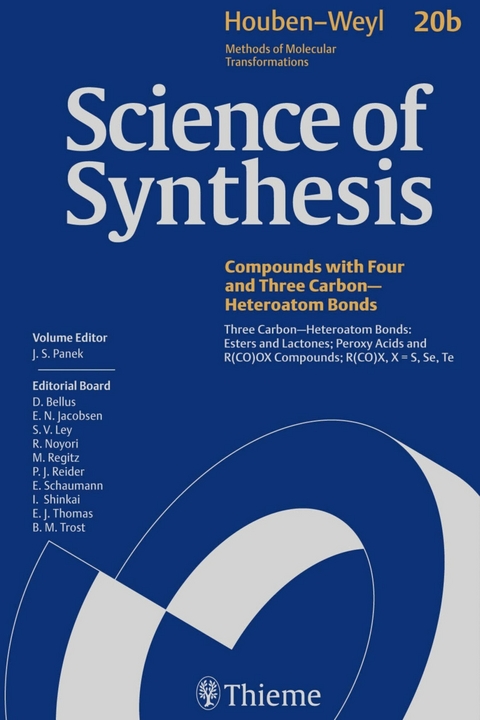
Science of Synthesis: Houben-Weyl Methods of Molecular Transformations Vol. 20b (eBook)
1203 Seiten
Georg Thieme Verlag KG
978-3-13-178131-4 (ISBN)
Science of Synthesis
Science of Synthesis
Science of Synthesis – Volume 20b: Three Carbon--Heteroatom Bonds: Esters and Lactones Peroxy Acids and R(CO)OX Compounds
Title page 3
Imprint 5
Preface 6
Volume Editor's Preface 8
Overview 10
Table of Contents 12
20.5 Product Class 5: Carboxylic Acid Esters 40
20.5.1 Product Subclass 1: Alkyl Alkanoates 40
20.5.1.1 Synthesis from Carbonic Acid Derivatives 62
20.5.1.1.1 Method 1: Use of Carbonic Acid Diesters 62
20.5.1.1.1.1 Variation 1: Reactions with Enolates 62
20.5.1.1.1.2 Variation 2: Reactions with Carbanions without Stabilizing Electron-Withdrawing a-Heteroatom Groups 67
20.5.1.1.1.3 Variation 3: Reaction with a-Heteroatom-Stabilized Carbanions 70
20.5.1.1.1.4 Variation 4: Intramolecular Rearrangements 72
20.5.1.1.2 Method 2: Use of Haloformates 75
20.5.1.1.2.1 Variation 1: Reactions with Enolates 76
20.5.1.1.2.2 Variation 2: Reaction with Carbanions without Stabilizing Electron-Withdrawing a-Heteroatom Groups 80
20.5.1.1.2.3 Variation 3: Reaction with a-Heteroatom-Stabilized Carbanions 85
20.5.1.1.2.4 Variation 4: Other Syntheses 88
20.5.1.1.3 Method 3: Use of Cyanoformate Esters 90
20.5.1.1.3.1 Variation 1: Reaction with Enolates 91
20.5.1.1.3.2 Variation 2: Using Other Carbon Nucleophiles 95
20.5.1.1.3.3 Variation 3: Novel Reactions 97
20.5.1.1.4 Method 4: Use of Di-tert-butyl Dicarbonate 99
20.5.1.2 Synthesis from Carboxylic Acids and Derivatives 108
20.5.1.2.1 Method 1: Synthesis from Carboxylic Acids 108
20.5.1.2.1.1 Variation 1: Phosphorus Activation of Alcohols (Mitsunobu Reaction) 108
20.5.1.2.1.2 Variation 2: Dicyclohexylcarbodiimide Activation of Acids 109
20.5.1.2.1.3 Variation 3: Direct Condensation of Acids and Alcohols Catalyzed by a Lewis Acid 110
20.5.1.2.1.4 Variation 4: Direct Condensation of Acids and Alcohols Using Ammonium Salts 111
20.5.1.2.2 Method 2: Synthesis from Acid Halides 112
20.5.1.2.3 Method 3: Synthesis from Acid Anhydrides 112
20.5.1.2.4 Method 4: Synthesis from Amides 114
20.5.1.2.5 Method 5: Synthesis from 2-Alkyl-4,5-dihydrooxazoles 114
20.5.1.2.6 Method 6: Synthesis from Nitriles 115
20.5.1.2.7 Method 7: Synthesis from Ketenes 116
20.5.1.2.7.1 Variation 1: Nucleophilic Addition of Alcohols 116
20.5.1.2.7.2 Variation 2: Asymmetric Chlorination 119
20.5.1.3 Synthesis from Aldehydes, Ketones, and Derivatives (Including Enol Ethers) 122
20.5.1.3.1 Synthesis from Aldehydes 122
20.5.1.3.1.1 Oxidative Processes 122
20.5.1.3.1.1.1 Method 1: Using Manganese(IV) Oxide and Sodium Cyanide 122
20.5.1.3.1.1.2 Method 2: Using Bromine 124
20.5.1.3.1.1.2.1 Variation 1: Using Pyridinium Tribromide 126
20.5.1.3.1.1.3 Method 3: Using Iodine 127
20.5.1.3.1.1.4 Method 4: Using Pyridinium Dichromate 128
20.5.1.3.1.1.5 Method 5: Using Sodium or Calcium Hypochlorites 129
20.5.1.3.1.1.6 Method 6: Using N-Bromosuccinimide 131
20.5.1.3.1.1.6.1 Variation 1: Using N-Bromosuccinimide and Alkoxytrimethylsilanes or Alkoxytrialkylstannanes 131
20.5.1.3.1.1.7 Method 7: Using N-Iodosuccinimide 132
20.5.1.3.1.1.8 Method 8: Using Caro's Acid 133
20.5.1.3.1.1.9 Method 9: Using Oxone 133
20.5.1.3.1.1.10 Method 10: Using Trichloroisocyanuric Acid 134
20.5.1.3.1.1.11 Method 11: Using Transition-Metal Catalysts 135
20.5.1.3.1.1.12 Method 12: Using Electrochemical Oxidation 136
20.5.1.3.1.1.13 Method 13: Using Ozone 138
20.5.1.3.1.1.14 Method 14: Using Hydrogen Peroxide 139
20.5.1.3.1.2 Oxidation/Reduction Processes 140
20.5.1.3.1.2.1 Method 1: Using the Tishchenko Reaction 140
20.5.1.3.1.2.1.1 Variation 1: Using the Homo Aldol--Tishchenko Reaction 142
20.5.1.3.1.2.1.2 Variation 2: Using the Hetero Aldol--Tishchenko Reaction 142
20.5.1.3.1.2.1.3 Variation 3: Using the Evans--Tishchenko Reaction 144
20.5.1.3.1.2.2 Method 2: Intramolecular Hydroacylation Reactions 146
20.5.1.3.2 Synthesis from Ketones via the Baeyer--Villiger Reaction 147
20.5.1.3.2.1 Method 1: Using Pertrifluoroacetic Acid 148
20.5.1.3.2.2 Method 2: Using Peroxybenzoic Acids 149
20.5.1.3.2.3 Method 3: Using Hydrogen Peroxide 150
20.5.1.3.2.4 Method 4: Using Bis(trimethylsilyl) Peroxide 151
20.5.1.3.2.5 Method 5: Using Enzymes 152
20.5.1.3.3 Synthesis from Acetals 152
20.5.1.3.3.1 Method 1: Using Ozone 152
20.5.1.3.3.2 Method 2: Using Hypochlorous Acid 154
20.5.1.3.3.3 Method 3: Using N-Bromosuccinimide 155
20.5.1.3.3.4 Method 4: Using Peroxy Acids 156
20.5.1.3.3.5 Method 5: Using Oxone 157
20.5.1.3.3.6 Method 6: Using Caro's Acid 158
20.5.1.3.3.7 Method 7: Using tert-Butyl Hydroperoxide and a Catalyst 159
20.5.1.3.3.8 Method 8: Photochemical Oxidation 160
20.5.1.3.3.9 Method 9: Using Potassium Permanganate 160
20.5.1.3.4 Synthesis from Enol Ethers 161
20.5.1.3.4.1 Method 1: Using Ozone 161
20.5.1.3.4.2 Method 2: Using 3-Chloroperoxybenzoic Acid 162
20.5.1.3.4.3 Method 3: Using Chromium(VI) Oxide 163
20.5.1.3.4.4 Method 4: Using Pyridinium Chlorochromate 164
20.5.1.3.5 Synthesis from a-Hydroxy Carbonyl Compounds and 1,2-Diones 165
20.5.1.3.5.1 Method 1: Using Lead(IV) Acetate 165
20.5.1.3.5.2 Method 2: Using Oxone or Potassium Peroxymonosulfate 166
20.5.1.3.5.3 Method 3: Using Dioxygen 168
20.5.1.3.5.4 Method 4: Using Electrochemistry 169
20.5.1.4 Synthesis from Organometallic Compounds, Alkyl Halides, Primary Alcohols, or Ethers (Excluding Reactions with Carboxylic Acid Derivatives) 174
20.5.1.4.1 Alkoxycarbonylation of Organometallic Compounds 174
20.5.1.4.1.1 Method 1: Alkoxycarbonylation of Organolithium Compounds 174
20.5.1.4.1.2 Method 2: Alkoxycarbonylation of Organomagnesium Compounds 175
20.5.1.4.1.3 Method 3: Alkoxycarbonylation of Organotransition-Metal Compounds 176
20.5.1.4.2 Alkoxycarbonylation of Alkyl Halides 178
20.5.1.4.2.1 Method 1: Alkoxycarbonylation of Alkyl Halides Promoted by Acids 178
20.5.1.4.2.2 Method 2: Alkoxycarbonylation of Alkyl Halides Promoted by Transition-Metal Catalysts 179
20.5.1.4.2.3 Method 3: Alkoxycarbonylation of Alkyl Iodides Promoted by Photolysis 181
20.5.1.4.3 Oxidation of Primary Alcohols 181
20.5.1.4.3.1 Method 1: Oxidation by Halonium-Generating Combinations 182
20.5.1.4.3.2 Method 2: Oxidation by Chromium(IV) Oxide 183
20.5.1.4.3.3 Method 3: Transition-Metal-Catalyzed Oxidations 183
20.5.1.4.4 Oxidation of Ethers, Silyl Ethers, or Stannyl Ethers 184
20.5.1.4.4.1 Method 1: Oxidation of Ethers 185
20.5.1.4.4.1.1 Variation 1: Oxidation by Halonium-Generating Combinations 185
20.5.1.4.4.1.2 Variation 2: Oxidation by Stoichiometric Transition-Metal Reagents 185
20.5.1.4.4.1.3 Variation 3: Transition-Metal-Catalyzed Oxidation 186
20.5.1.4.4.2 Method 2: Oxidation of Silyl and Stannyl Ethers Using N-Bromosuccinimide 187
20.5.1.5 Synthesis from Alkenes (Excluding Reactions with Carboxylic Acid Derivatives) 192
20.5.1.5.1 Method 1: Oxidative C==C Bond Cleavage 192
20.5.1.5.2 Method 2: Hydroesterification with Carbon Monoxide (Reppe Carbonylation) 194
20.5.1.5.3 Method 3: Hydroesterification with Formate Esters 199
20.5.1.5.4 Method 4: Cross Metathesis with Conjugated Esters 203
20.5.1.5.5 Method 5: Synthesis via Hydroboration with Two-Carbon Homologation 205
20.5.1.5.6 Method 6: Addition of Acetate Esters to Alkenes 208
20.5.1.5.7 Method 7: Hydroacyloxylation 210
20.5.1.5.7.1 Variation 1: Markovnikov Hydroacyloxylation Using Carboxylic Acids 211
20.5.1.5.7.2 Variation 2: Anti-Markovnikov Hydroacyloxylation via Hydroboration 215
20.5.1.5.8 Method 8: Allylic Acyloxylation 215
20.5.1.5.8.1 Variation 1: Allylic Acyloxylation without Double-Bond Migration 215
20.5.1.5.8.2 Variation 2: Allylic Acyloxylation with Double-Bond Migration 218
20.5.1.5.9 Method 9: The Prévost Reaction 219
20.5.1.6 Synthesis by Rearrangement 224
20.5.1.6.1 Method 1: Baeyer--Villiger Oxidation 224
20.5.1.6.2 Method 2: Cope Rearrangement 228
20.5.1.6.2.1 Variation 1: Cope Rearrangement of Silyl Cyanohydrins 228
20.5.1.6.2.2 Variation 2: Cope Rearrangement of Divinylcyclopropanes 230
20.5.1.6.3 Method 3: Rearrangement of Vinylcyclopropanes 233
20.5.1.6.4 Method 4: Rearrangement of Ketene Acetals 236
20.5.1.6.4.1 Variation 1: Rearrangement of Ketene Acetals Derived from Ortho Esters (The Johnson Protocol) 237
20.5.1.6.4.2 Variation 2: Rearrangement of Ketene Acetals Derived from Selenoxides 240
20.5.1.6.5 Method 5: [2,3]-Wittig Rearrangement of a-(Alkenyloxy) Esters
242
20.5.1.6.5.1 Variation 1: Via Lithium Enolates 242
20.5.1.6.5.2 Variation 2: Via Tin, Titanium, and Zirconium Enolates 245
20.5.1.6.6 Method 6: [3,3] Rearrangements of Allylic Esters 246
20.5.1.6.7 Method 7: The Pummerer Rearrangement 249
20.5.1.6.8 Method 8: Palladium-Catalyzed Carbonylation with Rearrangement 251
20.5.1.6.9 Method 9: Favorskii Rearrangement 252
20.5.1.6.10 Method 10: Arndt--Eistert and Related Reactions 254
20.5.1.7 Synthesis with Retention of the Functional Group 260
20.5.1.7.1 Conjugate Addition of a,ß-Unsaturated Esters 260
20.5.1.7.1.1 Method 1: Addition of Organocopper Reagents 260
20.5.1.7.1.2 Method 2: Addition of Organoborane Reagents 262
20.5.1.7.1.3 Method 3: Addition of Nitroalkanes 265
20.5.1.7.1.4 Method 4: Hydrohalogenation Reactions of Substituted Allenoates 266
20.5.1.7.1.5 Method 5: Addition of Alkyl Radicals 267
20.5.1.7.1.6 Method 6: Addition of Organomanganese(II) Reagents 268
20.5.1.7.1.7 Method 7: Addition of Grignard Reagents 268
20.5.1.7.1.8 Method 8: Nickel(0)-Catalyzed Conjugate Additions 269
20.5.1.7.1.9 Method 9: Reductive C--C Bond Formation of a,ß-Unsaturated Esters 270
20.5.1.7.1.10 Method 10: Addition of Allyltrimethylsilane 271
20.5.1.7.2 Alkylations of Alkyl Alkanoates 272
20.5.1.7.2.1 Method 1: a-Alkylation 272
20.5.1.7.2.1.1 Variation 1: Alkylation with Strong Base and an Alkylating Agent 272
20.5.1.7.2.1.2 Variation 2: Metal-Complex-Catalyzed a-Alkylation 274
20.5.1.7.2.1.3 Variation 3: Michael Addition of Ester Enolates 275
20.5.1.7.2.2 Method 2: Deconjugate Alkylation 276
20.5.1.7.2.3 Method 3: Reductive Alkylation 277
20.5.1.7.2.4 Method 4: Ene Reaction 278
20.5.1.7.2.5 Method 5: Asymmetric Alkylation 279
20.5.1.7.3 Cross-Coupling Reactions Catalyzed by Transition-Metal Complexes 280
20.5.1.7.3.1 Method 1: Sonogashira Coupling 280
20.5.1.7.3.2 Method 2: Hydrovinylation 281
20.5.1.7.3.3 Method 3: Hydroformylation 282
20.5.1.7.3.4 Method 4: Other Palladium-Complex-Catalyzed Cross Couplings 283
20.5.1.7.4 Cleavage Reactions 286
20.5.1.7.4.1 Method 1: Cleavage of Oxalates 286
20.5.1.7.4.2 Method 2: Cleavage of Malonates by Decarboxylation 287
20.5.1.7.4.3 Method 3: Cleavage of a-Cyano Esters by Decyanation 288
20.5.1.7.4.4 Method 4: Cleavage of ß-Oxo Esters 290
20.5.1.7.5 Oxidation Reactions 291
20.5.1.7.5.1 Method 1: Ozonolysis 291
20.5.1.7.5.2 Method 2: Photooxygenation 292
20.5.1.7.6 Conjugate Reduction of a,ß-Unsaturated Esters 292
20.5.1.7.6.1 Method 1: Use of Aluminum Hydride Reducing Agents 293
20.5.1.7.6.2 Method 2: Use of Borohydride Reducing Agents 293
20.5.1.7.6.3 Method 3: Reduction Using Samarium(II) Iodide 295
20.5.1.7.6.4 Method 4: Use of Metals in Protic Solvents as Reducing Agents 296
20.5.1.7.6.5 Method 5: Hydrostannation 297
20.5.1.7.6.6 Method 6: Use of Hydrosilane Reducing Agents 297
20.5.1.7.6.7 Method 7: Use of Sodium Dithionite Reducing Agents 299
20.5.1.7.6.8 Method 8: Asymmetric Conjugate Reduction 299
20.5.1.7.7 Selective Reduction of Distant Multiple Bonds in Unsaturated Esters 300
20.5.1.7.7.1 Method 1: Reduction of Triple Bonds 301
20.5.1.7.7.2 Method 2: Reduction of Double Bonds 302
20.5.1.7.8 Chemoselective Hydrogenations 302
20.5.1.7.8.1 Method 1: Heterogeneous Hydrogenations 303
20.5.1.7.8.2 Method 2: Homogeneous Hydrogenations 304
20.5.1.7.8.3 Method 3: Asymmetric Hydrogenations 306
20.5.1.7.9 Synthesis from Lactones by Ring Opening 308
20.5.1.7.9.1 Method 1: Ring Opening under Basic Conditions 308
20.5.1.7.9.2 Method 2: Ring Opening under Acidic Conditions 309
20.5.1.7.9.3 Method 3: Enzyme-Catalyzed Ring Opening 310
20.5.1.7.10 Synthesis from Alkyl Formates 311
20.5.1.7.10.1 Method 1: Hydroesterifications Catalyzed by Transition-Metal Complexes 311
20.5.1.7.10.2 Method 2: Free-Radical Addition 312
20.5.1.7.10.3 Method 3: Palladium-Catalyzed Reaction with Nitrobenzene 313
20.5.1.7.10.4 Method 4: Carbonylation Reactions of Formates with Organic Halides 314
20.5.1.7.11 Isomerizations 314
20.5.1.7.11.1 Method 1: Deconjugation 314
20.5.1.7.11.2 Method 2: Other Isomerizations 316
20.5.1.7.12 Alkene Metathesis 317
20.5.1.7.12.1 Method 1: Metathesis with Tungsten-Based Catalysts 317
20.5.1.7.12.2 Method 2: Metathesis with Molybdenum-Based Catalysts 318
20.5.1.7.12.3 Method 3: Metathesis with Ruthenium-Based Catalysts 320
20.5.1.7.12.4 Method 4: Metathesis with Rhenium-Based Catalysts 322
20.5.1.7.13 Transesterification 323
20.5.1.7.13.1 Method 1: Transesterification without Catalysis 323
20.5.1.7.13.2 Method 2: Transesterification with Chemical Catalysis 324
20.5.1.7.13.2.1 Variation 1: By Brønsted Acids 324
20.5.1.7.13.2.2 Variation 2: By Lewis Acids 325
20.5.1.7.13.2.3 Variation 3: By Solid Acids 327
20.5.1.7.13.2.4 Variation 4: By Bases 328
20.5.1.7.13.3 Method 3: Transesterification with Enzymes 329
20.5.1.7.14 Kinetic Resolution 331
20.5.1.7.14.1 Method 1: Resolution with Enzymatic Catalysis 331
20.5.1.7.14.2 Method 2: Non-Enzymatic Resolution 333
20.5.2 Product Subclass 2: Arenedicarboxylic Acid Esters 344
20.5.2.1 Synthesis of Product Subclass 2 344
20.5.2.1.1 Method 1: Direct Esterification of Arenedicarboxylic Acids Using Alkyl Halides 344
20.5.2.1.2 Method 2: Direct Esterification of Arenedicarboxylic Acids and Anhydrides Using Alcohols 345
20.5.2.1.2.1 Variation 1: Using a Morpholinium Salt as Catalyst 345
20.5.2.1.2.2 Variation 2: Using Heteropolyacids as Catalysts 346
20.5.2.1.3 Method 3: Direct Esterification of Arenedicarboxylic Acids Using Pentafluorophenol and N,N'-Dicyclohexylcarbodiimide 347
20.5.2.1.4 Method 4: Synthesis of Arene-1,2-dicarboxylic Acid Esters by Diels--Alder Reaction Followed by Aromatization 347
20.5.2.1.4.1 Variation 1: From 2H-Pyran-2-ones 347
20.5.2.1.4.2 Variation 2: From 4-Nitrostyrene 349
20.5.2.1.4.3 Variation 3: From Substituted Benzo[c]furan 350
20.5.2.1.5 Methods 5: Miscellaneous Methods 350
20.5.3 Product Subclass 3: Butenedioic and Butynedioic Acid Esters 354
20.5.3.1 Synthesis of Product Subclass 3 354
20.5.3.1.1 Method 1: Anhydride Cleavage 354
20.5.3.1.1.1 Variation 1: Solvolysis of Maleic Anhydride 354
20.5.3.1.1.2 Variation 2: Using Lactam Acetals 355
20.5.3.1.2 Method 2: Carbenoid Dimerization 356
20.5.3.1.2.1 Variation 1: Ruthenium-Mediated Reactions 356
20.5.3.1.2.2 Variation 2: Rhodium-Mediated Reactions 358
20.5.3.1.2.3 Variation 3: Copper-Mediated Reactions 358
20.5.3.1.3 Method 3: Phosphorus-Based Alkenations 359
20.5.3.1.3.1 Variation 1: From Thiiranes 359
20.5.3.1.3.2 Variation 2: From Lithiophosphoranes 361
20.5.3.1.4 Method 4: 1,4-Addition of Alcohols 362
20.5.3.1.4.1 Variation 1: Organic Base Mediated Reactions 362
20.5.3.1.4.2 Variation 2: Titanium-Mediated Reactions 362
20.5.3.1.4.3 Variation 3: Lead-Mediated Reactions 363
20.5.3.1.4.4 Variation 4: Silver-Mediated Reactions 364
20.5.3.1.5 Method 5: Elimination Protocols 365
20.5.3.1.5.1 Variation 1: From Aspartate Esters 365
20.5.3.1.5.2 Variation 2: From Monohalosuccinic Acid Esters 366
20.5.3.1.5.3 Variation 3: From Hydroxysuccinic Acid Esters 367
20.5.3.1.5.4 Variation 4: From Dibromosuccinic Acid Esters with Dimethylformamide 367
20.5.3.1.5.5 Variation 5: From Tartrates via Phosphinate Activation 368
20.5.3.1.5.6 Variation 6: From Tartrates via Cyclic Sulfates 369
20.5.3.1.5.7 Variation 7: From Bromosuccinic Acid Esters 370
20.5.3.1.5.8 Variation 8: From Dibromosuccinates with Sodium Dithionite 371
20.5.3.1.5.9 Variation 9: From vic-Diols via 1,3-Dioxolanes 372
20.5.3.1.5.10 Variation 10: From vic-Diols via Phosphonium Sulfates 373
20.5.3.1.5.11 Variation 11: From vic-Diols with Sodium Sulfide 375
20.5.3.1.5.12 Variation 12: From vic-Diols via Thermal Elimination 375
20.5.3.1.6 Method 6: Semihydrogenation 376
20.5.3.1.6.1 Variation 1: Using Homogeneous Palladium Catalysts 376
20.5.3.1.6.2 Variation 2: Using Hydrosilane Reagents 377
20.5.3.1.6.3 Variation 3: Using Nickel Boride Catalysts 378
20.5.3.1.6.4 Variation 4: Using a Polymer-Supported Palladium Catalyst 379
20.5.3.1.6.5 Variation 5: Using a Rhodium Hydride Complex 379
20.5.3.1.6.6 Variation 6: Using an Indium Hydride Complex 380
20.5.3.1.7 Methods 7: Other Methods 381
20.5.3.1.7.1 Variation 1: Phosphine Additions to Butynedioates 381
20.5.3.1.7.2 Variation 2: Carbene Additions to Maleic Anhydride Derivatives 382
20.5.4 Product Subclass 4: Alkanedioic Acid Esters 384
20.5.4.1 Synthesis of Product Subclass 4 384
20.5.4.1.1 Method 1: Esterification of Oxalic Acid by the Fischer Method 384
20.5.4.1.2 Method 2: Oxalate Esters by Nucleophilic Acyl Substitution on Activated Oxalyl Derivatives 385
20.5.4.1.2.1 Variation 1: From Oxalyl Chloride 385
20.5.4.1.2.2 Variation 2: From Ethyl Cyano(oxo)acetate 385
20.5.4.1.3 Method 3: Oxalate Esters by Oxidative Methods 386
20.5.4.1.3.1 Variation 1: Palladium-Mediated Oxidative Coupling of Carbon Monoxide 386
20.5.4.1.3.2 Variation 2: Oxidative Cleavage of 2-Chlorobuta-1,3-diene 387
20.5.4.1.4 Method 4: Esterification of Malonic Acids 387
20.5.4.1.4.1 Variation 1: Using Isobutene 387
20.5.4.1.4.2 Variation 2: Via the Monoacid Chloride 388
20.5.4.1.4.3 Variation 3: Via Mixed Carbonic Anhydrides 389
20.5.4.1.5 Method 5: Malonate Esters by Alkylation of Malonate Derivatives 390
20.5.4.1.5.1 Variation 1: Via Monoalkylation of Malonate Diesters 390
20.5.4.1.5.2 Variation 2: Phase-Transfer-Catalyzed Dialkylation of Malonates 391
20.5.4.1.5.3 Variation 3: Intramolecular Cyclization of .-(Bromoalkyl)malonates 392
20.5.4.1.5.4 Variation 4: Transition-Metal-Mediated Alkylations 393
20.5.4.1.5.5 Variation 5: Alkylation--Decarboxylation of Methanetricarboxylates 393
20.5.4.1.5.6 Variation 6: Via Alkylation of Meldrum's Acid 394
20.5.4.1.6 Method 6: Malonate Esters by Acylation of Malonate Derivatives 395
20.5.4.1.6.1 Variation 1: Via Ethoxymagnesium Malonates 395
20.5.4.1.6.2 Variation 2: C-Acylation Using Magnesium Oxide 396
20.5.4.1.6.3 Variation 3: C-Acylation Using Soft Enolization 397
20.5.4.1.7 Method 7: Malonate Esters by Conjugate Additions to Malonate Derivatives 398
20.5.4.1.7.1 Variation 1: Reduction of Alkylidenemalonates with Sodium Cyanoborohydride 398
20.5.4.1.7.2 Variation 2: Grignard Additions to Alkylidenemalonates 398
20.5.4.1.7.3 Variation 3: Phase-Transfer-Catalyzed Michael Addition of Malonate Enolates 399
20.5.4.1.8 Method 8: Malonate Esters by Knoevenagel Condensation of Malonates 400
20.5.4.1.8.1 Variation 1: With Acetaldehyde and Acetic Anhydride 400
20.5.4.1.8.2 Variation 2: With Paraformaldehyde and Copper(II) Acetate 400
20.5.4.1.8.3 Variation 3: From Pyrolysis of Malonate Diels--Alder Adducts 401
20.5.4.1.9 Method 9: Malonate Esters by Claisen Condensations with Oxalic Acid Esters 402
20.5.4.1.10 Method 10: Malonate Esters by Arylation of Malonate Derivatives 403
20.5.4.1.10.1 Variation 1: Via Electrophilic Aromatic Substitution 403
20.5.4.1.10.2 Variation 2: Via Nucleophilic Aromatic Substitution on Malonyl--Iron--Arene Complexes 405
20.5.4.1.11 Method 11: Malonate Esters by Addition of Allylsilanes to Activated Cyclopropanes 405
20.5.4.1.12 Method 12: Malonate Esters by Dichlorination of Malonates with Trifluoromethanesulfonyl Chloride 406
20.5.4.1.13 Method 13: Esterification of Succinic Acid 407
20.5.4.1.14 Method 14: Succinate Esters by Reduction of Butenedioates 407
20.5.4.1.14.1 Variation 1: Lewis Acid Mediated Reduction of Maleates 407
20.5.4.1.14.2 Variation 2: Ruthenium-Mediated Hydrogenation of 2-Methylenesuccinate Esters 408
20.5.4.1.14.3 Variation 3: Rhodium-Mediated Hydrogenation of 2-Methylenesuccinate Esters 409
20.5.4.1.15 Method 15: Succinate Esters by Alkene Dimerization 410
20.5.4.1.15.1 Variation 1: Radical-Based Methods 410
20.5.4.1.15.2 Variation 2: Oxidative Dimerization of Titanium Enolates 411
20.5.4.1.15.3 Variation 3: Oxidative Dimerization of Organocuprates 412
20.5.4.1.16 Method 16: Succinate Esters by Rearrangement Reactions 413
20.5.4.1.16.1 Variation 1: Ring Opening of Cyclopropanes 413
20.5.4.1.16.2 Variation 2: Malonate Displacements 414
20.5.4.1.16.3 Variation 3: Allylmalonate Rearrangement 415
20.5.4.1.17 Method 17: Succinate Esters by Carbonylation 416
20.5.4.1.17.1 Variation 1: Dicarbonylation of But-2-enes 416
20.5.4.1.17.2 Variation 2: Dicarbonylation of Terminal Alkenes and Cycloalkenes 417
20.5.4.1.17.3 Variation 3: Monocarbonylation of Acrylates 419
20.5.4.1.17.4 Variation 4: From Allylic Carbonates 420
20.5.4.1.18 Method 18: Succinate Esters by Conjugate Additions 420
20.5.4.1.18.1 Variation 1: Reaction of Thiols with Butenedioates 420
20.5.4.1.18.2 Variation 2: Reaction of Enamines with Nitroalkenes 421
20.5.4.1.18.3 Variation 3: Reaction of Cyanohydrins with Butenedioates 422
20.5.4.1.19 Method 19: Succinate Esters by Stobbe Condensations 423
20.5.4.1.20 Method 20: Succinate Esters by a-Alkylation of Succinoyl Derivatives 424
20.5.4.1.20.1 Variation 1: Using an Organometallic Auxiliary 424
20.5.4.1.20.2 Variation 2: Using Malate Esters 425
20.5.4.1.21 Method 21: Succinate Esters by Asymmetric Nucleophilic Addition Using a Chiral Ketone Auxiliary 426
20.5.4.1.22 Method 22: Succinate Esters by Stereoselective [2,3]-Wittig Rearrangement 427
20.5.4.1.23 Method 23: Succinate Esters by Asymmetric Alkylation Using N-Acyloxazolidinones (Evans Asymmetric Alkylation) 428
20.5.4.1.23.1 Variation 1: Application to the Synthesis of a Pharmaceutical Agent 429
20.5.4.1.24 Method 24: Succinate Esters by Aldol Approaches 430
20.5.4.1.24.1 Variation 1: Using Chiral Imines 430
20.5.4.1.24.2 Variation 2: 2-Substituted 2-Hydroxysuccinates Using a Stoichiometric Chiral Tin Lewis Acid 431
20.5.4.1.24.3 Variation 3: 2,3-Disubstituted 2-Hydroxysuccinates Using a Stoichiometric Chiral Tin Lewis Acid 432
20.5.4.1.24.4 Variation 4: Using Chiral N-Acylhydrazones 433
20.5.4.1.24.5 Variation 5: Using a Catalytic Chiral Titanium Lewis Acid 434
20.5.4.1.24.6 Variation 6: Using a Catalytic Chiral Copper Lewis Acid 435
20.5.4.1.24.7 Variation 7: Use of a Fluorous Lewis Acid Catalyst 436
20.5.4.1.24.8 Variation 8: Use of a Catalytic Tin Lewis Acid 438
20.5.4.1.24.9 Variation 9: Application of a Chiral Tin Lewis Acid in Total Synthesis 439
20.5.4.1.24.10 Variation 10: Use of a Cationic Scandium Lewis Acid 440
20.5.5 Product Subclass 5: Alkynyl Alkanoates 444
20.5.5.1 Synthesis of Product Subclass 5 444
20.5.5.1.1 Method 1: Metalation and Rearrangement of a,a-Dihalo Ketones (Alkynolate Anions) 444
20.5.5.1.2 Method 2: Reaction of Carboxylic Acids with Alkynyliodonium Salts 445
20.5.5.1.2.1 Variation 1: Using Preformed Alkynyliodonium Ions 445
20.5.5.1.2.2 Variation 2: Using (Diacyliodo)arenes 446
20.5.6 Product Subclass 6: Aryl Alkanoates 448
20.5.6.1 Synthesis of Product Subclass 6 449
20.5.6.1.1 Method 1: Acylation of Phenols 449
20.5.6.1.1.1 Variation 1: Direct Acylation 449
20.5.6.1.1.2 Variation 2: Lewis Acid Catalyzed Acylation 454
20.5.6.1.1.3 Variation 3: Lewis Base Catalyzed Acylation 456
20.5.6.1.2 Method 2: Oxidation of Arenes 457
20.5.6.1.2.1 Variation 1: Acyl Peroxide Mediated Oxidation 457
20.5.6.1.2.2 Variation 2: Lead(IV) Acetate Mediated Oxidation 459
20.5.6.1.3 Method 3: Displacement of Diazonium Groups by Nucleophiles (The Sandmeyer Reaction) 459
20.5.7 Product Subclass 7: Alkenyl Alkanoates 462
20.5.7.1 Synthesis of Product Subclass 7 466
20.5.7.1.1 Method 1: O-Acylation of Enolates 466
20.5.7.1.1.1 Variation 1: Kinetic Deprotonation 466
20.5.7.1.1.2 Variation 2: Fluoride-Catalyzed O-Acylation of Enolates 469
20.5.7.1.1.3 Variation 3: O-Acylation of Enolates and Enols Generated under Equilibrating Conditions 471
20.5.7.1.2 Method 2: O-Acylation of Aldehyde Enolates Derived from Alkynoate Anions 473
20.5.7.1.3 Method 3: Metal-Catalyzed Alkoxycarbonylation of Alkynes 474
20.5.7.1.4 Method 4: Cross-Coupling of Alkenylmercury Halides or Alkenyl Halides with Metal Acetate Salts 481
20.5.7.1.5 Method 5: Coupling of Fischer Carbenes with Acid Chlorides 483
20.5.7.1.6 Method 6: Alkenation Reactions 483
20.5.8 Product Subclass 8: 2-Oxo- and 2-Imino-Substituted Alkanoic Acid Esters, and Related Compounds 488
20.5.8.1 Synthesis of Product Subclass 8 488
20.5.8.1.1 Method 1: Esterification of 2-Heteroatom-Substituted Acids 488
20.5.8.1.2 Method 2: Hydrolysis of 2-Heteroatom-Substituted Esters 491
20.5.8.1.3 Method 3: Alcoholysis of 2-Heteroatom-Substituted Nitriles 494
20.5.8.1.4 Method 4: Oxidation Reactions 495
20.5.8.1.4.1 Variation 1: Oxidation of a-Hydroxy Esters 495
20.5.8.1.4.2 Variation 2: Oxidation of a-Diazo Esters 497
20.5.8.1.4.3 Variation 3: Oxidation of 3-Oxo-2-(triphenylphosphoranylidene)propanoates 498
20.5.8.1.4.4 Variation 4: Oxidation of 2-Alkylidene Esters 499
20.5.8.1.5 Method 5: Addition of Organometallic Reagents to Oxalates 500
20.5.8.1.6 Method 6: Friedel--Crafts Acylation of Buta-1,3-dienes, Arenes, and Hetarenes 503
20.5.8.1.7 Method 7: Sigmatropic Rearrangements 505
20.5.8.1.7.1 Variation 1: Claisen Rearrangement of Allyl Vinyl Ethers 505
20.5.8.1.7.2 Variation 2: Stevens Rearrangement of N,N-Dimethyl-N-(phenylethynyl)glycinium Bromides 506
20.5.8.1.8 Method 8: Hetero-Diels--Alder Reactions 507
20.5.8.1.9 Method 9: Aldol Condensations 507
20.5.9 Product Subclass 9: 2,2-Diheteroatom-Substituted Alkanoic Acid Esters 512
20.5.9.1 Synthesis of Product Subclass 9 512
20.5.9.1.1 Method 1: Esterification of 2,2-Diheteroatom-Substituted Acids 512
20.5.9.1.2 Method 2: Synthesis by Acetal Formation 514
20.5.9.1.2.1 Variation 1: Formation of Acetals and Hemiacetals 514
20.5.9.1.2.2 Variation 2: Formation of a,a-Diamino Esters 516
20.5.9.1.2.3 Variation 3: Formation of Thioacetals 517
20.5.9.1.3 Method 3: Alcoholysis of 2,2-Diheteroatom-Substituted Nitriles 517
20.5.9.1.4 Method 4: Oxidation of Alkene Derivatives 518
20.5.9.1.5 Method 5: Synthesis by Nucleophilic Attack of the a-Carbon of Esters 520
20.5.9.1.5.1 Variation 1: Nucleophilic Substitution at the a-Carbon of 2,2-Diheteroatom-Substituted Esters 520
20.5.9.1.5.2 Variation 2: Nucleophilic Substitution at the a-Carbon of Diesters and ß-Oxo Esters 521
20.5.9.1.5.3 Variation 3: Metal-Mediated C--C Bond Formation 522
20.5.9.1.6 Method 6: Radical-Mediated Transformations of 2-Halo-Substituted Esters 523
20.5.9.1.7 Method 7: 1,3-Allylic Rearrangement of a Chiral Acetal 524
20.5.9.1.8 Method 8: Rearrangement of (ortho-Nitroarylidene)malonates 524
20.5.10 Product Subclass 10: 2-Aminoalkanoic Acid Esters (a-Amino Acid Esters) 528
20.5.10.1 Synthesis of Product Subclass 10 528
20.5.10.1.1 a,ß-Didehydroamino Acid Esters 528
20.5.10.1.1.1 Synthesis of a,ß-Didehydroamino Acid Esters through Palladium(0)-Catalyzed Cross-Coupling Reactions 528
20.5.10.1.1.1.1 Method 1: Suzuki Coupling of ß-Bromoamidoacrylates with Aryl- and Vinylboronic Acids 528
20.5.10.1.1.1.2 Method 2: Heck Coupling of Amidoacrylates with Aryl and Vinyl Halides 529
20.5.10.1.1.2 Synthesis of a,ß-Didehydroamino Esters through Elimination 530
20.5.10.1.1.2.1 Method 1: Erlenmeyer Condensation 530
20.5.10.1.1.2.2 Method 2: Horner--Emmons Condensation 531
20.5.10.1.2 2-Aminoalkanoic Acid Esters 532
20.5.10.1.2.1 Introduction of the Side Chain: Alkylation of Glycine and Related Chiral Enolates 533
20.5.10.1.2.1.1 Method 1: Alkylation of Chiral Cyclic Enolates 533
20.5.10.1.2.1.1.1 Variation 1: Alkylation of Chiral Bis-lactim Ethers 533
20.5.10.1.2.1.1.2 Variation 2: Alkylation of Chiral Oxazinones 535
20.5.10.1.2.1.2 Method 2: Alkylation of Chiral Acyclic Schiff Bases 536
20.5.10.1.2.1.3 Method 3: Alkylation Utilizing Chiral Phase-Transfer Reagents 538
20.5.10.1.2.1.4 Method 4: Metal-Mediated Glycine Enolate Alkylation 540
20.5.10.1.2.1.4.1 Variation 1: Palladium-Catalyzed Allylation of Glycine Derivatives 540
20.5.10.1.2.1.4.2 Variation 2: Gold-Catalyzed Aldol Reactions 543
20.5.10.1.2.1.4.3 Variation 3: Titanium-Mediated Aldol Reactions 544
20.5.10.1.2.1.4.4 Variation 4: Aluminum--Salen-Catalyzed Aldol Reactions of 5-Alkoxyoxazoles 546
20.5.10.1.2.2 Introduction of the a-Amino Group: Nucleophilic Amination 547
20.5.10.1.2.2.1 Method 1: Intermolecular Nucleophilic Addition to Chiral Epoxides 547
20.5.10.1.2.2.2 Method 2: Intramolecular Nucleophilic Addition to Epoxides 548
20.5.10.1.2.2.3 Method 3: Nucleophilic Displacement of Halides 550
20.5.10.1.2.2.4 Method 4: Nucleophilic Displacement of Sulfonic Esters and Cyclic Sulfates 551
20.5.10.1.2.2.4.1 Variation 1: Displacement of Trifluoromethanesulfonates 551
20.5.10.1.2.2.4.2 Variation 2: Opening Cyclic Sulfates 552
20.5.10.1.2.2.5 Method 5: Mitsunobu Displacement of an a-Hydroxy Group 553
20.5.10.1.2.2.6 Method 6: Nucleophilic Addition to p-Allylpalladium Intermediates 553
20.5.10.1.2.3 Introduction of the a-Amino Group: Electrophilic Amination of Enolates 555
20.5.10.1.2.3.1 Method 1: Proline Organocatalysis 555
20.5.10.1.2.4 Introduction of the a-Hydrogen: Asymmetric Hydrogenation of a,ß-Didehydroamino Acid Esters 556
20.5.10.1.2.4.1 Method 1: Homogeneous Catalysis 556
20.5.10.1.2.4.1.1 Variation 1: Cationic Rhodium Complexes of Chiral C2-Symmetric Bisphosphines 559
20.5.10.1.2.4.1.2 Variation 2: Cationic Rhodium Complexes of Chiral C2-Symmetric Bisphosphinites 560
20.5.10.1.2.4.1.3 Variation 3: Cationic Rhodium Complexes of P-Chirogenic Phosphines 561
20.5.10.1.2.5 Introduction of the a-Hydrogen: Asymmetric Michael Addition 561
20.5.10.1.2.5.1 Method 1: Enantioselective Michael Addition--Hydrogen Atom Transfer 561
20.5.10.1.2.5.2 Method 2: Diastereoselective Organocuprate Michael Addition to Chiral Piperazine-2,5-dione Acceptors 562
20.5.10.1.2.6 Introduction of Carboxylate: Asymmetric Addition of Nitriles to Imines (Strecker Synthesis) 564
20.5.10.1.2.6.1 Method 1: Chiral Binuclear Zirconium-Complex-Catalyzed Strecker Synthesis 564
20.5.10.1.2.6.2 Method 2: Chiral Aluminum--Salen Complex Catalyzed Strecker Synthesis 565
20.5.10.1.2.7 Introduction of the Side Chain: Asymmetric Addition to Imino Esters 567
20.5.10.1.2.7.1 Method 1: Proline-Catalyzed Mannich Additions to Imino Esters 567
20.5.10.1.2.7.2 Method 2: Copper-Catalyzed Alkylations of Imino Esters 568
20.5.10.1.2.7.3 Method 3: Catalytic Asymmetric Mannich Additions to Imino Esters 568
20.5.10.1.2.7.4 Method 4: Catalytic Asymmetric Aza-Henry Addition to Imino Esters 569
20.5.10.1.2.7.5 Method 5: Palladium-Catalyzed Silyl Enol Ether Additions of Imino Esters 571
20.5.10.1.2.7.6 Method 6: Catalytic Asymmetric Aromatic Additions to Imino Esters 572
20.5.10.1.2.7.7 Method 7: Organometallic Additions to Chiral Imino Esters 573
20.5.10.1.2.7.8 Method 8: Mannich-Type Reaction of Electron-Rich Aromatic Compounds with Chiral Imino Lactones 574
20.5.10.1.2.7.9 Method 9: Rhodium-Catalyzed Addition of Arylboronic Acids to N-(tert-Butylsulfinyl)imino Esters 575
20.5.10.1.2.8 Introduction of the Side Chain: Diels--Alder Cycloaddition Reactions 577
20.5.10.1.2.8.1 Method 1: Catalytic Asymmetric Diels--Alder Addition to Chiral Imino Esters 577
20.5.10.1.2.8.2 Method 2: Asymmetric Diels--Alder Addition to Chiral Imino Esters Chiral Menthyl Derivatives
20.5.10.1.2.8.3 Method 3: Asymmetric Diels--Alder Addition to Chiral Imino Esters Chiral 1-Phenylethylamine Derivatives
20.5.10.1.2.9 Introduction of the a-Nitrogen: Sigmatropic Rearrangements 579
20.5.10.1.2.9.1 Method 1: Rearrangement of Allylic Trichloroacetimidates 579
20.5.10.1.2.9.1.1 Variation 1: Thermal Rearrangement of Chiral Allylic Trichloroacetimidates 580
20.5.10.1.2.9.1.2 Variation 2: Enantioselective Palladium-Catalyzed Rearrangement of Prochiral Allylic Trichloroacetimidates 581
20.5.10.1.2.10 Addition of the Carboxylate Group: Rearrangements 582
20.5.10.1.2.10.1 Method 1: Photolysis of Chromium--Carbene Complexes 582
20.5.10.1.3 a-Alkyl-a-aminoalkanoic Acid Esters 583
20.5.10.1.3.1 Introduction of the Side Chain: Alkylation of Chiral Amino Acid Enolates 584
20.5.10.1.3.1.1 Method 1: Alkylation of Bis-lactim Ethers 584
20.5.10.1.3.1.2 Method 2: Alkylation of Schiff Bases 585
20.5.10.1.3.1.2.1 Variation 1: Alkylation of Galactodialdehyde Aldimines 585
20.5.10.1.3.1.2.2 Variation 2: Alkylation of Camphor-Derived Sultams 586
20.5.10.1.3.1.3 Method 3: Transition-Metal-Catalyzed Asymmetric Allylic Alkylation of Azlactones 587
20.5.10.1.3.1.3.1 Variation 1: Palladium-Catalyzed Asymmetric Allylic Alkylation of Azlactones 588
20.5.10.1.3.1.3.2 Variation 2: Molybdenum-Catalyzed Asymmetric Allylic Alkylation of Azlactones 589
20.5.10.1.3.2 Introduction of the Side Chain: Rearrangements 590
20.5.10.1.3.2.1 Method 1: Rearrangement of O-Acylated Azlactones 590
20.5.10.1.3.3 Introduction of the a-Amino Group: Rearrangement of a,a-Dialkyl-ß-carbonyl Carboxylic Acid Esters 591
20.5.10.1.3.3.1 Method 1: Curtius Rearrangement of a,a-Dialkyl ß-Ester Carboxylic Acids 592
20.5.10.1.3.3.2 Method 2: Hofmann Rearrangement of a,a-Dialkyl-ß-amido Esters 592
20.5.10.1.3.3.3 Method 3: Schmidt Rearrangement of ß-Oxo Esters 593
20.5.10.1.3.3.4 Method 4: Beckmann Rearrangement of ß-Oxime Esters 594
20.5.11 Product Subclass 11: 2-Heteroatom-Substituted Alkanoic Acid Esters 600
20.5.11.1 Synthesis of Product Subclass 11 600
20.5.11.1.1 2-Haloalkanoates 600
20.5.11.1.1.1 2-Fluoroalkanoates 600
20.5.11.1.1.1.1 Method 1: Electrophilic Fluorination of Alkanoates 601
20.5.11.1.1.1.1.1 Variation 1: Fluorination with N-Fluorobis(trifluoromethylsulfonyl)amine 601
20.5.11.1.1.1.1.2 Variation 2: Fluorination with 2-Fluoro-1,3,2-benzodithiazole 1,1,3,3-Tetraoxide 602
20.5.11.1.1.1.1.3 Variation 3: Catalytic Asymmetric Fluorination of a-Cyano Esters by Treatment with Chiral Palladium Complexes and N-Fluorobis(phenylsulfonyl)amine 603
20.5.11.1.1.1.1.4 Variation 4: Catalytic Asymmetric Fluorination of ß-Oxo Esters 604
20.5.11.1.1.1.2 Method 2: Kinetic Enzymatic Resolution of Racemic 2-Fluoroalkanoates 604
20.5.11.1.1.2 2-Chloroalkanoates 605
20.5.11.1.1.2.1 Method 1: Chlorination of Ester Enolates 605
20.5.11.1.1.2.1.1 Variation 1: Catalytic Asymmetric Chlorination of ß-Oxo Esters Using Chiral Titanium Lewis Acids 606
20.5.11.1.1.2.1.2 Variation 2: Tandem Chlorination/Esterification of Acid Halides 606
20.5.11.1.1.2.2 Method 2: Nucleophilic Displacement of a Hydroxy Group 608
20.5.11.1.1.3 2-Bromoalkanoates 608
20.5.11.1.1.3.1 Method 1: Electrophilic Bromination of Carbon Nucleophiles 609
20.5.11.1.1.3.1.1 Variation 1: Catalytic Asymmetric Bromination with Chiral Bis(dihydrooxazole)--Copper(II) Complexes 609
20.5.11.1.1.3.1.2 Variation 2: Asymmetric Tandem Bromination/Esterification of Acid Chlorides 610
20.5.11.1.1.4 2-Iodoalkanoates 610
20.5.11.1.1.4.1 Method 1: Formation of 2-Iodoalkanoates with N-Iodosuccinimide under Microwave Conditions 611
20.5.11.1.2 2-Hydroxyalkanoates 611
20.5.11.1.2.1 Method 1: Catalytic Asymmetric Hydrogenation of 2-Oxoalkanoates 611
20.5.11.1.2.1.1 Variation 1: Homogeneous Catalytic Asymmetric Hydrogenation of 2-Oxoalkanoates 612
20.5.11.1.2.1.2 Variation 2: Heterogeneous Catalytic Asymmetric Hydrogenation of 2-Oxoalkanoates 613
20.5.11.1.2.1.3 Variation 3: Examples of Industrially Important Enantioselective Hydrogenations 614
20.5.11.1.2.2 Method 2: Catalytic Asymmetric C--C Bond-Forming Reactions 615
20.5.11.1.2.2.1 Variation 1: Asymmetric Alkylation of 2-Hydroxyacetates 616
20.5.11.1.2.2.2 Variation 2: Enantioselective Addition of Silyl Enol Ethers to Ethyl Glyoxylate and 2-Oxoalkanoates 617
20.5.11.1.2.3 Method 3: Asymmetric Oxidations 618
20.5.11.1.2.3.1 Variation 1: Oxidation of Enolates with Oxaziridines 618
20.5.11.1.2.3.2 Variation 2: Sharpless Catalytic Asymmetric Dihydroxylation of a,ß-Unsaturated Esters 619
20.5.11.1.2.3.3 Variation 3: Synthesis of the Taxol Side Chain Using the Sharpless Catalytic Asymmetric Aminohydroxylation of Cinnamate Esters 621
20.5.11.1.2.4 Method 4: Resolution 621
20.5.11.1.3 2-Alkoxyalkanoates 623
20.5.11.1.3.1 Method 1: O-Alkylation of a 2-Hydroxyalkanoate 623
20.5.11.1.3.2 Method 2: 2-Alkoxyalkanoates by C--C Bond-Forming Reactions 623
20.5.11.1.4 2,3-Epoxyalkanoates 624
20.5.11.1.4.1 Method 1: Asymmetric Epoxidation of a,ß-Unsaturated Esters with Chiral Dioxiranes 625
20.5.11.1.4.2 Method 2: Chiral Manganese(III)--Salen Catalyzed Enantioselective Epoxidation of cis-a,ß-Unsaturated Esters 626
20.5.11.1.4.3 Method 3: Catalytic Enantioselective Epoxidation of a,ß-Unsaturated Esters Using a Lanthanide Lewis Acid Catalyst and tert-Butyl Hydroperoxide 626
20.5.11.1.5 2-Sulfanylalkanoates 627
20.5.11.1.5.1 Method 1: Sulfanylation of Enolates 628
20.5.11.1.5.1.1 Variation 1: Sulfanylation of Ester Enolates 628
20.5.11.1.5.1.2 Variation 2: Catalytic Enantioselective Sulfanylation of ß-Oxo Esters 628
20.5.11.1.5.2 Method 2: Nucleophilic Displacement with Thiolates 629
20.5.11.1.5.2.1 Variation 1: Direct Displacement of a Chiral Methanesulfonate 629
20.5.11.1.5.2.2 Variation 2: Dynamic Resolution of 2-Bromoalkanoic Acid N-Methylpseudoephedrine Esters with Triphenylmethanethiol 630
20.5.11.1.6 2-Selanylalkanoates 631
20.5.11.1.6.1 Method 1: Selanylation of Enolates 631
20.5.11.1.6.2 Method 2: Synthesis Using the Selenide Anion 632
20.5.11.1.6.2.1 Variation 1: Opening of Epoxides 632
20.5.11.1.6.2.2 Variation 2: Synthesis of Selenides by Nucleophilic Substitution 632
20.5.11.1.7 2-Tellanylalkanoates 633
20.5.11.1.7.1 Method 1: Synthesis Using the Telluride Anion 633
20.5.11.1.7.2 Method 2: Synthesis from Iodotelluride 634
20.5.12 Product Subclass 12: Alk-2-ynoic Acid Esters 640
20.5.12.1 Synthesis of Product Subclass 12 640
20.5.12.1.1 Method 1: Esterification of Alk-2-ynoic Acids or Derivatives 640
20.5.12.1.1.1 Variation 1: Direct Esterification of Alk-2-ynoic Acids 640
20.5.12.1.1.2 Variation 2: Alkylation of Alk-2-ynoic Acids or Their Salts 646
20.5.12.1.1.3 Variation 3: Alcoholysis of Alk-2-ynoic Acid Derivatives 650
20.5.12.1.2 Method 2: Carboxylation of Alk-1-ynes 652
20.5.12.1.2.1 Variation 1: Carboxylation of Alk-1-ynes by Deprotonation--Carboxylation 652
20.5.12.1.2.2 Variation 2: Carboxylation of Lithium Acetylides Derived from 1,1-Dihaloalkenes Produced from Aldehydes by Corey--Fuchs Alkenation 656
20.5.12.1.2.3 Variation 3: Carboxylation of Lithium Acetylides Derived from 1-Haloalkenes 658
20.5.12.1.2.4 Variation 4: Palladium-Catalyzed Carboxylation of Alk-1-ynes with Chloroformates 658
20.5.12.1.2.5 Variation 5: Palladium-Catalyzed Carboxylation of Alk-1-ynes with Carbon Monoxide and Alcohols 659
20.5.12.1.2.6 Variation 6: Copper-Catalyzed Carboxylation of Alk-1-ynes with Carbon Dioxide and Alkyl Bromides 661
20.5.12.1.3 Method 3: Synthesis from Alk-2-enoic Acid Esters by Bromination--Dehydrobromination 661
20.5.12.1.4 Method 4: Using Wittig-Type Reactions 662
20.5.12.1.4.1 Variation 1: Reaction of [(Alkoxycarbonyl)methylene]triphenylphospho-ranes with Acyl Chlorides, Anhydrides, or Carboxylic Acids 662
20.5.12.1.4.2 Variation 2: Reaction of [(Ethoxycarbonyl)iodomethyl]triphenyl-phosphonium Iodide with Aldehydes 666
20.5.12.1.5 Method 5: Modifications of Propynoic Acid Esters or Derivatives 667
20.5.12.1.5.1 Variation 1: Coupling of Propynoic Acid Esters 667
20.5.12.1.5.2 Variation 2: Coupling of Bromopropynoic Acid Esters 671
20.5.12.1.5.3 Variation 3: Addition of Metalated Propynoic Acid Esters to Electrophiles 672
20.5.12.1.6 Method 6: Dehydration of ß-Oxo Esters 676
20.5.12.1.7 Method 7: Deaminative Dehydration of a-Diazo-ß-hydroxy Esters Derived from Aldehydes 676
20.5.13 Product Subclass 13: Arenecarboxylic Acid Esters 682
20.5.13.1 Synthesis of Product Subclass 13 682
20.5.13.1.1 Method 1: Friedel--Crafts Acylation 682
20.5.13.1.2 Method 2: Oxidation of Benzylic Ethers 683
20.5.13.1.3 Method 3: Radical Benzyloxylation 684
20.5.13.1.4 Method 4: Metalation/Carbonylation of Arenes 685
20.5.13.1.4.1 Variation 1: Direct Metalation 685
20.5.13.1.4.2 Variation 2: Reductive Metalation of Haloarenes 686
20.5.13.1.4.3 Variation 3: Lithium--Halogen Exchange with Haloarenes 687
20.5.13.1.4.4 Variation 4: Metalation of Tricarbonylchromium--.6-Arene Complexes 688
20.5.13.1.5 Method 5: Palladium-Mediated C--H Activation and Carbonylation 689
20.5.13.1.6 Method 6: Palladium-Catalyzed Carbonylation of Main-Group Arylmetal Species 690
20.5.13.1.6.1 Variation 1: Stille Coupling of Alkyl Chloroformates with Arylstannanes 690
20.5.13.1.6.2 Variation 2: Carbonylation of Arylboranes with Carbon Monoxide 691
20.5.13.1.7 Method 7: Transition-Metal-Catalyzed Carbonylation of Haloarenes 691
20.5.13.1.8 Method 8: Construction of the Aromatic Ring by Anionic Methods 692
20.5.13.1.8.1 Variation 1: Anionic [3 + 3] Aromatic Ring Formation with Chan's Diene 692
20.5.13.1.8.2 Variation 2: Anionic [4 + 2] Aromatic Ring Formation by Phthalide Annulation 693
20.5.13.1.8.3 Variation 3: Anionic [5 + 1] Aromatic Ring Formation by Addition to Pyrylium Salts 694
20.5.13.1.9 Method 9: Construction of the Aromatic Ring by Radical Cyclizations of ß-Oxo Esters 695
20.5.13.1.10 Method 10: Construction of the Aromatic Ring by Cycloadditions 695
20.5.13.1.10.1 Variation 1: [4 + 2] Diels--Alder Cycloadditions and Aromatization 695
20.5.13.1.10.2 Variation 2: Transition-Metal-Catalyzed [2 + 2 + 2] Cyclotrimerization of Alkynes 697
20.5.13.1.11 Method 11: Construction of the Aromatic Ring by Electrocyclization and Elimination 697
20.5.13.1.12 Method 12: Oxidative Rearrangement of 2-(Hydroxyaryl) Acylhydrazones 698
20.5.13.1.13 Method 13: Lithiation and Alkylation of Benzoate Esters 698
20.5.14 Product Subclass 14: Alk-2-enoic Acid Esters 702
20.5.14.1 Synthesis of Product Subclass 14 702
20.5.14.1.1 Method 1: Alkoxycarbonylation of Alkenyl Organometallics 702
20.5.14.1.1.1 Variation 1: Metalation/Alkoxycarbonylation of Alkenyl Ethers, Sulfides, and Enecarbamates 702
20.5.14.1.1.2 Variation 2: Reductive Metalation/Alkoxycarbonylation of Haloalkenes 703
20.5.14.1.1.3 Variation 3: Reductive Alkoxycarbonylation of Alkynes 704
20.5.14.1.1.4 Variation 4: Zirconium-Catalyzed Carboalumination/Alkoxycarbonylation of Alkynes 705
20.5.14.1.1.5 Variation 5: Palladium-Catalyzed Carbonylation/Alkoxylation of Alkenyl Electrophiles 705
20.5.14.1.2 Method 2: Elimination Reactions 706
20.5.14.1.2.1 Variation 1: Oxidative Elimination of Hydrogen from Alkanoic Acid Esters 706
20.5.14.1.2.2 Variation 2: Palladium-Mediated Oxidation of Silyl Enol Ethers 707
20.5.14.1.2.3 Variation 3: Elimination from ß-Heteroatom-Substituted Alkanoic Acid Esters 708
20.5.14.1.2.4 Variation 4: Elimination from a-Heteroatom-Substituted Alkanoic Acid Esters 709
20.5.14.1.2.5 Variation 5: Pericyclic syn-Elimination from a-Acetoxy, a-Sulfinyl, and a-Seleninyl Alkanoic Acid Esters 710
20.5.14.1.2.6 Variation 6: Reductive Elimination of Vicinal Heteroatom Substituents 711
20.5.14.1.2.7 Variation 7: Conversion of a-Oxo Esters into 2-Alkoxy- and 2-Aminoalk-2-enoic Acid Esters 712
20.5.14.1.2.8 Variation 8: Conversion of ß-Oxo Esters into 3-Alkoxy- and 3-Aminoalk-2-enoic Acid Esters 713
20.5.14.1.3 Method 3: Aldol-Type Condensations 714
20.5.14.1.3.1 Variation 1: Knoevenagel and Doebner-Modified Knoevenagel Condensations 714
20.5.14.1.3.2 Variation 2: Stobbe Condensation 716
20.5.14.1.3.3 Variation 3: Carbonyl Homologation by Siloxyalkynes and Alkoxyalkynes 716
20.5.14.1.4 Method 4: Wittig and Related Alkenylations 717
20.5.14.1.4.1 Variation 1: Wittig Reaction 718
20.5.14.1.4.2 Variation 2: Horner--Wittig Reaction 719
20.5.14.1.4.3 Variation 3: Horner--Wadsworth--Emmons Reaction 719
20.5.14.1.4.4 Variation 4: The Peterson Alkenation 721
20.5.14.1.4.5 Variation 5: Alkenation of a-Oxo Esters 722
20.5.14.1.5 Method 5: Eschenmoser Sulfide Contraction 723
20.5.14.1.6 Method 6: Semihydrogenation of Alk-2-ynoic Acid Esters 723
20.5.14.1.7 Method 7: Phosphine-Catalyzed Internal Redox Isomerization of Alk-2-ynoic Acid Esters to Dienoic Acid Esters 725
20.5.14.1.8 Method 8: Conjugate Addition to Alk-2-ynoic Acid Esters 726
20.5.14.1.9 Method 9: Cycloadditions of Alk-2-ynoic Acid Esters 727
20.5.14.1.10 Method 10: a-Alkylation of Preformed Alk-2-enoic Acid Esters 729
20.5.14.1.11 Method 11: Conjugate Addition--Elimination of 3-Heterosubstituted Alk-2-enoic Acid Esters 730
20.5.14.1.12 Method 12: Transition-Metal-Catalyzed Cross Couplings of Alk-2-enoic Acid Esters 731
20.5.14.1.13 Method 13: Heck Reaction 733
20.5.14.1.14 Method 14: Alkene Metathesis 734
20.5.15 Product Subclass 15: 3-Oxo- and 3,3-Diheteroatom-Substituted Alkanoic Acid Esters 738
20.5.15.1 Synthesis of Product Subclass 15 738
20.5.15.1.1 3-Oxoalkanoic Acid Esters 738
20.5.15.1.1.1 Method 1: Oxidation of 3-Hydroxyalkanoic Acid Esters 738
20.5.15.1.1.2 Method 2: Addition of Methyl Ketones to Carbonyl Compounds 739
20.5.15.1.1.2.1 Variation 1: Using Carbonates 739
20.5.15.1.1.2.2 Variation 2: Using Cyanoformates 739
20.5.15.1.1.2.3 Variation 3: Using Chloroformates 740
20.5.15.1.1.3 Method 3: Addition of 2,2-Dimethyl-1,3-dioxane-4,6-dione to Acylating Agents 741
20.5.15.1.1.3.1 Variation 1: Using Acid Chlorides 741
20.5.15.1.1.3.2 Variation 2: Using Activated Carboxylic Acids 742
20.5.15.1.1.3.3 Variation 3: Using Imidates 743
20.5.15.1.1.4 Method 4: Addition of Nitroalkanes to Ethyl Glyoxalate 743
20.5.15.1.1.5 Method 5: Addition of the Enolates of Acetates to Carbonyl Compounds 744
20.5.15.1.1.5.1 Variation 1: Using Acid Chlorides 744
20.5.15.1.1.5.2 Variation 2: Using Mixed Anhydrides 745
20.5.15.1.1.5.3 Variation 3: Using 1-Alkanoylimidazoles 746
20.5.15.1.1.5.4 Variation 4: Using N-Methoxy-N-methylamides 746
20.5.15.1.1.5.5 Variation 5: Using a Lithium (Trimethylsilyl)acetate and a 1-Acylimidazole 747
20.5.15.1.1.6 Method 6: Addition of Acetates to Acid Chlorides (via a Titanium Enolate) 748
20.5.15.1.1.7 Method 7: Addition of Acetates to Carbonyl Compounds (via a Formal Zinc Enolate) 748
20.5.15.1.1.7.1 Variation 1: Using a Reformatsky Reagent and an Acid Chloride 748
20.5.15.1.1.7.2 Variation 2: Using a Reformatsky Reagent and a Nitrile 749
20.5.15.1.1.8 Method 8: Claisen Condensation of Acetates 750
20.5.15.1.1.9 Method 9: Rearrangement of (Alkanoylsulfanyl)acetates 750
20.5.15.1.1.10 Method 10: Addition of Ethyl Diazoacetate to Aldehydes 750
20.5.15.1.1.11 Method 11: Reduction of Ethyl 3-Oxo-2-(triphenylphosphoranylidene)alkanoates 751
20.5.15.1.1.12 Method 12: Elimination of a Heterocylic Substituent from a 3-Hetaryl-3-hydroxyalkanoate 752
20.5.15.1.1.12.1 Variation 1: Elimination of Pyrrole from 3-Hydroxy-3-(1H-pyrrol-1-yl)alkanoates 752
20.5.15.1.1.12.2 Variation 2: Deprotection of tert-Butyl 3-Hydroxy-3-(1-methyl-1H-imidazol-2-yl)nonanoate 752
20.5.15.1.1.13 Method 13: Pyrolysis of 3-Hydroxy-2-(phenylsulfinyl)alkanoic Acid Esters 753
20.5.15.1.1.14 Method 14: Acylation of 3-Oxoalkanoic Acid Esters 753
20.5.15.1.1.14.1 Variation 1: Acylation of Methyl Acetoacetate with Acid Chlorides 753
20.5.15.1.1.14.2 Variation 2: Acylation of 3-Oxoalkanoic Acid Esters with Nitriles 754
20.5.15.1.1.15 Method 15: Acylation of Malonates 755
20.5.15.1.1.15.1 Variation 1: Acylation of Dialkyl Malonates with Acid Chlorides 755
20.5.15.1.1.15.2 Variation 2: Acylation of Magnesium Methyl Malonate with 1-Acylimidazoles 756
20.5.15.1.1.15.3 Variation 3: Acylation of Ethyl Hydrogen Malonate 756
20.5.15.1.1.15.4 Variation 4: Acylation of Methyl Tetrahydro-2H-pyran-2-yl Malonate 757
20.5.15.1.1.16 Method 16: Oxidation of Methyl Alk-2-ynoates 757
20.5.15.1.1.17 Method 17: Oxidation of Alk-2-enoates 758
20.5.15.1.1.17.1 Variation 1: Wacker Oxidation 758
20.5.15.1.1.17.2 Variation 2: Epoxidation and Rearrangement of Alk-2-enoic Esters 759
20.5.15.1.1.18 Method 18: Acetoacetylation of Alcohols Using Diketene 759
20.5.15.1.1.19 Method 19: Addition of Diketene to Aldehydes or Acetals 760
20.5.15.1.1.19.1 Variation 1: From Aldehydes 760
20.5.15.1.1.19.2 Variation 2: From Acetals 761
20.5.15.1.1.20 Method 20: Transesterification of 1,3-Dioxin-4-ones 762
20.5.15.1.1.21 Method 21: Alkylation of 3-Oxoalkanoic Acid Esters 764
20.5.15.1.2 3,3-Difluoroalkanoic Acid Esters 765
20.5.15.1.2.1 Method 1: Fluorination of Ethyl 3-Oxoalkanoates 765
20.5.15.1.2.2 Method 2: Reaction of Fluorinated Alkenes and Trimethyl Orthoacetate 765
20.5.15.1.2.3 Method 3: Transesterification of 3,3-Difluoroalkanoic Acid Esters 766
20.5.15.1.3 3,3-Dioxyalkanoic Acid Esters 766
20.5.15.1.3.1 Method 1: Addition of a Silyl Ketene Acetal to 2-Ethoxy-2-methyl-1,3-dioxolane 766
20.5.15.1.3.2 Method 2: Addition of a Silyl Ketene Acetal to a 1,3-Dioxolan-2-ylium Cation 767
20.5.15.1.3.3 Method 3: Addition of Pyrocatechol to Alkyl Penta-2,3-dienoates 767
20.5.15.1.4 3-Oxy-3-sulfanylalkanoic Acid Esters 768
20.5.15.1.4.1 Method 1: Addition of 2-Sulfanylphenol to Alkyl Penta-2,3-dienoates 768
20.5.15.1.5 3-Amino-3-oxyalkanoic Acid Esters 768
20.5.15.1.5.1 Method 1: Addition of the Lithium Enolate of an Ester to 1-Alkanoyl-1H-pyrroles 768
20.5.15.1.6 3,3-Disulfanylalkanoic Acid Esters 769
20.5.15.1.6.1 Method 1: Addition of 4-Methylbenzene-1,2-dithiol to Methyl Penta-2,3-dienoate 769
20.5.15.1.7 3-Amino-3-sulfanylalkanoic Acid Esters 769
20.5.15.1.7.1 Method 1: Addition of 2-Aminoethanethiol to an Alk-2-ynoic Acid Ester 769
20.5.16 Product Subclass 16: 3-Heteroatom-Substituted Alkanoic Acid Esters 772
20.5.16.1 Synthesis of Product Subclass 16 772
20.5.16.1.1 Haloalkanoic Acid Esters 772
20.5.16.1.1.1 Method 1: C==C Addition Reactions 772
20.5.16.1.1.2 Method 2: Nucleophilic Substitutions 773
20.5.16.1.1.3 Method 3: Cycloaddition Reactions 774
20.5.16.1.1.4 Method 4: Ring Opening 776
20.5.16.1.2 Hydroxy- and Sulfanylalkanoic Acid Esters and Derivatives 777
20.5.16.1.2.1 Method 1: Addition to a,ß-Unsaturated Esters 777
20.5.16.1.2.1.1 Variation 1: Michael Addition 777
20.5.16.1.2.1.2 Variation 2: Oxidative Addition 778
20.5.16.1.2.2 Method 2: Nucleophilic Substitutions 780
20.5.16.1.2.3 Method 3: Cycloaddition Reactions 783
20.5.16.1.2.3.1 Variation 1: Cyclopropanation of Functionalized Alkenes 783
20.5.16.1.2.3.2 Variation 2: [2 + 2] Cycloaddition 784
20.5.16.1.2.3.3 Variation 3: Diels--Alder Reaction 786
20.5.16.1.2.4 Method 4: Ring Opening of Cyclic Precursors 788
20.5.16.1.2.4.1 Variation 1: Ring Opening of Lactones 788
20.5.16.1.2.4.2 Variation 2: Ring Opening of Epoxides 789
20.5.16.1.2.5 Method 5: Reduction of ß-Dicarbonyl Compounds 790
20.5.16.1.2.5.1 Variation 1: Selective Reductions of ß-Oxo Esters 790
20.5.16.1.2.5.2 Variation 2: Monoreduction of Malonates 792
20.5.16.1.2.6 Method 6: Oxidation Reactions 794
20.5.16.1.2.6.1 Variation 1: Oxidation of a Preexisting Alcohol or Aldehyde Function 794
20.5.16.1.2.6.2 Variation 2: “Ex-novo” Oxidative Insertion of the Ester Function 796
20.5.16.1.2.6.3 Variation 3: Oxidative Insertion of the Hydroxy Function 797
20.5.16.1.2.7 Method 7: Carboxylation Reactions 798
20.5.16.1.2.8 Methods 8: Miscellaneous Reactions 799
20.5.16.1.3 Amino- and Phosphorylalkanoic Esters and Derivatives 799
20.5.16.1.3.1 Method 1: Addition to a,ß-Unsaturated Esters 799
20.5.16.1.3.1.1 Variation 1: Michael Addition 799
20.5.16.1.3.1.2 Variation 2: Oxidative Addition 805
20.5.16.1.3.2 Method 2: Nucleophilic Substitutions 807
20.5.16.1.3.3 Method 3: Cycloaddition Reactions 809
20.5.16.1.3.3.1 Variation 1: Cyclopropanation of Functionalized Alkenes 809
20.5.16.1.3.3.2 Variation 2: [2 + 2] Cycloaddition 810
20.5.16.1.3.4 Method 4: Ring Opening of Cyclic Precursors 812
20.5.16.1.3.4.1 Variation 1: Ring Opening of Lactams 812
20.5.16.1.3.4.2 Variation 2: Ring Opening of Epoxides 813
20.5.16.1.3.4.3 Variation 3: Ring Opening of Isoxazolidines 814
20.6 Product Class 6: Lactones 818
20.6.1 Synthesis of Product Class 6 821
20.6.1.1 Method 1: Lactonization 821
20.6.1.1.1 Variation 1: Lactonization To Give Five-Membered Lactones 821
20.6.1.2 Method 2: Asymmetric Dihydroxylation Followed by Lactonization 823
20.6.1.2.1 Variation 1: Butyrolactones from 1,4-Unsaturated Esters 823
20.6.1.2.2 Variation 2: Butyrolactones from 1,3-Unsaturated Esters 826
20.6.1.2.3 Variation 3: Butyrolactones from Epoxides and C2 Building Blocks 828
20.6.1.2.4 Variation 4: Butyrolactones from the Addition of C3 Building Blocks to Carbonyl Compounds 835
20.6.1.3 Method 3: Metalation of Aromatic Carboxylic Acid Derivatives 841
20.6.1.3.1 Variation 1: Base-Induced Lactonization 844
20.6.1.3.2 Variation 2: Lactonization To Give Six-Membered Lactones 846
20.6.1.3.3 Variation 3: d-Lactones from the Opening of Epoxides with C3 Building Blocks 848
20.6.1.3.4 Variation 4: d-Lactones from the Addition of C4 Building Blocks to Carbonyl Compounds 850
20.6.1.3.5 Variation 5: Lactonization To Give Four-Membered Lactones 852
20.6.1.4 Method 4: Macrolactonization and Difficult Lactonizations 853
20.6.1.4.1 Variation 1: The Corey--Nicolaou Method 853
20.6.1.4.2 Variation 2: The Masamune Method 856
20.6.1.4.3 Variation 3: The Mukaiyama Method 856
20.6.1.4.4 Variation 4: The Steliou Method 857
20.6.1.4.5 Variation 5: The Yamaguchi Method 859
20.6.1.4.6 Variation 6: Using Other Benzoic Acid Anhydrides 862
20.6.1.4.7 Variation 7: The Keck Method 863
20.6.1.4.8 Variation 8: Cyclization of 9-Hydroxydecanoic Acid 865
20.6.1.4.9 Variation 9: The Trost Method 865
20.6.1.4.10 Variation 10: Other Routes 867
20.6.1.5 Method 5: Lactones by Cycloalkylating Reactions 867
20.6.1.6 Method 6: Mitsunobu Lactonization 872
20.6.1.7 Method 7: Lactonization of Unsaturated Carboxylic Acids 878
20.6.1.7.1 Variation 1: Proton-Catalyzed Lactonization 879
20.6.1.7.2 Variation 2: Halolactonization 879
20.6.1.7.3 Variation 3: (Phenylselanyl)- and (Phenylsulfanyl)lactonization 890
20.6.1.8 Method 8: Lactones by Intramolecular Epoxide Opening with Carboxy Functions 892
20.6.1.9 Method 9: Spiro Lactones by Oxidative Cyclization 893
20.6.1.10 Method 10: Lactones by Baeyer--Villiger Oxidation 895
20.6.1.10.1 Variation 1: Baeyer--Villiger Oxidation of Cyclobutanones 895
20.6.1.10.2 Variation 2: Baeyer--Villiger Oxidation of Monocyclic, Annulated, and Spirocyclic Ketones 899
20.6.1.10.3 Variation 3: Baeyer--Villiger Oxidation of Bi- and Polycyclic Ketones 906
20.6.1.10.4 Variation 4: Macrolactones by Baeyer--Villiger Oxidation 910
20.6.1.10.5 Variation 5: Enzymatic Baeyer--Villiger Reactions 911
20.6.1.10.6 Variation 6: Metal-Catalyzed Baeyer--Villiger Oxidation 913
20.6.1.11 Method 11: ß-Lactones by [2 + 2]-Cycloaddition Reactions 916
20.6.1.12 Method 12: Lactones from Heterocyclic Precursors 925
20.6.1.12.1 Variation 1: Reduction of Cyclic Anhydrides to Lactones 925
20.6.1.13 Method 13: Butenolides from Furans 928
20.6.1.13.1 Variation 1: Unsaturated d-Lactones from Glycals 931
20.6.1.14 Methods 14: Other Methods 933
20.7 Product Class 7: Peroxy Acids and Derivatives 950
20.7.1 Product Subclass 1: Peroxy Acids, Peroxy Acid Salts, and Peroxy Acid Esters 950
20.7.1.1 Synthesis of Product Subclass 1 950
20.7.1.1.1 Method 1: Synthesis of Phthaloyl Peroxide 950
20.7.1.2 Applications of Product Subclass 1 in Organic Synthesis 951
20.7.1.2.1 Method 1: Asymmetric Allylic Oxidation of Alkenes 951
20.7.1.2.2 Method 2: Diastereofacial Selective Epoxidation 955
20.7.1.2.3 Method 3: Hydrolysis of Peroxy Esters in the Presence of Bis(tributyltin) Oxide 957
20.7.2 Product Subclass 2: O-Acylhydroxylamines and Related Compounds 957
20.7.2.1 Synthesis of Product Subclass 2 957
20.7.2.1.1 Method 1: N-Aryl-O-benzoylhydroxylamines by Reaction of N-Arylhydroxylamines with Benzoyl Chloride 957
20.7.2.1.2 Method 2: N-Alkyl-O-benzoylhydroxylamines by Reduction of Oxime Benzoates 958
20.7.2.1.3 Method 3: O-Aroylhydroxylamines from Aroyl Cyanides or Aroyl Chlorides 959
20.7.2.1.4 Method 4: O-Acetyl-N-allyl-N-pent-4-enoylhydroxylamine from O-Acetyl-N-allylhydroxylamine 961
20.7.2.1.5 Method 5: Cysteine Protease Inhibitor 961
20.7.2.1.6 Method 6: Optically Active Isoxazolidin-5-ones from Nitrones 962
20.7.2.1.7 Method 7: 3-Phenylcyclobutanone O-Benzoyloxime from Hydroxylamine and Benzoyl Chloride 963
20.7.2.1.8 Method 8: Optically Pure Spiro-.4-sulfanes from Sulfides 963
20.7.2.1.8.1 Variation 1: Stereospecific Synthesis of Optically Active (Acylamino)(acyloxy)diarylspiro-.4-sulfanes 964
20.7.2.1.8.2 Variation 2: Bis(acyloxy)spiro-.4-sulfanes from Sulfoxides 965
20.7.2.1.9 Method 9: Trihalomethanesulfenyl Acetates and Trifluoroacetates from Sulfenyl Chlorides 965
20.7.2.1.10 Method 10: (R)-Acetyl 1,1'-Binaphthyl-2,2'-diyl Phosphite 966
20.7.2.1.11 Method 11: Carboxyalkyl a-Aminoalkylphosphonic Acid Monoesters from Spirophosphoranes 967
20.7.2.1.12 Method 12: A (Benzoyloxy)(benzyl)phenylphosphine--Tungsten Complex via Phospha-Wittig Reaction 968
20.7.2.1.12.1 Variation 1: Synthesis of 1,2-Oxaphosphole--Pentacarbonyltungsten Complexes 968
20.7.2.1.13 Method 13: Spiro-.4-selanes from Selenides 969
20.7.2.1.13.1 Variation 1: Acyloxy-.4-selanes from Carboxylic Acids by Chlorination 970
20.7.2.1.13.2 Variation 2: Trifluoroacetoxy-.4-selanes from Selenoxides 970
20.7.2.1.14 Method 14: A Phenylselanyl Ester in Roseophilin Synthesis 970
20.7.2.1.15 Method 15: Benzeneselenenyl Trifluoroacetate from Benzeneseleninic Anhydride and Diphenyl Diselenide 971
20.7.2.1.16 Method 16: Spiro-.4-tellane Synthesis Using the 2-exo-Hydroxy-10-bornyl Group as a Chiral Ligand 971
20.7.2.1.17 Method 17: Macrocyclic Multi-.4-tellanes by Reaction of a Telluronium Salt with Phthalate Salts 972
20.7.2.2 Applications of Product Subclass 2 in Organic Synthesis 973
20.7.2.2.1 Method 1: Synthesis of Adenosine Derivatives 973
20.7.2.2.2 Method 2: Conversion of Cyclobutanone O-Benzoyloximes into Nitriles 974
20.7.2.2.3 Method 3: Synthesis of Secondary Amines 974
20.7.2.2.4 Method 4: Synthesis of N-Hydroxy Peptides 975
20.7.2.2.5 Method 5: Synthesis of the N-tert-Butyl-N-(3,5-dinitrobenzoyl)nitroxyl Radical 975
20.7.2.2.6 Method 6: Addition of Trihalomethanesulfenyl Acetates to Alkenes 976
20.7.2.2.7 Method 7: Synthesis of Thioacetylated Lactosides 976
20.7.2.2.8 Method 8: Reaction of Cyclic Phosphites with ß-Dicarbonyl Compounds 977
20.7.2.2.9 Method 9: Applications of Benzeneselenenyl Trifluoroacetate 978
20.7.2.2.10 Method 10: One-Pot Method for Alkene Trifunctionalization 979
20.7.2.2.11 Method 11: Transformation of Allylsilanes into Allylamines via Phenyltellurinylation 981
20.7.2.2.12 Method 12: Cyclofunctionalization of Alkenyl Carbamates Using Benzenetellurinic Trifluoroacetate 982
20.7.2.2.13 Method 13: Diacetoxylation of Dienes by Acetoxytelluration Followed by Acetylation 982
20.7.3 Product Subclass 3: Acetyl Hypohalites 984
20.7.3.1 Synthesis of Product Subclass 3 984
20.7.3.1.1 Method 1: Synthesis of Acetyl Hypohalites 984
20.7.3.2 Applications of Product Subclass 3 in Organic Synthesis 985
20.7.3.2.1 Method 1: Iodocyclization Using Acetyl Hypoiodite 985
20.7.3.2.2 Method 2: Fluorination Using Acetyl Hypofluorite 986
20.7.3.2.2.1 Variation 1: Direct Fluorination of Peptides Containing Tyrosine 986
20.7.3.2.2.2 Variation 2: Fluorination of 1,3-Dicarbonyl Derivatives 986
20.7.3.2.2.3 Variation 3: Fluorination of Nitro Compounds 987
20.7.3.2.2.4 Variation 4: Synthesis of a-Fluorocarboxylates 988
20.7.3.2.2.5 Variation 5: Acetoxylation of Nitrogen Heterocycles 988
20.7.4 Product Subclass 4: Peroxy Esters of Sulfur, Nitrogen, and Phosphorus 989
20.7.4.1 Synthesis of Product Subclass 4 989
20.7.4.1.1 Method 1: Pentafluorosulfur Peroxy Esters from Acyl Fluorides and Pentafluoro-.6-sulfane Hydroperoxide 989
20.7.4.1.2 Method 2: 1-(Benzoylperoxy)-2,2,6,6-tetramethylpiperidine by Direct Reaction of Dibenzoyl Peroxide 990
20.7.4.1.3 Method 2: Trifluoroacetyl Peroxynitrate by Nitration of Trifluoroperacetic Acid 990
20.7.4.2 Applications of Product Subclass 4 in Organic Synthesis 991
20.7.4.2.1 Method 1: As Radical Initiators Used in the Bulk Polymerization of Styrene 991
20.8 Product Class 8: Thiocarboxylic S-Acids, Selenocarboxylic Se-Acids, Tellurocarboxylic Te-Acids, and Derivatives 994
20.8.1 Product Subclass 1: Thiocarboxylic S-Acids and Their Salts 994
20.8.1.1 Synthesis of Product Subclass 1 995
20.8.1.1.1 Method 1: Acylation of a Sulfur Source 995
20.8.1.1.2 Method 2: Direct Thiation of Carboxylic Acids 997
20.8.1.1.3 Methods 3: Miscellaneous Procedures 998
20.8.2 Product Subclass 2: Thioanhydrides (Diacyl Sulfides) 1000
20.8.2.1 Synthesis of Product Subclass 2 1001
20.8.2.1.1 Method 1: Reaction of an Acylating Agent with a Sulfide Source 1001
20.8.2.1.2 Method 2: Reaction of Thiocarboxylic Acids and an Acylating Agent 1004
20.8.2.1.3 Methods 3: Miscellaneous Procedures 1006
20.8.3 Product Subclass 3: Acyl Sulfones 1007
20.8.3.1 Synthesis of Product Subclass 3 1007
20.8.3.1.1 Method 1: Oxidation of Thiocarboxylic Acid S-Esters 1007
20.8.3.1.2 Methods 2: Miscellaneous Procedures 1008
20.8.4 Product Subclass 4: Thiocarboxylic Acid S-Esters 1008
20.8.4.1 Synthesis of Product Subclass 4 1009
20.8.4.1.1 Method 1: Synthesis from Thiocarboxylic Acids 1009
20.8.4.1.1.1 Variation 1: Alkylation of Thiocarboxylic Acids with Alkyl Halides or Related Compounds 1009
20.8.4.1.1.2 Variation 2: Addition Reactions 1013
20.8.4.1.1.3 Variation 3: Arylation of Thiocarboxylic Acids 1015
20.8.4.1.2 Method 2: Acylation of Thiols 1016
20.8.4.1.2.1 Variation 1: Acylation by Carboxylic Acid Halides 1016
20.8.4.1.2.2 Variation 2: Acylation by Acid Anhydrides 1019
20.8.4.1.2.3 Variation 3: Acylation by Carboxylic Acids 1021
20.8.4.1.2.4 Variation 4: Acylation by Carboxylic Acid Esters 1024
20.8.4.1.3 Method 3: Carbonylation Reactions 1027
20.8.4.1.4 Method 4: Synthesis by Rearrangement 1031
20.8.4.1.5 Method 5: Synthesis by Modification of the Acyl Group 1032
20.8.4.1.6 Method 6: Synthesis by Modification of the Sulfur Unit 1035
20.8.4.1.7 Methods 7: Miscellaneous Procedures 1036
20.8.5 Product Subclass 5: Acylsulfenyl Halides 1038
20.8.5.1 Synthesis of Product Subclass 5 1038
20.8.5.1.1 Method 1: Direct Halogenation of Thiocarboxylic S-Acids or Their Salts 1038
20.8.6 Product Subclass 6: Acylsulfenic Acids and Derivatives 1040
20.8.7 Product Subclass 7: Diacyl Disulfides 1042
20.8.7.1 Synthesis of Product Subclass 7 1042
20.8.7.1.1 Method 1: Oxidation of Thiocarboxylic S-Acids 1042
20.8.7.1.2 Method 2: Reaction of Acid Chlorides and a Disulfide Source 1043
20.8.7.1.3 Method 3: Reaction of Thiocarboxylic S-Acids and Electrophilic Acylsulfanyl Donors 1044
20.8.7.1.4 Methods 4: Miscellaneous Procedures 1045
20.8.8 Product Subclass 8: Acyl Disulfides (Acyl Dithioperoxides) 1046
20.8.8.1 Synthesis of Product Subclass 8 1046
20.8.8.1.1 Method 1: Synthesis from Thiocarboxylic S-Acids and Electrophilic Sulfur Species 1046
20.8.8.1.2 Method 2: Synthesis from Acylsulfenyl Chlorides and Sulfur Nucleophiles 1047
20.8.8.1.3 Methods 3: Miscellaneous Procedures 1048
20.8.9 Product Subclass 9: S-Acyl Selenothioperoxides and Tellurothioperoxides 1049
20.8.9.1 Synthesis of Product Subclass 9 1050
20.8.9.1.1 Method 1: Synthesis from a Thiocarboxylic S-Acid and an Electrophilic Selenium or Tellurium Fragment 1050
20.8.9.1.2 Method 2: Synthesis from Acylsulfenyl Halides and Chalcogen Nucleophiles 1051
20.8.9.1.3 Methods 3: Miscellaneous Procedures 1052
20.8.10 Product Subclass 10: Acyl Sulfenamides and Related Compounds 1052
20.8.10.1 Synthesis of Product Subclass 10 1053
20.8.10.1.1 Method 1: Synthesis from Thiocarboxylic S-Acids and Electrophilic Amine Sources 1053
20.8.11 Product Subclass 11: Selenocarboxylic Acid Se-Esters and Tellurocarboxylic Acid Te-Esters 1055
20.8.11.1 Synthesis of Product Subclass 11 1057
20.8.11.1.1 Method 1: Selenocarboxylic Acid Se-Esters and Tellurocarboxylic Acid Te-Esters by Alkylation of Chalcogenocarboxylic Acids 1057
20.8.11.1.2 Method 2: Synthesis from Carboxylic Acids 1059
20.8.11.1.3 Method 3: Synthesis from Activated Esters 1062
20.8.11.1.4 Method 4: Synthesis from Carboxylic Acid Esters 1065
20.8.11.1.5 Methods 5: Miscellaneous Procedures 1067
20.8.12 Product Subclass 12: Other Acylselenium and Acyltellurium Compounds 1069
20.8.12.1 Synthesis of Product Subclass 12 1070
20.8.12.1.1 Method 1: Synthesis of Selenocarboxylic Se-Acids and Tellurocarboxylic Te-Acids 1070
20.8.12.1.2 Method 2: Synthesis of Diacyl Selenides (Selenoanhydrides) and Diacyl Tellurides (Telluroanhydrides) 1071
20.8.12.1.3 Method 3: Synthesis of Acyl Diselenides, Acyl Ditellurides, and Mixed Chalcogen Derivatives 1071
20.8.12.1.4 Method 4: Synthesis of Diacyl Diselenides and Diacyl Ditellurides 1072
20.8.12.1.5 Method 5: Synthesis of Acylselenenyl Halides 1072
20.8.12.1.6 Method 6: Synthesis of Acylselenium(IV) and Acyltellurium(IV) Compounds 1073
Keyword Index 1088
Author Index 1138
Abbreviations 1198
| Erscheint lt. Verlag | 14.5.2014 |
|---|---|
| Verlagsort | Stuttgart |
| Sprache | englisch |
| Themenwelt | Naturwissenschaften ► Chemie ► Organische Chemie |
| Technik | |
| Schlagworte | Chemie • Chemische Synthese • chemistry of organic compound • chemistry organic reaction • chemistry reference work • C HEMISTRY REFERENCE WORK • chemistry synthetic methods • compound functional group • compound organic synthesis • esters • lactones • Mechanism • methods in organic synthesis • methods peptide synthesis • Organic Chemistry • organic chemistry functional groups • organic chemistry reactions • organic chemistry review • organic chemistry synthesis • ORGANIC CHEM ISTRY SYNTHESIS • organic method • organic reaction • organic reaction mechanism • ORGANI C REACTION MECHANISM • Organic Syntheses • organic synthesis • organic synthesis reference work • Organisch-chemische Synthese • Organische Chemie • Peptide synthesis • peroxy acids • P EROXY ACIDS • Practical • practical organic chemistry • Reactions • reference work • Review • review organic synthesis • review synthetic methods • REVIEW SYNTHE TIC METHODS • Synthese • Synthetic chemistry • Synthetic Methods • Synthetic Organic Chemistry • synthetic transformation • three carbon-heteroatom bonds |
| ISBN-10 | 3-13-178131-9 / 3131781319 |
| ISBN-13 | 978-3-13-178131-4 / 9783131781314 |
| Informationen gemäß Produktsicherheitsverordnung (GPSR) | |
| Haben Sie eine Frage zum Produkt? |
 EPUB (Wasserzeichen)
DRM: Digitales Wasserzeichen
Dieses eBook enthält ein digitales Wasserzeichen und ist damit für Sie personalisiert. Bei einer missbräuchlichen Weitergabe des eBooks an Dritte ist eine Rückverfolgung an die Quelle möglich.
Dateiformat: EPUB (Electronic Publication)
EPUB ist ein offener Standard für eBooks und eignet sich besonders zur Darstellung von Belletristik und Sachbüchern. Der Fließtext wird dynamisch an die Display- und Schriftgröße angepasst. Auch für mobile Lesegeräte ist EPUB daher gut geeignet.
Systemvoraussetzungen:
PC/Mac: Mit einem PC oder Mac können Sie dieses eBook lesen. Sie benötigen dafür die kostenlose Software Adobe Digital Editions.
eReader: Dieses eBook kann mit (fast) allen eBook-Readern gelesen werden. Mit dem amazon-Kindle ist es aber nicht kompatibel.
Smartphone/Tablet: Egal ob Apple oder Android, dieses eBook können Sie lesen. Sie benötigen dafür eine kostenlose App.
Geräteliste und zusätzliche Hinweise
Buying eBooks from abroad
For tax law reasons we can sell eBooks just within Germany and Switzerland. Regrettably we cannot fulfill eBook-orders from other countries.
aus dem Bereich