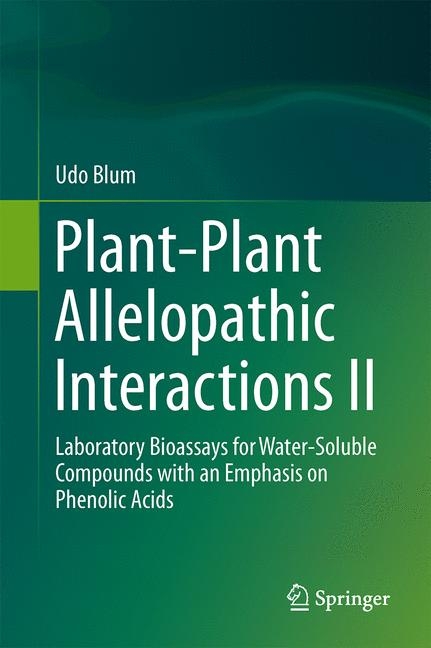
Plant-Plant Allelopathic Interactions II (eBook)
XXI, 322 Seiten
Springer International Publishing (Verlag)
978-3-319-04732-4 (ISBN)
This volume presents detailed descriptions and analyses of the underlying features, issues and suppositions associated with seed and seedling laboratory bioassays presented in a previous volume. It is, however, broader in scope and substance in that the information provided is relevant to all water-soluble compounds released to soil by putative allelopathic living plants and their litter and residues. It is ultimately an attempt to update and expand the practical guidelines for designing laboratory bioassays that have previously been provided in the literature with the hope that the designs of future seed and seedling laboratory bioassays will become more relevant to field systems. Standard references have been included to provide background and additional details. This volume has been written specifically for researchers and their graduate students who are interested in studying plant-plant allelopathic interactions.
Professor Emeritus at NC State University, Prof. Udo Blum is interested in characterizing and identifying the mechanisms by which allelopathic compounds, specifically phenolic acids (e.g., ferulic acid, p-coumaric acid, vanillic acid, p-hydroxybenzoic acid), released into the soil environment may impact soil chemistry (e.g., soil nutrition, organic pools, sorption and desorption), soil microbiology (e.g., population biology, natural selection, carbon utilization), rhizosphere ecology (e.g., microbial population biology) and population biology (e.g., germination, seedling emergence) and physiology (e.g., mineral nutrition, carbon allocation, water relations, growth) of dicot weeds in no-till agroecosystems.
Professor Emeritus at NC State University, Prof. Udo Blum is interested in characterizing and identifying the mechanisms by which allelopathic compounds, specifically phenolic acids (e.g., ferulic acid, p-coumaric acid, vanillic acid, p-hydroxybenzoic acid), released into the soil environment may impact soil chemistry (e.g., soil nutrition, organic pools, sorption and desorption), soil microbiology (e.g., population biology, natural selection, carbon utilization), rhizosphere ecology (e.g., microbial population biology) and population biology (e.g., germination, seedling emergence) and physiology (e.g., mineral nutrition, carbon allocation, water relations, growth) of dicot weeds in no-till agroecosystems.
1 Background for Designing Laboratory Bioassays1.1 Introduction1.2 Allelopathic Interactions1.3 Nature of Allelopathic Compounds1.4 Sources of Allelopathic Compounds and Modifiers in Soils1.5 Holism and Reductionism1.6 Benefits and Limits of Laboratory Bioassays1.7 False Assumptions and Misconceptions for Laboratory Bioassays1.8 References2 Introduction to the Fundamentals of Laboratory Bioassays2.1 Factors of Bioassay Systems2.2 Basic Information Required for All Bioassay Systems2.3 References3 Some Issues and Challenges When Designing Laboratory Bioassays3.1 Introduction3.2 Treatment Concentrations3.3 Field Inputs and Laboratory Treatments of Water-Soluble Compounds3.4 Mobility and Proximity of Compounds in Soil Media3.5 Seed and Seedling Densities3.6 Symbiotic Relationships3.7 Soil Microorganisms (Microflora and Fauna)3.8 Herbivory and Disease3.9 Physicochemical Environments3.10 References or Controls3.11 Measurements3.12 Final Comments3.13 References4 Hypothetical Standard Screening Bioassays4.1 Introduction4.2 Living Plants4.3 Plant Litter and Residues4.4 Field Soils4.5 Final Comments4.6 References5 Effects, Modifiers, and Modes of Action of Allelopathic Compounds Using Phenolic Acids as Model Compounds5.1 Introduction5.2 Individual Compounds5.3 Simple Mixtures5.4 Complex Mixtures5.5 Modes of Action5.6 Final Comments5.7 References6 Hypothetical Cause and Effect Bioassays6.1 Introduction6.2 Identified Putative Allelopathic (IPA) Organic Compounds6.3 Complex Solutions6.4 Using Regression Analyses to Relate Potential Causes with Effects6.5 Treatment Surface Areas6.6 Using Omics Methods as Tools6.7 References7 Laboratory Model Systems and Field Systems: Some Final Thoughts7.1 Introduction7.2 Comparison of Field and Present Laboratory Model Systems7.3 Is the Present Criticism by Critics Regarding Plant-Plant Allelopathic Interactions in the Field Credible?7.4 Improving the Value of Laboratory Bioassay Systems7.5 Future Directions: Questions that Need Answers7.6 Central Tenets (i.e., Opinions, Doctrines, or Principles) Articulated in this Volume7.7 Final Comments7.8 ReferencesAuthor IndexSubject Index
| Erscheint lt. Verlag | 24.3.2014 |
|---|---|
| Zusatzinfo | XXI, 322 p. 27 illus. |
| Verlagsort | Cham |
| Sprache | englisch |
| Themenwelt | Naturwissenschaften ► Biologie ► Genetik / Molekularbiologie |
| Naturwissenschaften ► Chemie | |
| Technik ► Maschinenbau | |
| Schlagworte | Allelopathic interactions • Biossays • ecotoxicology • Phenolic acids |
| ISBN-10 | 3-319-04732-9 / 3319047329 |
| ISBN-13 | 978-3-319-04732-4 / 9783319047324 |
| Informationen gemäß Produktsicherheitsverordnung (GPSR) | |
| Haben Sie eine Frage zum Produkt? |
 PDF (Wasserzeichen)
DRM: Digitales Wasserzeichen
Dieses eBook enthält ein digitales Wasserzeichen und ist damit für Sie personalisiert. Bei einer missbräuchlichen Weitergabe des eBooks an Dritte ist eine Rückverfolgung an die Quelle möglich.
Dateiformat: PDF (Portable Document Format)
Mit einem festen Seitenlayout eignet sich die PDF besonders für Fachbücher mit Spalten, Tabellen und Abbildungen. Eine PDF kann auf fast allen Geräten angezeigt werden, ist aber für kleine Displays (Smartphone, eReader) nur eingeschränkt geeignet.
Systemvoraussetzungen:
PC/Mac: Mit einem PC oder Mac können Sie dieses eBook lesen. Sie benötigen dafür einen PDF-Viewer - z.B. den Adobe Reader oder Adobe Digital Editions.
eReader: Dieses eBook kann mit (fast) allen eBook-Readern gelesen werden. Mit dem amazon-Kindle ist es aber nicht kompatibel.
Smartphone/Tablet: Egal ob Apple oder Android, dieses eBook können Sie lesen. Sie benötigen dafür einen PDF-Viewer - z.B. die kostenlose Adobe Digital Editions-App.
Buying eBooks from abroad
For tax law reasons we can sell eBooks just within Germany and Switzerland. Regrettably we cannot fulfill eBook-orders from other countries.
aus dem Bereich