Power Electronic Converters for Microgrids (eBook)
John Wiley & Sons (Verlag)
978-0-470-82404-7 (ISBN)
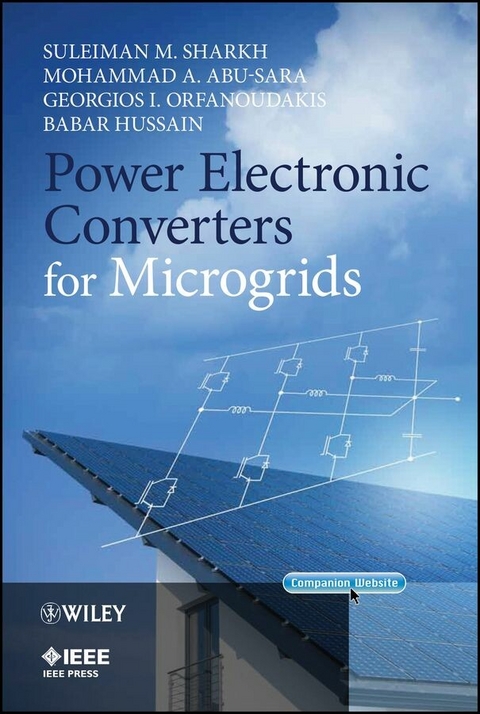
As concerns about climate change, energy prices, and energy security loom, regulatory and research communities have shown growing interest in alternative energy sources and their integration into distributed energy systems. However, many of the candidate microgeneration and associated storage systems cannot be readily interfaced to the 50/60 Hz grid. In Power Electronic Converters for Microgrids, Sharkh and Abu-Sara introduce the basics and practical concerns of analyzing and designing such micro-generation grid interface systems. Readers will become familiar with methods for stably feeding the larger grid, importing from the grid to charge on-site storage, disconnecting from the grid in case of grid failure, as well as connect multiple microgrids while sharing their loads appropriately. Sharkh and Abu-Sara introduce not only the larger context of the technology, but also present potential future applications, along with detailed case studies and tutorials to help the reader effectively engineer microgrid systems.
S. M. Sharkh is a Senior Lecturer at the School of Engineering Sciences, University of Southampton and the Managing Director of HiT Systems Ltd, which specializes in electromagnetic system analysis and design, control systems and web applications. He has approximately 17 years research experience in electrical and electromagnetic systems, and has been awarded numerous research grants leading to commercialized products in a number of related areas: grid connected PWM inverters, electric machines in harsh environments (high-speed, high temperature, high pressure, corrosive chemicals, submerged in liquids or underwater) PM machines (axial gap dc machines, VRPM transverse flux machines), characterization of and management of lithium ion batteries, sensorless control of PM machines, novel structurally integrated electric machines for marine thrusters and electromagnetic losses in high-speed machines, and microgrid intefaces. Sharkh has lectured on the subject of grid-connected inverters and their control to both undergraduate and postgraduate students, as well as companies. He holds a BEng and PhD in electrical engineering from the University of Southampton. M. A. Abu-Sara works with Bowman Power Systems, where he is the lead engineer in designing and developing systems for micro-generation. He holds a PhD in Electrical Engineering from the University of Southampton.
Chapter 1
Introduction
Fossil fuels are running out and current centralized power generation plants using these fuels are inefficient with a significant amount of energy lost as heat to the environment. These plants also produce harmful emissions and greenhouse gases. Furthermore, existing power systems, especially in developing countries, suffer from several limitations, such as the high cost of expansion and efficiency improvement limits within the existing grid infrastructure. Renewable energy sources can help address these issues, but their variable nature poses challenges to their integration within the grid.
Distributed generators (DGs), including renewable sources, within microgrids can help overcome power system capacity limitations, improve efficiency, reduce emissions, and manage the variability of renewable sources. A microgrid, a relatively new concept, is a zone within the main grid where a cluster of electrical loads and small microgeneration systems, such as solar cells, fuel cells, wind turbine, and small combined heat and power (CHP) systems, exist together under an embedded management and control system, with the option of energy storage. Other benefits of generating power close to electrical loads include the use of waste heat locally, saving the cost of upgrading the grid to supply more power from central plants, reducing transmission losses, and creating opportunities for increasing competition in the sector, which can stimulate innovation and reduce consumer prices [1, 2].
Power electronic converters are used in microgrids to control the flow of power and convert it into suitable DC or AC form. Different types of converter are needed to perform the many functions within a microgrid, but it is not the aim of this chapter or this book to review all of these possible types of converter, many of which are covered in textbooks and other publications [3]. The book will primarily focus on converters used to connect DG systems, including microCHP and renewable energy sources, to an AC grid or to local AC loads, as illustrated in Figure 1.1. They convert DC (from photovoltaic cells [4], batteries, fuel cells [5]) or variable frequency AC (wind and marine turbine [6]) into 50/60 Hz AC power that is injected into the grid and/or used to supply local loads. Converters are also used to connect flywheel energy storage systems or high-speed microturbine generators to the grid.
Figure 1.1 A schematic diagram of a microgrid
1.1 Modes of Operation of Microgrid Converters
Normally, converters are used to connect DG systems in parallel with the grid or other sources, but it may be useful for the converters to continue functioning in stand-alone mode when the other sources become unavailable, in order to supply critical loads. Converters connected to batteries or other storage devices will also need to be bidirectional to charge and discharge these devices.
1.1.1 Grid Connection Mode
In this mode of operation, the converter connects the power source in parallel with other sources to supply local loads and possibly feed power into the main grid. Parallel connection of embedded generators is governed by national standards [7–9]. The standards require that the embedded generator should not regulate or oppose the voltage at the point of common coupling, and that the current fed into the grid should be of high quality with upper limits on its total harmonic distortion (THD). There is also a limit on the maximum DC current injected into the grid.
The power injected into the grid can be controlled either by direct control of the current fed into the grid [10] or by controlling the power angle [11]. In the latter case, the voltage is controlled to be sinusoidal. However, using power angle control without directly controlling the output current may not be effective at reducing the output current THD when the grid voltage is highly distorted. But this is also an issue in the case of electric machine generators which effectively use power angle control. This raises the question of whether it is reasonable to specify current THD limits, regardless of the quality of the utility voltage.
In practice, the converter output current or voltage needs to be synchronized with the grid, which is usually achieved by using a phase-locked loop or grid voltage zero crossing detection [12]. The standards also require that embedded generators, including power electronic converters, should incorporate an anti-islanding feature, so that they are disconnected from the point of common coupling when the grid power is lost. There are many anti-islanding techniques, the most common being the rate of change of frequency (RoCoF) technique [13].
1.1.2 Stand-Alone Mode
It may be desirable for the converter to continue to supply a critical local load when the main grid is disconnected, for example, by the anti-islanding protection system. In this stand-alone mode the converter needs to maintain constant voltage and frequency, regardless of load imbalance or the quality of the current, which can be highly distorted if the load is nonlinear.
A situation may arise in a microgrid, disconnected from the main grid, where two or more power electronic converters switch to stand-alone mode to supply a critical load. In this case, these converters need to share the load equitably. Equitable sharing of load by parallel connected converters operating in stand-alone mode requires additional control. There are several methods for parallel connection, which can be broadly classified into two categories: (i) frequency and voltage droop method [14] and (ii) master-slave method, whereby one of the converters acts as a master, setting the frequency and voltage, and communicating to the other converters their share of the load [15].
1.1.3 Battery Charging Mode
In a microgrid, storage batteries, or other energy storage devices are needed to handle disturbances and fast load changes [16]. In other words, energy storage is needed to accommodate the variations of available power generation and demand, thus improving the reliability of the microgrid. The power electronic converter could then be used as a battery charger.
1.2 Converter Topologies
Most of the current commercially available power electronic converters used for grid connection are based on the voltage-source two-level PWM (pulse width modulation) inverter, as illustrated in Figure 1.2 [10, 17]. An LCL filter is commonly used, but L filters have been also used [18, 19]. An LCL filter is smaller in size compared to a simple L filter, but it requires a more complex control system to manage the LC resonance. Additionally, the impedance of L2C in Figure 1.2 tends to be relatively low, which provides an easy path for current harmonics to flow from the grid. This can cause the THD of the current to increase beyond permitted limits in cases where the grid voltage THD is relatively high. Ideally, this drawback could be overcome by increasing the feedback controller gain in a current controlled grid connected converter, but this can prove to be difficult to achieve in practice while maintaining good stability [20].
Figure 1.2 Twolevel grid-connected inverter with LCL filter
Other filter topologies have also been proposed. For example, Guoqiao et al. [21], proposed an LCCL filter arrangement, feeding back the current measured between the two capacitors. By selecting the values of the capacitors to match the inductor values, the closed loop transfer function of the system becomes non-resonant, which helps to improve the performance of the controller, as discussed in Section1.4.
The size and cost of the filter can be very significant. Filter size can be reduced by either increasing the switching frequency of the converter or reducing the converter voltage step changes. However, the switching frequency, which is limited by losses in the power electronic devices, tends to reduce as the power ratings of the devices and the converters increase. This means that high power two-level converters could have disproportionately large filters.
Alterative converter topologies, which can help reduce the size of the filter, have been the subject of recent research. Multi-level converters have been proposed, including the neutral point clamped (NPC) inverter shown in Figure 1.3a [22], and the cascaded converter shown in Figure 1.3b (only one phase is shown) [23]. Multi-level converters have the advantage of reducing the voltage step changes, and hence the size and the cost of the main filter inductor for given current ripple, at the expense of increased complexity and cost of the power electronics and control components [24].
Figure 1.3 Multi-level voltage source inverter (a) NPC and (b) cascaded
An alternative to the multi-level converter is to use an interleaved converter topology, as illustrated in Figure 1.4, which shows a converter that has two channels. A grid-connected converter based on this topology, with six channels, has already been designed, built, and tested by the authors (see Chapter 7). Interleaving is a form of paralleling technique where the switching instants are phase shifted over a switching period. By introducing an equal phase shift between parallel power stages, the output filter capacitor ripple is reduced due to the ripple cancellation effect [25, 26]. Additionally, by using smaller low current devices, it is possible to switch at high frequency, and therefore the inductors and overall filter size would be smaller than a...
| Erscheint lt. Verlag | 14.4.2014 |
|---|---|
| Reihe/Serie | IEEE Press |
| Wiley - IEEE | Wiley - IEEE |
| Sprache | englisch |
| Themenwelt | Technik ► Elektrotechnik / Energietechnik |
| Schlagworte | Alternative • candidate • Climate • Communities • Concerns • Distributed • Electrical & Electronics Engineering • electronic converters • Elektrotechnik u. Elektronik • Energie • Energy • GRID • Integration • interfaced • Leistungselektronik • many • microgeneration • Microgrids • Power • Power Electronics • readily • Regulatory • Research • shown • Smart Grid • Solarenergie u. Photovoltaik • Solar Energy & Photovoltaics • Storage • Systems • systems cannot |
| ISBN-10 | 0-470-82404-2 / 0470824042 |
| ISBN-13 | 978-0-470-82404-7 / 9780470824047 |
| Informationen gemäß Produktsicherheitsverordnung (GPSR) | |
| Haben Sie eine Frage zum Produkt? |
 EPUB (Adobe DRM)
Größe: 23,8 MB
Kopierschutz: Adobe-DRM
Adobe-DRM ist ein Kopierschutz, der das eBook vor Mißbrauch schützen soll. Dabei wird das eBook bereits beim Download auf Ihre persönliche Adobe-ID autorisiert. Lesen können Sie das eBook dann nur auf den Geräten, welche ebenfalls auf Ihre Adobe-ID registriert sind.
Details zum Adobe-DRM
Dateiformat: EPUB (Electronic Publication)
EPUB ist ein offener Standard für eBooks und eignet sich besonders zur Darstellung von Belletristik und Sachbüchern. Der Fließtext wird dynamisch an die Display- und Schriftgröße angepasst. Auch für mobile Lesegeräte ist EPUB daher gut geeignet.
Systemvoraussetzungen:
PC/Mac: Mit einem PC oder Mac können Sie dieses eBook lesen. Sie benötigen eine
eReader: Dieses eBook kann mit (fast) allen eBook-Readern gelesen werden. Mit dem amazon-Kindle ist es aber nicht kompatibel.
Smartphone/Tablet: Egal ob Apple oder Android, dieses eBook können Sie lesen. Sie benötigen eine
Geräteliste und zusätzliche Hinweise
Zusätzliches Feature: Online Lesen
Dieses eBook können Sie zusätzlich zum Download auch online im Webbrowser lesen.
Buying eBooks from abroad
For tax law reasons we can sell eBooks just within Germany and Switzerland. Regrettably we cannot fulfill eBook-orders from other countries.
 PDF (Adobe DRM)
Kopierschutz: Adobe-DRM
Adobe-DRM ist ein Kopierschutz, der das eBook vor Mißbrauch schützen soll. Dabei wird das eBook bereits beim Download auf Ihre persönliche Adobe-ID autorisiert. Lesen können Sie das eBook dann nur auf den Geräten, welche ebenfalls auf Ihre Adobe-ID registriert sind.
Details zum Adobe-DRM
Dateiformat: PDF (Portable Document Format)
Mit einem festen Seitenlayout eignet sich die PDF besonders für Fachbücher mit Spalten, Tabellen und Abbildungen. Eine PDF kann auf fast allen Geräten angezeigt werden, ist aber für kleine Displays (Smartphone, eReader) nur eingeschränkt geeignet.
Systemvoraussetzungen:
PC/Mac: Mit einem PC oder Mac können Sie dieses eBook lesen. Sie benötigen eine
eReader: Dieses eBook kann mit (fast) allen eBook-Readern gelesen werden. Mit dem amazon-Kindle ist es aber nicht kompatibel.
Smartphone/Tablet: Egal ob Apple oder Android, dieses eBook können Sie lesen. Sie benötigen eine
Geräteliste und zusätzliche Hinweise
Buying eBooks from abroad
For tax law reasons we can sell eBooks just within Germany and Switzerland. Regrettably we cannot fulfill eBook-orders from other countries.
aus dem Bereich